Crypto market’s weekly winners and losers – KAIA, CC, ENA, ARB

ambcryptoPublished on 2026-01-25Last updated on 2026-01-25

Abstract

Bitcoin (BTC) fell 6% this week, while Ethereum (ETH) dropped 10%, marking their first significant weekly losses this year. Despite the downturn, the market reaction varied, with some cryptocurrencies posting gains. Weekly winners included Kaia (KAIA), which surged mid-week before a 20% pullback due to profit-taking, though its bullish structure remained intact. Canton Network (CC) defied the broader privacy coin decline with a 36% rally. MYX Finance (MYX) jumped 32% following its V2 upgrade. Tether Gold (XAUT) and PAX Gold (PAX) rose 9% and 10%, respectively, amid macroeconomic uncertainty, while LayerZero (ZRO) gained 11%. Weekly losers featured Ethena (ENA), which fell roughly 15% with sustained selling pressure and weak buyer interest. Arbitrum (ARB) slid nearly 15%, breaking key support levels. Artificial Superintelligence Alliance (FET) dropped over 8% as AI token momentum waned. Larger caps like Solana (SOL) and Chainlink (LINK) fell around 10-11%, and Sui Network (SUI) declined 16%. The week highlighted market rotation rather than collapse, with selective risk-taking and defensive moves shaping performance.

After weeks of holding steady, Bitcoin [BTC] slipped about 6% this week, while Ethereum [ETH] took a 10% hit. These are the top cryptos’ first meaningful weekly losses of the year.

What you really need to look at, though, is how the rest of the market reacted when the cracks started to show. So grab your coffee (or something stronger), and here are some of the big moves from the week gone by!

Weekly winners

Kaia [KAIA] surged high… until profits kicked in

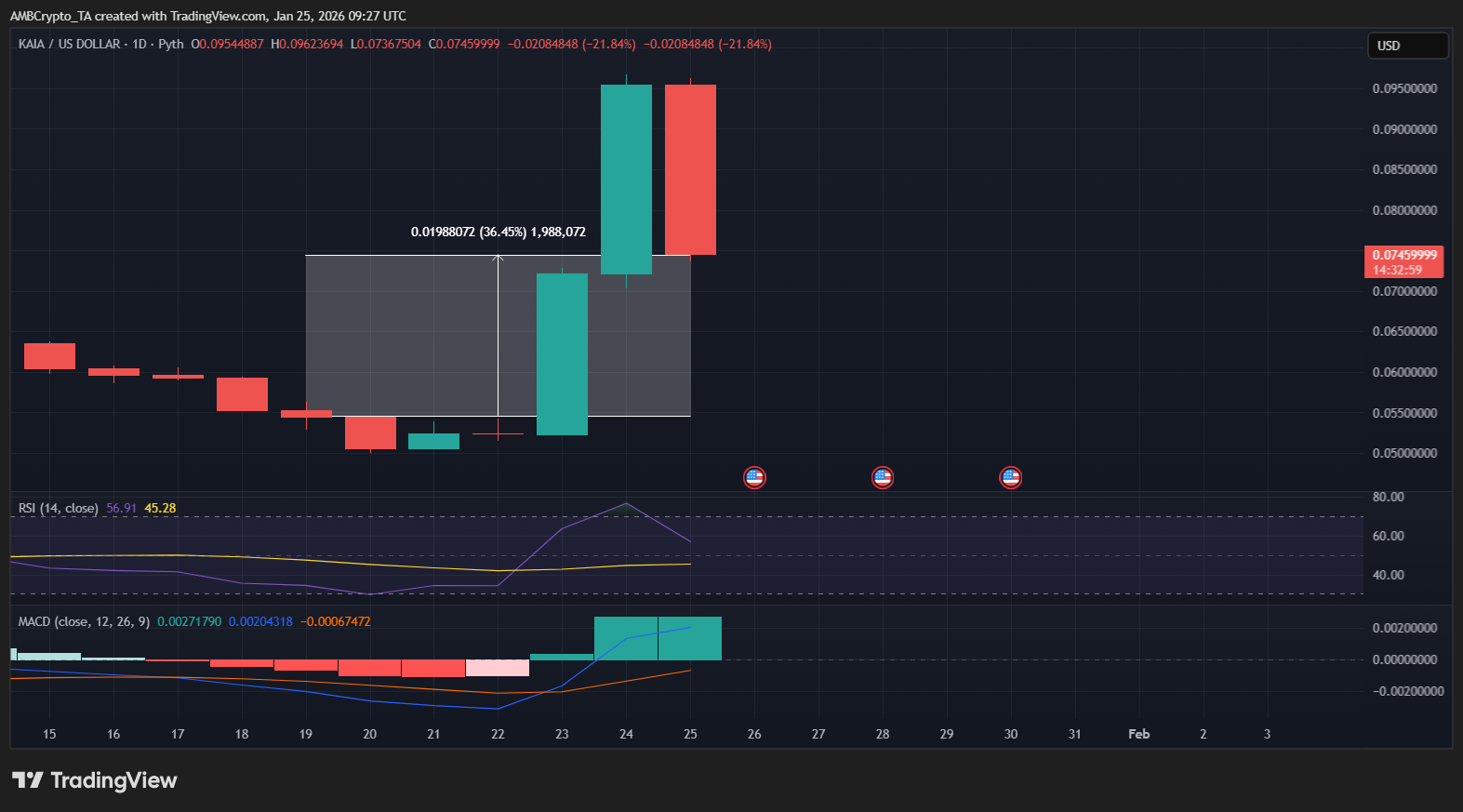
Kaia [KAIA] saw a huge breakout mid-week, before running into heavy profit-taking. That surge was followed by a steep 20%+ daily pullback, bringing prices back toward the $0.074 zone at press time.

Source: TradingView

Despite the drop, it wasn’t a full trend reversal. RSI went from near-overbought levels to the mid-40s, while MACD remained in positive territory; the bullish structure hadn’t fully broken down yet.

Kaia recently joined the Japan Blockchain Association and is developing Project Unify with Line Next, aiming to build an Asia-focused stablecoin hub for USD, JPY, and THB via a super app. The project is planned for late 2026.

Canton Network [CC] defied the privacy coin pressure trend

Canton Network [CC] stood out this week in an otherwise weak corner of the market. The privacy-coin posted a solid 36% rally, climbing from the $0.12 region to highs near $0.16 before slowing down.

Price began to consolidate near recent highs, with RSI holding around the mid-50s. Meanwhile, DMI readings continued to favor buyers, so the greater trend hadn’t yet changed.

Notably, CC was the only major privacy coin to post gains this week, so there’s selective risk-taking as traders avoid the wider segment.

MYX Finance [MYX] jumps with V2 upgrade

MYX Finance [MYX] had a strong week with a 32% surge; buyers stepped in following its V2 upgrade launch on the 22nd of January. Price rebounded from the $5.3-$5.4 zone and pushed toward the $7 level.

The rally was backed by favorable RSI numbers. CMF flipped back toward neutral, so capital is coming back after a dip. The new upgrade saw the launch of portfolio margining, expanded cross-chain support, and a 10 million MYX/ZKP airdrop.

Other notable winners

Tether Gold [XAUT] and PAX Gold [PAX] climbed 9% and 10% respectively, with demand for gold-backed tokens soaring with macro uncertainty. LayerZero [ZRO] also stood out, gaining 11% on the week. Capital has rotated both into defensive assets and select high-conviction bets!

Weekly losers

Ethena [ENA] slides as sellers take hold of the reins

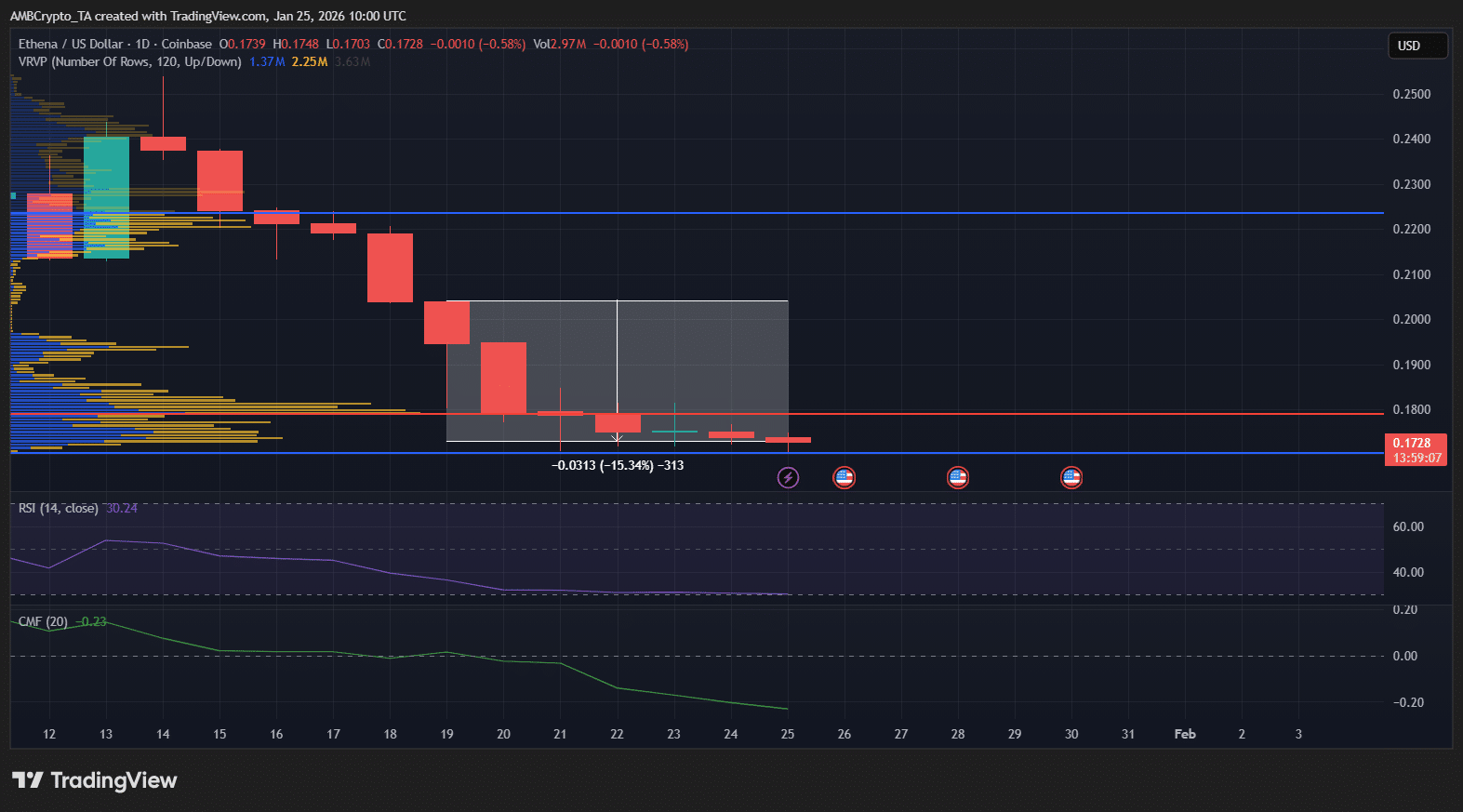
Ethena [ENA] had a rough week, extending its downtrend with a drop of roughly 15% over the last several sessions. There’s been a steady series of lower closes, with price slipping below the $0.18 support zone and failing to attract meaningful dip buying.

Source: TradingView

RSI was near oversold levels, while a negative CMF confirmed capital outflows. Volume thinned as the week progressed, so buyers don’t seem quite confident.

ENA seems to be in a consolidation-at-the-lows phase, with the market waiting before reassessing downside risk.

Arbitrum [ARB] is weak with a lesser pace

Arbitrum [ARB] slid close to 15% with higher selling pressure. The chart showed a breakdown from the $0.20-$0.21 zone, followed by a steady float toward the $0.17-$0.18 range. Attempts at short-term rebounds were quickly sold into, keeping price capped. RSI fell into the mid-30s, so bearish momentum is sustained.

With price consolidating near weekly lows, ARB is in a wait-and-watch phase.

Artificial Superintelligence Alliance [FET] falls as AI tokens lose momentum

Artificial Superintelligence Alliance [FET] ended the week on the back foot, slipping a little over 8% as selling pressure stayed steady. The chart showed a breakdown from the $0.25 region, followed by a slow grind lower toward $0.22-$0.23. Any short-lived bounce attempts were quickly absorbed by sellers.

RSI was below 40, while MACD remained firmly negative, a persistent bearish bias. This fall comes as most AI tokens finished the week with double digit losses.

Other notable losers

Losses were not limited to mid-caps. Solana [SOL] fell around 10%, while Chainlink [LINK] dropped nearly 11%. Another big decline came from Sui Network [SUI], which slid about 16% on the week.

Wrapping up…

This week was a good reminder that even when Bitcoin and Ethereum finally wobble, the rest of the market doesn’t all move the same way. Some traders rushed to lock in profits, and others chased strength where it showed up.

As always, these moves aren’t set in stone.

DYOR, manage your risk, and don’t let one rough week (or a good one) do the thinking for you.

Same time next week!


Final Thoughts

  • Bitcoin and Ethereum slipping triggered a rotation.
  • The market is correcting, and not collapsing. It’s a good sign.
Next: Bitcoin whales vs. retail panic: 3 factors define BTC’s next breakout
Share
  • Share
  • Tweet

Trending Cryptos

Related Questions

QWhat were the weekly price changes for Bitcoin (BTC) and Ethereum (ETH) mentioned in the article?

ABitcoin (BTC) slipped about 6% this week, while Ethereum (ETH) took a 10% hit.

QWhich cryptocurrency saw a huge breakout mid-week but then experienced a steep 20%+ daily pullback due to profit-taking?

AKaia (KAIA) saw a huge breakout mid-week, which was followed by a steep 20%+ daily pullback due to profit-taking.

QWhat was the standout performer among privacy coins this week, and what was its price increase?

ACanton Network (CC) was the standout performer among privacy coins, posting a solid 36% rally.

QWhat were two gold-backed tokens that saw significant gains this week, and what were their approximate increases?

ATether Gold (XAUT) climbed 9% and PAX Gold (PAX) climbed 10% this week.

QWhich two major cryptocurrencies, besides the AI tokens, were mentioned as notable losers with double-digit declines?

ASolana (SOL) fell around 10% and Chainlink (LINK) dropped nearly 11% this week.

Related Reads

Annual Salary of Millions Competing for Electricians, Meta Rushes to Open Its Own Technical School

The AI boom is facing an unexpected bottleneck: a severe shortage of skilled construction workers and electricians. As tech giants like Meta, OpenAI, and Alphabet race to build massive data centers—such as OpenAI's $16 billion "Stargate" project—they are hitting a critical labor wall. The U.S. needs an estimated 130,000 more electricians, 240,000 construction workers, and 150,000 supervisors by 2030 for AI infrastructure alone, but tens of thousands of electrician jobs go unfilled each year. While AI companies offer high premiums, with electricians earning up to $280,000 annually, worker scarcity still causes massive losses—delays on a single project can cost $14.2 million per month. The complexity of building AI data centers, which require immense power (equivalent to powering hundreds of thousands of homes), sophisticated electrical systems, and advanced liquid cooling solutions, demands highly skilled technicians who are in short supply. To combat this, companies are investing heavily in training. Meta has committed $115 million to a free training school offering tuition, housing, and stipends, targeting 5,000 new workers. OpenAI is partnering with unions to secure skilled labor. These efforts are paying off, with a significant rise in Gen Z interest in trade schools over college. However, the power demands are staggering. AI data centers are driving a rapid surge in electricity consumption, projected to account for up to 12% of U.S. power use by 2028 and raising costs for consumers. Furthermore, the construction boom is project-based, leading to a potential future glut of trained workers once building peaks, which could depress wages industry-wide. The race for AI supremacy now depends as much on skilled hands as on advanced chips.

marsbit44m ago
Annual Salary of Millions Competing for Electricians, Meta Rushes to Open Its Own Technical School

marsbit44m ago

OpenAI No Longer Sells Its Most Expensive Model for Profit

OpenAI is shifting its business strategy away from promoting its most expensive, flagship models for every task. Recent price cuts—80% for GPT-5.6 Luna and 20% for Terra—signal a deeper change: the company now actively advises users that many tasks don't require the most powerful model. Instead, OpenAI recommends a tiered approach: use the high-end GPT-5.6 Sol for complex planning and analysis, then delegate execution to cheaper models like Luna. This mirrors moves by Anthropic, which recently launched Claude Opus 5 at half the price of its top model, Fable 5. Both companies are de-emphasizing flagship models as primary revenue drivers, using them instead for brand prestige and technological showcases. The industry is entering a "mass-market" phase, similar to automotive, where high-volume, cost-effective models handle daily operations and drive scale. OpenAI's price reductions are partly enabled by AI models themselves optimizing underlying code and infrastructure, creating a self-reinforcing cycle of efficiency gains and cost reduction. Competition is shifting from "who is smartest" to "who offers the best value." The goal is no longer selling individual models but fostering widespread API adoption and ecosystem lock-in. By making AI calls cheap and ubiquitous, companies like OpenAI aim to become the indispensable, utility-like infrastructure powering automated workflows—the "water and electricity" of software, quietly embedded everywhere.

marsbit44m ago

OpenAI No Longer Sells Its Most Expensive Model for Profit

marsbit44m ago

Will the Fed Definitely Raise Interest Rates in September? How Will Crypto and U.S. Stocks Withstand the Pressure?

The market's expectation for a September Fed rate hike surged dramatically in early August, jumping from under 50% to over 80% within a week. This shift followed a contentious July FOMC meeting, where a 9-3 vote to hold rates revealed growing dissent from hawkish members advocating for an immediate hike to combat persistent inflation. The primary catalyst for this repricing is rising oil prices, driven by renewed geopolitical tensions around the Strait of Hormuz, which threaten global supply. Energy costs directly influence inflation metrics, making the upcoming July CPI report (due August 12th) a critical data point. If it shows inflation reaccelerating, the probability of a September hike will solidify. For Bitcoin and crypto assets, this is typically bearish news. Bitcoin continues to behave as a high-beta, liquidity-sensitive risk asset. A rate hike raises the opportunity cost of holding non-yielding assets and could drive capital toward money markets, pressuring crypto prices in the short term. However, historical patterns suggest that if a hike is perceived as the end of a tightening cycle rather than the start, any negative price impact may be brief. U.S. stocks, particularly crypto-linked equities like Coinbase and growth-oriented tech stocks, are also vulnerable. Higher rates increase discount rates in valuation models, putting pressure on high-multiple companies. This coincides with a pivotal tech earnings season where investor focus has shifted from massive AI capital expenditure to tangible revenue and cash flow generation. Companies with negative cash flow and weak growth narratives could face heightened volatility if borrowing costs rise in September. In summary, a September Fed hike has evolved into a mainstream market scenario. Key factors to watch are oil prices, the July CPI report, and Fed communications, which will determine the final decision and its impact on volatile crypto and equity markets.

marsbit55m ago

Will the Fed Definitely Raise Interest Rates in September? How Will Crypto and U.S. Stocks Withstand the Pressure?

marsbit55m ago

Trading

Spot

Hot Articles

How to Buy ARB

Welcome to HTX.com! We've made purchasing Arbitrum (ARB) simple and convenient. Follow our step-by-step guide to embark on your crypto journey.Step 1: Create Your HTX AccountUse your email or phone number to sign up for a free account on HTX. Experience a hassle-free registration journey and unlock all features.Get My AccountStep 2: Go to Buy Crypto and Choose Your Payment MethodCredit/Debit Card: Use your Visa or Mastercard to buy Arbitrum (ARB) instantly.Balance: Use funds from your HTX account balance to trade seamlessly.Third Parties: We've added popular payment methods such as Google Pay and Apple Pay to enhance convenience.P2P: Trade directly with other users on HTX.Over-the-Counter (OTC): We offer tailor-made services and competitive exchange rates for traders.Step 3: Store Your Arbitrum (ARB)After purchasing your Arbitrum (ARB), store it in your HTX account. Alternatively, you can send it elsewhere via blockchain transfer or use it to trade other cryptocurrencies.Step 4: Trade Arbitrum (ARB)Easily trade Arbitrum (ARB) on HTX's spot market. Simply access your account, select your trading pair, execute your trades, and monitor in real-time. We offer a user-friendly experience for both beginners and seasoned traders.

6.3k Total ViewsPublished 2024.03.29Updated 2026.06.02

How to Buy ARB

Discussions

Welcome to the HTX Community. Here, you can stay informed about the latest platform developments and gain access to professional market insights. Users' opinions on the price of ARB (ARB) are presented below.

活动图片