This Russell Signal Has Predicted Every Bitcoin Bull Market And It Just Got Triggered Again

bitcoinistPublished on 2026-05-08Last updated on 2026-05-08

Abstract

Crypto analyst Bull Theory highlights a signal from the Russell 2000 index that has historically preceded every major Bitcoin bull market. The index has reportedly broken out after its longest consolidation period in over 20 years (64 months), a pattern seen before the bull runs of 2012, 2016, and 2020. The analyst explains this breakout signals increasing market liquidity and risk appetite, as capital flows to risk-on assets like crypto. This view is supported by a rising ISM Manufacturing PMI, another liquidity indicator. While noting past performance doesn't guarantee future results, the analyst suggests the setup for a powerful new Bitcoin bull market is present. Separately, Bitmine's Tom Lee suggests the bear market is over if Bitcoin closes above $76,000 for a third consecutive month—a pattern not seen in prior bear markets. Bitcoin is currently trading around $79,600, having closed March and April positively, though some analysts warn of a potential bull trap and further decline.

Crypto pundit Bull Theory has alluded to a Russell 2000 signal, which has always triggered every major Bitcoin bull market. This signal is again said to have triggered, signaling that another major bull run may be on the horizon.

Russell 2000 Signal Points To Another Bitcoin Bull Market

In an X post, Bull Theory stated that the Russell 2000 just gave the same signal that has triggered every major Bitcoin bull market in the past. The pundit further revealed that this index has broken out after consolidating for 64 months, which is its longest base in over 20 years. This matters because of how a bull run has followed every breakout.

The pundit pointed to the fourth quarters of 2012, 2016, and 2020, when the Russell broke out, after which Bitcoin bull markets followed. Now, the Russell has broken out again after 64 months, which is 17 months longer than the consolidation prior to the three previous breakouts. Bull Theory explained that the Russell 2000 is a leading indicator of liquidity and risk appetite, as when small caps rally, it means that capital is flowing to risk-on assets such as crypto.
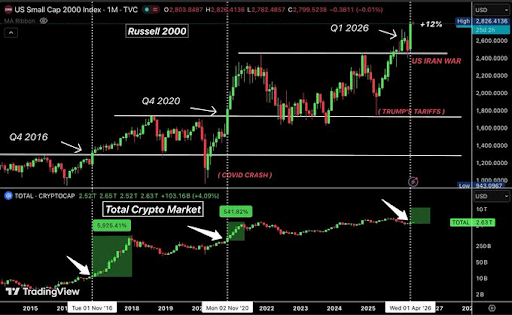
Source: Chart from Bull Theory on X

Bull Theory also noted that the length of this consolidation matters, as it means liquidity was constrained for an unusually long time. However, the breakout signals that conditions have materially changed. Furthermore, the pundit stated that the ISM Manufacturing PMI confirms liquidity expansion, as the Bitcoin cycle has historically begun 4 to 5 months after the PMI bottoms.

As such, Bull Theory believes that the small caps and the PMI are sending the same message that liquidity is rising and risk appetite is returning, which means that the setup for a new Bitcoin bull market is here. The pundit added that the upcoming bull run could be more powerful given the depth of the consolidation. He warned that past performance is never a guarantee of future results, but that the Russell 2000 has a strong track record of calling major shifts in the liquidity cycle.

The Bear Market Is Over If This Happens

Speaking at the Consensus conference, Bitmine’s Chairman Tom Lee said that the bear market is definitely over if Bitcoin closes this month above $76,000. He explained that BTC has never closed three consecutive months in the green in prior bear markets, which is why the crypto winter may be over.

BTC notably closed March and April in the green despite the ongoing U.S.-Iran war, signaling that the Bitcoin bull market may be back. However, analysts such as Doctor Profit have warned that the recent rally is simply a bull trap, with the leading crypto likely to see another massive decline.

At the time of writing, the Bitcoin price is trading at around $79,600, down in the last 24 hours, according to data from CoinMarketCap.

BTC trading at $79,679 on the 1D chart | Source: BTCUSDT on Tradingview.com

Related Questions

QWhat is the Russell 2000 signal and what does it predict according to the article?

AThe Russell 2000 signal, as discussed in the article, refers to a breakout of the Russell 2000 index after a period of consolidation. According to crypto pundit Bull Theory, this signal has historically predicted every major Bitcoin bull market, as these bull runs have followed the index's breakout in the past.

QHow long did the Russell 2000 consolidate before the latest breakout mentioned in the article?

AAccording to the article, the Russell 2000 consolidated for 64 months before the latest breakout, which is described as its longest base in over 20 years and 17 months longer than the consolidations prior to the previous three breakouts.

QAccording to Tom Lee, when is the Bitcoin bear market definitely over?

AAccording to Bitmine's Chairman Tom Lee at the Consensus conference, the Bitcoin bear market is definitely over if Bitcoin closes the current month (the article's context) above $76,000. He bases this on the historical precedent that BTC has never closed three consecutive months in the green during prior bear markets.

QWhat other indicator does Bull Theory mention that confirms liquidity expansion and its relation to the Bitcoin cycle?

ABull Theory also mentions the ISM Manufacturing PMI as an indicator that confirms liquidity expansion. The pundit states that historically, the Bitcoin cycle has begun 4 to 5 months after the PMI bottoms.

QWhat is the current Bitcoin price and its 24-hour trend as reported at the end of the article?

AAt the time of writing reported in the article, the Bitcoin price is trading at around $79,600, showing a decline in the last 24 hours.

Related Reads

Gensyn AI: Don't Let AI Repeat the Mistakes of the Internet

In recent months, the rapid growth of the AI industry has attracted significant talent from the crypto sector. A persistent question among researchers intersecting both fields is whether blockchain can become a foundational part of AI infrastructure. While many previous AI and Crypto projects focused on application layers (like AI Agents, on-chain reasoning, data markets, and compute rentals), few achieved viable commercial models. Gensyn differentiates itself by targeting the most critical and expensive layer of AI: model training. Gensyn aims to organize globally distributed GPU resources into an open AI training network. Developers can submit training tasks, nodes provide computational power, and the network verifies results while distributing incentives. The core issue addressed is not decentralization for its own sake, but the increasing centralization of compute power among tech giants. In the era of large models, access to GPUs (like the H100) has become a decisive bottleneck, dictating the pace of AI development. Major AI companies are heavily dependent on large cloud providers for compute resources. Gensyn's approach is significant for several reasons: 1) It operates at the core infrastructure layer (model training), the most resource-intensive and technically demanding part of the AI value chain. 2) It proposes a more open, collaborative model for compute, potentially increasing resource utilization by dynamically pooling idle GPUs, similar to early cloud computing logic. 3) Its technical moat lies in solving complex challenges like verifying training results, ensuring node honesty, and maintaining reliability in a distributed environment—making it more of a deep-tech infrastructure company. 4) It targets a validated, high-growth market with genuine demand, rather than pursuing blockchain integration without purpose. Ultimately, the boundaries between Crypto and AI are blurring. AI requires global resource coordination, incentive mechanisms, and collaborative systems—areas where crypto-native solutions excel. Gensyn represents a step toward making advanced training capabilities more accessible and collaborative, moving beyond a niche controlled by a few giants. If successful, it could evolve into a fundamental piece of AI infrastructure, where the most enduring value in the AI era is often created.

marsbit5h ago

Gensyn AI: Don't Let AI Repeat the Mistakes of the Internet

marsbit5h ago

Why is China's AI Developing So Fast? The Answer Lies Inside the Labs

A US researcher's visit to China's top AI labs reveals distinct cultural and organizational factors driving China's rapid AI development. While talent, data, and compute are similar to the West, Chinese labs excel through a pragmatic, execution-focused culture: less emphasis on individual stardom and conceptual debate, and more on teamwork, engineering optimization, and mastering the full tech stack. A key advantage is the integration of young students and researchers who approach model-building with fresh perspectives and low ego, prioritizing collective progress over personal credit. This contrasts with the US culture of self-promotion and "star scientist" narratives. Chinese labs also exhibit a strong "build, don't buy" mentality, preferring to develop core capabilities—like data pipelines and environments—in-house rather than relying on external services. The ecosystem feels more collaborative than tribal, with mutual respect among labs. While government support exists, its scale is unclear, and technical decisions appear driven by labs, not state mandates. Chinese companies across sectors, from platforms to consumer tech, are building their own foundational models to control their tech destiny, reflecting a broader cultural drive for technological sovereignty. Demand for AI is emerging, with spending patterns potentially mirroring cloud infrastructure more than traditional SaaS. Despite challenges like a less mature data industry and GPU shortages, Chinese labs are propelled by vast talent, rapid iteration, and deep integration with the open-source community. The competition is evolving beyond a pure model race into a contest of organizational execution, developer ecosystems, and industrial pragmatism.

marsbit6h ago

Why is China's AI Developing So Fast? The Answer Lies Inside the Labs

marsbit6h ago

3 Years, 5 Times: The Rebirth of a Century-Old Glass Factory

Corning, a 175-year-old glass company, is experiencing a dramatic revival as a key player in AI infrastructure, driven by surging demand for high-performance optical fiber in data centers. AI data centers require vastly more fiber than traditional ones—5 to 10 times as much per rack—to handle high-speed data transmission between GPUs. This structural demand shift, coupled with supply constraints from the lengthy expansion cycle for fiber preforms, has created a significant supply-demand gap. Nvidia has invested in Corning, along with Lumentum and Coherent, in a $4.5 billion total commitment to secure the optical supply chain for AI. Corning's competitive edge lies in its expertise in producing ultra-low-loss, high-density, and bend-resistant specialty fiber, which is critical for 800G+ and future 1.6T data rates. Its deep involvement in co-packaged optics (CPO) with partners like Nvidia further solidifies its position. While not the largest fiber manufacturer globally, Corning's revenue from enterprise/data center clients now exceeds 40% of its optical communications sales, and it has secured multi-year supply agreements with major hyperscalers including Meta and Nvidia. Financially, Corning's optical communications revenue has surged, doubling from $1.3 billion in 2023 to over $3 billion in 2025. Its stock price has risen nearly 6-fold since late 2023. Key future catalysts include the rollout of Nvidia's CPO products and the scale of undisclosed customer agreements. However, risks include high current valuations and potential disruption from next-generation technologies like hollow-core fiber. The company's long-term bet on light over electricity, maintained even through the telecom bubble crash, is now being validated by the AI boom.

marsbit7h ago

3 Years, 5 Times: The Rebirth of a Century-Old Glass Factory

marsbit7h ago

Trading

Spot
Futures

Hot Articles

What is $BITCOIN

DIGITAL GOLD ($BITCOIN): A Comprehensive Analysis Introduction to DIGITAL GOLD ($BITCOIN) DIGITAL GOLD ($BITCOIN) is a blockchain-based project operating on the Solana network, which aims to combine the characteristics of traditional precious metals with the innovation of decentralized technologies. While it shares a name with Bitcoin, often referred to as “digital gold” due to its perception as a store of value, DIGITAL GOLD is a separate token designed to create a unique ecosystem within the Web3 landscape. Its goal is to position itself as a viable alternative digital asset, although specifics regarding its applications and functionalities are still developing. What is DIGITAL GOLD ($BITCOIN)? DIGITAL GOLD ($BITCOIN) is a cryptocurrency token explicitly designed for use on the Solana blockchain. In contrast to Bitcoin, which provides a widely recognized value storage role, this token appears to focus on broader applications and characteristics. Notable aspects include: Blockchain Infrastructure: The token is built on the Solana blockchain, known for its capacity to handle high-speed and low-cost transactions. Supply Dynamics: DIGITAL GOLD has a maximum supply capped at 100 quadrillion tokens (100P $BITCOIN), although details regarding its circulating supply are currently undisclosed. Utility: While precise functionalities are not explicitly outlined, there are indications that the token could be utilized for various applications, potentially involving decentralized applications (dApps) or asset tokenization strategies. Who is the Creator of DIGITAL GOLD ($BITCOIN)? At present, the identity of the creators and development team behind DIGITAL GOLD ($BITCOIN) remains unknown. This situation is typical among many innovative projects within the blockchain space, particularly those aligning with decentralized finance and meme coin phenomena. While such anonymity may foster a community-driven culture, it intensifies concerns about governance and accountability. Who are the Investors of DIGITAL GOLD ($BITCOIN)? The available information indicates that DIGITAL GOLD ($BITCOIN) does not have any known institutional backers or prominent venture capital investments. The project seems to operate on a peer-to-peer model focused on community support and adoption rather than traditional funding routes. Its activity and liquidity are primarily situated on decentralized exchanges (DEXs), such as PumpSwap, rather than established centralized trading platforms, further highlighting its grassroots approach. How DIGITAL GOLD ($BITCOIN) Works The operational mechanics of DIGITAL GOLD ($BITCOIN) can be elaborated on based on its blockchain design and network attributes: Consensus Mechanism: By leveraging Solana’s unique proof-of-history (PoH) combined with a proof-of-stake (PoS) model, the project ensures efficient transaction validation contributing to the network's high performance. Tokenomics: While specific deflationary mechanisms have not been extensively detailed, the vast maximum token supply implies that it may cater to microtransactions or niche use cases that are still to be defined. Interoperability: There exists the potential for integration with Solana’s broader ecosystem, including various decentralized finance (DeFi) platforms. However, the details regarding specific integrations remain unspecified. Timeline of Key Events Here is a timeline that highlights significant milestones concerning DIGITAL GOLD ($BITCOIN): 2023: The initial deployment of the token occurs on the Solana blockchain, marked by its contract address. 2024: DIGITAL GOLD gains visibility as it becomes available for trading on decentralized exchanges like PumpSwap, allowing users to trade it against SOL. 2025: The project witnesses sporadic trading activity and potential interest in community-led engagements, although no noteworthy partnerships or technical advancements have been documented as of yet. Critical Analysis Strengths Scalability: The underlying Solana infrastructure supports high transaction volumes, which could enhance the utility of $BITCOIN in various transaction scenarios. Accessibility: The potential low trading price per token could attract retail investors, facilitating wider participation due to fractional ownership opportunities. Risks Lack of Transparency: The absence of publicly known backers, developers, or an audit process may yield skepticism regarding the project's sustainability and trustworthiness. Market Volatility: The trading activity is heavily reliant on speculative behavior, which can result in significant price volatility and uncertainty for investors. Conclusion DIGITAL GOLD ($BITCOIN) emerges as an intriguing yet ambiguous project within the rapidly evolving Solana ecosystem. While it attempts to leverage the “digital gold” narrative, its departure from Bitcoin's established role as a store of value underscores the need for a clearer differentiation of its intended utility and governance structure. Future acceptance and adoption will likely depend on addressing the current opacity and defining its operational and economic strategies more explicitly. Note: This report encompasses synthesised information available as of October 2023, and developments may have transpired beyond the research period.

363 Total ViewsPublished 2025.05.13Updated 2025.05.13

What is $BITCOIN

Discussions

Welcome to the HTX Community. Here, you can stay informed about the latest platform developments and gain access to professional market insights. Users' opinions on the price of BTC (BTC) are presented below.

活动图片