Real Finance secures $29M to build institutional rails for tokenized assets

cointelegraphPublished on 2025-12-09Last updated on 2025-12-09

Abstract

Real-world asset tokenization network Real Finance has raised $29 million in private funding, led by a $25 million commitment from Nimbus Capital, to build institutional infrastructure for tokenized assets. The funds will support the expansion of its compliance and operational systems as it develops a full-stack RWA platform. The company aims to tokenize $500 million in RWAs, targeting 2% of the current tokenized asset market. The market is currently dominated by US Treasury products, private credit, and alternative funds, with tokenized money market funds growing rapidly. Industry experts, including Plume CEO Chris Yin, project major expansion in 2025, with potential for significant user growth and diversification into assets like private credit, mineral rights, and energy.

Real-world asset (RWA) tokenization network Real Finance has secured $29 million in private funding to build an infrastructure layer for RWAs, aiming to make it easier for institutions to adopt tokenized assets.

The funding round included a $25 million capital commitment from Nimbus Capital, a digital asset investment firm, with additional participation from Magnus Capital and Frekaz Group, the company informed Cointelegraph.

Real Finance stated that the funding will be utilized to expand its compliance and operational infrastructure as it develops a full-stack RWA platform.

In the near term, the company aims to tokenize $500 million worth of RWAs — a target it says would represent about 2% of today’s tokenized asset market.

To date, the tokenization market has been dominated by US Treasury products, private credit and institutional alternative funds, although tokenized public equities and other asset types are also beginning to gain traction, according to industry data.
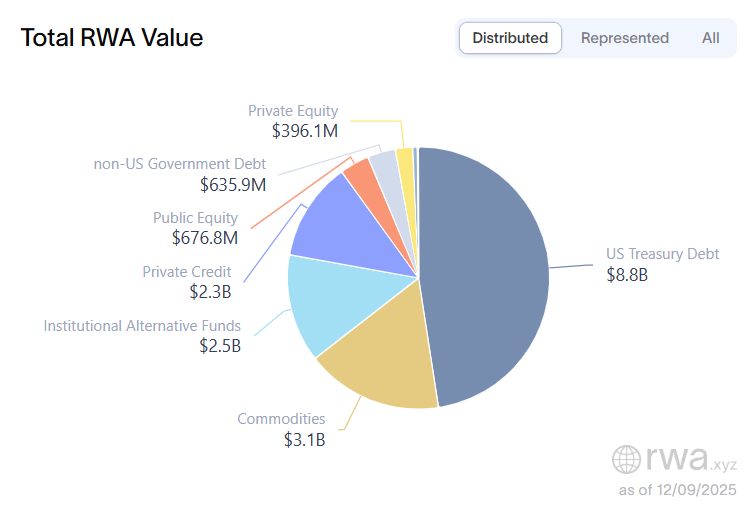
The existing RWA market by asset type. Source: RWA.xyz

Money market funds, which are low-risk investment vehicles that invest in short-term, highly liquid assets, often hold some of the same instruments, such as Treasury bills. Tokenized money market funds have also been expanding quickly, with their market size growing roughly tenfold since 2023, according to data from the Bank for International Settlements.

Goldman Sachs and BNY Mellon are among the largest institutions to enter the tokenized money market fund space, adding further momentum to one of the fastest-growing segments of the RWA sector.

Related: Tokenized money market funds emerge as Wall Street’s answer to stablecoins

Tokenized RWA market poised for major expansion, industry insiders say

With 2025 already a landmark year for tokenized real-world assets due to rising institutional participation, next year could see even stronger growth, according to Chris Yin, co-founder and CEO of Plume, an RWA-focused layer-2 blockchain.

“Currently, we are tracking to over 10x the RWA holders number since the start of the year,” Yin told Cointelegraph, adding that “we think it’s not crazy to imagine another banner year with 25x+ in user growth numbers.”

Beyond US government debt, Yin said the market is seeing rising interest in private credit, mineral rights, energy assets, GPUs and other nontraditional categories.
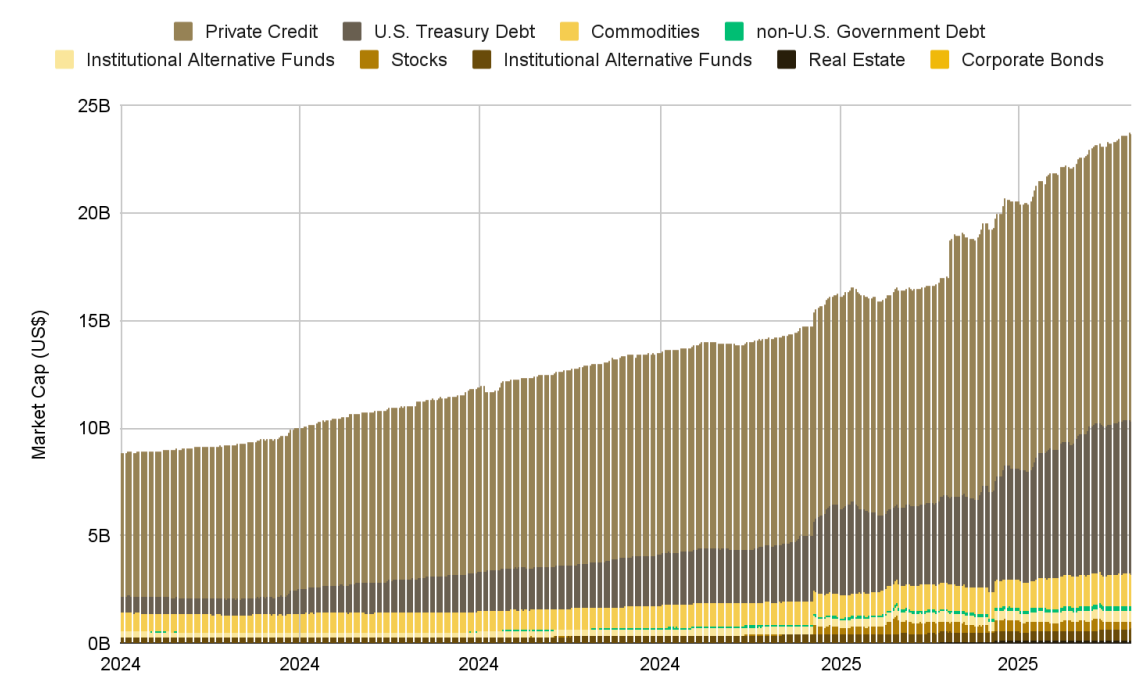
The tokenized RWA market has experienced significant growth since 2024. Source: Binance Research

His outlook aligns with a June report from Binance Research, which noted that clearer regulatory expectations in the United States could draw even more major institutions into tokenization.

Related: SEC ends Biden-era probe into tokenized equity platform Ondo Finance

Related Reads

Digital Asset Vaults Lose Their Luster: Twenty One's Stock Plunges 20% on First Trading Day

Twenty One Capital, a Bitcoin-focused treasury company backed by Tether and SoftBank, saw its shares plunge approximately 20% on its first day of trading on the New York Stock Exchange. The sharp decline reflects investor skepticism toward the valuation and business model of Bitcoin treasury companies amid a significant cryptocurrency market downturn. The company, led by 31-year-old CEO Jack Mallers, holds around 43,500 BTC. However, Bitcoin holdings have fallen over 25% since October’s all-time high near $126,000, putting pressure on the "digital asset treasury" (DAT) model. Despite its large Bitcoin reserve and strong backers, investors remain cautious due to unclear revenue paths and heavy reliance on Bitcoin’s volatile price. Twenty One went public via a merger with SPAC Cantor Equity. Unlike traditional companies, its valuation is almost entirely tied to its Bitcoin holdings, using metrics like "Bitcoin per Share" (BPS). Yet, the firm has not detailed how it will generate sustainable profits beyond holding Bitcoin. The sell-off reflects broader pressures on crypto-linked stocks. Other Bitcoin-heavy companies like Metaplanet, Trump Media, and Empery Digital also face millions in unrealized losses and falling share prices as Bitcoin corrects. The debut underscores high volatility and valuation risks in crypto investing. Despite innovation and institutional support, long-term viability requires transparent business models and clear profitability strategies—lessons even high-profile crypto firms must heed.

cointelegraph_中文52분 전

Digital Asset Vaults Lose Their Luster: Twenty One's Stock Plunges 20% on First Trading Day

cointelegraph_中文52분 전

Trading

Spot
Futures
活动图片