Adam Back slams Bitcoiner VC for ‘uninformed noise’ about quantum risk

cointelegraphPubblicato 2025-12-20Pubblicato ultima volta 2025-12-20

Introduzione

Blockstream CEO Adam Back criticized Castle Island Ventures' Nic Carter for amplifying concerns about quantum computing threats to Bitcoin, calling it "uninformed noise." Carter defended his firm's investment in quantum-resistant startup Project Eleven, stating he was "quantum pilled" and believes Bitcoin is vulnerable. He argues governments are preparing for quantum risks and Bitcoin is a "bug bounty" for quantum attacks. While some, like Capriole Investments' Charles Edwards, warn the threat could emerge in 2-9 years, Back contends quantum technology is still decades away from being a real threat. Others, like Kevin O’Leary, doubt attacking Bitcoin would be a practical use of quantum computing.

Blockstream CEO Adam Back has criticized Castle Island Ventures founding partner Nic Carter for amplifying concerns about quantum computing threats to Bitcoin.

“You make uninformed noise and try to move the market or something. You’re not helping,” Back said in an X post on Friday, after Carter explained in an X post why Castle Island Ventures invested in Project Eleven, a startup focused on protecting Bitcoin and other crypto assets from the threat of quantum computing.

Back said the Bitcoin community is not in denial about the need to research and develop protections against potential quantum computing threats, but is instead doing that work “quietly.” However, Carter refuted Back’s comment, arguing that many Bitcoin developers are still in “total denial” about the risk of quantum computing to Bitcoin.
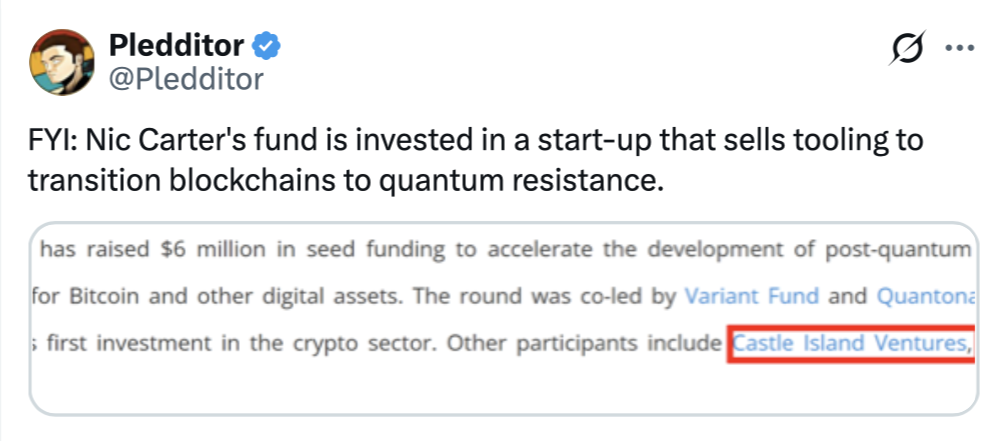
Source: Pledditor

While Castle Island Ventures’ investment only recently resurfaced on social media within the Bitcoin community, Carter first disclosed it in a Substack post on Oct. 20. “I disclosed this in the first sentence of my main article on quantum. Can’t get more transparent than that,” Carter said.

Carter says he was “quantum pilled”

Carter said that he invested in the project because Project Eleven CEO Alex Pruden “quantum pilled” him. “I became extremely concerned about quantum threats to blockchains. I put capital behind my convictions, always have,” he said.
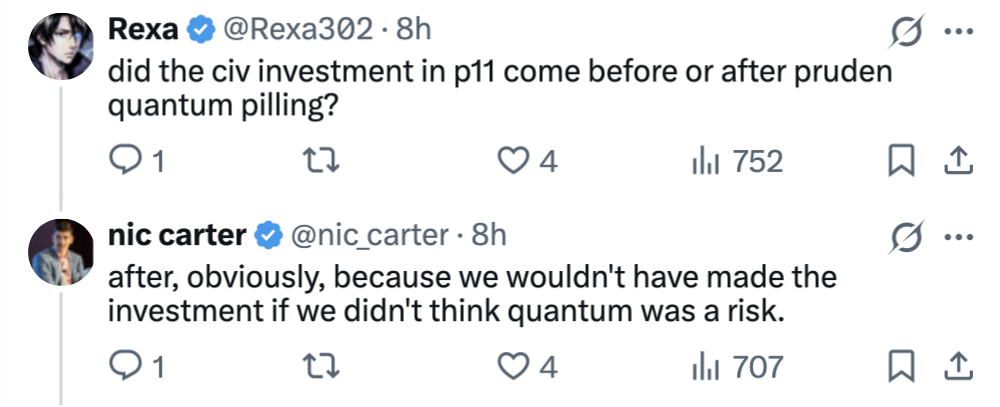
Source: Nic Carter

“I knew the bad faith criticisms would come, so I made absolutely sure to be crystal clear about my financial exposure here,” Carter added.

Carter raised several points why quantum computing poses a risk to Bitcoin, including governments planning for a post-quantum world, Bitcoin itself being “a bug bounty” for quantum supremacy, and the increasing amount of investment in quantum firms.

Carter isn’t the only prominent Bitcoin figure to have recently stepped up public warnings about the potential quantum computing threat to Bitcoin.

Some warn the threat could emerge in as little as two years

Capriole Investments founder Charles Edwards warned in a post on X on Thursday that quantum computing could pose a genuine threat to Bitcoin within the next two to nine years unless the network upgrades to quantum-resistant cryptography.

However, others are less concerned.

Related: Anxiety of quantum risk to Bitcoin is weighing on its price: Execs

Multimillionaire entrepreneur Kevin O’Leary recently told Cointelegraph Magazine that using quantum computing to break Bitcoin’s security wouldn’t be the most effective use of the technology, arguing it would be far more valuable in areas like AI-driven medical research.

Meanwhile, Back recently said it is good for Bitcoin to be “quantum ready,” but it won’t be a threat for the next few decades, as the technology is still “ridiculously early,” and has research and development issues.

Magazine: Big questions: Would Bitcoin survive a 10-year power outage?

Domande pertinenti

QWhat is Adam Back's criticism of Nic Carter regarding quantum computing threats to Bitcoin?

AAdam Back criticized Nic Carter for making 'uninformed noise' and trying to move the market, arguing that the Bitcoin community is already working 'quietly' on quantum protections rather than being in denial.

QWhy did Nic Carter invest in Project Eleven?

ANic Carter invested in Project Eleven because its CEO Alex Pruden 'quantum pilled' him, making him extremely concerned about quantum threats to blockchains, and he wanted to put capital behind his convictions.

QWhat are some reasons Carter believes quantum computing poses a risk to Bitcoin?

ACarter cited governments planning for a post-quantum world, Bitcoin being 'a bug bounty' for quantum supremacy, and increasing investments in quantum firms as reasons for the risk.

QHow soon does Charles Edwards believe quantum computing could threaten Bitcoin?

ACharles Edwards warned that quantum computing could pose a genuine threat to Bitcoin within the next two to nine years unless the network upgrades to quantum-resistant cryptography.

QWhat is Adam Back's timeline for when quantum computing might become a threat to Bitcoin?

AAdam Back stated that quantum computing won't be a threat to Bitcoin for the next few decades, as the technology is still 'ridiculously early' and has research and development issues.

Letture associate

Wall Street's 'Compliance Hunt': The Great Stablecoin Reserve Migration

In a concentrated move over the past week, several Wall Street giants have advanced their tokenized money market fund initiatives, signaling a strategic shift driven by impending U.S. stablecoin regulations. JPMorgan Chase launched its second such fund, JLTXX, on Ethereum, explicitly targeting future stablecoin issuer reserve needs. Concurrently, Franklin Templeton partnered with Kraken to integrate its BENJI tokenized funds onto the exchange platform for use as collateral and cash management tools. BlackRock further solidified its position by filing for two new tokenized funds with the SEC, aiming to convert its massive traditional stablecoin custody business into a tokenized model. These parallel developments represent a multi-pronged institutional "compliance hunt" to capture future crypto liquidity. BlackRock and JPMorgan are focusing on the backend, preparing to serve as the core reserve and settlement infrastructure for compliant stablecoins as outlined by the GENIUS Act. This act defines strict "qualified reserve asset" requirements for stablecoin backing while prohibiting interest payments to holders. Franklin Templeton and Kraken, however, are exploiting a potential regulatory gap. By offering a tokenized fund (BENJI) that is not a stablecoin, they aim to provide yield-bearing, collateralizable digital cash instruments, circumventing GENIUS Act's ban on stablecoin yield. The impending CLARITY Act, which will delineate digital asset market structure, is seen as a complementary piece to GENIUS. Its treatment of passive income could solidify the niche for instruments like BENJI. With conservative market size estimates for tokenized money market funds reaching hundreds of billions by 2030, Wall Street institutions are positioning themselves early, using on-chain settlement as a key competitive differentiator to offer superior liquidity and composability for the next generation of dollar reserves.

marsbit53 min fa

Wall Street's 'Compliance Hunt': The Great Stablecoin Reserve Migration

marsbit53 min fa

Altman Drops Bombshell While Musk is Away: He Once Wanted His Children to Inherit OpenAI

In a California court, Sam Altman testified for the first time in the ongoing legal battle between Elon Musk and OpenAI. Altman made a striking claim: Musk once suggested that control of OpenAI could one day be passed down to his children. This statement reframes the long-standing conflict not as a simple governance dispute but as a foundational power struggle. Altman sought to counter the narrative that OpenAI betrayed its original non-profit, idealistic mission. He argued that from the beginning, it was Musk who sought increasing control over the organization, including a larger equity stake and ultimate decision-making authority. Altman opposed this, citing OpenAI's core principle that AGI should not be controlled by any single individual. He also addressed the key point of contention about OpenAI's shift to a for-profit structure, claiming Musk was aware of and initially supportive of exploring such a model to secure the massive funding needed for advanced AI research. Altman framed the change as a practical necessity, not a betrayal. Further testimony revealed internal concerns after Musk left OpenAI's board, with worries he might take retaliatory action. Altman critiqued Musk's management style as unsuitable for a research lab, damaging morale and culture. Throughout his testimony, Altman's focus appeared to shift from technological idealism to the realities of organizational governance and resource requirements. Regarding his brief ouster in 2023, Altman stated he seriously considered joining Microsoft but ultimately returned because OpenAI was too important to abandon.

marsbit1 h fa

Altman Drops Bombshell While Musk is Away: He Once Wanted His Children to Inherit OpenAI

marsbit1 h fa

Trading

Spot
Futures
活动图片