The Company That Makes Glass for iPhones Sees Its Stock Price Soar 500% Because of AI

marsbitPubblicato 2026-05-08Pubblicato ultima volta 2026-05-08

Introduzione

The iPhone screen glass supplier Corning, known for Gorilla Glass, is experiencing a meteoric rise driven by the AI boom, with its stock price increasing fivefold over two years. The catalyst is a dramatic shift in its core business. While historically reliant on telecom and display glass, its optical communications division—inventor of low-loss fiber optics—has become the growth engine, fueled by massive AI data center demand. AI training requires vastly denser "east-west" data traffic between thousands of GPUs, making traditional copper cables inadequate and creating an urgent need for high-bandwidth, low-latency fiber optics. Corning has secured at least four multi-year contracts worth tens of billions of dollars in recent months, including deals with Meta and two unnamed companies. Its optical communications revenue surged 35% in 2025. A key factor is Corning's "Springboard" plan, which boosted profits faster than sales through premium pricing, product upgrades for AI clusters, and utilizing idle capacity. Its innovations, like rollable ribbon fiber that triples capacity within existing conduits and cuts installation time, command a significant premium as they save critical months in AI factory construction. NVIDIA's recent $5 billion investment in Corning (with an option to increase to $32 billion), including nearly free shares, signals a strategic partnership. This is part of NVIDIA's broader move beyond chips to becoming an "AI factory" systems integrator, securing ...

On the afternoon of May 6, NVIDIA announced an investment. The amount wasn't exceptionally large, $5 billion. But the contract stipulated that it could be increased to $32 billion in the future. Corning's stock price rose 14% that day.

What's more intriguing is the structure of this deal. Among the 18 million equity warrants Corning gave to NVIDIA, 3 million had an exercise price of $0.0001. This essentially means those 3 million shares were almost gifted to Corning. That same afternoon, at an investor meeting in New York, Corning raised its revenue growth target to $40 billion by 2030.

But this isn't the most unusual part of Corning's recent months. The company's first-quarter earnings report stated that in the past few months, two unnamed companies had each signed multi-year contracts worth $6 billion with Corning. The reason for saying "another" is that Corning had recently just signed a contract of the same scale with Meta.
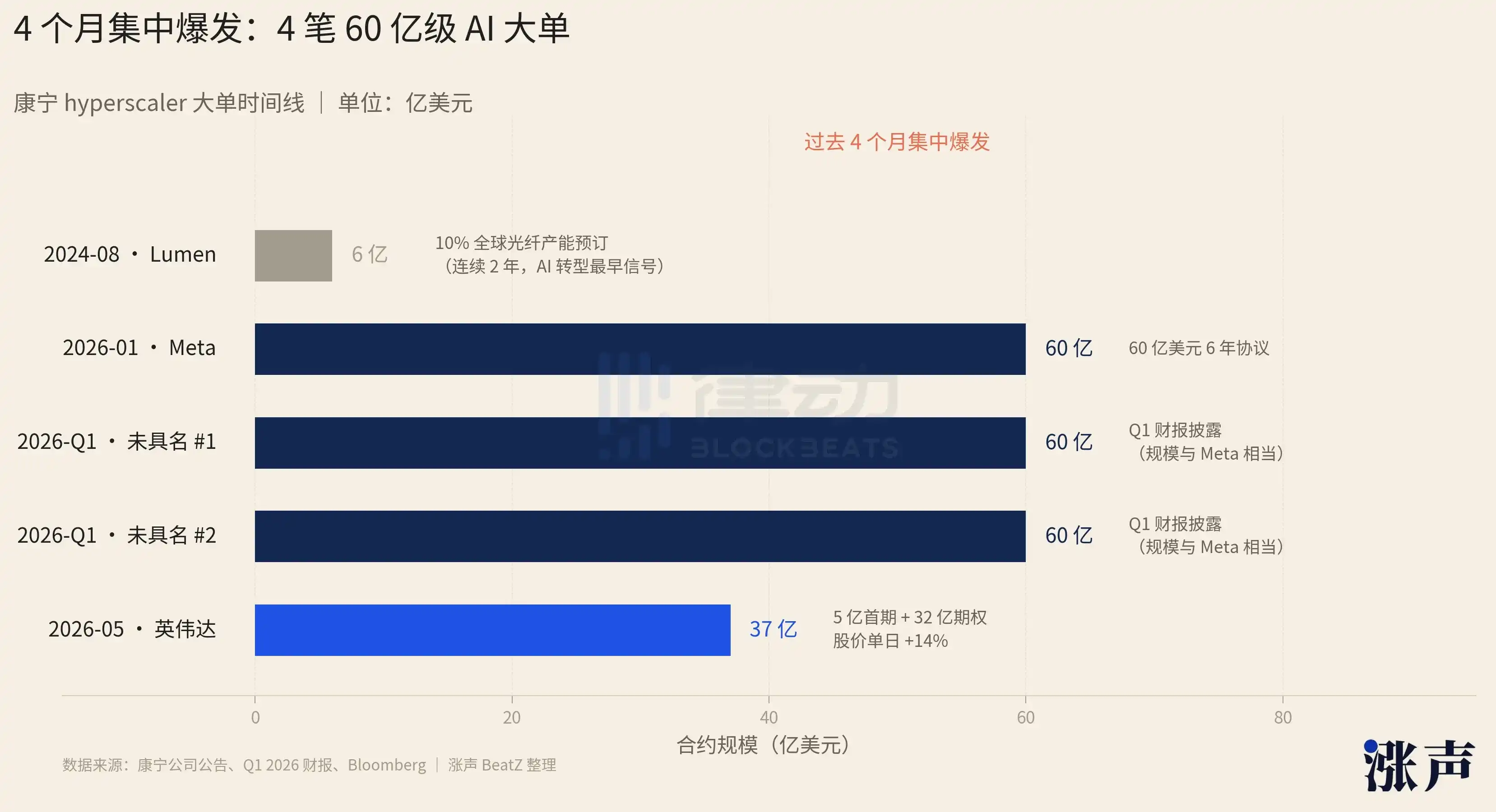
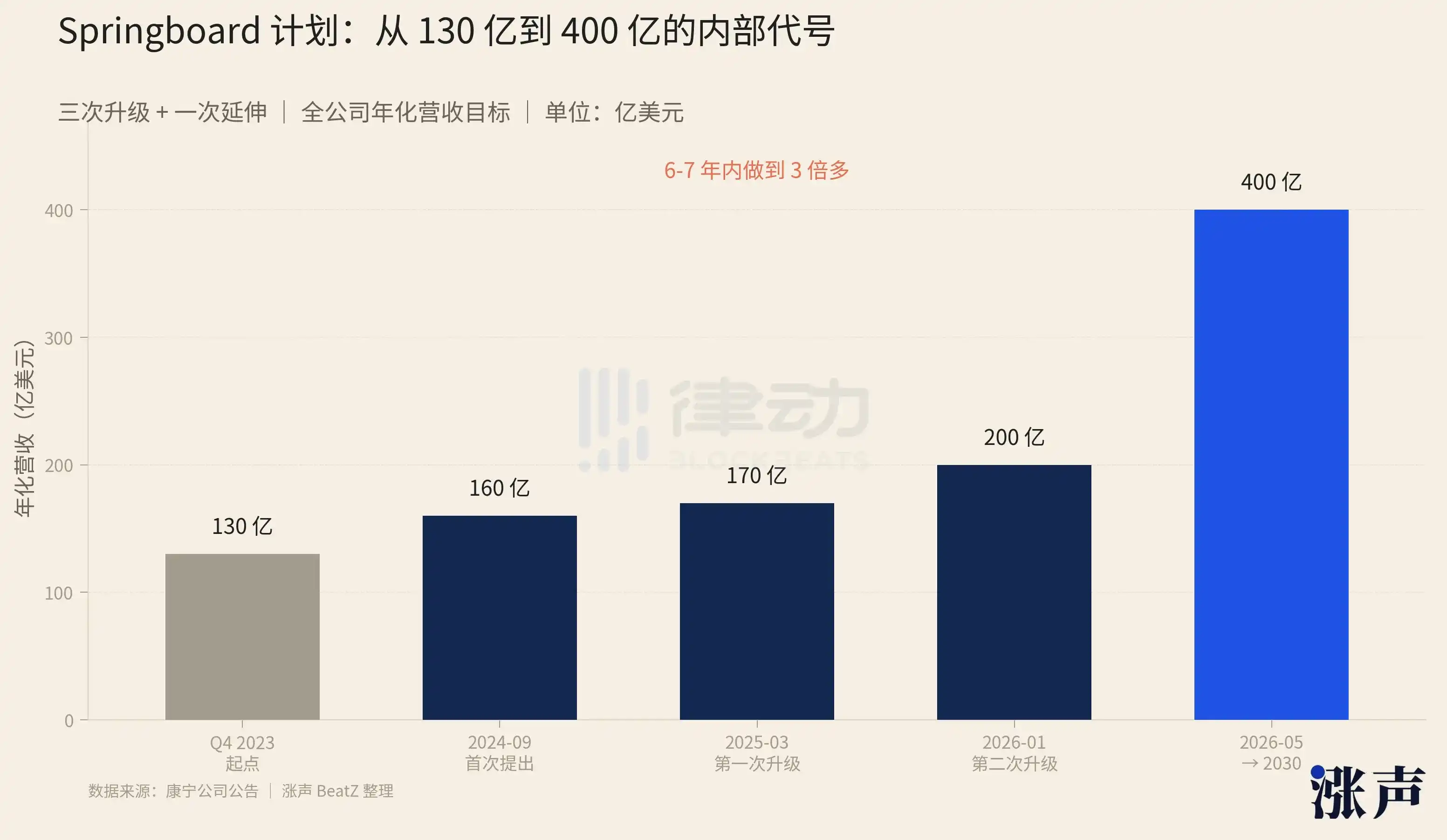
Count them up, and you'll find that in the past 4 months, at least 4 multi-billion dollar AI orders, each worth tens of billions, have concentrated on this 174-year-old glass company. Over the past 6 months, Corning's stock price has risen 140%, and compared to two years ago, it has already increased fivefold.

From Selling Phone Glass to the Darling of AI Factories

If you're reading this article on a phone, the glass covering your screen most likely was produced by Corning. Since the first-generation iPhone in 2007, Corning's Gorilla Glass has almost become the default choice for premium smartphone screens globally. But being a "phone glass supplier" is just one facet of Corning, and not the most profitable one.
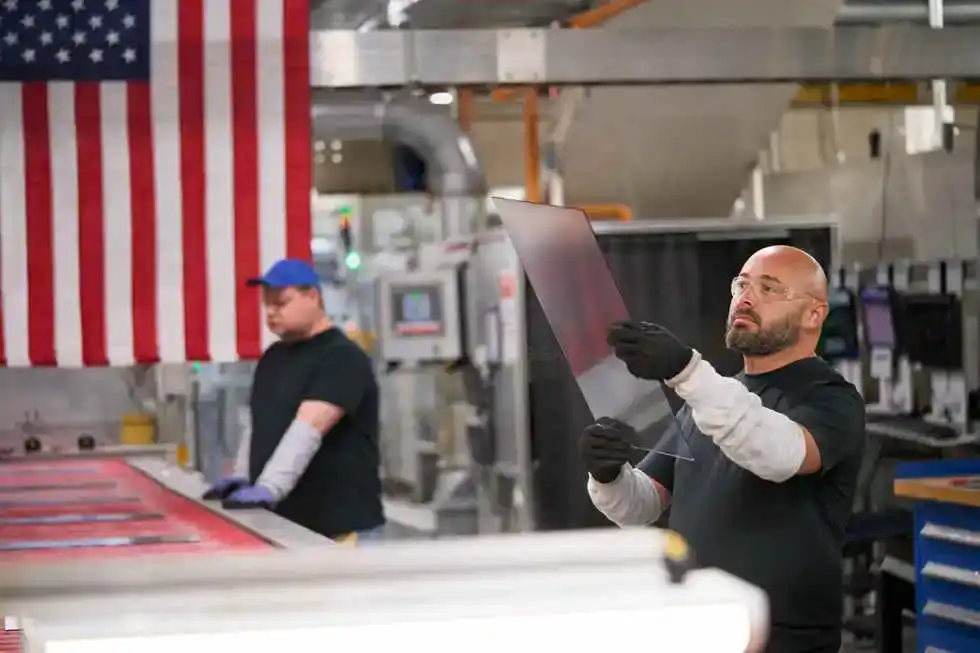
Corning's Gorilla Glass production line, Source: Apple

The company was founded in 1851. It made the glass shell for Edison's first incandescent light bulb, invented low-loss optical fiber from scratch in the 1970s, creating the entire modern optical fiber industry. The 2007 iPhone glass marked its third major business transformation. Today's Corning is undergoing its fourth transformation, with optical communications becoming the true locomotive driving its business.

Corning's optical communications business has a history of over 50 years, but its customer structure has undergone a complete reversal in the last two years.

For a long time, Corning's optical fiber was primarily sold to telecommunications operators like AT&T and Verizon. These companies used it to build fiber-to-the-home networks and 4G/5G base stations. In 2009, Corning launched a data center cabling solution called EDGE, formally adding data center operators to its customer list. Over the past decade-plus, with the explosion of mobile internet, the proliferation of cloud services, and the surge in remote work during the pandemic, Corning's optical communications business grew steadily but never became the major revenue driver.

In November 2022, OpenAI launched ChatGPT to the public. From that moment on, data centers worldwide began redesigning their physical infrastructure for the new computational task of AI training. The fiber density required for AI training is unprecedented in any previous era.

The earliest sign appeared in August 2024. A US telecommunications operator named Lumen booked 10% of Corning's global fiber optic capacity in one go, for two consecutive years. This was the earliest public signal of Corning's business transitioning towards the AI domain.

By early 2026, the aforementioned four $6+ billion contracts burst onto the scene. Corning had collaborated with data center operators for 15 years, but the shift from "secondary client" to "absolute mainstay" happened only in the past 24 months.

The direct effect of this customer flip is written in Corning's financial reports. Corning's full-year revenue for 2023 fell 11% year-over-year, a period of industry downturn. But by 2025, full-year revenue surged to $15.6 billion, a 19% increase. In the first quarter of this year, revenue grew another 18% year-over-year. The most explosive growth was in optical communications, with full-year growth at 35%. The proportion of optical communications to total revenue rose from 30% in 2020 to 37% in 2025. The absolute change is more直观: from $2 billion five years ago to $6.3 billion in 2025, more than tripling.

This leap from "secondary business" to "locomotive" isn't accidental; it's driven by a growth plan led by CEO Wendell Weeks. This plan has an internal codename: Springboard.

Two years ago, Corning was described by Wall Street analysts as a "boring glass manufacturer," categorized as a mature, low-growth dividend stock. But three years after the implementation of the Springboard plan, Corning's stock price rose from just over $30 at the beginning of 2024 to $162, a fivefold increase in two years, with a 140% surge in the past six months alone. The glass factory has transformed into the "nervous system of the AI revolution."
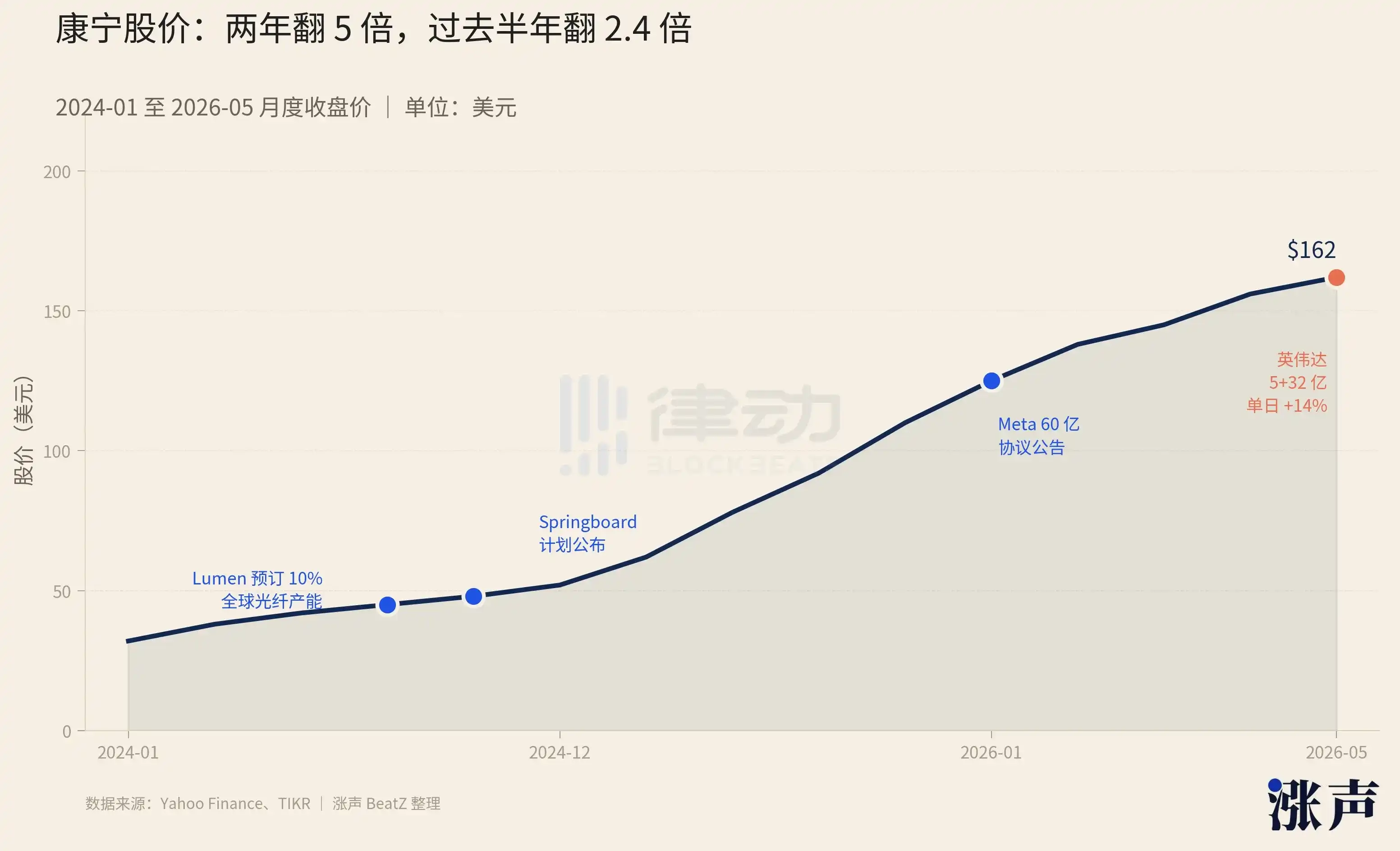
Springboard was first announced in September 2024. The starting point was the annualized revenue level in the fourth quarter of 2023, around $13 billion. The initial goal was to increase annualized revenue by more than $3 billion by the end of 2026, achieving an overall operating profit margin of 20%.

However, over the next year and a half, this target was raised three times consecutively, pushing it to $6.5 billion. This aimed to push the annualized revenue by the end of 2026 to the $20 billion scale. Following NVIDIA's investment in Corning on May 6, the company directly raised its internal revenue target for 2030 to $40 billion. Meanwhile, Corning achieved its 20% profit margin target a year early in the fourth quarter of 2025.
The key to the Springboard plan lies in "premium." The company's sales grew by 18%, but earnings per share grew by 46%, with profit growth being 2.5 times that of sales growth. On the business side, Corning mainly did three specific things:

First, it aggressively raised prices for mature businesses. Corning's display glass is already a mature, non-growth business. But at the end of 2024, Corning raised prices on this line by over 10% and locked in the yen exchange rate until 2030. The result was that this line stably contributes $900-950 million in net profit annually, even in a depreciating yen environment, maintaining a net profit margin of 25%.

Second, it upgraded its optical communications products. In full-year 2025, optical communications sales increased by 35%, but net profit increased by 71%. This means optical communications not only sold more, but each fiber earned more profit.

Third, it utilized idle capacity. Corning did not build large-scale new factories but restarted capacity that was idle during previous cyclical downturns, raising the company's overall gross margin from 33% in 2024 to 36% in 2025.

Of course, the ability to raise prices means someone is willing to pay. The ability to earn more from product upgrades means someone is willing to pay more for the upgraded products. The essence of Springboard driving Corning's profit growth faster than its revenue is that its customer structure now includes a group willing to pay a premium.

Everyone is Scrambling for Fiber

The AGI race and order demand have made every data center operator intensely anxious about time.

The core business of cloud giants has always been "renting IT to enterprises." Companies like Netflix, Airbnb, and Uber, which rose with the mobile internet, generate mostly "north-south" traffic. A user opens an app from outside, the request is sent to a server in the cloud, and the server returns data. Servers occasionally communicate with each other, but the volume and frequency aren't high. This network structure doesn't place stringent demands on the underlying physical infrastructure: Ethernet works, copper cables work, ordinary fiber works. Cloud giants have used this architecture for over a decade—stable, reliable, and profitable.

That all started to change with the launch of ChatGPT.

In the following years, almost all cloud giants began to engage in training themselves. Microsoft is the primary compute provider for OpenAI, AWS is deeply tied to Anthropic, and Alibaba trains Tongyi. The core business of cloud giants is shifting from "renting IT to enterprises" to "training AI for the world."

But the chain reaction triggered by this shift at the physical infrastructure level has surpassed all the accumulated knowledge of the past 20 years.

The traffic characteristic of AI training is "east-west." Training a large model might require tens of thousands of GPUs to communicate with each other simultaneously, synchronizing computed gradients. If any single connection is slightly slower, the entire training phase waits for it—tens of thousands of GPUs become "cars stopped at an intersection." Therefore, the latency and bandwidth requirements for east-west traffic are dozens of times greater than those for past north-south traffic.

Prior to this, most high-speed connections within data centers were copper cables. Copper is cheap, easy to install, and stable—it has long been the default choice for data centers. The geometric structure of AI training clusters is precisely what copper cables dislike the most. Tens of thousands of GPUs are distributed across dozens of racks, often separated by tens of meters, making copper connections impractical. Fiber optics, however, have no distance limit in this regard.

Overnight, the previously sufficient sparse networks became inadequate. Cloud giants need to re-lay fiber, denser than ever before.

The scale of this re-laying is already reflected in their capital expenditures. In 2026, the combined capital expenditure of the world's six largest cloud giants is projected to exceed $600 billion. The number of operational hyperscale data centers globally has reached 1,297, nearly triple the number at the beginning of 2018. In 2026 alone, over 150 new data centers are expected to be added, corresponding to AI infrastructure spending exceeding $400 billion.

Market research firms estimate that the total fiber demand for AI clusters is 10 to 100 times that of traditional cloud services. This is the fundamental reason Corning can now secure four $6+ billion mega-orders.

Between data centers, between racks, all fiber must pass through things called conduit/cable trays. These are typically plastic or metal pipes with 2-inch to 4-inch inner diameters, either buried underground or running along racks. A key characteristic is that once laid, it's very difficult to add more. To bury an additional conduit between cities means reapplying for right-of-way, digging up the road again—a process measured in years. To add another conduit in an already operational machine room means downtime for renovation, measured in months.
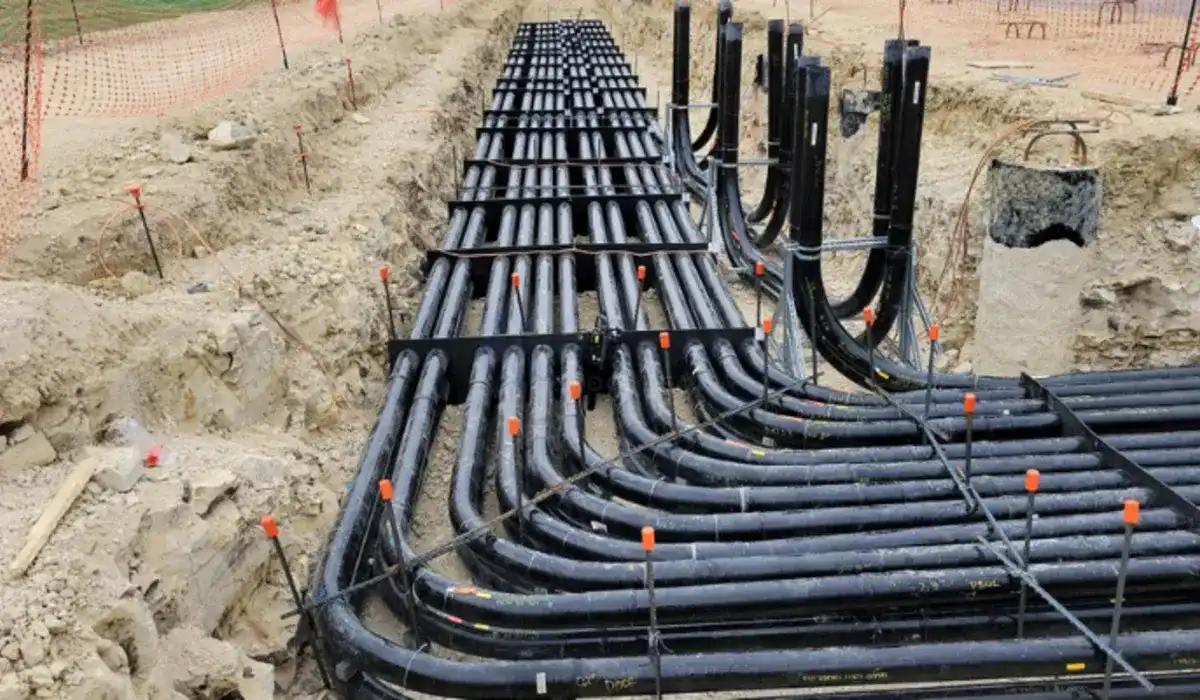
Conduit about to be buried underground, Source: Internet

What Corning has specifically done for AI data centers over the past two years is to enable existing conduits to hold more fiber without increasing their number.

Besides making the fiber itself thinner, Corning changed the fiber arrangement from loose "spaghetti-style" to flat, ribbon-like cables that can be rolled up. They are flattened when needed and rolled up when not, then densely packed into the conduit. Originally, a 2-inch conduit could hold a little over a thousand fibers. Corning's new design can pack in over three thousand, doubling the count. If using a 4-inch conduit with six such cables side-by-side, it can hold over twenty thousand fibers, more than six times the traditional design.
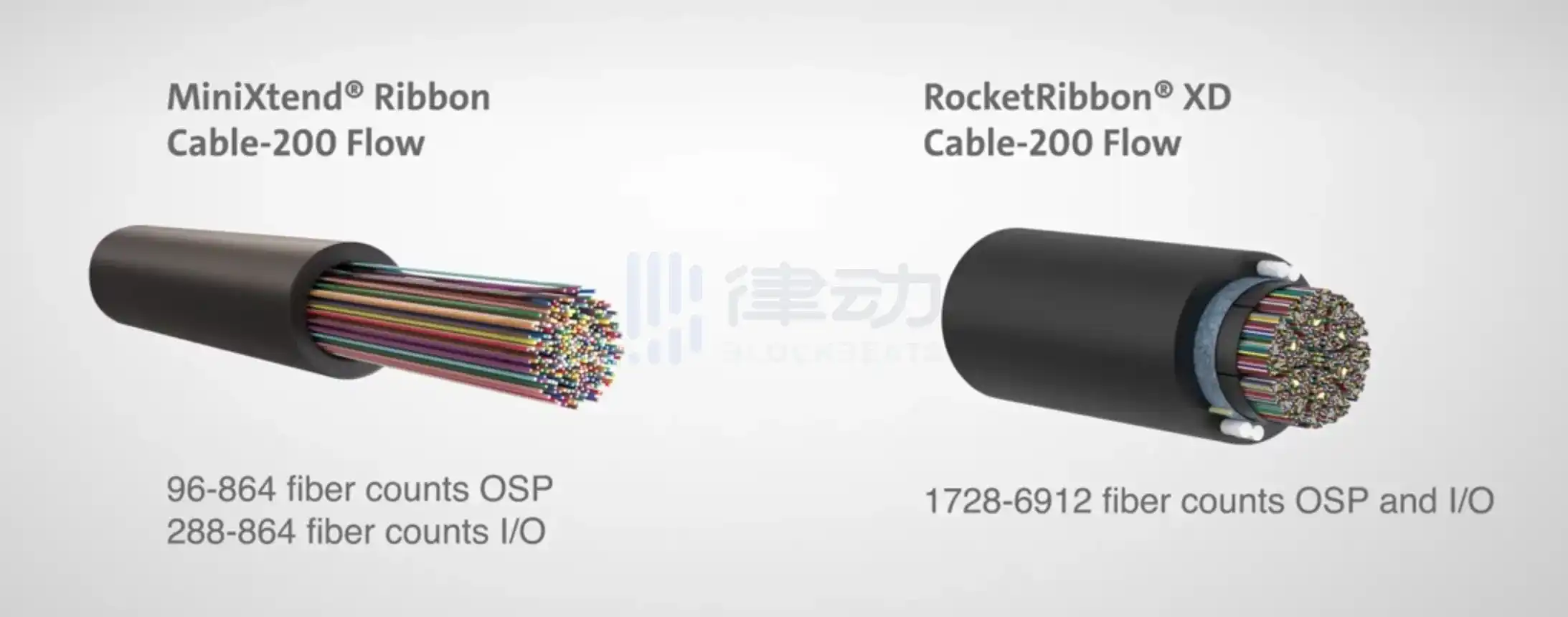
Corning's rollable fiber ribbon, Source: Corning

It's not just about packing more; termination is also less labor-intensive. A 3,456-fiber cable, using traditional methods, would require over 200 man-hours to connect strand by strand. Corning's ribbon design can reduce this to under 40 hours, and cable preparation time is reduced by 30%. Remember, the US already faces a shortage of optical communication engineers.

In the construction of a large AI factory, every month of delay means massive GPU depreciation and postponed training tasks, costing hundreds of millions on the books. A product that can cut months of time and millions in engineering costs is an absolute bargain compared to paying a 30% to 70% premium on the fiber itself.

Jensen Huang's "Unprecedented Scale"

On May 8, NVIDIA CEO Jensen Huang emphasized again in an interview that next-generation AI infrastructure requires massive optical connectivity, and copper wires can no longer meet the demand. He also stated that NVIDIA needs to expand the application of optical technology on an unprecedented scale.

The details of the investment deal with Corning indeed reveal this "unprecedented scale." Among the 18 million equity warrants, 3 million were "given away." This structure is rare in NVIDIA's ecosystem investments over the past year, indicating that NVIDIA secured significant equity exposure in Corning immediately without using cash. It's more like a signing bonus for a long-term partnership agreement.

And Corning isn't the only piece NVIDIA has bet on. Since last September, NVIDIA has entered a new investment rhythm. First, the scale has grown larger. Second, the structure frequently uses financial instruments like "frameworks," "options," and "prepaid warrants" to lock in commitments first and then fulfill them in stages. Besides the $100 billion investment framework for OpenAI, NVIDIA has successively invested tens to hundreds of billions of dollars in AI infrastructure companies like Anthropic, Intel, and CoreWeave.

The most easily overlooked is its investment in the optical communication line. Besides Corning, NVIDIA invested $2 billion each in Lumentum and Coherent, two of the world's largest optical component companies. Counting Corning's $500 million initial investment plus the $3.2 billion option, NVIDIA has poured approximately $7.7 billion into just the optical communication niche.
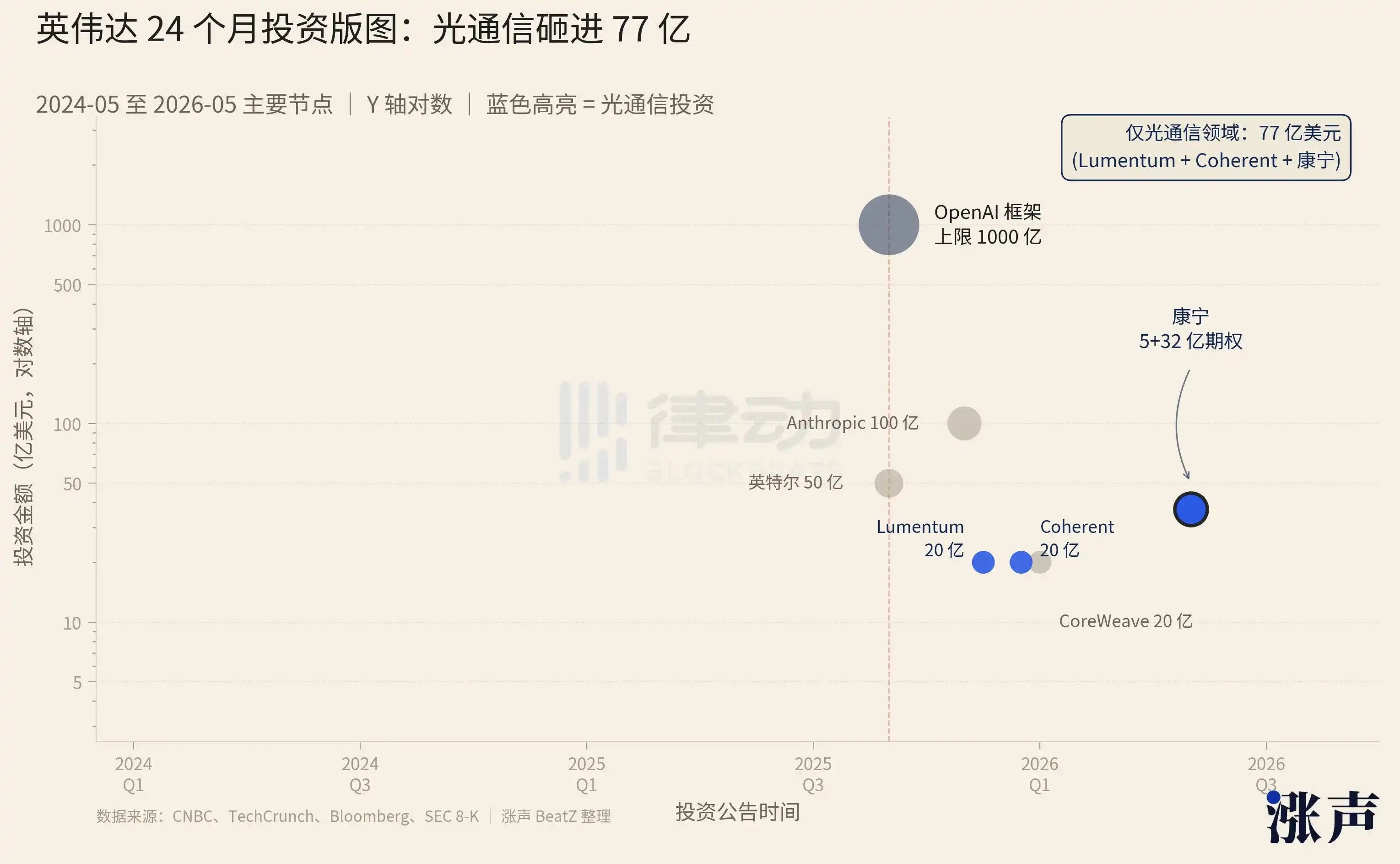
Placing this investment list on a table reveals it's essentially an AI factory construction checklist: compute, networking, optics, power, cooling, software, customers, models—every layer has NVIDIA locking in at least one key supplier. At this year's GTC conference, NVIDIA packaged this full-stack integration into a publicly available blueprint, releasing a hardware reference architecture called Vera Rubin DSX and a digital twin solution called Omniverse DSX Blueprint. The whole thing is basically the "construction blueprint for an AI factory."

A GW-scale (electricity usage scale for 1 million households) AI factory takes 18 to 24 months from planning to operation, requiring coordination among over 100 suppliers. Previously, data center operators handled this themselves, each redoing interface verification. But NVIDIA's Omniverse DSX systematizes this process. All partner products have been validated in NVIDIA's digital twin, parameters aligned, and interfaces standardized. Cloud giants can simply purchase according to NVIDIA's blueprint.
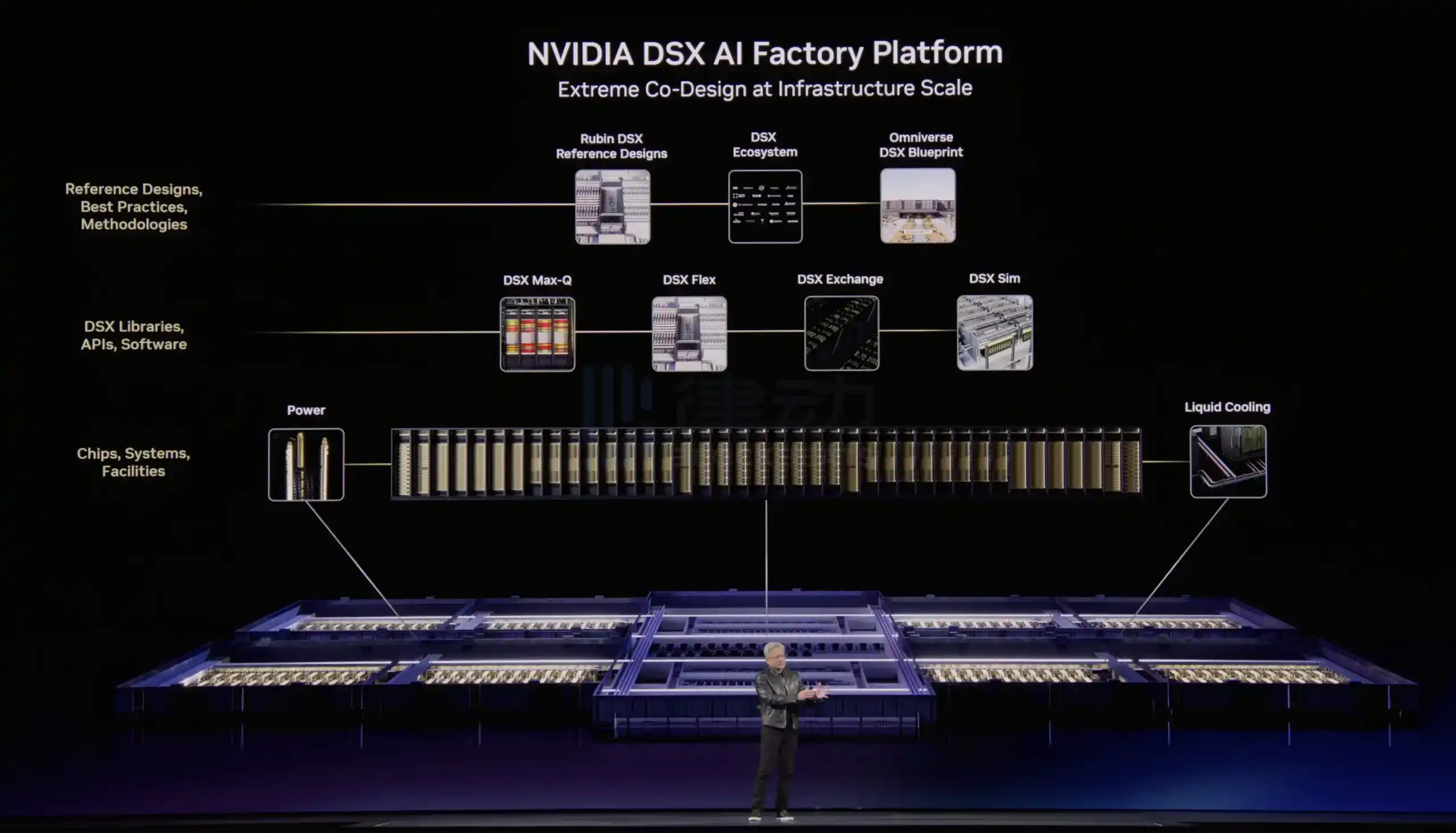
Jensen Huang unveiling the AI factory blueprint platform at GTC 2026, Source: NVIDIA

This marks NVIDIA's critical step from a chip company to an "AI factory general contractor." Increased integration expands profit margins. Even if AMD or Broadcom developed a GPU with equivalent performance tomorrow, replicating this supply chain coordination capability from chips to fiber to power grids would take at least several more years.

Therefore, the true meaning behind NVIDIA's $3.2 billion option for Corning is locking in a key player for the "localized optical communication capacity" slot in its AI factory blueprint. Of course, at present, NVIDIA is the only one capable of drawing this blueprint.

Domande pertinenti

QWhy has Corning's stock price surged recently, and what is the main driver behind it?

ACorning's stock price has surged, increasing by 140% in the past six months and 5-fold over two years, primarily driven by massive AI-related investments and contracts. Key events include a strategic investment from NVIDIA (starting at $500 million, potentially up to $3.2 billion) and several multi-billion dollar, multi-year contracts with major tech companies like Meta and other unnamed firms for its optical communications products, which are critical for building AI data centers.

QWhat is Corning's 'Springboard' plan, and how has it impacted the company's financial performance?

ACorning's 'Springboard' plan is an internal growth strategy aimed at significantly increasing revenue and profitability. Initially targeting a $3+ billion annualized revenue increase by the end of 2026, the goal has been raised multiple times, now targeting $65 billion in additional revenue. The plan focuses on generating premium profits by raising prices on mature products (like display glass), upgrading optical communication products, and reactivating idle capacity. It has led to profits growing 2.5 times faster than sales, with the company achieving its 20% operating margin target a year early.

QHow has the rise of AI training changed the demand for optical fiber in data centers?

AThe rise of AI training has fundamentally changed data center traffic from 'north-south' (user-to-server) to 'east-west' (server-to-server within a cluster). Training large AI models requires thousands of GPUs to communicate simultaneously with extremely low latency and high bandwidth. Copper cables, which were sufficient for traditional data centers, cannot meet the distance and density requirements for large AI clusters. This has created unprecedented demand for high-density optical fiber, with estimates suggesting AI clusters need 10 to 100 times more fiber than traditional cloud services.

QWhat specific innovation has Corning developed to meet the dense fiber needs of AI data centers?

ATo meet the dense fiber needs of AI data centers without laying new cable ducts (which is time-consuming and expensive), Corning developed a new, compact fiber cable design. This innovation involves making individual fibers thinner and arranging them into flat, rollable ribbons instead of loose bundles. This allows existing 2-inch ducts to hold over 3,000 fibers (doubling capacity) and 4-inch ducts with multiple cables to hold over 20,000 fibers (a 6x increase). This design also drastically reduces installation and termination time, saving months on AI factory construction timelines.

QWhat is the strategic significance of NVIDIA's investment in Corning, and how does it fit into NVIDIA's broader strategy?

ANVIDIA's investment in Corning is strategically significant as it secures a key supplier for the optical communication layer in NVIDIA's vision of an 'AI factory.' The investment, part of which includes 'free' shares, resembles a long-term partnership agreement. It fits into NVIDIA's broader strategy of acting as a 'general contractor' for AI infrastructure. NVIDIA is investing across the entire AI stack—compute, networking, optics, power, cooling—and providing integrated blueprints (like the Vera Rubin DSX architecture) to streamline and accelerate the construction of massive AI data centers, locking in critical partners and creating a high-barrier ecosystem.

Letture associate

One Article to Understand $UORE: The V4 Hook Project That Packs Mining, Lottery, and NFT Into a Single Transaction

An In-Depth Look at $UORE: The V4 Hook Project Packing Mining, Lotteries, and NFTs into a Single Transaction $UORE is the latest project leveraging the Uniswap V4 Hook mechanism, following in the footsteps of projects like SATO, uPEG, and Slonks. It distinguishes itself by integrating multiple functions—on-chain mining, a buy-to-enter lottery, auto-generated pixel NFTs (Orelings), and a deflationary burn mechanism—all within a single Uniswap V4 liquidity pool transaction. This complexity results in transaction gas fees that are 2-3 times higher than a standard swap. The project's tokenomics are intricate. Each whole $UORE token held automatically mints a corresponding Oreling NFT, a 32x32 pixel miner character with random traits determined by the next block's hash. Each Oreling has a Class (rarity) and Hash value, which combine to form its Mining Power for staking rewards. Rewards are distributed daily from an emission that decays by 1% daily, with an 80/20 split between stakers and a Motherlode lottery pool. A "refined-ore boost" mechanism taxes early reward claims, redistributing 10% to remaining stakers. The Motherlode lottery awards tickets for buys of ≥0.1 ETH, with winning chances scaling up to 1% for 1 ETH purchases. Wins split the pool 50% to the buyer and 50% to a random staker. A 1% buy tax is burned, and a 1% sell tax funds an automatic buyback-and-burn mechanism triggered at 0.1 ETH. The project's code is a fork of uPEG, with claimed fixes for NFT duplication and flash loan attacks. Its creator, Noah, describes it as a fusion of Solana's ORE mining concept with uPEG's V4 Hook framework. Key challenges noted include high gas costs, the narrowing attention window for V4 Hook narratives as it's the fourth such project, and significant complexity that creates a high barrier to understanding for users. The project's whitepaper notably advises users to "Read the contracts and understand the mechanics before deploying capital," underscoring its complex and fast-moving nature within a trend where the "alpha" lifespan for new projects appears to be shrinking rapidly.

marsbit17 min fa

One Article to Understand $UORE: The V4 Hook Project That Packs Mining, Lottery, and NFT Into a Single Transaction

marsbit17 min fa

Gate Institute: Polymarket Accelerates Growth, Gate Launches New Portal to Prediction Markets

Gate Research Institute: Polymarket Growth Accelerates, Gate Expands into Prediction Markets with New Portal This analysis examines the growth of the prediction market platform Polymarket, which has evolved from an early experiment into a major event-driven trading venue. Data shows a significant, step-like increase in trading volume and active users, though growth remains heavily tied to major political, sports, and geopolitical events. Fee and revenue growth is driven by both genuine trading demand and recent changes to platform fee structures. Polymarket's market structure is highly concentrated, with over 90% of volume in these few high-profile categories. While it functions as both an information and sentiment market, its price discovery is most active during high-attention news cycles. The platform's core value lies in creating a liquid market for trading the outcome of future events, a unique niche within crypto. Gate's recent integration of Polymarket addresses different challenges. It simplifies access by allowing users to trade with exchange-held USDT, lowering friction for its existing user base. This highlights two emerging pathways for prediction markets: Polymarket's native, on-chain model versus Gate's centralized, low-friction account integration. Both paths will likely coexist, targeting different user segments. Key challenges for Polymarket include ongoing regulatory uncertainty, reliance on cyclical event-driven demand, potential oracle or settlement disputes, and achieving sustainable user retention beyond peak event periods. The platform has proven its commercial viability and ability to scale but has yet to demonstrate it can become a stable, everyday trading category independent of major news cycles.

marsbit32 min fa

Gate Institute: Polymarket Accelerates Growth, Gate Launches New Portal to Prediction Markets

marsbit32 min fa

Dissolving xAI, Musk Wants to Rebuild an AI Company Using Rocket-Building Methods

Elon Musk is making an unprecedented move by dissolving his AI startup, xAI, and folding it into his aerospace company, SpaceX, ahead of a planned public offering. This aims to package SpaceX's lucrative rocket and Starlink business with the high-cost, high-growth potential of AI. However, xAI's flagship model, Grok, has struggled to gain significant commercial or enterprise traction compared to leaders like OpenAI's ChatGPT or Anthropic's Claude. Internal turmoil led to the departure of much of xAI's founding AI talent. Musk has responded by installing SpaceX engineers as managers to transform xAI from a research lab into a high-efficiency "AI factory," focusing on infrastructure like its Colossus supercomputing cluster. Musk's vision positions the combined "SpaceXAI" as a future AI infrastructure company, addressing bottlenecks in computing power, energy, and data centers. He even proposes futuristic concepts like space-based AI data centers. To validate this story, SpaceXAI has begun sharing compute resources with former rival Anthropic. Financially, the merger appears to be a move to secure funding for xAI's massive losses by leveraging SpaceX's stable cash flow. While the combined entity targets a $1.25 trillion valuation, the market has yet to price in significant synergy. The strategic choice of SpaceX over Tesla, despite Tesla's closer ties to physical AI applications like robots and cars, is seen as Musk securing maximum control. Ultimately, Musk is betting that his proven methodology—centralized control, vertical integration, and aggressive engineering timelines—will succeed in the AI arena. But this time, he faces competitors like OpenAI and Google who are equally fast, well-funded, and determined. The merger is less about a guaranteed victory and more about ensuring Musk remains a key player at the table, regardless of the final outcome.

marsbit59 min fa

Dissolving xAI, Musk Wants to Rebuild an AI Company Using Rocket-Building Methods

marsbit59 min fa

Trading

Spot
Futures

Articoli Popolari

Cosa è GROK AI

Grok AI: Rivoluzionare la Tecnologia Conversazionale nell'Era Web3 Introduzione Nel panorama in rapida evoluzione dell'intelligenza artificiale, Grok AI si distingue come un progetto notevole che collega i domini della tecnologia avanzata e dell'interazione con l'utente. Sviluppato da xAI, un'azienda guidata dal rinomato imprenditore Elon Musk, Grok AI cerca di ridefinire il modo in cui interagiamo con l'intelligenza artificiale. Mentre il movimento Web3 continua a prosperare, Grok AI mira a sfruttare il potere dell'IA conversazionale per rispondere a query complesse, offrendo agli utenti un'esperienza che è non solo informativa ma anche divertente. Cos'è Grok AI? Grok AI è un sofisticato chatbot di intelligenza artificiale conversazionale progettato per interagire dinamicamente con gli utenti. A differenza di molti sistemi di intelligenza artificiale tradizionali, Grok AI abbraccia un'ampia gamma di domande, comprese quelle tipicamente considerate inappropriate o al di fuori delle risposte standard. Gli obiettivi principali del progetto includono: Ragionamento Affidabile: Grok AI enfatizza il ragionamento di buon senso per fornire risposte logiche basate sulla comprensione contestuale. Supervisione Scalabile: L'integrazione dell'assistenza degli strumenti garantisce che le interazioni degli utenti siano sia monitorate che ottimizzate per la qualità. Verifica Formale: La sicurezza è fondamentale; Grok AI incorpora metodi di verifica formale per migliorare l'affidabilità delle sue uscite. Comprensione del Lungo Contesto: Il modello di IA eccelle nel trattenere e richiamare una vasta storia di conversazione, facilitando discussioni significative e consapevoli del contesto. Robustezza Adversariale: Concentrandosi sul miglioramento delle sue difese contro input manipolati o malevoli, Grok AI mira a mantenere l'integrità delle interazioni degli utenti. In sostanza, Grok AI non è solo un dispositivo di recupero informazioni; è un partner conversazionale immersivo che incoraggia un dialogo dinamico. Creatore di Grok AI Il cervello dietro Grok AI non è altri che Elon Musk, un individuo sinonimo di innovazione in vari campi, tra cui automotive, viaggi spaziali e tecnologia. Sotto l'egida di xAI, un'azienda focalizzata sull'avanzamento della tecnologia AI in modi benefici, la visione di Musk mira a rimodellare la comprensione delle interazioni con l'IA. La leadership e l'etica fondamentale sono profondamente influenzate dall'impegno di Musk nel superare i confini tecnologici. Investitori di Grok AI Sebbene i dettagli specifici riguardanti gli investitori che sostengono Grok AI rimangano limitati, è pubblicamente riconosciuto che xAI, l'incubatore del progetto, è fondato e supportato principalmente dallo stesso Elon Musk. Le precedenti imprese e partecipazioni di Musk forniscono un robusto sostegno, rafforzando ulteriormente la credibilità e il potenziale di crescita di Grok AI. Tuttavia, al momento, le informazioni riguardanti ulteriori fondazioni di investimento o organizzazioni che supportano Grok AI non sono facilmente accessibili, segnando un'area per potenziali esplorazioni future. Come Funziona Grok AI? Le meccaniche operative di Grok AI sono innovative quanto il suo framework concettuale. Il progetto integra diverse tecnologie all'avanguardia che facilitano le sue funzionalità uniche: Infrastruttura Robusta: Grok AI è costruito utilizzando Kubernetes per l'orchestrazione dei container, Rust per prestazioni e sicurezza, e JAX per il calcolo numerico ad alte prestazioni. Questo trio garantisce che il chatbot operi in modo efficiente, si scaldi efficacemente e serva gli utenti prontamente. Accesso alla Conoscenza in Tempo Reale: Una delle caratteristiche distintive di Grok AI è la sua capacità di attingere a dati in tempo reale attraverso la piattaforma X—precedentemente nota come Twitter. Questa capacità consente all'IA di accedere alle informazioni più recenti, permettendole di fornire risposte e raccomandazioni tempestive che altri modelli di IA potrebbero perdere. Due Modalità di Interazione: Grok AI offre agli utenti la scelta tra “Modalità Divertente” e “Modalità Normale”. La Modalità Divertente consente uno stile di interazione più giocoso e umoristico, mentre la Modalità Normale si concentra sulla fornitura di risposte precise e accurate. Questa versatilità garantisce un'esperienza su misura che soddisfa varie preferenze degli utenti. In sostanza, Grok AI sposa prestazioni con coinvolgimento, creando un'esperienza che è sia arricchente che divertente. Cronologia di Grok AI Il viaggio di Grok AI è segnato da traguardi fondamentali che riflettono le sue fasi di sviluppo e distribuzione: Sviluppo Iniziale: La fase fondamentale di Grok AI si è svolta in circa due mesi, durante i quali sono stati condotti l'addestramento iniziale e il perfezionamento del modello. Rilascio Beta di Grok-2: In un significativo avanzamento, è stata annunciata la beta di Grok-2. Questo rilascio ha introdotto due versioni del chatbot—Grok-2 e Grok-2 mini—ognuna dotata delle capacità per chattare, programmare e ragionare. Accesso Pubblico: Dopo lo sviluppo beta, Grok AI è diventato disponibile per gli utenti della piattaforma X. Coloro che hanno account verificati tramite un numero di telefono e attivi per almeno sette giorni possono accedere a una versione limitata, rendendo la tecnologia disponibile a un pubblico più ampio. Questa cronologia racchiude la crescita sistematica di Grok AI dall'inizio all'impegno pubblico, enfatizzando il suo impegno per il miglioramento continuo e l'interazione con gli utenti. Caratteristiche Chiave di Grok AI Grok AI comprende diverse caratteristiche chiave che contribuiscono alla sua identità innovativa: Integrazione della Conoscenza in Tempo Reale: L'accesso a informazioni attuali e rilevanti differenzia Grok AI da molti modelli statici, consentendo un'esperienza utente coinvolgente e accurata. Stili di Interazione Versatili: Offrendo modalità di interazione distinte, Grok AI soddisfa varie preferenze degli utenti, invitando alla creatività e alla personalizzazione nella conversazione con l'IA. Avanzata Struttura Tecnologica: L'utilizzo di Kubernetes, Rust e JAX fornisce al progetto un solido framework per garantire affidabilità e prestazioni ottimali. Considerazione del Discorso Etico: L'inclusione di una funzione di generazione di immagini mette in mostra lo spirito innovativo del progetto. Tuttavia, solleva anche considerazioni etiche riguardanti il copyright e la rappresentazione rispettosa di figure riconoscibili—una discussione in corso all'interno della comunità AI. Conclusione Come entità pionieristica nel campo dell'IA conversazionale, Grok AI incarna il potenziale per esperienze utente trasformative nell'era digitale. Sviluppato da xAI e guidato dall'approccio visionario di Elon Musk, Grok AI integra conoscenze in tempo reale con capacità di interazione avanzate. Si sforza di spingere i confini di ciò che l'intelligenza artificiale può realizzare, mantenendo un focus su considerazioni etiche e sicurezza degli utenti. Grok AI non solo incarna il progresso tecnologico, ma rappresenta anche un nuovo paradigma conversazionale nel panorama Web3, promettendo di coinvolgere gli utenti con sia conoscenze esperte che interazioni giocose. Man mano che il progetto continua a evolversi, si erge come testimonianza di ciò che l'incrocio tra tecnologia, creatività e interazione simile a quella umana può realizzare.

441 Totale visualizzazioniPubblicato il 2024.12.26Aggiornato il 2024.12.26

Cosa è GROK AI

Cosa è ERC AI

Euruka Tech: Una Panoramica di $erc ai e delle sue Ambizioni in Web3 Introduzione Nel panorama in rapida evoluzione della tecnologia blockchain e delle applicazioni decentralizzate, nuovi progetti emergono frequentemente, ciascuno con obiettivi e metodologie uniche. Uno di questi progetti è Euruka Tech, che opera nel vasto dominio delle criptovalute e del Web3. L'obiettivo principale di Euruka Tech, in particolare del suo token $erc ai, è presentare soluzioni innovative progettate per sfruttare le crescenti capacità della tecnologia decentralizzata. Questo articolo si propone di fornire una panoramica completa di Euruka Tech, un'esplorazione dei suoi obiettivi, della funzionalità, dell'identità del suo creatore, dei potenziali investitori e della sua importanza nel contesto più ampio del Web3. Cos'è Euruka Tech, $erc ai? Euruka Tech è caratterizzato come un progetto che sfrutta gli strumenti e le funzionalità offerte dall'ambiente Web3, concentrandosi sull'integrazione dell'intelligenza artificiale nelle sue operazioni. Sebbene i dettagli specifici sul framework del progetto siano piuttosto sfuggenti, è progettato per migliorare l'engagement degli utenti e automatizzare i processi nello spazio crypto. Il progetto mira a creare un ecosistema decentralizzato che non solo faciliti le transazioni, ma incorpori anche funzionalità predittive attraverso l'intelligenza artificiale, da cui il nome del suo token, $erc ai. L'obiettivo è fornire una piattaforma intuitiva che faciliti interazioni più intelligenti e un'elaborazione delle transazioni più efficiente all'interno della crescente sfera del Web3. Chi è il Creatore di Euruka Tech, $erc ai? Attualmente, le informazioni riguardanti il creatore o il team fondatore di Euruka Tech rimangono non specificate e piuttosto opache. Questa assenza di dati solleva preoccupazioni, poiché la conoscenza del background del team è spesso essenziale per stabilire credibilità nel settore blockchain. Pertanto, abbiamo classificato queste informazioni come sconosciute fino a quando dettagli concreti non saranno resi disponibili nel dominio pubblico. Chi sono gli Investitori di Euruka Tech, $erc ai? Allo stesso modo, l'identificazione degli investitori o delle organizzazioni di supporto per il progetto Euruka Tech non è prontamente fornita attraverso la ricerca disponibile. Un aspetto cruciale per i potenziali stakeholder o utenti che considerano di impegnarsi con Euruka Tech è la garanzia che deriva da partnership finanziarie consolidate o dal supporto di società di investimento rispettabili. Senza divulgazioni sulle affiliazioni di investimento, è difficile trarre conclusioni complete sulla sicurezza finanziaria o sulla longevità del progetto. In linea con le informazioni trovate, anche questa sezione rimane allo stato di sconosciuto. Come funziona Euruka Tech, $erc ai? Nonostante la mancanza di specifiche tecniche dettagliate per Euruka Tech, è essenziale considerare le sue ambizioni innovative. Il progetto cerca di sfruttare la potenza computazionale dell'intelligenza artificiale per automatizzare e migliorare l'esperienza dell'utente all'interno dell'ambiente delle criptovalute. Integrando l'IA con la tecnologia blockchain, Euruka Tech mira a fornire funzionalità come operazioni automatizzate, valutazioni del rischio e interfacce utente personalizzate. L'essenza innovativa di Euruka Tech risiede nel suo obiettivo di creare una connessione fluida tra gli utenti e le vaste possibilità presentate dalle reti decentralizzate. Attraverso l'utilizzo di algoritmi di apprendimento automatico e IA, mira a ridurre le sfide degli utenti alle prime armi e semplificare le esperienze transazionali all'interno del framework Web3. Questa simbiosi tra IA e blockchain sottolinea l'importanza del token $erc ai, fungendo da ponte tra le interfacce utente tradizionali e le avanzate capacità delle tecnologie decentralizzate. Cronologia di Euruka Tech, $erc ai Sfortunatamente, a causa delle limitate informazioni disponibili riguardo a Euruka Tech, non siamo in grado di presentare una cronologia dettagliata dei principali sviluppi o traguardi nel percorso del progetto. Questa cronologia, tipicamente preziosa per tracciare l'evoluzione di un progetto e comprendere la sua traiettoria di crescita, non è attualmente disponibile. Man mano che le informazioni su eventi notevoli, partnership o aggiunte funzionali diventano evidenti, gli aggiornamenti miglioreranno sicuramente la visibilità di Euruka Tech nella sfera crypto. Chiarimento su Altri Progetti “Eureka” È importante sottolineare che più progetti e aziende condividono una nomenclatura simile con “Eureka.” La ricerca ha identificato iniziative come un agente IA della NVIDIA Research, che si concentra sull'insegnamento ai robot di compiti complessi utilizzando metodi generativi, così come Eureka Labs ed Eureka AI, che migliorano l'esperienza utente nell'istruzione e nell'analisi del servizio clienti, rispettivamente. Tuttavia, questi progetti sono distinti da Euruka Tech e non dovrebbero essere confusi con i suoi obiettivi o funzionalità. Conclusione Euruka Tech, insieme al suo token $erc ai, rappresenta un attore promettente ma attualmente oscuro nel panorama del Web3. Sebbene i dettagli sul suo creatore e sugli investitori rimangano non divulgati, l'ambizione centrale di combinare intelligenza artificiale e tecnologia blockchain si erge come un punto focale di interesse. Gli approcci unici del progetto nel promuovere l'engagement degli utenti attraverso l'automazione avanzata potrebbero distinguerlo mentre l'ecosistema Web3 progredisce. Con l'evoluzione continua del mercato crypto, gli stakeholder dovrebbero tenere d'occhio gli sviluppi riguardanti Euruka Tech, poiché lo sviluppo di innovazioni documentate, partnership o una roadmap definita potrebbe presentare opportunità significative nel prossimo futuro. Così com'è, attendiamo ulteriori approfondimenti sostanziali che potrebbero svelare il potenziale di Euruka Tech e la sua posizione nel competitivo panorama crypto.

461 Totale visualizzazioniPubblicato il 2025.01.02Aggiornato il 2025.01.02

Cosa è ERC AI

Cosa è DUOLINGO AI

DUOLINGO AI: Integrare l'apprendimento delle lingue con Web3 e innovazione AI In un'era in cui la tecnologia rimodella l'istruzione, l'integrazione dell'intelligenza artificiale (AI) e delle reti blockchain annuncia una nuova frontiera per l'apprendimento delle lingue. Entra in scena DUOLINGO AI e la sua criptovaluta associata, $DUOLINGO AI. Questo progetto aspira a fondere la potenza educativa delle principali piattaforme di apprendimento delle lingue con i benefici della tecnologia decentralizzata Web3. Questo articolo esplora gli aspetti chiave di DUOLINGO AI, esaminando i suoi obiettivi, il framework tecnologico, lo sviluppo storico e il potenziale futuro, mantenendo chiarezza tra la risorsa educativa originale e questa iniziativa indipendente di criptovaluta. Panoramica di DUOLINGO AI Alla sua base, DUOLINGO AI cerca di stabilire un ambiente decentralizzato in cui gli studenti possono guadagnare ricompense crittografiche per il raggiungimento di traguardi educativi nella competenza linguistica. Applicando smart contracts, il progetto mira ad automatizzare i processi di verifica delle competenze e le allocazioni di token, aderendo ai principi di Web3 che enfatizzano la trasparenza e la proprietà da parte degli utenti. Il modello si discosta dagli approcci tradizionali all'acquisizione linguistica, facendo forte affidamento su una struttura di governance guidata dalla comunità, che consente ai detentori di token di suggerire miglioramenti ai contenuti dei corsi e alle distribuzioni delle ricompense. Alcuni degli obiettivi notevoli di DUOLINGO AI includono: Apprendimento Gamificato: Il progetto integra traguardi blockchain e token non fungibili (NFT) per rappresentare i livelli di competenza linguistica, promuovendo la motivazione attraverso ricompense digitali coinvolgenti. Creazione di Contenuti Decentralizzati: Apre opportunità per educatori e appassionati di lingue di contribuire con i propri corsi, facilitando un modello di condivisione dei ricavi che beneficia tutti i collaboratori. Personalizzazione Guidata dall'AI: Utilizzando modelli avanzati di machine learning, DUOLINGO AI personalizza le lezioni per adattarsi ai progressi individuali, simile alle funzionalità adattive presenti nelle piattaforme consolidate. Creatori del Progetto e Governance A partire da aprile 2025, il team dietro $DUOLINGO AI rimane pseudonimo, una pratica comune nel panorama decentralizzato delle criptovalute. Questa anonimato è inteso a promuovere la crescita collettiva e il coinvolgimento degli stakeholder piuttosto che concentrarsi su sviluppatori individuali. Lo smart contract distribuito sulla blockchain di Solana annota l'indirizzo del wallet dello sviluppatore, che segna l'impegno verso la trasparenza riguardo alle transazioni, nonostante l'identità dei creatori sia sconosciuta. Secondo la sua roadmap, DUOLINGO AI mira a evolversi in un'Organizzazione Autonoma Decentralizzata (DAO). Questa struttura di governance consente ai detentori di token di votare su questioni critiche come l'implementazione di funzionalità e le allocazioni del tesoro. Questo modello si allinea con l'etica dell'empowerment della comunità presente in varie applicazioni decentralizzate, enfatizzando l'importanza del processo decisionale collettivo. Investitori e Partnership Strategiche Attualmente, non ci sono investitori istituzionali o capitalisti di rischio identificabili pubblicamente legati a $DUOLINGO AI. Invece, la liquidità del progetto proviene principalmente da scambi decentralizzati (DEX), segnando un netto contrasto con le strategie di finanziamento delle aziende tradizionali di tecnologia educativa. Questo modello di base indica un approccio guidato dalla comunità, riflettendo l'impegno del progetto verso la decentralizzazione. Nel suo whitepaper, DUOLINGO AI menziona la formazione di collaborazioni con “piattaforme educative blockchain” non specificate, mirate ad arricchire la sua offerta di corsi. Sebbene partnership specifiche non siano ancora state divulgate, questi sforzi collaborativi suggeriscono una strategia per mescolare innovazione blockchain con iniziative educative, ampliando l'accesso e il coinvolgimento degli utenti attraverso diverse vie di apprendimento. Architettura Tecnologica Integrazione AI DUOLINGO AI incorpora due componenti principali guidate dall'AI per migliorare la sua offerta educativa: Motore di Apprendimento Adattivo: Questo sofisticato motore apprende dalle interazioni degli utenti, simile ai modelli proprietari delle principali piattaforme educative. Regola dinamicamente la difficoltà delle lezioni per affrontare le sfide specifiche degli studenti, rinforzando le aree deboli attraverso esercizi mirati. Agenti Conversazionali: Utilizzando chatbot alimentati da GPT-4, DUOLINGO AI offre una piattaforma per gli utenti per impegnarsi in conversazioni simulate, promuovendo un'esperienza di apprendimento linguistico più interattiva e pratica. Infrastruttura Blockchain Costruito sulla blockchain di Solana, $DUOLINGO AI utilizza un framework tecnologico completo che include: Smart Contracts per la Verifica delle Competenze: Questa funzionalità assegna automaticamente token agli utenti che superano con successo i test di competenza, rinforzando la struttura di incentivi per risultati di apprendimento genuini. Badge NFT: Questi token digitali significano vari traguardi che gli studenti raggiungono, come completare una sezione del loro corso o padroneggiare competenze specifiche, consentendo loro di scambiare o mostrare digitalmente i loro successi. Governance DAO: I membri della comunità dotati di token possono partecipare alla governance votando su proposte chiave, facilitando una cultura partecipativa che incoraggia l'innovazione nell'offerta di corsi e nelle funzionalità della piattaforma. Cronologia Storica 2022–2023: Concettualizzazione I lavori per DUOLINGO AI iniziano con la creazione di un whitepaper, evidenziando la sinergia tra i progressi dell'AI nell'apprendimento delle lingue e il potenziale decentralizzato della tecnologia blockchain. 2024: Lancio Beta Un lancio beta limitato introduce offerte in lingue popolari, premiando i primi utenti con incentivi in token come parte della strategia di coinvolgimento della comunità del progetto. 2025: Transizione DAO Ad aprile, avviene un lancio completo della mainnet con la circolazione di token, stimolando discussioni nella comunità riguardo a possibili espansioni nelle lingue asiatiche e ad altri sviluppi dei corsi. Sfide e Direzioni Future Ostacoli Tecnici Nonostante i suoi obiettivi ambiziosi, DUOLINGO AI affronta sfide significative. La scalabilità rimane una preoccupazione costante, in particolare nel bilanciare i costi associati all'elaborazione dell'AI e nel mantenere una rete decentralizzata reattiva. Inoltre, garantire la creazione e la moderazione di contenuti di qualità in un'offerta decentralizzata presenta complessità nel mantenere standard educativi. Opportunità Strategiche Guardando al futuro, DUOLINGO AI ha il potenziale per sfruttare partnership di micro-credentialing con istituzioni accademiche, fornendo validazioni verificate dalla blockchain delle competenze linguistiche. Inoltre, l'espansione cross-chain potrebbe consentire al progetto di attingere a basi utenti più ampie e a ulteriori ecosistemi blockchain, migliorando la sua interoperabilità e portata. Conclusione DUOLINGO AI rappresenta una fusione innovativa di intelligenza artificiale e tecnologia blockchain, presentando un'alternativa focalizzata sulla comunità ai sistemi tradizionali di apprendimento delle lingue. Sebbene il suo sviluppo pseudonimo e il modello economico emergente comportino alcuni rischi, l'impegno del progetto verso l'apprendimento gamificato, l'istruzione personalizzata e la governance decentralizzata illumina un percorso per la tecnologia educativa nel regno di Web3. Man mano che l'AI continua a progredire e l'ecosistema blockchain evolve, iniziative come DUOLINGO AI potrebbero ridefinire il modo in cui gli utenti interagiscono con l'istruzione linguistica, potenziando le comunità e premiando il coinvolgimento attraverso meccanismi di apprendimento innovativi.

416 Totale visualizzazioniPubblicato il 2025.04.11Aggiornato il 2025.04.11

Cosa è DUOLINGO AI

Discussioni

Benvenuto nella Community HTX. Qui puoi rimanere informato sugli ultimi sviluppi della piattaforma e accedere ad approfondimenti esperti sul mercato. Le opinioni degli utenti sul prezzo di AI AI sono presentate come di seguito.

活动图片