US Banking Giants Are Quietly Piling Into Bitcoin Credit, Claims Michael Saylor

bitcoinistPublished on 2025-12-10Last updated on 2025-12-10

Abstract

In his keynote at Bitcoin MENA 2025, Michael Saylor revealed that major US banks, including BNY Mellon, Wells Fargo, Bank of America, Charles Schwab, JP Morgan, and Citi, have shifted from excluding Bitcoin to actively building financial products around it. These institutions are now approaching him to issue credit against Bitcoin or Bitcoin derivatives like IBIT. Saylor highlighted a significant policy shift in Washington, treating Bitcoin as "digital gold" and a strategic asset. He positioned his company, MicroStrategy, as a leader in industrializing BTC-backed credit, holding 660,624 BTC and acquiring $500 million to $1 billion worth weekly. Saylor explained how BTC-backed credit, over-collateralized to protect against volatility, can be transformed into low-volatility, yield-generating "digital money" instruments, appealing to sovereign wealth funds and regulators. BTC was trading at $92,700 at the time.

At Bitcoin MENA 2025 in Abu Dhabi, Michael Saylor used his keynote to deliver a clear message: major US banks have quietly pivoted from excluding Bitcoin to actively building products on top of it – and they are now coming directly to him.

“In the past six months I have noted and been approached by BNY Mellon, by Wells Fargo, by Bank of America, by Charles Schwab, by JP Morgan, by Citi,” the Strategy (MSTR) executive chairman said. “They are all starting to issue credit against either Bitcoin or against Bitcoin derivatives like IBIT.”

Big Banks Now Want Bitcoin Exposure

Saylor contrasted that with the situation a year earlier, when “all of the large banks in the United States” still refused to bank Bitcoin. Now, he said, the sector is moving toward custody and credit. “Wells Fargo and Citi have both public announced intent to allow the custody of Bitcoin within the banks and in the year 2026 they’ll start to extend credit,” he told the audience.

Saylor framed this as the institutional expression of a broader policy shift in Washington, which he described as treating BTC as “digital gold” and, more broadly, “digital capital.” He claimed there is now “a profound consensus amongst everyone running the United States” – from the president and vice president to the Treasury, SEC and other top officials – that Bitcoin is a strategic digital asset.

“The United States is the most influential financial regulator in the world,” he said. “Whatever the US banking system does and the US security market does ripples through South America [...] Europe [...] the Middle East [...] even Hong Kong. Even the Chinese will copy what the US is doing.”

Against that backdrop, Saylor positioned Strategy as “the world’s first digital treasury company,” whose business model is to industrialize BTC-backed credit. He reported that the company now holds 660,624 BTC, including 10,600 BTC acquired “yesterday,” and is currently buying “in the range of $500 million to a billion a week” in Bitcoin. “We’re not stopping,” he said. “I think that we can buy more Bitcoin than the sellers can sell. And we’re going to take it all. And we’re going to take it out of circulation.”

The core of his argument is the conversion of volatile “digital capital” into more stable “digital credit.” Strategy over-collateralizes its credit instruments “five-to-one or ten-to-one,” aiming to protect principal even if BTC falls 90%. In return, it targets yields around 8–12.5% in its preferred and note structures, funded by BTC’s expected long-term appreciation.

Saylor presented MSTR equity as “amplified Bitcoin” because issuing credit and reinvesting in BTC can, in his model, double BTC-per-share roughly every seven years. For investors who “don’t trust anybody,” he argued, holding BTC directly remains rational; for those wanting yield and lower volatility, he pitched BTC-backed credit as the superior choice.

He then extended the logic further, outlining a path from digital credit to “digital money.” By constructing a fund that is mostly composed of short-duration BTC-backed credit (such as his “Stretch” structure), buffered with fiat instruments and cash, Saylor claimed one can create a $1 instrument with near-zero volatility and an estimated yield around 8%, distributed as tax-deferred dividends. “I could create what looks like a stablecoin [...] a $1 stablecoin stable to six significant digits that pays you 8% yield tax-deferred but powered by Bitcoin,” he said, adding that banks, asset managers or crypto firms could wrap this into coins, funds or deposit-like accounts.

The speech ended as a direct appeal to sovereign wealth funds and regulators in the region. Saylor urged nations that “want to be the Switzerland of the 21st century” to let banks custody Bitcoin, extend BTC-backed credit and ultimately offer digital-money accounts that pay several hundred basis points above the risk-free rate. “If you give people money that’s better than every other bank on Earth, all of the capital in the world will flow into that country, that bank,” he said.

At press time, BTC traded at $92,700.
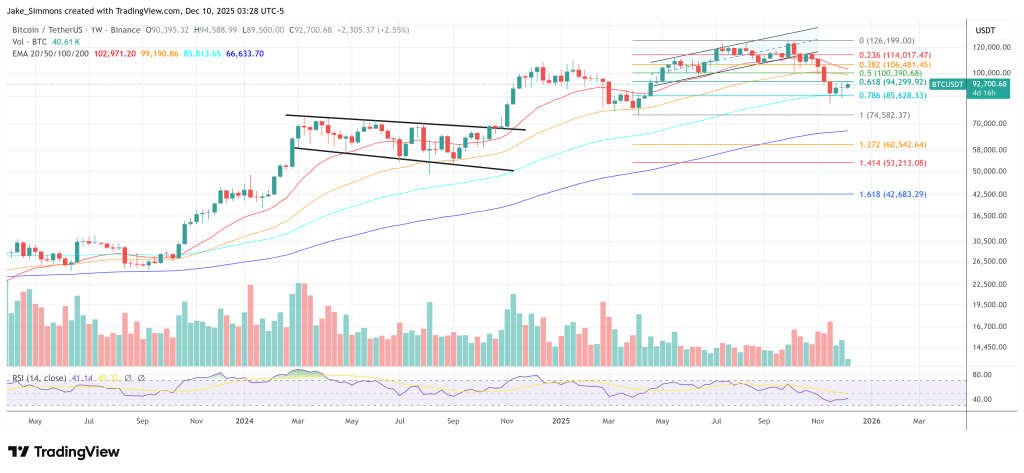
BTC still hovers below the 0.618 Fib, 1-week chart | Source: BTCUSDT on TradingView.com

Related Reads

Eight Years of Turbulence in Web3 Phones: From 'Geek Toy' to Xiaomi's 'Factory Standard'

Web3 Smartphones: An 8-Year Evolution from 'Geek Toy' to Xiaomi's 'Standard Feature' On December 10th, high-performance blockchain Sei announced a partnership with Xiaomi, the world's third-largest smartphone manufacturer. The Sei Foundation will develop a next-gen crypto wallet and DApp discovery platform, which will be pre-installed on Xiaomi's new smartphones for global markets (excluding mainland China and the US). Utilizing MPC technology, the collaboration aims to allow users to log in directly via Google or Xiaomi accounts, eliminating intimidating seed phrases. A pilot stablecoin payment system is also slated for 2026, enabling purchases at Xiaomi's retail stores with tokens like USDC. The journey of Web3 phones began around 2018 with devices like Sirin Labs' Finney and HTC's Exodus 1, which focused on "hardware sovereignty" and extreme security, often featuring physical safeguards or trusted execution environments (TEE). These early attempts, including niche projects like Pundi X's communication-focused BOB phone and Electroneum's low-cost "cloud mining" M1, were commercially unsuccessful due to high costs and poor user experience, remaining confined to tech enthusiasts. Mainstream manufacturers like Samsung cautiously entered the space around 2019, integrating features like the Samsung Blockchain Keystore into flagship models. A notable early example was the "KlaytnPhone" edition of the Galaxy Note 10, which included free KLAY, prefiguring the later "airdrop" model. Luxury brand Vertu and HTC also made attempts, but Web3 functions often remained hidden or mere marketing gimmicks. The market was revitalized in 2023 by the Solana Saga. Initially struggling, it sold out instantly after its included BONK token airdrop exceeded the phone's price, earning it the nickname "dividend phone." This success ushered in a new era of "ecosystem binding" and token incentives. Subsequent models like Solana Chapter 2 (Seeker) refined this model with soul-bound tokens (SBT) to prevent scalping. Competition intensified with the TON ecosystem's $99 Universal Basic Smartphone (UBS), Binance Labs' Coral Phone, and the JamboPhone—a $99 device focused on "learn-to-earn" models in emerging markets. An alternative approach emerged from China Telecom and Conflux's BSIM card, which adds Web3 capabilities to any Android phone via a secure SIM card. The evolution highlights five key shifts: 1) Advanced security is moving from simple TEE to architectures like TEEPIN and MPC; 2) Phones are now gateways to specific ecosystems (e.g., Solana, Aptos, Movement Labs); 3) User growth is driven by airdrops and economic incentives, not just security; 4) The focus has shifted from technical concepts (running a full node) to practical applications like payments; 5) The scale is changing dramatically, as Xiaomi's massive annual shipments could onboard hundreds of millions of users, far surpassing niche manufacturers. The conclusion is clear: the greatest barrier to Web3 adoption is not security but complex user experience. The ultimate goal is for Web3 to become an invisible, seamless feature—like 5G—rather than a marketed label. Solana Mobile proved incentive-driven adoption works, but the partnership between Sei and Xiaomi may demonstrate that experience-driven integration is the sustainable path to bringing Web3 to a billion users.

marsbit1 分前

Eight Years of Turbulence in Web3 Phones: From 'Geek Toy' to Xiaomi's 'Factory Standard'

marsbit1 分前

Institutional Dominance in the Crypto Market: The End of Decentralization or the Dawn of a New Era?

In 2025, institutional investors now account for approximately 95% of cryptocurrency inflows, while retail participation has declined to just 5–6%, marking a structural shift in the market. According to Aishwary Gupta of Polygon Labs, this transition is driven by maturing infrastructure rather than sentiment. Major asset managers like BlackRock and Apollo are allocating portions of their portfolios to digital assets via ETFs and on-chain tokenized products, leveraging blockchain for yield generation and operational efficiency. Gupta highlights that institutional adoption is progressing in two phases: first, through yield-bearing products like tokenized treasuries and regulated staking, and second, via efficiency gains such as faster settlement and programmable assets. While retail interest waned due to meme coin losses, he expects gradual return as more transparent, regulated products emerge. Addressing concerns about centralization, Gupta argues that institutional involvement can enhance blockchain’s without compromising decentralization, provided infrastructure remains open. He envisions a future financial system where DeFi, NFTs, and traditional assets coexist on public chains. Although compliance may limit some experimentation, it fosters more sustainable innovation. Increased institutional participation is expected to reduce volatility and accelerate growth in areas like real-world asset tokenization and cross-chain interoperability. Ultimately, this trend signifies crypto’s evolution from a speculative asset to a core component of global finance.

marsbit15 分前

Institutional Dominance in the Crypto Market: The End of Decentralization or the Dawn of a New Era?

marsbit15 分前

Trading

Spot
Futures
活动图片