Citi's Interpretation: Upgrading China, Downgrading South Korea, Is the Emerging Markets Rally Beginning to Broaden?

marsbit2026-07-20 tarihinde yayınlandı2026-07-20 tarihinde güncellendi

Özet

In its latest emerging markets strategy report, Citi has upgraded China to overweight from neutral, while downgrading South Korea to neutral from overweight. It maintains an overweight rating for China-Taiwan markets. The report sets MSCI EM index targets of 1870 by end-2026 and 2050 by mid-2027, implying further upside of approximately 12% and over 20% respectively from current levels. Citi's move reflects a search for "broadening" opportunities beyond the concentrated rally in AI hardware and tech, which has driven EM gains year-to-date, led by South Korea and China-Taiwan markets. The upgrade for China is based on factors including light investor positioning, potential benefits from lower oil prices, and relative attractiveness in a recovering global growth cycle. While maintaining a strong long-term view on South Korea, Citi notes its recent outperformance and elevated volatility prompted a tactical downgrade. The report highlights that EM earnings revisions remain narrow, with the IT sector contributing about 85% of 2026 EPS estimate upgrades. For a sustained rally, Citi argues that market gains need to broaden to other sectors and regions. China, South Africa, and Mexico rank highly as potential "broadening candidates" based on factors like sensitivity to a weaker dollar, lower bond yields, and oil prices. Key uncertainties include the sustainability of AI capital expenditure returns, geopolitical risks, and Federal Reserve policy. Citi's stance is cautiously optimis...

According to Citi's latest Emerging Markets Strategy report, the bank has upgraded its stance on China equities from Neutral to Overweight, while tactically downgrading South Korea from Overweight to Neutral. It maintains an Overweight on Taiwan-China markets and sets target levels for the MSCI EM Index at 1870 by the end of 2026 and 2050 by mid-2027.

The most immediate market hook of this report is that despite the MSCI EM Index rising approximately 20% year-to-date, Citi still sees room for further upside. From the current level of around 1664 points, 1870 points implies about 12% upside, while the 2050 point target suggests around 20% potential gains by mid-2027.

However, Citi is not betting on a broad-based emerging markets bull run. Gains in EM have been highly concentrated in South Korea, Taiwan-China tech, and the AI hardware supply chain recently, with other countries and sectors not keeping pace. China's upgrade to Overweight stems from Citi beginning to look for 'broadening' candidates beyond the AI chain.
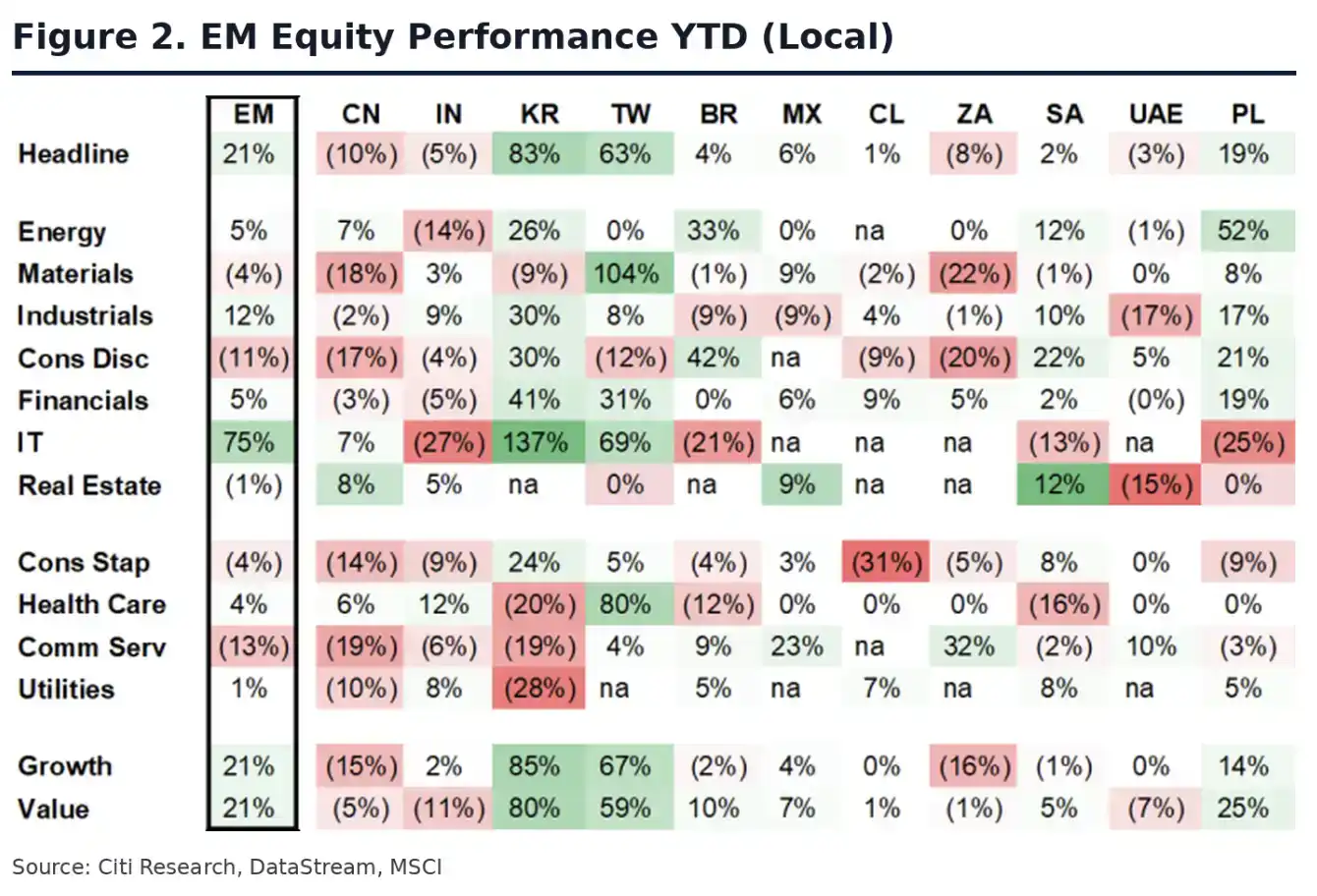
South Korea has delivered nearly 40% positive returns, and Taiwan-China markets over 30%, highlighting the high concentration of this year's EM rally.
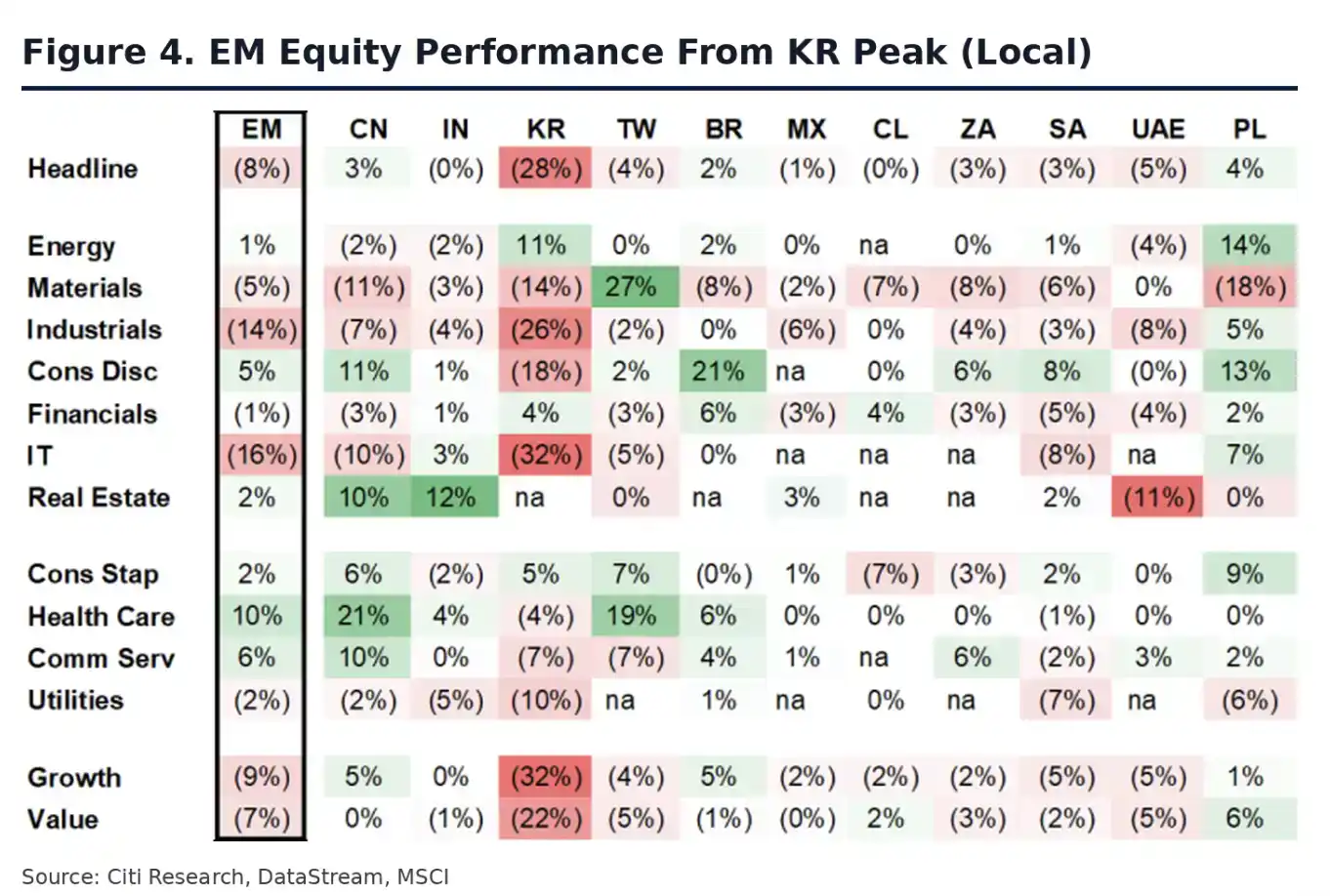
South Korea's pullback and the lack of comprehensive follow-through from other markets.

China Upgraded to Overweight, South Korea Cools Off First

In this round of allocation adjustments, China was upgraded from Neutral to Overweight, and Mexico was raised to Neutral. South Korea was downgraded from Overweight to Neutral, while Taiwan-China markets remain on the Overweight list.

China's appeal primarily stems from three factors. Global investors remain underweight on Chinese stocks, leaving significant room for capital inflows if global risk appetite improves. Falling oil prices benefit energy-importing markets like China. As global growth data improves, some cyclical assets regain support, with China ranking relatively high among macro-sensitive markets in this cycle.

This contrasts with the dominant theme in emerging markets over the past two years. The strongest trades were previously concentrated in the AI hardware supply chain, with South Korea and Taiwan-China markets being the biggest winners due to demand for semiconductors, memory, and AI servers. However, for the index to continue rising, relying solely on a few tech stocks becomes increasingly difficult, requiring funds to find more markets capable of sustaining the rally.

South Korea's downgrade does not equate to a weakening fundamental outlook. Public reports indicate that Citi retains a relatively strong long-term view on the South Korean equity market, with local strategists having previously set a KOSPI target of 10,000 points. According to the source report, the logic includes the potential for memory shortages to persist into 2027, and continued demand growth from AI tokens and customization supporting the memory upcycle. The near-term issue lies in South Korea's outsized prior gains, elevated implied volatility, and the amplification of fluctuations by retail leveraged products.

Taiwan-China markets remain one of the most direct beneficiaries within the AI hardware chain. According to the source report, local strategists have set a mid-2027 target for the Taiwan Weighted Index at 53,500 points. However, this market faces similar issues – trading has become crowded, and volatility often manifests first in these prior winners if greater skepticism emerges regarding the returns on AI capital expenditure.

EM Has Room to Run, Yet Earnings Revisions Remain Narrow

The two specific index targets set by Citi for MSCI EM are the clearest numerical calls in this report: 1870 by end-2026 and 2050 by mid-2027.

The support does not come from significant valuation expansion. The current 12-month forward P/E for MSCI EM is around 11.5x, roughly in line with its long-term average. Following this year's rally in emerging markets, valuations have not been pushed into a clear bubble zone; index gains have come more from improved earnings expectations.

The earnings numbers appear robust. The 2026 EPS growth forecast for MSCI EM reaches 63%, revised up by 28 percentage points cumulatively since late February. Growth is expected to moderate to 24% in 2027, but still remains above comparable assets in developed markets.

The issue is that the source of earnings improvement remains narrow. The Information Technology sector contributed about 85% of the 2026 EPS upward revisions, with South Korean and Taiwan-China AI supply chains still being the primary sources. Revisions for most non-tech sectors like Consumer, Real Estate, and Utilities remain weak. In other words, while the EM index appears supported by earnings on the surface, the upward earnings revisions have not yet broadened out to more industries.
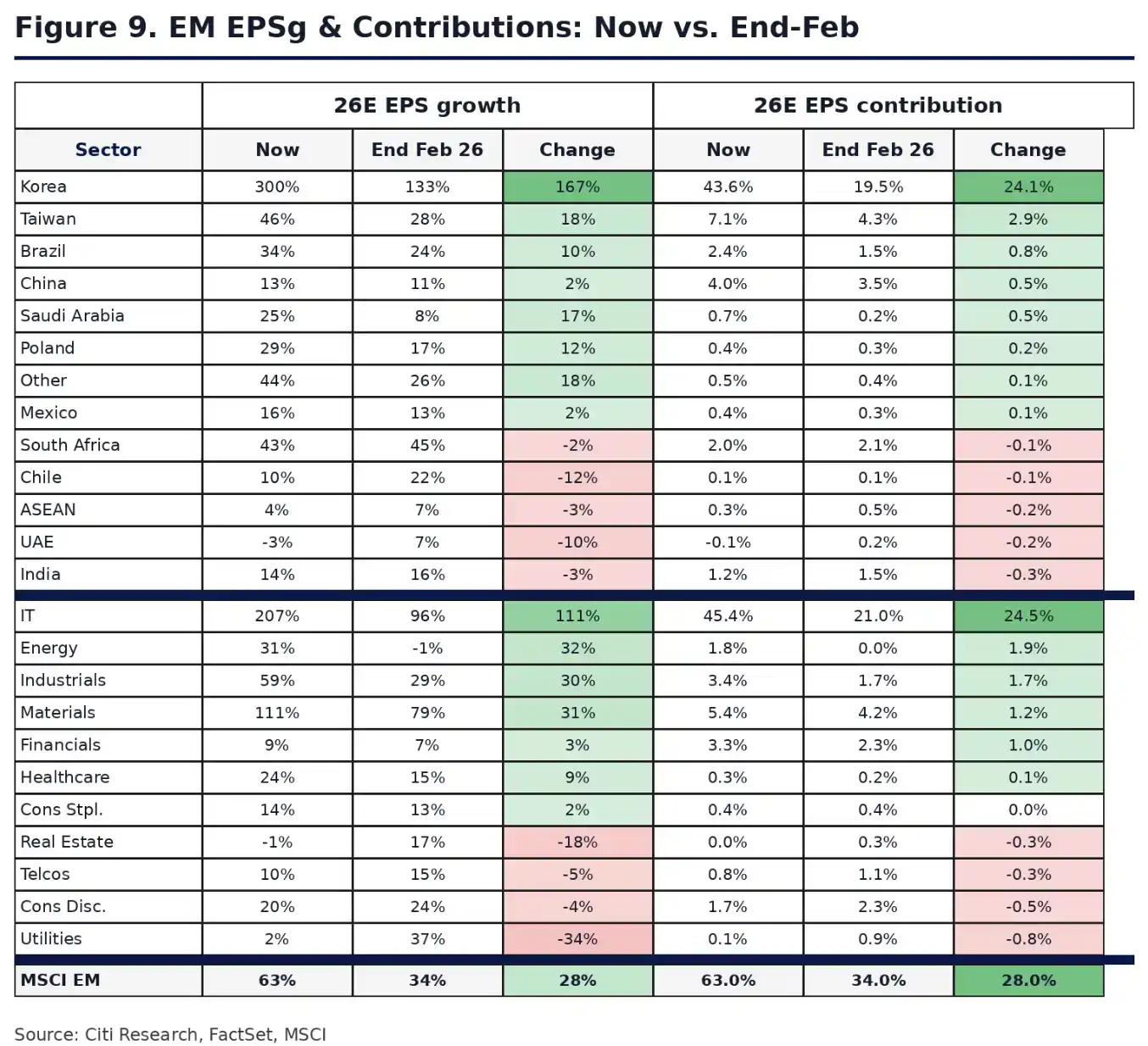
MSCI EM 2026E EPS growth of 63%, with the IT sector contributing roughly 85% of the upward revision magnitude.

This is also why Citi has not upgraded Emerging Markets to an Overweight stance within its global asset allocation framework. It can increase weights to markets like China within the region, but at the global asset allocation level, Emerging Markets remains Neutral. Citi's stance is closer to 'selectively adding exposure to broadening beneficiaries' rather than confirming a full-blown bull market.

The So-Called 'Broadening' Means Momentum Needs to Move Beyond a Few AI Winners

In plain terms, what Citi refers to as 'broadening trades' means this year's emerging market rally cannot continue to rely solely on gains in South Korea, Taiwan-China markets, and the AI chain. Funds either need to find new countries and sectors, or the index's further upside will be constrained.

This screening framework primarily looks at several conditions: whether a market benefits from a weaker US Dollar and declining US Treasury yields, whether it benefits from falling oil prices, its historical performance during improvements in global economic data, whether its near-term earnings revisions are turning positive, and whether its current trading is already too crowded.

Under this framework, China, South Africa, and Mexico rank high. According to the source report, their composite scores in the 'broadening candidate' screen are 4.2, 5.0, and 5.3 respectively. While South Korea and Taiwan-China markets remain recent winners, they face more pronounced issues of near-term crowding and volatility.

Oil prices present a real-world condition. Citi's baseline assumption is that oil averages around $75/barrel in Q3 2026, declining to around $65/barrel by early 2027. Falling oil prices typically benefit energy-importing markets like South Korea, Taiwan-China, India, and China, while posing challenges for some resource-heavy and oil-sensitive markets.
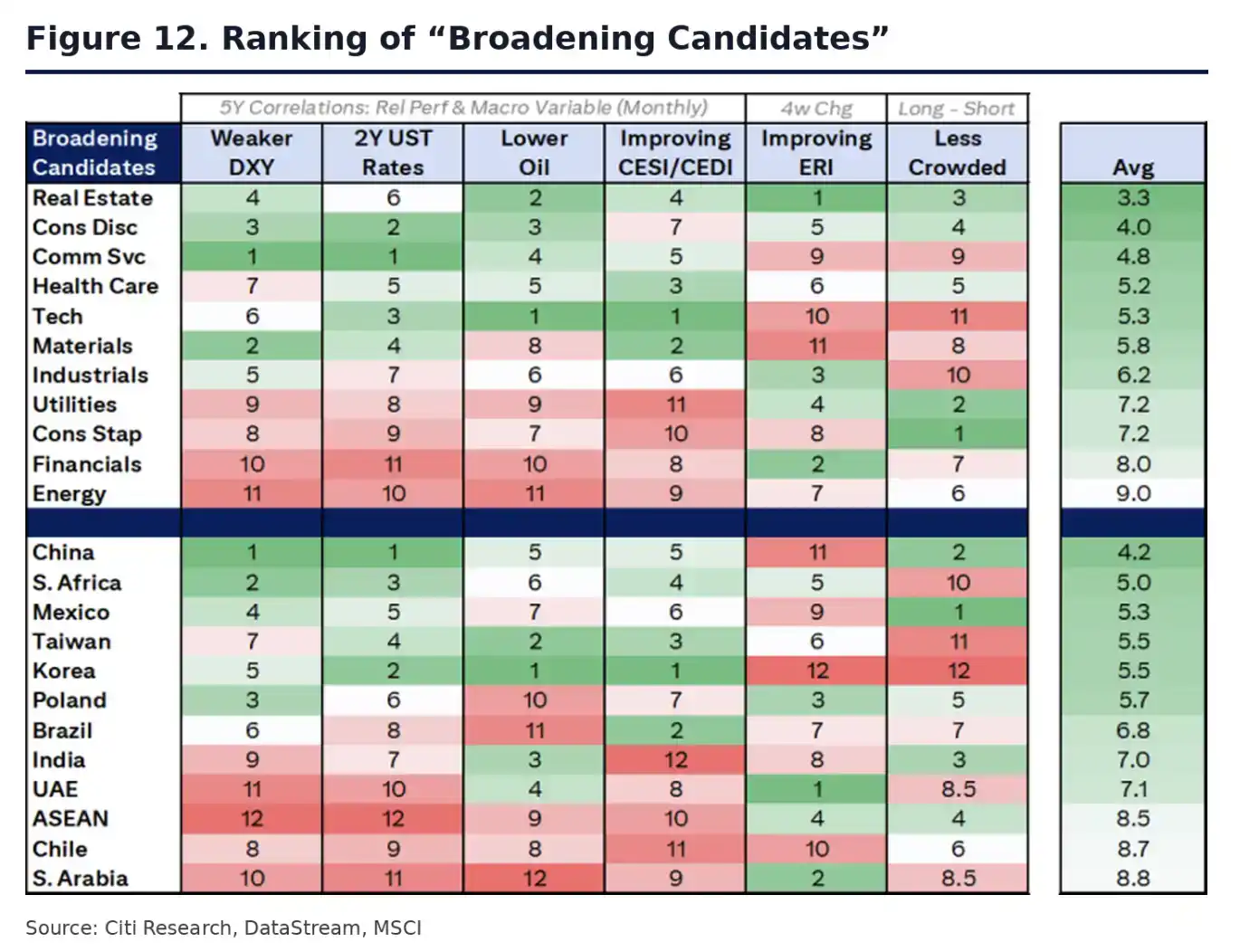
The 'Broadening Candidates' table shows China, South Africa, and Mexico ranking high across dimensions including weak USD, US Treasury yields, oil prices, and crowding.

This context is key to China's upgrade. It is neither this year's strongest performer nor the most crowded trade within the AI hardware chain. However, under the combination of improving global growth, declining oil prices, and room for positioning catch-up, it possesses the conditions to attract rotational flows.

Broadening Not Yet Complete; AI Chain Remains the Biggest Divergence

The cautious aspect of this report is that Citi does not present 'broadening' as an accomplished fact.

This year's EM gains are highly concentrated, with cross-market return dispersion reaching levels among the highest in the past 25 years. South Korean and Taiwan-China tech/AI sectors have contributed almost all the index-level returns. If future earnings revisions remain confined to the IT sector, the so-called broadening looks more like a short-term portfolio rotation rather than a broad-based fundamental improvement.

AI capital expenditure remains the greatest uncertainty. Previously, the market was willing to assign higher expectations to memory, semiconductors, and AI infrastructure due to sustained demand for training and inference pushing compute investment. However, if investors begin to question the returns on this capital expenditure, the prior winners like South Korea and Taiwan-China could face greater pressure.

Macro risks have not disappeared. Renewed geopolitical escalation could push oil prices away from the downward scenario. Fed policy remains a point of divergence; if rate cuts fall short of expectations, the US Dollar and Treasury yields could pressure emerging markets. A potential super El Niño could also bring new inflationary pressures.
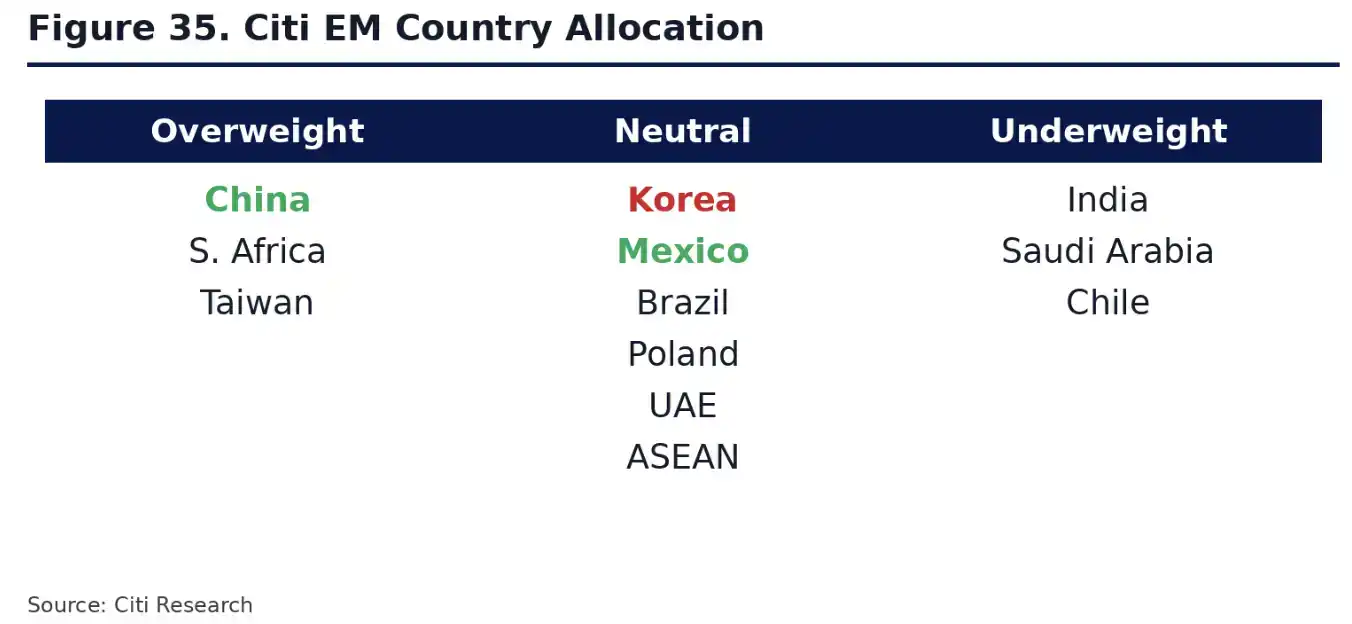
Citi's EM country allocation table shows Overweight positions in China, South Africa, and Taiwan-China markets, with South Korea downgraded to Neutral.

Citi's judgment on emerging markets is more akin to 'the rally has the potential to broaden' rather than 'a full-blown bull market is already confirmed.' China was upgraded because it offers better risk-reward in this potential broadening trade. South Korea was cooled off, indicating that prior winners are not necessarily incapable of further gains, but that their short-term gains and volatility have diminished their near-term appeal.

Whether MSCI EM can reach 1870 or even 2050 points depends not only on how much further the AI chain can rise but also on whether non-tech sector earnings can halt their downward revisions, whether the global cyclical improvement can be sustained, and whether funds are genuinely willing to flow from the few winners to a wider range of markets.


Trend Kriptolar

İlgili Sorular

QWhat were the main changes made by Citi in its emerging market strategy report regarding China and South Korea?

ACiti upgraded China from neutral to overweight and tactically downgraded South Korea from overweight to neutral.

QWhat are the two price targets set by Citi for the MSCI EM Index, and what do they imply in terms of upside?

ACiti set a target of 1870 points for the MSCI EM Index by the end of 2026 and 2050 points by mid-2027. From the current level of approximately 1664 points, this implies an upside of about 12% and 20% respectively.

QWhat is the 'broadening' trade that Citi refers to in the context of emerging markets?

AThe 'broadening' trade refers to the potential for market gains to spread beyond the concentrated winners of the AI hardware chain (like South Korea and Taiwan/China tech) to other countries and sectors, such as China, South Africa, and Mexico, to sustain the index's upward momentum.

QWhat are the primary reasons Citi cites for upgrading China to overweight?

ACiti's reasons for upgrading China include: 1) Overseas investors remain underweight on Chinese stocks, leaving room for reallocation if global risk appetite improves. 2) Falling oil prices benefit energy-importing markets like China. 3) China ranks high among macro-sensitive markets as global growth data improves, supporting some cyclical assets.

QWhy does Citi maintain a neutral stance on emerging markets at the global asset allocation level despite its positive internal adjustments?

ACiti maintains a neutral stance globally because the earnings recovery in emerging markets is still narrow, driven overwhelmingly by the IT sector (especially the AI chain). For a more bullish overweight call, improvements need to broaden to more non-tech sectors and countries beyond the current concentrated winners.

İlgili Okumalar

After Three Consecutive Quarters of Decline, Can the Crypto Market Find a Window for Stabilization in Q3?

The cryptocurrency market has just concluded its worst-performing quarter since 2022, with total capitalization dropping 12.6% to $2.1 trillion. All core metrics indicate capital is leaving the sector, not just rotating within it. Bitcoin fell 14.2% and Ethereum dropped 25.4% in Q2, breaking their previous correlation with US tech stocks. A key driver is the reversal in US spot Bitcoin ETF flows, which saw a net outflow of approximately $4.67 billion in Q2, including a record monthly outflow near $4.5 billion in June. While recent data suggests long-term holders are accumulating again, sustained ETF outflows mean continued selling pressure. Market focus is now singularly on the Federal Reserve. The upcoming July FOMC meeting is seen as the most critical event for Q3. A dovish signal could support Bitcoin reclaiming a $68,000-$84,000 range, while a hawkish stance might establish a new trading band around $50,000-$56,000. Additionally, regulatory uncertainty persists, with the progress of the crucial *CLARITY Act* stalling in the Senate, reducing its perceived 2026 passage probability to 40-45%. Despite the broad downturn, a few sectors showed growth. Prediction markets saw nominal volume surge 48.7% year-over-year to $113.8 billion, and tokenized collectibles transaction volume rose 143% quarterly to $1.4 billion. The Real-World Asset (RWA) tokenization sector also continued steady growth, now representing ~$28.1 billion in on-chain value. The market's foundation for an extreme crash appears limited, with Bitcoin price hovering near its 200-week moving average. However, the trading paradigm has shifted from narrative-driven speculation to decisions based on price action, policy developments, and interest rate expectations, making a broad sentiment-driven rally unlikely in the near term.

marsbit18 saat önce

After Three Consecutive Quarters of Decline, Can the Crypto Market Find a Window for Stabilization in Q3?

marsbit18 saat önce

BIT Trading Moment: BTC Still Suppressed by Weekly 200 EMA, Rejection May Restart Decline; Storage and Semiconductors that Surged Last Night Begin Falling in Evening Trading

**Crypto & Stock Market Wrap: Bitcoin Tests Resistance, Stocks Retreat After AI Surge** Bitcoin consolidates around $66,000, facing key resistance near $68,000—an area seen as a major psychological and technical hurdle where previous rallies have failed. Analysts note the cryptocurrency is caught between its 200-week moving average (~$63,333) and 200-week EMA (~$68,328). A clear break above $68k is needed to signal a stronger bullish trend, while a rejection could lead to a retest of $63k support. Market sentiment remains cautious, with low futures open interest pointing to a low-liquidity rebound rather than a full bull market. Bitcoin spot ETFs saw another $203 million inflow. US stock futures pointed lower after a strong Tuesday session led by a massive rebound in semiconductors and memory stocks. The rally was fueled by renewed optimism about AI-driven hardware demand, with Micron, SanDisk, and SK Hynix surging. However, those gains reversed in pre-market trading. Super Micro Computer (SMCI) soared over 20% after hours on strong guidance and a record backlog. Other standouts included Rocket Lab and nuclear energy plays Oklo and X-Energy. Rising oil prices (Brent above $91) and climbing Treasury yields (10-year near 4.64%), however, are reigniting inflation concerns and acting as a headwind for equities. In Asia, markets were mixed. South Korea's KOSPI pared early gains to close slightly higher as semiconductor stocks like SK Hynix gave back initial surges. Japan's Nikkei edged lower as the yen hit a fresh 38-year low against the dollar, raising fears of potential market intervention. Key events to watch include the Samsung Galaxy launch, AMD's AI event, and a slew of major tech earnings from Alphabet, Tesla, and IBM after the close on Wednesday, followed by the ECB meeting and Intel's earnings on Thursday.

marsbit18 saat önce

BIT Trading Moment: BTC Still Suppressed by Weekly 200 EMA, Rejection May Restart Decline; Storage and Semiconductors that Surged Last Night Begin Falling in Evening Trading

marsbit18 saat önce

Former CFTC Chairman, Circle President Tarbert: Preaching Long-Termism While Cashing Out $30 Million Himself

Former CFTC Chairman and Circle President Heath Tarbert has consistently advocated for a long-term vision in public, urging patience from investors as Circle’s stock price has fallen significantly from its peak. However, it has been revealed that since Circle’s IPO, Tarbert has continuously sold his CRCL shares through pre-arranged trading plans, cashing out approximately $30 million, without making any public market purchases. This contrast between his public messaging and personal actions has drawn criticism. Tarbert joined Circle in July 2023 as Chief Legal Officer, leveraging his regulatory experience to help guide the company through its IPO and expansion. Despite promoting stablecoins as long-term infrastructure, he established a 10b5-1 trading plan just before Circle went public, leading to substantial stock sales over the following year. In March 2026, he initiated another plan to sell more shares. His career trajectory highlights a pattern of moving between high-level regulatory roles and influential positions in the financial sector. After resigning as CFTC Chairman in early 2021, he joined Citadel Securities as Chief Legal Officer just 27 days later, during a period of intense regulatory scrutiny for the firm. He later joined Circle, aiding its efforts to navigate regulatory challenges for its public listing. While Tarbert's expertise in policy and compliance is valuable to companies like Circle, his actions—advocating long-term confidence while personally divesting—raise questions about the alignment between his public statements and his private financial decisions, leaving investors who followed his advice to bear the market risks.

marsbit19 saat önce

Former CFTC Chairman, Circle President Tarbert: Preaching Long-Termism While Cashing Out $30 Million Himself

marsbit19 saat önce

Gate Research Institute: The 'Wall Street-ization' Wave of Crypto Financial Products – Competition or Integration?

The article titled "Gate Research Institute: Are Crypto Financial Products Sparking a 'Wall Street' Wave—Competition or Convergence?" explores the evolving relationship between the crypto ecosystem and traditional finance (TradFi). The piece begins by reflecting on Bitcoin's original 2009 vision of decentralization, disintermediation, and moving away from banks. It then contrasts this with the 2024 landscape, where key crypto assets like Bitcoin are increasingly held through Wall Street products like ETFs issued by giants like BlackRock. The article questions whether this signifies that TradFi is systematically taking over the rights to issue, price, custody, and distribute crypto financial assets. The core argument is that this is not a zero-sum takeover but rather a bidirectional convergence where each side addresses the other's weaknesses. Crypto offers 24/7 global markets, programmable settlement, and open access but lacks compliant channels, institutional-grade custody, deep fiat liquidity, and mainstream distribution. TradFi possesses these but is constrained by legacy systems, limited operating hours, and slow settlement. Two primary convergence paths are highlighted: * **Path A (CEX to TradFi):** Exemplified by Gate, which has progressed from offering tokenized stocks and CFDs to providing direct, real stock trading (US, Hong Kong, South Korea) within its platform, using USDT. * **Path B (TradFi to Crypto):** Exemplified by Robinhood, which has integrated crypto trading, acquired exchanges like Bitstamp, and is moving traditional assets like stocks onto the blockchain via tokenization and its own Layer 2. Both paths are ultimately competing to become the next-generation, unified financial account—a "super account" where users can seamlessly trade cryptocurrencies, stocks, ETFs, RWA (Real World Assets), and tokenized treasury products in one interface. The growth of RWA and tokenized treasuries (e.g., BlackRock's BUIDL) is presented as the asset-layer fusion, providing stable, yield-bearing assets on-chain and acting as a bridge between the two worlds. In conclusion, the "Wall Street-ization" of crypto is framed as a mutual transformation. Decentralized ideals persist in the protocol layer, while at the application layer, a more efficient, global, and accessible unified capital market is emerging from this convergence. The future competition lies not between crypto exchanges and stockbrokers, but between platforms vying to offer the most comprehensive asset coverage, liquidity, and user experience within a single account.

marsbit19 saat önce

Gate Research Institute: The 'Wall Street-ization' Wave of Crypto Financial Products – Competition or Integration?

marsbit19 saat önce

İşlemler

Spot

Popüler Makaleler

$BANK Nedir

Bank AI: Bankacılıkta Devrimsel Bir Adım Giriş Teknolojideki hızlı ilerlemelerin damgasını vurduğu bir çağda, Bank AI, yapay zeka (AI) ve bankacılık hizmetleri kesişiminde yer almaktadır. Bu yenilikçi proje, finansal manzarayı yeniden tanımlamayı, operasyonel verimliliği, güvenlik önlemlerini ve müşteri deneyimlerini AI'nin gücüyle geliştirmeyi hedefliyor. Bank AI yolculuğuna çıkarken, projenin içeriğine, operasyonel dinamiklerine, tarihsel bağlamına ve önemli kilometre taşlarına dalacağız. Bank AI Nedir? Bank AI, yapay zekanın çeşitli bankacılık operasyonlarına entegrasyonunu hedefleyen dönüştürücü bir girişimi temsil etmektedir. Bu proje, süreçleri otomatikleştirmek, risk yönetimi protokollerini geliştirmek ve kişiselleştirilmiş hizmetler aracılığıyla müşteri etkileşimini artırmak için AI'nin yeteneklerinden yararlanmaktadır. Bank AI'nin temel hedefleri şunlardır: Bankacılık Fonksiyonlarının Otomasyonu: AI teknolojilerini kullanarak, Bank AI rutin görevleri otomatikleştirmeyi, insan kaynakları üzerindeki yükü azaltmayı ve verimliliği artırmayı amaçlamaktadır. Geliştirilmiş Risk Yönetimi: Proje, dolandırıcılık ve diğer tehditlere karşı güvenlik önlemlerini güçlendirerek riski tahmin edip tanımlamak için AI algoritmalarını kullanmaktadır. Bankacılık Hizmetlerinin Kişiselleştirilmesi: Bank AI, müşteri verilerini ve davranışlarını analiz ederek, özel finansal ürünler ve hizmetler sunmaya odaklanmaktadır. Müşteri Deneyimini İyileştirme: Chatbotlar ve sanal asistanlar gibi AI destekli çözümlerin uygulanması, kullanıcıların daha insana yakın etkileşimler yaşamasını sağlamayı hedeflemekte, bankalarla etkileşim biçimlerini devrim niteliğinde değiştirmektedir. Bu hedeflerle, Bank AI, bankacılığı daha verimli, güvenli ve kullanıcı odaklı hale getiren önemli bir oyuncu olarak kendini konumlandırmaktadır. Bank AI'nin Yaratıcısı Kimdir? Bank AI'nin yaratıcısı hakkında detaylar bilinmemektedir. Bu nedenle, mevcut bilgilerde belirli bir kişi veya organizasyon tanımlanmamıştır. Projenin başlangıcı etrafındaki anonimlik soruları gündeme getirse de, bunun iddialı vizyonu ve hedefleri üzerinde bir olumsuz etkisi yoktur. Bank AI'nin Yatırımcıları Kimlerdir? Proje yaratıcılarında olduğu gibi, Bank AI'nin yatırımcıları veya destekleyen organizasyonları hakkında da özel bilgiler açıklanmamıştır. Bu bilgiler olmadan, projenin ilerlemesini destekleyen finansal destek ve kurumsal destek hakkında bir çerçeve çizmek zordur. Yine de, böyle yenilikçi bir alanda gelişimi sürdürmek için sağlam bir yatırım temelinin önemi büyüktür. Bank AI Nasıl Çalışır? Bank AI, geleneksel bankacılık çerçevelerinden ayıran benzersiz faktörlere odaklanarak birden fazla yenilikçi alanda faaliyet göstermektedir. İşte temel operasyonel özellikler: Otomasyon: Makine öğrenimi algoritmalarını uygulayarak, Bank AI bankalar içindeki çeşitli manuel süreçleri otomatikleştirir. Bu, operasyonel maliyetleri azaltır ve insan çalışanların daha stratejik faaliyetlere yönelmelerini sağlar. Gelişmiş Risk Yönetimi: Risk yönetimi uygulamalarına AI entegrasyonu, bankaların dolandırıcılık gibi potansiyel tehditleri doğru bir şekilde tahmin etme araçlarıyla donatılmasını sağlar, böylece müşteri bilgileri ve varlıkları güvence altına alınır. Özelleştirilmiş Finansal Tavsiyeler: Müşteri etkileşimlerinden sürekli olarak öğrenerek, AI sistemleri kullanıcı ihtiyaçlarının daha iyi anlaşılmasını sağlar ve finansal kararlar hakkında özelleştirilmiş tavsiyeler sunar. Geliştirilmiş Müşteri Etkileşimleri: AI destekli chatbotlar ve sanal asistanlar kullanarak, Bank AI daha etkileşimli bir müşteri deneyimi sunar, kullanıcıların sorularını hızlı bir şekilde çözmelerine imkan tanır, bekleme sürelerini azaltır ve memnuniyet seviyelerini artırır. Bu operasyonel özellikler, Bank AI'yi bankacılık sektöründe bir öncü olarak konumlandırmakta ve hizmet sunumu ile operasyonel mükemmeliyet için yeni standartlar belirlemektedir. Bank AI Zaman Çizelgesi Bank AI'nin gidişatını anlamak için tarihsel bağlamına bir göz atmak gerekmektedir. Aşağıda önemli kilometre taşlarını ve gelişmeleri vurgulayan bir zaman çizelgesi bulunmaktadır: 2010'ların Başları: AI entegrasyonunun bankacılık hizmetlerine olan ilgisi arttı, bankacılık kurumları potansiyel faydalarını tanımaya başladılar. 2018: Bankaların temel müşteri hizmetleri ve geliştirilmiş güvenlik yönetimi için risk yönetim sistemlerinde chatbotlar gibi AI araçları kullanmaya başlamasıyla AI teknolojilerinin uygulanmasında belirgin bir artış yaşandı. 2023: AI'nin karmaşıklığı artmaya devam etti ve belge işleme ile gerçek zamanlı yatırım analizi gibi daha karmaşık görevler için üretken AI devreye alındı. Bu yıl, AI teknolojisi sayesinde bankaların sahip olduğu yeteneklerde önemli bir sıçrama yaşandı. 2024-Güncel Durum: Bu yıl itibarıyla, Bank AI yükselişte, devam eden araştırmalar ve geliştirmeler bankacılık operasyonlarındaki yetenekleri daha da artırmaya hazırlanıyor. AI uygulamalarının sürekli araştırılması, heyecan verici gelişmelere işaret etmektedir. Bank AI Hakkında Anahtar Noktalar Bankacılıkta AI Entegrasyonu: Bank AI, bankacılık süreçlerini kolaylaştırmak ve kullanıcı deneyimlerini geliştirmek için yapay zekanın benimsenmesine odaklanmaktadır. Otomasyon ve Risk Yönetimi Vurgusu: Proje, rutin görevlerin yükünü azaltmayı amaçlarken, tahmine dayalı analizlerle güvenlik çerçevelerini geliştirmeye büyük önem vermektedir. Kişiselleştirilmiş Bankacılık Çözümleri: Müşteri verilerinden yararlanarak, Bank AI bireysel kullanıcı ihtiyaçlarına yönelik özelleştirilmiş bankacılık hizmetleri sunar. Gelişime Bağlılık: Bank AI, teknolojinin sürekli evrimi ile uyumlu olmasını sağlamak ve güncel kalmak için sürekli araştırma ve geliştirme çabalarına bağlı kalmaktadır. Sonuç Özetle, Bank AI bankacılık endüstrisinde önemli bir adımı temsil etmekte, yapay zekayı kullanarak operasyonel paradigmaları yeniden şekillendirmekte, güvenliği artırmakta ve müşteri memnuniyetini teşvik etmektedir. Yaratıcı ve yatırımcılar hakkındaki bilgi eksikliklerine rağmen, Bank AI'nin net hedefleri ve işlevsel mekanizmaları, devam eden evrimi için güçlü bir temel sunmaktadır. AI teknolojisi gelişmeye ve bankacılık sektörüyle birleşmeye devam ettikçe, Bank AI finansal hizmetlerin geleceğini önemli ölçüde etkilemeye hazır durumda, bankacılıkla olan anlayışımızı ve etkileşim biçimlerimizi geliştirmektedir.

188 Toplam GörüntülenmeYayınlanma 2024.04.06Güncellenme 2024.12.03

$BANK Nedir

BANK Nasıl Satın Alınır

HTX.com’a hoş geldiniz! Lorenzo Protocol (BANK) satın alma işlemlerini basit ve kullanışlı bir hâle getirdik. Adım adım açıkladığımız rehberimizi takip ederek kripto yolculuğunuza başlayın. 1. Adım: HTX Hesabınızı OluşturunHTX'te ücretsiz bir hesap açmak için e-posta adresinizi veya telefon numaranızı kullanın. Sorunsuzca kaydolun ve tüm özelliklerin kilidini açın. Hesabımı Aç2. Adım: Kripto Satın Al Bölümüne Gidin ve Ödeme Yönteminizi SeçinKredi/Banka Kartı: Visa veya Mastercard'ınızı kullanarak anında Lorenzo Protocol (BANK) satın alın.Bakiye: Sorunsuz bir şekilde işlem yapmak için HTX hesap bakiyenizdeki fonları kullanın.Üçüncü Taraflar: Kullanımı kolaylaştırmak için Google Pay ve Apple Pay gibi popüler ödeme yöntemlerini ekledik.P2P: HTX'teki diğer kullanıcılarla doğrudan işlem yapın.Borsa Dışı (OTC): Yatırımcılar için kişiye özel hizmetler ve rekabetçi döviz kurları sunuyoruz.3. Adım: Lorenzo Protocol (BANK) Varlıklarınızı SaklayınLorenzo Protocol (BANK) satın aldıktan sonra HTX hesabınızda saklayın. Alternatif olarak, blok zinciri transferi yoluyla başka bir yere gönderebilir veya diğer kripto para birimlerini takas etmek için kullanabilirsiniz.4. Adım: Lorenzo Protocol (BANK) Varlıklarınızla İşlem YapınHTX'in spot piyasasında Lorenzo Protocol (BANK) ile kolayca işlemler yapın.Hesabınıza erişin, işlem çiftinizi seçin, işlemlerinizi gerçekleştirin ve gerçek zamanlı olarak izleyin. Hem yeni başlayanlar hem de deneyimli yatırımcılar için kullanıcı dostu bir deneyim sunuyoruz.

775 Toplam GörüntülenmeYayınlanma 2025.05.09Güncellenme 2026.06.02

BANK Nasıl Satın Alınır

Tartışmalar

HTX Topluluğuna hoş geldiniz. Burada, en son platform gelişmeleri hakkında bilgi sahibi olabilir ve profesyonel piyasa görüşlerine erişebilirsiniz. Kullanıcıların BANK (BANK) fiyatı hakkındaki görüşleri aşağıda sunulmaktadır.

活动图片