As Channel Dividends Fade, What Can DeFi Protocols Rely On to Resist Giant Harvesting?

marsbitPublished on 2026-06-22Last updated on 2026-06-22

Abstract

The article discusses how major tech companies like Coinbase, Stripe, and Kraken are increasingly acquiring or building their own underlying infrastructure to capture profits, moving away from relying on external DeFi protocols. It uses the example of Coinbase's Base blockchain, which generates sequencing fees for Coinbase from protocols like Morpho that deploy on it. Similarly, Stripe acquired Bridge to capture stablecoin yield instead of paying it to Circle, and Kraken bought NinjaTrader for its derivatives licenses. The core argument is that when channel-based advantages (like user traffic) fade, control over the profit-generating infrastructure becomes critical. While this could lead to a future dominated by a few integrated giants, the article suggests a more balanced outcome is possible. Protocols that have already achieved deep, multi-chain integration and embedded themselves into corporate backends create high switching costs, making them difficult to replace. Examples include Morpho (despite reliance on Base, it's widely deployed) and Uniswap. The piece concludes that the race between institutional expansion and open-source protocol proliferation will ultimately shape the industry's structure.

Author: Thejaswini M A

Compiler: Saoirse, Foresight News

In Goodfellas, Ray Liotta has a line: "Forget about it. Pay me." This line shatters the romantic filter of mafia morality glorified in works like The Godfather, starkly revealing the cold, parasitic, and profit-driven essence of organized crime. Following this similar logic, let's discuss large tech companies.

You control value by controlling profits. To achieve this, you don't even need to build a public blockchain protocol or a project. This is a profit war with no rules. However, we cannot blame companies like Coinbase, Stripe, or Kraken for making such choices.

From the most fundamental business logic, their operations resemble a shrewd real estate play: securing traffic distribution channels first. Now holding the power of these channels, they look down and ask, "Who really holds the pricing power?"

Coinbase built its own blockchain; Stripe spent $11 billion acquiring infrastructure it could have leased; Kraken spent $15 billion acquiring a derivatives trading platform; Apple built the App Store. The logic of this playbook is: let others explore the market and bear the early-stage risks, then acquire the underlying infrastructure once the profitability of the sector becomes sufficiently attractive. The core question this article explores: when traffic distribution channels no longer hold core value, where will the industry head?

Coinbase has 110 million verified users. For years, its lending products offered to users were built on the open-source protocol Morpho, with all protocol fees going to Morpho. Later, Coinbase launched its own Layer 2 blockchain, Base. Morpho chose to deploy on Base solely because Coinbase's massive user base could bring transaction volume. Now, every transaction on Base generates sequencing fees that flow entirely into Coinbase's pockets, not Morpho's.

Base generated $76 million in net sequencing fee revenue in 2024, and $74 million in 2025. Before February 2026, according to a licensing agreement, Coinbase needed to share a portion of revenue with Optimism. But eventually, Coinbase severed the partnership, switched to self-developed underlying architecture, and now keeps the entire $64 million revenue stream. Meanwhile, Morpho remains firmly rooted on Base, developing well with a Total Value Locked (TVL) of $2.5 billion. However, every business processed by Morpho now shares a portion with Coinbase.
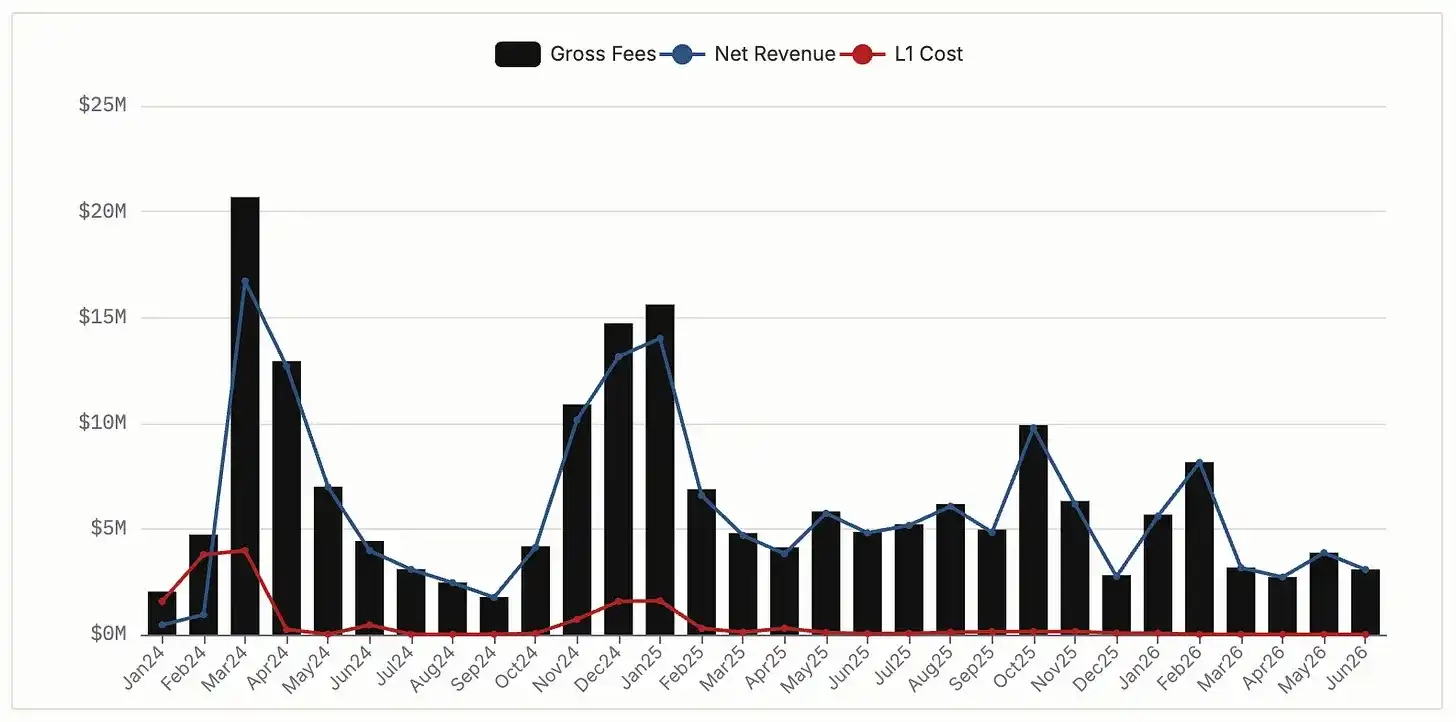
Base Monthly Sequencing Fee Revenue, Data Source: DeFiLlama

Coinbase, relying on Morpho's underlying architecture, launched a $300 million Bitcoin-backed lending product. Its issued wrapped Bitcoin, cbBTC, is the largest collateral asset within Morpho, accounting for 38% of the protocol's total TVL. This creates a mutual interdependence: Morpho holds the underlying core capability of Coinbase's credit products, while Coinbase can extract a revenue share from all of Morpho's business, making it difficult for either side to easily sever the cooperation.

Consider Stripe's case: in early 2025, it spent $11 billion acquiring Bridge. Before that, Stripe's stablecoin business relied on Circle's infrastructure. Circle held the stablecoin issuance rights and earned the floating interest generated by the reserve collateral assets. At that time, all revenue from Stripe's trillion-level stablecoin transactions flowed to Circle. The acquisition of Bridge completely reversed this situation. Bridge issues its own stablecoin, USDB, collateralized by BlackRock money market funds. After switching to USDB, the sizable interest from these reserves remained entirely within Stripe's ecosystem. Stripe's annual payment transaction volume reaches $1.4 trillion; long-term rental of a competitor's profit-generating foundation meant losing hundreds of millions in annual profit.

Patrick Collison once called stablecoins "the room-temperature superconductors of finance." Spending $11 billion to fully own this underlying tool is far more economical than continuously paying tolls to a competitor.

Pure spot exchanges have a natural growth ceiling, with users only able to trade hundreds of tokens. But Kraken wanted to attract institutional investors and sophisticated retail traders, groups that primarily trade via futures and clearing derivatives. Operating a derivatives business requires registration with the U.S. Commodity Futures Trading Commission (CFTC), membership with the National Futures Association (NFA), and broker-dealer licenses. Building this entire compliance system takes years; even building from scratch, regulators could deny approval for various uncontrollable reasons.

This is why Kraken targeted NinjaTrader. The $1.5 billion acquisition in January 2025 brought not only 1.7 million funded trading accounts but, more crucially, directly provided Kraken with the full set of broker-dealer licenses it would have struggled to quickly develop and obtain on its own.

By acquiring ready-made compliance qualifications, Kraken completely freed itself from dependence on external partners. It now fully owns the entire technological system and licenses, needing to rely on no one else nor spend years awaiting regulatory approval.

Some might say: large enterprises swallowing small protocols, isn't that industry norm? What's new here?

Morpho's total TVL is $6.4 billion, with $3.308 billion deployed on Ethereum and $2.488 billion deployed on Base. If Coinbase decided to delist Morpho and use a self-developed lending protocol instead, Morpho would immediately lose 39% of its TVL; but it would still retain 52% on Ethereum, while continuing to expand across multiple chains like Hyperliquid L1, Monad, and Arbitrum, allowing its overall business to operate stably.
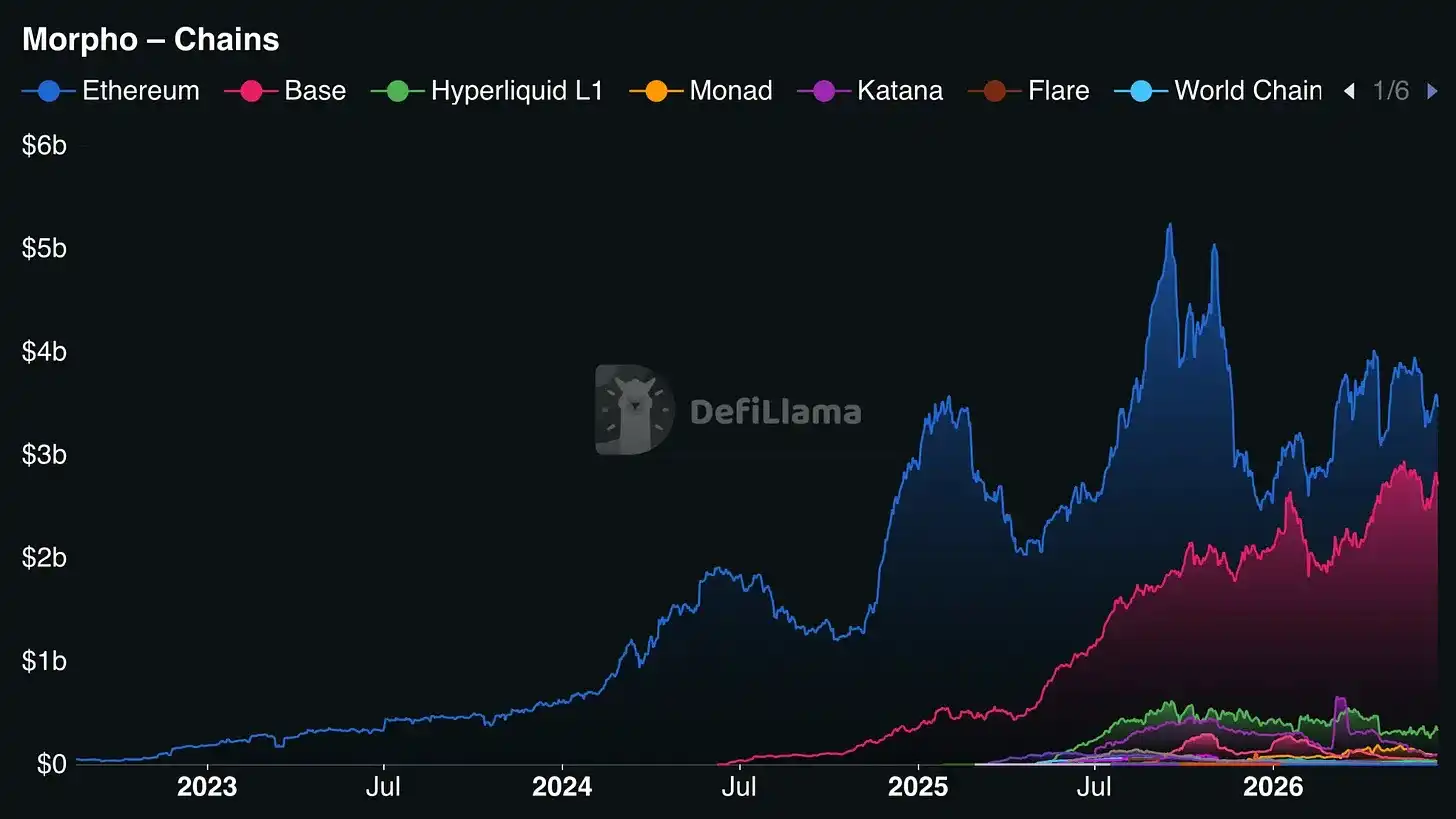
Morpho TVL Distribution Across Chains, Data Source: DeFiLlama

The case of Aerodrome on the Base chain vividly demonstrates the industry impact when a chain operator promotes its own competitor. Aerodrome is Base's native decentralized exchange (DEX), optimized for Base's architecture. Coinbase Ventures holds approximately $20 million worth of AERO tokens, its largest liquidity token investment; meanwhile, the project, through locked AERO token voting, guides liquidity towards Coinbase's products, including cbBTC pools. Aerodrome captures about 51% of Base's DEX trading volume, peaking at 77% in September 2024. Uniswap, deployed across 44 chains, is Base's second-largest DEX, holding 30% trading volume. Even after losing its top position on a single chain, Uniswap did not die: in 2025, it processed $212 billion in volume on Base, with estimated all-chain monthly trading volume around $73 billion.
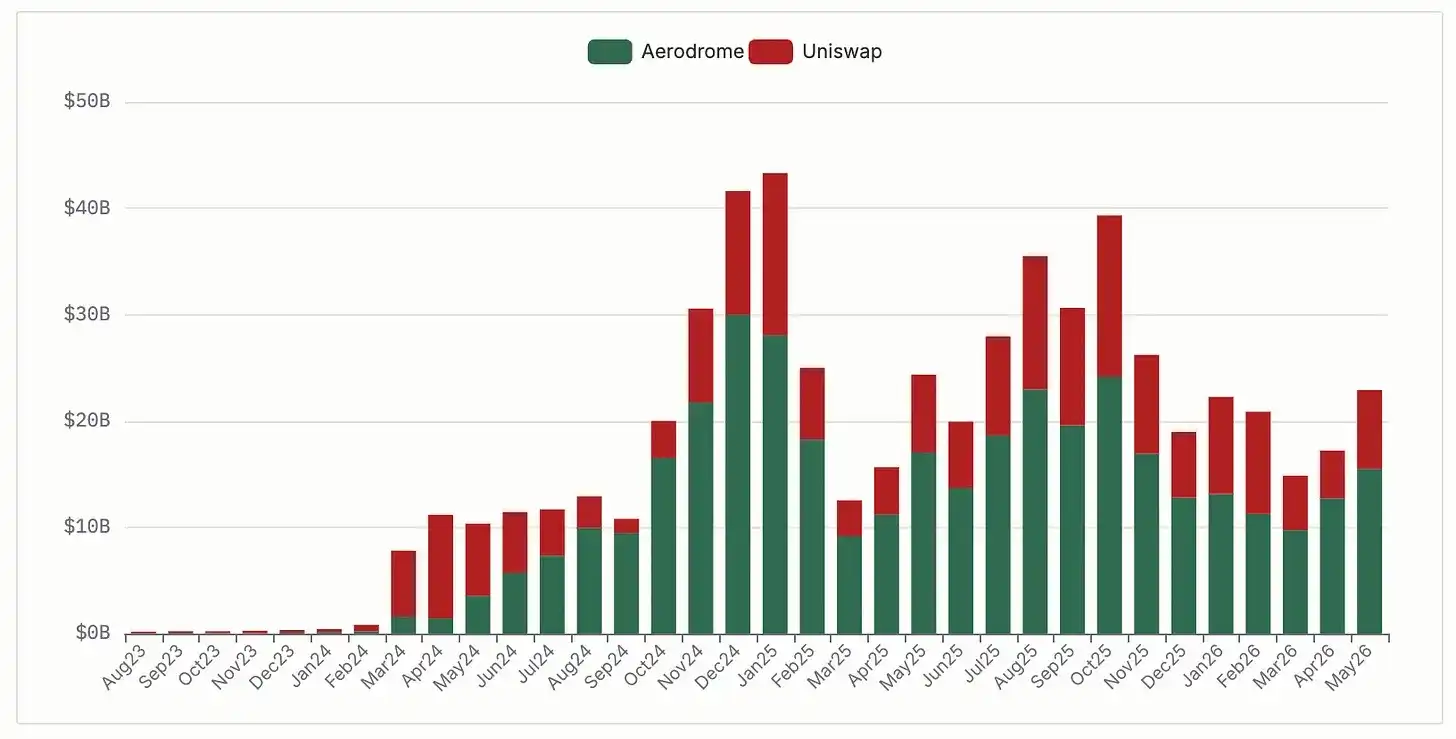
Base DEX Trading Volume Share, Data Source: DeFiLlama

This case confirms that multi-chain deployment is a protocol's natural moat. A project deployed only on a single chain is entirely at the mercy of the chain operator, who can at any time promote a competitor to squeeze its survival space. Conversely, a multi-chain deployed protocol can continue operating normally across other tracks even if it loses one chain's market. After witnessing Uniswap's traffic diversion on Base by Aerodrome, Morpho rapidly expanded its deployment across multiple chains. Large traffic platforms can vertically integrate downwards into the underlying layer, while open-source protocols can horizontally expand across multiple chains to diversify risk.

If you rely on underlying infrastructure you do not own, you do not truly control your business. The party controlling the underlying layer holds overwhelming pricing power over you, can define your product experience, and ultimately influence your operational stability. For companies of this scale, this dependency relation results in tangible profit loss daily. This business logic is not unique to crypto: Amazon built its moat on AWS; Apple, once constrained by Intel's chip roadmap, spent years developing custom chips to break free.

Everyone can check in real-time how much revenue Coinbase earns from Base sequencing fees and clearly view Morpho's TVL across various chains. This value extraction process is entirely transparent, unlike the internal infrastructure profits of traditional internet giants like Amazon.

One potential industry direction is a future market entirely controlled by giants like Coinbase, Stripe, Kraken, and a few banks. They would control the entire industry chain from underlying protocols to payment cards, with open-source protocols merely filling niche gaps the giants haven't yet addressed. This is a fully plausible development path for fintech. Open-source technology would no longer be a free, vast fertile ground for innovation but merely a patch of tape filling tiny crevices in giant enterprises not yet monetized. Like the joke goes: "Look at this high-quality small open-source protocol; let's just build a commercialization system on top of it to harvest the traffic."

However, I lean towards an optimistic view: considering several current acquisition cases, the probability of such complete monopolistic control is not as high as it seems. Underlying protocols are difficult to be exclusively monopolized by giants like traffic channels. Morpho can complete deployment on a new chain in mere weeks; replacing a battle-tested lending protocol deeply embedded in institutional operations incurs extremely high costs, not easily perceptible to outsiders. Coinbase's $300 million Bitcoin lending product still relies on Morpho because replicating Morpho's security system from scratch would take years and introduce security risks Coinbase is unwilling to bear.

Protocols that can survive this wave of giant consolidation share a core condition: completing full multi-chain deployment before traffic giants build their own ecosystems, deeply embedding themselves into major enterprises' backend systems, making the economic cost of replacement prohibitively high. Even Robinhood, a traffic giant with a massive user base, chose to integrate the third-party zero-knowledge proof perpetual contract exchange Lighter as its trading backend. Robinhood Ventures participated in Lighter's $68 million funding round, and founder Vlad Tenev maintains close communication with the project.

If only traffic channels could build moats, Robinhood could have self-developed the entire backend like Coinbase. But it didn't: combining centralized exchange trading speed with zero-knowledge verifiable matching logic is an extremely difficult niche technical challenge; the Lighter team spent over a year solving it. Robinhood calculated that purchasing the right to use mature technology is far more economical than developing from scratch.

Currently, Morpho occupies this favorable position of mutual deterrence, and Uniswap is the pioneer of this path. The speed of institutional expansion and the speed of open-source protocols' horizontal multi-chain expansion are in a game, the outcome of which will determine the direction of the industry landscape.

For now, the underlying operations of giants like Stripe and Coinbase still rely on open-source technology. In the short term, open-source protocols can still stand firm. In two years, we can re-examine the industry landscape.


Trending Cryptos

Related Questions

QWhat is the core issue discussed in the article regarding DeFi protocols and large tech companies?

AThe core issue is how DeFi protocols can survive and compete when large tech companies and centralized platforms (like Coinbase, Stripe, Kraken) that control key distribution channels move to capture the underlying infrastructure and value, extracting fees and potentially replacing the protocols they once relied on.

QAccording to the article, what strategic move did Coinbase make to capture value from protocols like Morpho?

ACoinbase launched its own Layer 2 blockchain, Base. While Morpho deployed on Base to access its user base, all transaction sequencing fees generated on Base flow to Coinbase, not to Morpho, allowing Coinbase to capture value from Morpho's operations.

QHow does the article suggest DeFi protocols like Morpho can build a 'moat' against such centralization pressures?

AThe article suggests that multi-chain deployment is a key defensive moat. By spreading across multiple blockchains (like Ethereum, Arbitrum, Monad), a protocol is not reliant on any single chain operator. If it loses dominance on one chain, its operations on others can sustain it, making it harder for a centralized entity to control its fate.

QWhat example does the article use to illustrate the high cost of replacing a deeply integrated, battle-tested protocol?

AThe article uses Coinbase's own $300 million Bitcoin-backed lending product. Despite having the incentive to replace Morpho, Coinbase continues to use it because replicating Morpho's security and proven system from scratch would take years and introduce unacceptable risks that Coinbase is unwilling to bear.

QWhat contrasting example does the article provide to show that not all large platforms choose to build everything in-house?

AThe article cites Robinhood, which chose to integrate with the third-party ZK-powered perpetual exchange Lighter instead of building its own. Robinhood calculated that licensing the mature, specialized technology from Lighter was more economical than undertaking the difficult and time-consuming in-house development.

Related Reads

After Three Consecutive Quarters of Decline, Can the Crypto Market Find a Window for Stabilization in Q3?

The cryptocurrency market has just concluded its worst-performing quarter since 2022, with total capitalization dropping 12.6% to $2.1 trillion. All core metrics indicate capital is leaving the sector, not just rotating within it. Bitcoin fell 14.2% and Ethereum dropped 25.4% in Q2, breaking their previous correlation with US tech stocks. A key driver is the reversal in US spot Bitcoin ETF flows, which saw a net outflow of approximately $4.67 billion in Q2, including a record monthly outflow near $4.5 billion in June. While recent data suggests long-term holders are accumulating again, sustained ETF outflows mean continued selling pressure. Market focus is now singularly on the Federal Reserve. The upcoming July FOMC meeting is seen as the most critical event for Q3. A dovish signal could support Bitcoin reclaiming a $68,000-$84,000 range, while a hawkish stance might establish a new trading band around $50,000-$56,000. Additionally, regulatory uncertainty persists, with the progress of the crucial *CLARITY Act* stalling in the Senate, reducing its perceived 2026 passage probability to 40-45%. Despite the broad downturn, a few sectors showed growth. Prediction markets saw nominal volume surge 48.7% year-over-year to $113.8 billion, and tokenized collectibles transaction volume rose 143% quarterly to $1.4 billion. The Real-World Asset (RWA) tokenization sector also continued steady growth, now representing ~$28.1 billion in on-chain value. The market's foundation for an extreme crash appears limited, with Bitcoin price hovering near its 200-week moving average. However, the trading paradigm has shifted from narrative-driven speculation to decisions based on price action, policy developments, and interest rate expectations, making a broad sentiment-driven rally unlikely in the near term.

marsbit20h ago

After Three Consecutive Quarters of Decline, Can the Crypto Market Find a Window for Stabilization in Q3?

marsbit20h ago

BIT Trading Moment: BTC Still Suppressed by Weekly 200 EMA, Rejection May Restart Decline; Storage and Semiconductors that Surged Last Night Begin Falling in Evening Trading

**Crypto & Stock Market Wrap: Bitcoin Tests Resistance, Stocks Retreat After AI Surge** Bitcoin consolidates around $66,000, facing key resistance near $68,000—an area seen as a major psychological and technical hurdle where previous rallies have failed. Analysts note the cryptocurrency is caught between its 200-week moving average (~$63,333) and 200-week EMA (~$68,328). A clear break above $68k is needed to signal a stronger bullish trend, while a rejection could lead to a retest of $63k support. Market sentiment remains cautious, with low futures open interest pointing to a low-liquidity rebound rather than a full bull market. Bitcoin spot ETFs saw another $203 million inflow. US stock futures pointed lower after a strong Tuesday session led by a massive rebound in semiconductors and memory stocks. The rally was fueled by renewed optimism about AI-driven hardware demand, with Micron, SanDisk, and SK Hynix surging. However, those gains reversed in pre-market trading. Super Micro Computer (SMCI) soared over 20% after hours on strong guidance and a record backlog. Other standouts included Rocket Lab and nuclear energy plays Oklo and X-Energy. Rising oil prices (Brent above $91) and climbing Treasury yields (10-year near 4.64%), however, are reigniting inflation concerns and acting as a headwind for equities. In Asia, markets were mixed. South Korea's KOSPI pared early gains to close slightly higher as semiconductor stocks like SK Hynix gave back initial surges. Japan's Nikkei edged lower as the yen hit a fresh 38-year low against the dollar, raising fears of potential market intervention. Key events to watch include the Samsung Galaxy launch, AMD's AI event, and a slew of major tech earnings from Alphabet, Tesla, and IBM after the close on Wednesday, followed by the ECB meeting and Intel's earnings on Thursday.

marsbit20h ago

BIT Trading Moment: BTC Still Suppressed by Weekly 200 EMA, Rejection May Restart Decline; Storage and Semiconductors that Surged Last Night Begin Falling in Evening Trading

marsbit20h ago

Former CFTC Chairman, Circle President Tarbert: Preaching Long-Termism While Cashing Out $30 Million Himself

Former CFTC Chairman and Circle President Heath Tarbert has consistently advocated for a long-term vision in public, urging patience from investors as Circle’s stock price has fallen significantly from its peak. However, it has been revealed that since Circle’s IPO, Tarbert has continuously sold his CRCL shares through pre-arranged trading plans, cashing out approximately $30 million, without making any public market purchases. This contrast between his public messaging and personal actions has drawn criticism. Tarbert joined Circle in July 2023 as Chief Legal Officer, leveraging his regulatory experience to help guide the company through its IPO and expansion. Despite promoting stablecoins as long-term infrastructure, he established a 10b5-1 trading plan just before Circle went public, leading to substantial stock sales over the following year. In March 2026, he initiated another plan to sell more shares. His career trajectory highlights a pattern of moving between high-level regulatory roles and influential positions in the financial sector. After resigning as CFTC Chairman in early 2021, he joined Citadel Securities as Chief Legal Officer just 27 days later, during a period of intense regulatory scrutiny for the firm. He later joined Circle, aiding its efforts to navigate regulatory challenges for its public listing. While Tarbert's expertise in policy and compliance is valuable to companies like Circle, his actions—advocating long-term confidence while personally divesting—raise questions about the alignment between his public statements and his private financial decisions, leaving investors who followed his advice to bear the market risks.

marsbit20h ago

Former CFTC Chairman, Circle President Tarbert: Preaching Long-Termism While Cashing Out $30 Million Himself

marsbit20h ago

Gate Research Institute: The 'Wall Street-ization' Wave of Crypto Financial Products – Competition or Integration?

The article titled "Gate Research Institute: Are Crypto Financial Products Sparking a 'Wall Street' Wave—Competition or Convergence?" explores the evolving relationship between the crypto ecosystem and traditional finance (TradFi). The piece begins by reflecting on Bitcoin's original 2009 vision of decentralization, disintermediation, and moving away from banks. It then contrasts this with the 2024 landscape, where key crypto assets like Bitcoin are increasingly held through Wall Street products like ETFs issued by giants like BlackRock. The article questions whether this signifies that TradFi is systematically taking over the rights to issue, price, custody, and distribute crypto financial assets. The core argument is that this is not a zero-sum takeover but rather a bidirectional convergence where each side addresses the other's weaknesses. Crypto offers 24/7 global markets, programmable settlement, and open access but lacks compliant channels, institutional-grade custody, deep fiat liquidity, and mainstream distribution. TradFi possesses these but is constrained by legacy systems, limited operating hours, and slow settlement. Two primary convergence paths are highlighted: * **Path A (CEX to TradFi):** Exemplified by Gate, which has progressed from offering tokenized stocks and CFDs to providing direct, real stock trading (US, Hong Kong, South Korea) within its platform, using USDT. * **Path B (TradFi to Crypto):** Exemplified by Robinhood, which has integrated crypto trading, acquired exchanges like Bitstamp, and is moving traditional assets like stocks onto the blockchain via tokenization and its own Layer 2. Both paths are ultimately competing to become the next-generation, unified financial account—a "super account" where users can seamlessly trade cryptocurrencies, stocks, ETFs, RWA (Real World Assets), and tokenized treasury products in one interface. The growth of RWA and tokenized treasuries (e.g., BlackRock's BUIDL) is presented as the asset-layer fusion, providing stable, yield-bearing assets on-chain and acting as a bridge between the two worlds. In conclusion, the "Wall Street-ization" of crypto is framed as a mutual transformation. Decentralized ideals persist in the protocol layer, while at the application layer, a more efficient, global, and accessible unified capital market is emerging from this convergence. The future competition lies not between crypto exchanges and stockbrokers, but between platforms vying to offer the most comprehensive asset coverage, liquidity, and user experience within a single account.

marsbit20h ago

Gate Research Institute: The 'Wall Street-ization' Wave of Crypto Financial Products – Competition or Integration?

marsbit20h ago

Trading

Spot

Hot Articles

How to Buy RAY

Welcome to HTX.com! We've made purchasing Raydium (RAY) simple and convenient. Follow our step-by-step guide to embark on your crypto journey.Step 1: Create Your HTX AccountUse your email or phone number to sign up for a free account on HTX. Experience a hassle-free registration journey and unlock all features.Get My AccountStep 2: Go to Buy Crypto and Choose Your Payment MethodCredit/Debit Card: Use your Visa or Mastercard to buy Raydium (RAY) instantly.Balance: Use funds from your HTX account balance to trade seamlessly.Third Parties: We've added popular payment methods such as Google Pay and Apple Pay to enhance convenience.P2P: Trade directly with other users on HTX.Over-the-Counter (OTC): We offer tailor-made services and competitive exchange rates for traders.Step 3: Store Your Raydium (RAY)After purchasing your Raydium (RAY), store it in your HTX account. Alternatively, you can send it elsewhere via blockchain transfer or use it to trade other cryptocurrencies.Step 4: Trade Raydium (RAY)Easily trade Raydium (RAY) on HTX's spot market. Simply access your account, select your trading pair, execute your trades, and monitor in real-time. We offer a user-friendly experience for both beginners and seasoned traders.

5.4k Total ViewsPublished 2024.12.07Updated 2026.06.02

How to Buy RAY

Discussions

Welcome to the HTX Community. Here, you can stay informed about the latest platform developments and gain access to professional market insights. Users' opinions on the price of RAY (RAY) are presented below.

活动图片












