ZetaChain 2.0 Launches With Anuma, Bringing Private Memory and AI Interoperability to Creators

TheNewsCryptoPubblicato 2026-01-27Pubblicato ultima volta 2026-01-27

Introduzione

ZetaChain has launched ZetaChain 2.0, introducing Anuma—a privacy-first AI interface and interoperability layer. Anuma brings private, user-owned memory and cross-AI model interoperability to creators, enabling applications to operate across multiple AI models and blockchains without lock-in. Built by core contributor Ankur Nandwani (co-creator of Basic Attention Token), the platform emphasizes user control, encrypted memory, and built-in monetization. ZetaChain 2.0 includes an AI Portal for unified model routing and a Private Memory Layer for secure, permissioned context retention. The release also features an SDK for developers to build privacy-preserving, multi-model AI apps with global payment support. A waitlist for Anuma is now open.

San Francisco, USA, January 27th, 2026, Chainwire

What Brave helped mainstream for private browsing, Anuma brings to AI with private, user-owned memory and AI Portal-based interoperability powered by ZetaChain 2.0.

ZetaChain today announced the beta launch and public waitlist for Anuma, a privacy-first AI interface built on ZetaChain 2.0. ZetaChain also introduced ZetaChain 2.0, a new AI interoperability layer designed to help developers build applications and agents that work across AI models, preserve private user context, and monetize globally without backend infrastructure.

ZetaChain Core Contributor Ankur Nandwani previously co-created Basic Attention Token (BAT), which powers the Brave browser ecosystem with over 100M monthly active users. Brave helped mainstream privacy-first browsing by blocking trackers and ads by default. Anuma applies that same “privacy and user control by default” approach to the next major consumer interface of AI where context and memory increasingly define user experience.

AI adoption is accelerating at internet scale: McKinsey notes that ChatGPT reached 100 million users in two months, and OpenAI has reported 800 million weekly active users by late 2025. Yet the ecosystem remains fragmented, with only 9% of consumers paying for more than one AI subscription across major assistants. This combination creates lock-in at the model layer and forces developers to repeatedly rebuild the same integration, routing, state, and billing infrastructure, while privacy and data are routinely shared across applications, agents, and model providers.

ZetaChain was built to address fragmentation in Web3 by enabling universal apps — applications that can natively access assets like BTC and execute across multiple blockchains through a single platform. In 2025, the ZetaChain network scaled to more than 11.5 million users and processed more than 225 million transactions. With ZetaChain 2.0, ZetaChain is extending this unification thesis to AI so applications can operate across both chains and models, with permissions and private context built in.

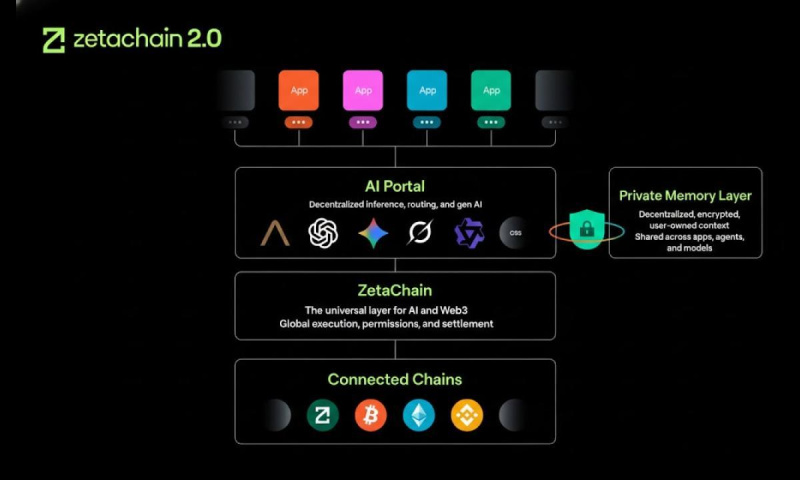
ZetaChain 2.0 is composed of two core components:

  • AI Portal: A unified routing and execution layer that allows applications to access multiple AI model providers without lock-in, with built-in support for availability, fallback, and cost-performance optimization.
  • Private Memory Layer: A protocol-level memory system designed to keep user context encrypted and permissioned, enabling persistent experiences across sessions while maintaining user control over what applications and agents can access.

Developer SDK and Platform

ZetaChain 2.0 is designed to scale as a developer platform. Alongside the protocol components, ZetaChain is releasing a developer SDK that packages private persistent memory, cross-model interoperability, and monetization primitives into a single toolkit. The goal is to make it straightforward to build privacy-first apps and agents that can maintain continuity across sessions, connect to multiple model providers, and support global monetization rails from onchain settlement to traditional payment processors without requiring teams to build bespoke infrastructure.
Anuma: First Consumer Showcase

Anuma is the first consumer AI interface built on ZetaChain 2.0. The product provides access to multiple leading AI models through a single experience, supports switching between models without losing context, and is designed so memory remains private and user-controlled. Users can request early access through the public waitlist.

“Brave and BAT proved that privacy-first defaults can win at consumer scale,” said Ankur Nandwani, Core Contributor at ZetaChain. “We’ve already unified the blockchain experience at scale, powering more than 225 million transactions. ZetaChain 2.0 extends that same approach to AI, enabling the next generation of apps and agents that run across models and chains with private, permissioned memory and global monetization by default.”

In 2023, ZetaChain announced a $27 million funding round with participation from Blockchain.com, Human Capital, VY Capital, Sky9 Capital, Jane Street Capital, VistaLabs, CMT Digital, Foundation Capital, Lingfeng Capital, GSR, and others.

About ZetaChain

ZetaChain is the universal layer for AI and Web3, letting developers build apps that run across chains and models, keep memory private, and monetize without infrastructure. With native connectivity across major blockchains and an AI interoperability stack powered by a Private Memory Layer, ZetaChain is building the foundation for the next generation of apps, agents, and experiences.

Users can follow ZetaChain on X (Twitter) and join the conversation on Discord and Telegram.

Contact

CMO
Jonathan Covey
ZetaChain
jonathan@zetachain.com

Domande pertinenti

QWhat is the core innovation that ZetaChain 2.0 introduces with the launch of Anuma?

AZetaChain 2.0 introduces an AI interoperability layer with two core components: the AI Portal, a unified routing and execution layer for accessing multiple AI models, and the Private Memory Layer, a protocol-level system that keeps user context encrypted and permissioned.

QWho is Ankur Nandwani and what is his previous significant contribution mentioned in the article?

AAnkur Nandwani is a Core Contributor at ZetaChain who previously co-created the Basic Attention Token (BAT), which powers the Brave browser ecosystem with over 100 million monthly active users.

QWhat problem in the current AI ecosystem does ZetaChain 2.0 aim to solve?

AZetaChain 2.0 aims to solve the fragmentation and lock-in in the AI ecosystem, where developers are forced to repeatedly rebuild integration, routing, state, and billing infrastructure, while user privacy and data are routinely shared across applications and model providers.

QWhat are the key features of the Anuma AI interface as the first consumer showcase on ZetaChain 2.0?

AAnuma provides access to multiple leading AI models through a single experience, supports switching between models without losing context, and is designed so that user memory remains private and user-controlled.

QHow did ZetaChain demonstrate its scalability in the Web3 space prior to this announcement?

AIn 2025, the ZetaChain network scaled to more than 11.5 million users and processed more than 225 million transactions, demonstrating its ability to unify the blockchain experience at scale.

Letture associate

Unlocking $100 Million in Liquidity? Pump.fun's New Policy Tests the 5-Minute Pump Technique

Pump.fun, a popular meme coin launchpad, has introduced a new standard mechanism called BOOST. It aims to address a significant capital efficiency issue: when a newly launched token graduates from its initial bonding curve to a liquidity pool (LP), roughly 20% of its liquidity becomes permanently locked as "dead liquidity," estimated to waste over $100 million annually. Instead of locking these funds permanently, BOOST repurposes them. Upon a token's migration, approximately 20% of the settlement funds (e.g., 17.6 SOL or ~$2516 USDC) are used to buy back the token on the open market over a 5-minute period via a Time-Weighted Average Price (TWAP) mechanism. All purchased tokens are immediately burned. This creates a brief, systematic buy pressure immediately after migration, potentially generating a short-term price surge ("pump") while permanently reducing the token's circulating supply. The goal is to enhance the immediate post-launch trading experience, potentially increasing trader retention and sustainable protocol revenue, which funds ongoing token buybacks. However, concerns exist that this artificial 5-minute boost could lower the barrier for launching low-quality tokens and lead to steeper price crashes once the buy pressure stops, if followed by large sell-offs. The feature automatically applies to tokens migrating after July 21, 2024, but not to previously migrated tokens or those launched via the Mayhem AI Agent lab.

marsbit3 min fa

Unlocking $100 Million in Liquidity? Pump.fun's New Policy Tests the 5-Minute Pump Technique

marsbit3 min fa

Podcast Notes | Conversation with GSR Asset Management Head: To Determine if This Crypto Rally is Real, Just Watch the Lending Rates on Aave

Podcast Summary: Dialogue with GSR's Head of Asset Management: To Determine if This Crypto Rally is Real, Just Check Lending Rates on Aave Andy Baehr, Managing Director of Asset Management at GSR, discusses the current crypto market, characterizing it as stuck in a state of "ambivalence" with short-lived, unsustainable rallies. He outlines a simple framework: the market moves between "ambivalence" and "conviction" (sustained upward momentum). Currently, every rally resembles a single-stage rocket booster that quickly fizzles out. Baehr identifies three key signals to watch: 1) DeFi lending rates, 2) the potential passage of the CLARITY Act, and 3) the market forming a consensus on the "Fed hawkish peak." He emphasizes that the most immediate indicator for the sustainability of the recent CPI-triggered rally is the USDC borrowing rate on Aave, currently around 3.75%—close to U.S. Treasury yields. The absence of a credit spread indicates low leverage demand and a lack of market energy. He explains that a healthy, sustained rally requires layered buying pressure. Last year's rally progressed from an ETH short squeeze to crypto-native trader influx and finally to ETF inflows. Currently, this structure is missing. Other potential structural buyers like Digital Asset Treasury (DAT) companies are absent, and ETF flows have proven transient. Baehr notes that while small-cap crypto tokens outperformed large caps in Q2—a potential sign of capitation in major assets—capital is also flowing to more exciting opportunities like AI stocks and tech IPOs, leaving crypto sidelined. Regarding DeFi, he highlights that platforms like Aave provide a clear, real-time signal of leverage demand through their supply/demand-driven interest rates. A significant, sustained rate increase would signal genuine market conviction. He also observes the quiet emergence of fixed-income-like products and vaults in DeFi. On regulation, the probability of the CLARITY Act passing before the August 7th deadline has dropped linearly from 75% to below 40% on Polymarket. Baehr suggests its passage would be treated as a bullish surprise, a potent driver for price movement. However, political hurdles, including ethical clause debates and disclosures about the First Family's crypto profits, remain significant obstacles. Ultimately, the market awaits clarity on the Fed's terminal rate under Chair Warsh. Until the "Fed Solstice"—the point where the market collectively understands the peak of hawkish policy—sustained conviction will be difficult to achieve.

marsbit34 min fa

Podcast Notes | Conversation with GSR Asset Management Head: To Determine if This Crypto Rally is Real, Just Watch the Lending Rates on Aave

marsbit34 min fa

Trading

Spot
活动图片





