Zcash Developers Spin Out New Wallet After ECC Breakup

bitcoinistPubblicato 2026-01-10Pubblicato ultima volta 2026-01-10

Introduzione

Following the breakup of the Electric Coin Company, the team behind Zashi has formed a new Zcash-focused company and is launching a new wallet called "cashZ," built from the existing Zashi codebase. The move aims to scale Zcash to billions of users while maintaining a dedicated focus on the Zcash ecosystem. The team emphasized its commitment to full-stack Zcash development, with no plans to launch new coins. The decision to spin out was driven by three factors: Zcash's cypherpunk roots, governance and incentive alignment, and the need for scalability. The team criticized the current regulatory environment as "a decade of compliance theater," arguing that privacy is a civil-liberties issue requiring assertive leadership. They also highlighted misalignments between nonprofit and for-profit structures, advocating for a governance model free from bureaucratic constraints. The goal is to make Zcash so large that privacy cannot be marginalized. The team cited Zcash's recent resurgence and ecosystem growth, stating, "We are no longer so small they can’t see us. We now need to get so big they can’t stop us." The cashZ wallet is currently accepting waitlist sign-ups, with a full launch expected in a few weeks.

A day after the Electric Coin Company’s breakup, the team behind Zashi said it is spinning out into a new Zcash-focused company and launching a new wallet built from the existing Zashi codebase. The move is framed as an effort to “scale Zcash to billions,” while keeping the group’s work narrowly centered on the Zcash stack.

In a message signed by Josh Swihart, the developers said the new wallet is code-named “cashZ” and will reuse the codebase originally built for Zashi. The team also opened a waitlist for early access, telling existing Zashi users that “all you need to do is join the waitlist” and that a migration will be designed to feel as seamless as the current Zashi experience once cashZ is live “in a few weeks.”

The announcement attempted to answer what it expects will be the community’s first question after an organizational breakup: whether the engineers are still committed to Zcash. “The entire team that worked at Electric Coin Company and built Zashi is still 100% focused on full-stack Zcash development,” the post said. “We aren’t launching any new coins, we’re just scaling Zcash. To do that, it required that we leave and start a new Zcash-focused company.”

Why Zcash’s Core Builders Are Starting A New Company

The team said the decision to form a new company came down to three ideas: Zcash’s cypherpunk roots, governance and incentive alignment, and a need to scale.

In the longest section, the developers cast the past decade of crypto regulation as a kind of prolonged stress test for privacy, describing it as “a decade of compliance theater.” The post argued that privacy-preserving tools are not merely a technical preference but a civil-liberties issue that requires a more assertive posture from the organizations building them.

“This effort was not simply about complying with unjust laws. Of course, we must abide by the law, or else be thrown in a cage,” the message said. “But when the law is unjust, we have a moral imperative to work to change the unjust law. One tool for that is code.”

From that premise, the team connected Zcash’s mission to mainstreaming privacy online, positioning the protocol as “a peaceful global reform movement” and saying that a structure bogged down by internal friction would be poorly suited to that fight. “To do this, we need an organization that has courage,” it added, arguing for “cypherpunk leadership” and a governance model that “can’t cut through red tape.”

A second argument centered on what the post described as chronic misalignment when nonprofits and venture-style startups are intertwined. The team cited recent commentary from Andreessen Horowitz to bolster the idea that crypto’s “foundation era” is ending, while distinguishing the Zcash Foundation as an example of a standalone nonprofit that can do effective work.

The critique was not subtle: “Nonprofits are about rule-lawyering, while tech startups are about rewriting the rules,” the statement said, adding that nonprofit boards often lack the accountability mechanisms of corporate boards. The team also pointed to heightened scrutiny of US nonprofits and the risk of tax exemptions being challenged, arguing there is “no benefit in keeping a fast-growing technology company under a nonprofit when the substance of the organization is a for-profit.”

The final section placed the wallet launch inside a bigger ambition: to make Zcash large enough that privacy becomes difficult to marginalize. It framed the strategic choice as binary: “to be so small they can’t see you, or so big they can’t stop you.”

The post claimed that Zcash has undergone “a complete rebirth” over the past two years, crediting an ecosystem-wide effort and naming contributors including Sean Bowe, genzcash, and Shielded Labs, alongside “many more who prefer to remain unnamed.” That resurgence, it argued, changes the operating environment: “We are no longer so small they can’t see us. Everyone can see us. We now need to get so big they can’t stop us.”

For now, the tangible deliverable is cashZ, with the team promising more details later and signaling that execution will be the message. “Actions will speak louder than words,” Swihart wrote, urging users to join the waitlist as the developers “boot up” the new wallet and push toward what they describe as “onboarding billions to Zcash.”

At press time, the ZEC price recovered some losses from yesterday’s crash and traded at $436.
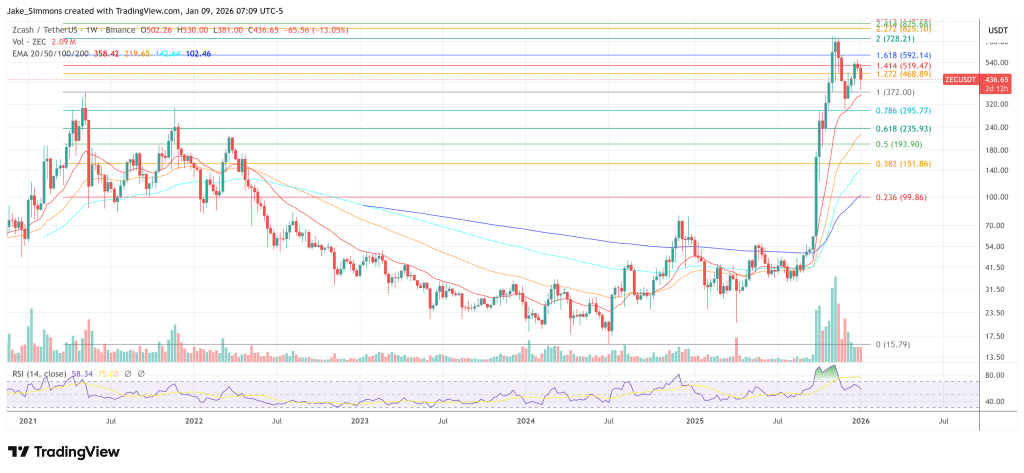
Zcash makes a higher low, 1-week chart | Source: BTCUSDT on TradingView.com

Domande pertinenti

QWhat is the name of the new wallet being launched by the developers after the ECC breakup?

AThe new wallet is code-named 'cashZ'.

QWhy did the team decide to form a new company instead of staying with the Electric Coin Company?

AThe decision was based on three main ideas: Zcash's cypherpunk roots, governance and incentive alignment, and the need to scale Zcash to billions of users.

QAccording to the announcement, what is the team's stance on launching new coins?

AThe team stated they are not launching any new coins and are '100% focused on full-stack Zcash development' with the goal of scaling Zcash.

QWhat did the developers describe as a 'chronic misalignment' in their post?

AThey described a chronic misalignment when nonprofits and venture-style startups are intertwined, arguing that nonprofits are about 'rule-lawyering' while tech startups are about 'rewriting the rules'.

QWhat is the team's stated ultimate goal for the Zcash protocol?

AThe ultimate goal is to make Zcash so large that 'privacy becomes difficult to marginalize,' aiming to onboard billions of users and become 'so big they can’t stop us.'

Letture associate

Dalio Warns: AI Boom Shows Signs of a Bubble, Day of Reckoning Will Be the Time of Burst

Ray Dalio, founder of Bridgewater Associates, warns that the current artificial intelligence investment boom shows classic signs of a bubble, which he expects will eventually burst. In a Bloomberg Television interview, he noted that great technological revolutions often lead to capital inflows that create bubbles, making it difficult for investors and companies to calibrate their spending accurately—either overspending to capture market share or underspending and losing their competitive position. This caution comes amid significant rallies in AI-related assets, particularly chipmakers, driven by soaring demand for data centers and high-bandwidth chips, raising debates about overheating valuations. In contrast, Nvidia CEO Jensen Huang recently asserted that investors embracing the AI wave would see "crazy" returns and dismissed concerns over return on investment for data center spending as outdated. Dalio, however, focuses on the risks in the profit realization phase. He argues that bubbles tend to show signs of破裂 when markets transition from investment to the need for tangible returns, describing the burst as a process of converting paper wealth into cash. While acknowledging AI's intrinsic value, he expressed concern over the future profitability of some AI companies, suggesting the market is repeating a familiar pattern. The 76-year-old billionaire, who fully exited Bridgewater in 2025, has a net worth estimated at $21.5 billion according to the Bloomberg Billionaires Index.

marsbit5 min fa

Dalio Warns: AI Boom Shows Signs of a Bubble, Day of Reckoning Will Be the Time of Burst

marsbit5 min fa

Privacy Coin Crisis of Confidence! ZEC Plunges Over 56% in a Single Day

Zcash (ZEC), a leading privacy-focused cryptocurrency, experienced a severe crash on June 5th, plummeting over 56% in a single day and erasing nearly two months of gains. The flash crash was triggered by the disclosure of a critical zero-knowledge proof vulnerability within Zcash's Orchard privacy pool, which had existed since the pool's launch in May 2022. The flaw theoretically allowed an attacker to forge unlimited ZEC undetectably due to the pool's privacy features. The vulnerability was discovered on May 29th by independent security researcher Taylor Hornby during a proactive audit commissioned by Shielded Labs, utilizing AI-assisted analysis. The Zcash development team responded swiftly, implementing an emergency soft fork to disable Orchard transactions on June 2nd and executing a permanent hard fork fix (NU6.2) on June 3rd. Despite the technical fix, a major crisis of confidence emerged. The core issue is that Orchard's privacy design makes it cryptographically impossible to prove whether the vulnerability was exploited over the past four years, casting permanent doubt on the historical supply integrity of ZEC. While Shielded Labs argues exploitation was unlikely, the inability to provide definitive proof has severely damaged market trust. This sentiment was exacerbated when BitMEX co-founder Arthur Hayes, a prominent ZEC supporter, announced he was selling his entire position. He stated that privacy assets require "perfect security" rather than "probable safety." The combined effect of the disclosure and Hayes's exit ignited widespread panic selling, leading to massive liquidations and significant price decline. Analysts note the event highlights a fundamental tension within privacy coins: the conflict between verifiable supply and cryptographic privacy.

链捕手8 min fa

Privacy Coin Crisis of Confidence! ZEC Plunges Over 56% in a Single Day

链捕手8 min fa

Trading

Spot
Futures
活动图片