Zcash Developer Rift: Entire ECC Team Walks Out Of Bootstrap

bitcoinistPubblicato 2026-01-09Pubblicato ultima volta 2026-01-09

Introduzione

The entire Electric Coin Company (ECC) team behind Zcash has left the nonprofit Bootstrap, citing a governance breakdown. ECC CEO Josh Swihart stated the team was constructively discharged by a majority faction of the board (Zaki Manian, Christina Garman, Alan Fairless, and Michelle Lai), making their work untenable. The ECC team will form a new company but will continue building on Zcash, stressing the protocol itself is unaffected. Zcash founder Zooko Wilcox reassured users the network remains secure and operational. Bootstrap's board responded that the dispute was not about Zcash's mission but about legal and fiduciary obligations as a nonprofit. They were negotiating a deal involving Zashi and argued the proposed structure introduced legal and political risks to the ecosystem. The conflict caused ZEC's price to drop by 13%.

The entire Electric Coin Company (ECC) team behind privacy coin Zcash has left Bootstrap, a nonprofit created to support the token, after what ECC CEO Josh Swihart described as a governance breakdown that made the team’s work untenable. Swihart said the team will form a new company and continue building on Zcash, while stressing that the protocol itself is unaffected.

A Zcash Civil War In The Making?

In a statement posted to X, Swihart said that “over the past few weeks, it’s become clear that the majority of Bootstrap board members ... have moved into clear misalignment with the mission of Zcash,” naming Zaki Manian, Christina Garman, Alan Fairless, and Michelle Lai, which he referred to collectively as “ZCAM.”

Swihart framed the departure as a response to employment changes imposed by the board majority. “Yesterday, the entire ECC team left after being constructively discharged* by ZCAM,” he wrote. “In short, the terms of our employment were changed in ways that made it impossible for us to perform our duties effectively and with integrity.”

The exit represents a sharp escalation in tensions inside one of the support structures surrounding Zcash, a network that has historically relied on a small number of specialist organizations to fund and coordinate development. Swihart did not provide specific details on the governance actions or employment terms at issue, but portrayed the split as a defensive move to protect Electric Coin Company’s ability to execute its mandate.

“We’re founding a new company, but we’re still the same team with the same mission: building unstoppable private money,” Swihart said. He emphasized that “the Zcash protocol is unaffected,” adding that the decision was “simply about protecting our team’s work from malicious governance actions that have made it impossible to honor ECC’s original mission.”

Zooko Wilcox, the founder of Zcash said the conflict does not involve him or Shielded Labs, also sought to separate the organizational dispute from the operational status of the network. “Big drama in one (or two now?) of the many Zcash support orgs,” he wrote on X, before offering reassurance to users.

“The Zcash network is open source, permissionless, secure, and private, and nothing that happens in this conflict can change that,” Zooko said. “You can safely continue to use Zcash.”

In a second point, Zooko offered a character reference for the board members named by Swihart, highlighting how personal trust and long-running working relationships can factor into ecosystem governance disputes. “I’ve worked closely with Alan Fairless, Zaki Manian, and Christina Garman for more than 10 years, through many intense and difficult situations, and with Michelle Lai for about 5 years,” he wrote. “Based on my experiences, I believe them all to be people of exceptionally high integrity.”

Bootstrap Board Responds

[UPDATE:] After Swihart’s post, Bootstrap’s board issued its own statement tying the dispute to governance and legal constraints around a proposed transaction involving Zashi, describing the fallout as a disagreement over structure rather than over Zcash’s underlying mission. “We are saddened by this outcome and respect the contributions of those who have chosen to depart,” the board wrote, before adding that “it’s important to clarify the nature of the disagreement.”

Bootstrap said it was formed as a 501(c)(3) public-benefit nonprofit with “specific legal and fiduciary obligations” governing how assets, intellectual property, and transactions can be structured. According to the board, it had been discussing “external investment and alternative structures to privatize Zashi,” while working with legal counsel to ensure any path forward complied with US nonprofit law and preserved the long-term Zcash mission.

“There is nothing wrong with for-profits,” the statement said, adding that a well-executed effort could bring “a large amount of outside capital into making Zcash and privacy great and user-friendly,” but emphasizing that “Bootstrap/ECC’s nonprofit constraints are real.”

The board warned that the most recent version of the proposed deal could create legal and political risk for the broader ecosystem, arguing it “introduces new vulnerabilities for politically-motivated attacks on Zcash.” It cited the possibility of donor lawsuits and even an unwinding scenario in which “Zashi would have to be transferred back to ECC,” framing those tail risks as a threat not just to the parties involved but to “the entire Zcash ecosystem.”

In that context, the statement cast the standoff as a compliance issue: “This is not a disagreement about Zcash’s mission, which remains unchanged,” the board wrote. “It is about compliance with the legal and fiduciary obligations of a 501(c)(3), and about the moral imperative of ensuring Bootstrap’s assets remain dedicated to the mission they were meant to serve.”

At press time, the ZEC price was strongly affected by the drama, trading at $408.57.
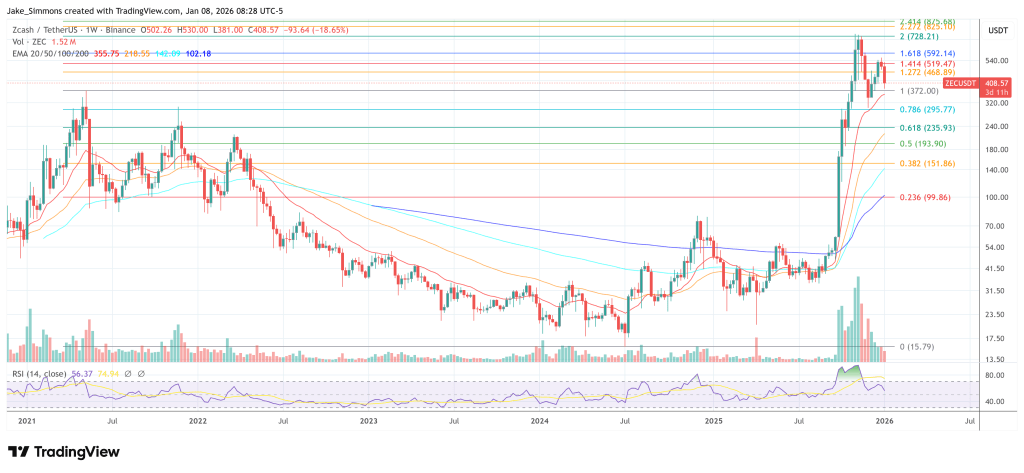
ZEC price crashes by 13%, 1-week chart | Source: ZECUSDT on TradingView.com

Letture associate

Within Strategy's Framework, STRC's Dividend Yield Remains at 12% as Share Price Stays Below Par Value

Michael Saylor, Executive Chairman of Strategy (MSTR), confirmed that the dividend rate for its STRC perpetual preferred shares will remain at 12.00% through August 2026. The rate has increased from 9% at its July 2025 launch to the current high via a "ratchet" mechanism, which permanently raises the rate by 0.5% whenever the share price falls below $95. This mechanism is intended to push the price back toward its $100 par value and support Strategy's "at-the-market" (ATM) program for issuing new shares to fund Bitcoin purchases. However, the mechanism has not worked as intended. STRC shares closed at $89.46 on July 31, remaining about 10-11% below par value despite the record-high dividend. Competition from rival Strive's higher-yielding SATA securities has pressured demand. The persistent discount has forced Strategy to suspend new STRC issuances via its ATM program, limiting this funding channel for Bitcoin acquisitions. STRC's struggles reflect Bitcoin's own volatility, as the preferred shares historically move in tandem. Analysts have warned the ratchet structure carries long-term, one-way risk. A law firm is investigating Strategy's ability to maintain dividend payments if Bitcoin's price stays low. Retail investors own roughly 83% of outstanding STRC shares, a group seen as prone to panic selling during downturns. In response, Strategy has established financial reserves, including a liquidity cushion covering about 26 months of dividend/interest obligations, and a $2 billion share buyback program alongside a Bitcoin monetization framework, though the company emphasized it is not obligated to sell any Bitcoin.

cryptonews.ru2 min fa

Within Strategy's Framework, STRC's Dividend Yield Remains at 12% as Share Price Stays Below Par Value

cryptonews.ru2 min fa

Analyst: Bitcoin's Price Will Drop to $60k in August, Then Rebound to $70k

Financial analyst Andrey Poroshin has provided a new forecast for Bitcoin's price dynamics in August. Poroshin, an analyst at the Bitbanker exchange, expects the cryptocurrency market to experience a downturn this month, with prices retesting the $60,000 level due to a lack of supportive macroeconomic catalysts. He noted that the recent US Federal Reserve decision to hold interest rates did not significantly impact the market, while inflation remains above the 2% target. Poroshin stated that Bitcoin is ending July under pressure from moderate volatility and a lack of new macroeconomic stimuli, leading to continued market caution. According to his base scenario, Bitcoin will drop to a range of $60,000 to $62,000 before recovering to $70,000. He pointed out that even $70,000 remains below the cost of mining in the US, which has prompted some miners to shift towards AI data center operations. Poroshin cited the winding down of BitMEX's operations as a potential catalyst for a price rebound, suggesting the exit of weaker players often coincides with market reversals and reduced short-term selling pressure. He believes Bitcoin is currently less susceptible to geopolitical shocks, such as the Iran-US conflict, and does not expect significant market changes in August related to the pending CLARITY Act. Looking ahead, Poroshin forecasts that September will bring more active price fluctuations driven by potential Fed rate decisions and possible discussions or approval of the CLARITY Act.

cryptonews.ru2 min fa

Analyst: Bitcoin's Price Will Drop to $60k in August, Then Rebound to $70k

cryptonews.ru2 min fa

In Jinjiang, Fujian, a Storage Super Unicorn Lies Quiet

In Fujian's Jinjiang, a city known for sportswear, lies a quiet semiconductor giant: Fujian Jinhua Integrated Circuit Co. (JHICC). Once a promising domestic DRAM manufacturer alongside Yangtze Memory and ChangXin Memory Technologies (CXMT), its journey was derailed in 2018 when the U.S. placed it on an Entity List and filed criminal charges for alleged trade secret theft. This halted production for years. A turning point came in February 2024 when a U.S. federal court found JHICC not guilty. However, it had lost crucial time. While CXMT soared to become a top-valued A-share company in 2024, JHICC, with an estimated valuation of 80 billion RMB, was just restarting. Its current output is primarily customized DDR4 chips, not the advanced DDR5/HBM demanded for AI, but it still benefits from the broader memory chip upcycle. JHICC's story is tied to Chen Zhengkun, a veteran engineer who left Micron to lead the venture. Founded in 2016 with state-backed funding, JHICC partnered with Taiwan's UMC to develop DRAM technology. Rapid progress was cut short by the U.S. actions, which Micron initiated, partly due to its heavy reliance on the Chinese market. Post-sanctions, Chen's team worked to rebuild the production line with reduced reliance on U.S. technology. According to its records, JHICC achieved small-scale production and revenue growth under immense pressure. It now focuses on the stable "niche" DRAM market (e.g., TVs, routers) with a monthly capacity of ~40,000 wafers, aiming for 60,000 by 2026. It holds over 1,000 patents but remains on the Entity List. For Jinjiang, investing in JHICC was a bold industrial leap. The local government provided unwavering financial and logistical support during the crisis, helping the company survive. JHICC has become the anchor for a growing local semiconductor cluster. Though its scale lags behind domestic peers, JHICC's persistence symbolizes a hard-won foothold in a global market long dominated by Samsung, SK Hynix, and Micron. Having missed one boom, it seeks a place in the new AI-driven memory supercycle.

marsbit2 h fa

In Jinjiang, Fujian, a Storage Super Unicorn Lies Quiet

marsbit2 h fa

Trading

Spot
活动图片





