XRP treasury filing signals institutional push – Can demand sustain the shift?

ambcryptoPubblicato 2026-03-21Pubblicato ultima volta 2026-03-21

Introduzione

Ripple's XRP treasury strategy is gaining institutional momentum as Evernorth Holdings moves toward a Nasdaq listing via a SPAC merger. The company plans to hold 473 million XRP, supported by SBI Holdings and Pantera Capital, and aims to generate yield through lending, DeFi, and validator activities—shifting from passive holding to active management. However, while the model draws inspiration from MicroStrategy’s Bitcoin treasury approach, XRP faces challenges in institutional adoption and capital flow compared to Bitcoin. Recent on-chain data shows significant whale outflows and large transfers, suggesting possible accumulation but also highlighting the need for sustained demand to support price stability and growth.

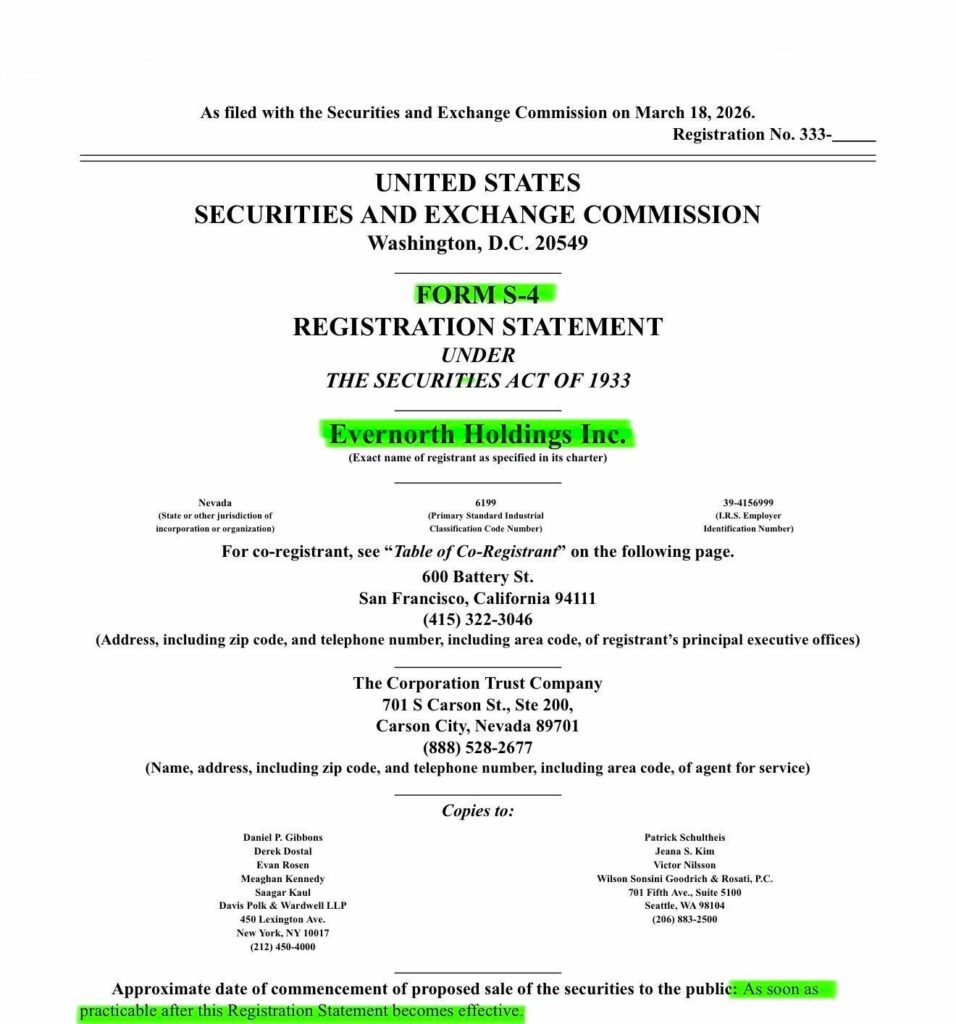
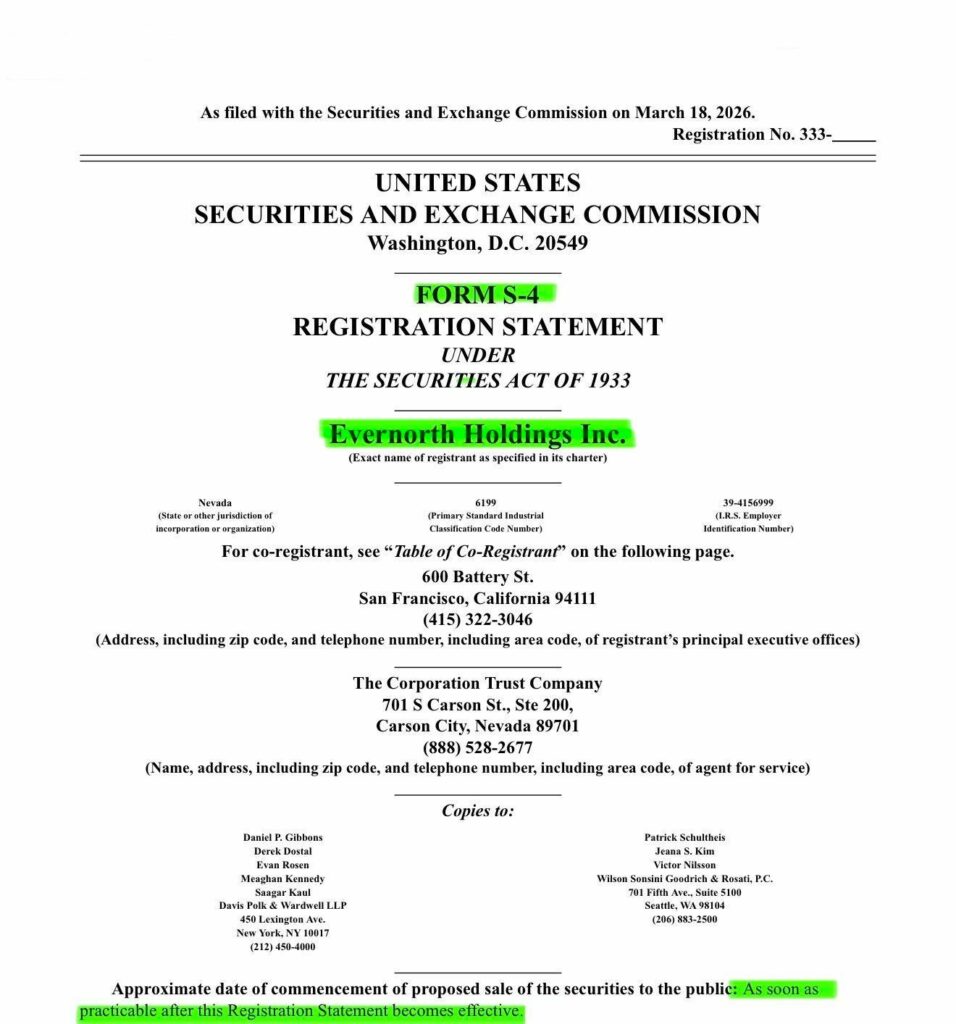
Armada Acquisition Corp. II filed the S-4 to register its proposed merger with Evernorth Holdings, moving the Ripple [XRP] treasury deal closer to market approval. As this process advances, the filing will set the legal path for Evernorth to enter public markets through a Nasdaq listing under XRPN.

Building on this, Evernorth targets holding about 473 million XRP at launch, forming a sizeable treasury base. Backing from SBI Holdings and Pantera Capital strengthens capital credibility, while leadership from Asheesh Birla adds operational depth.
Source: X

From here, the strategy shifts towards application, using lending, DeFi yields, and validator participation to grow XRP per share.

As this model unfolds, it moves beyond passive holding towards active yield generation, hinting at a new institutional framework that markets are yet to fully price in.

Evernorth’s XRP treasury model faces Bitcoin’s institutional benchmark

Evernorth’s XRP treasury model takes cues from MicroStrategy’s Bitcoin approach. And yet, the structure differs in depth and market positioning. Strategy holds 761,068 BTC worth about $53.9 billion, while its multiple to Net Asset Value (mNAV) ranges between 0.96x and 1.18x – A sign of strong conviction.

On the contrary, XRP’s price was trading near $1.45 with daily volume around $2.3–$2.4 billion – Evidence of steady liquidity, but lower institutional preference. As Bitcoin continues to dominate treasury allocations, XRP captures a smaller share of capital flows.

Building on this, Evernorth’s plan to raise over $1 billion introduces a new entry point for XRP exposure. However, the model also relies on developing a stronger narrative beyond payments.

As liquidity remains deep and reserves gradually decline, XRP can absorb demand. However, sustained strength will depend on consistent inflows rather than short-term capital bursts.

XRP outflows rise as whales reposition

As institutional positioning around XRP builds, on-chain flows have begun to reflect how capital is moving beneath the surface.

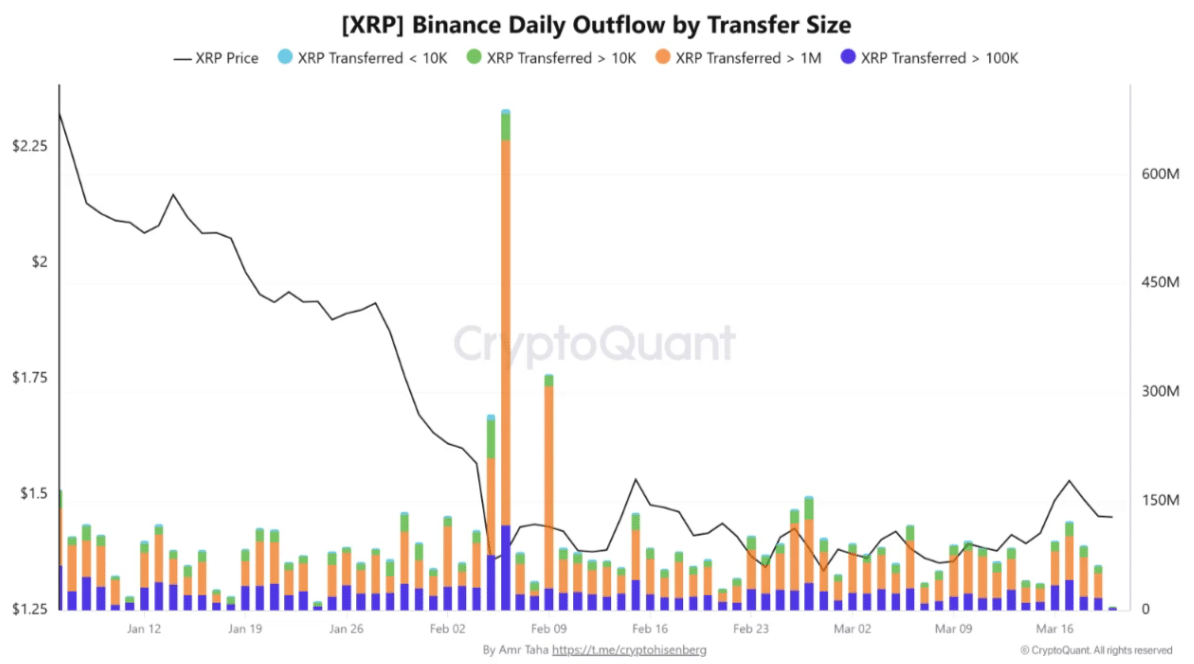
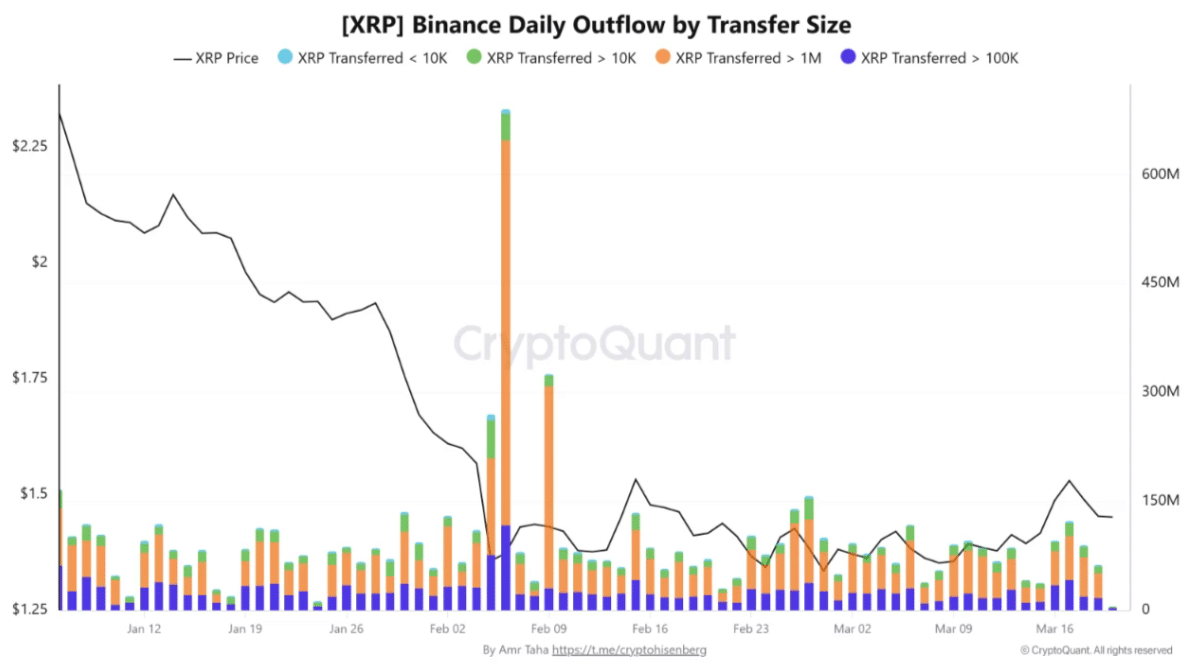
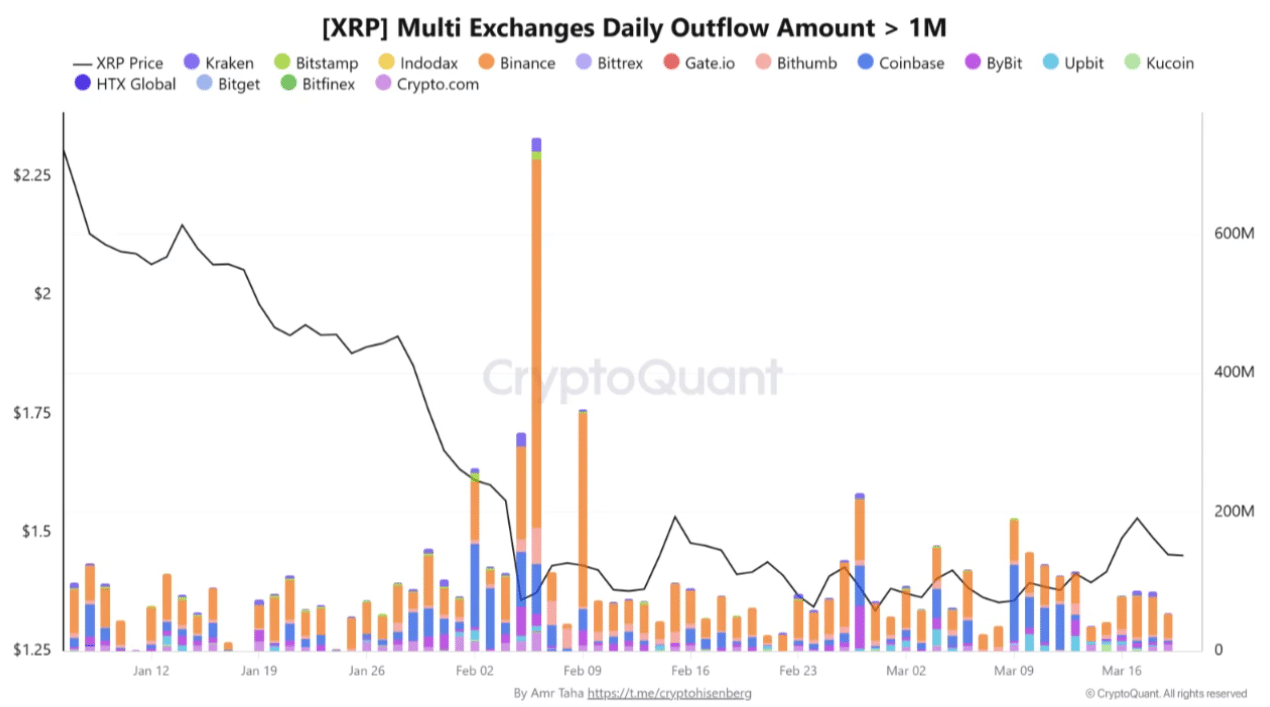
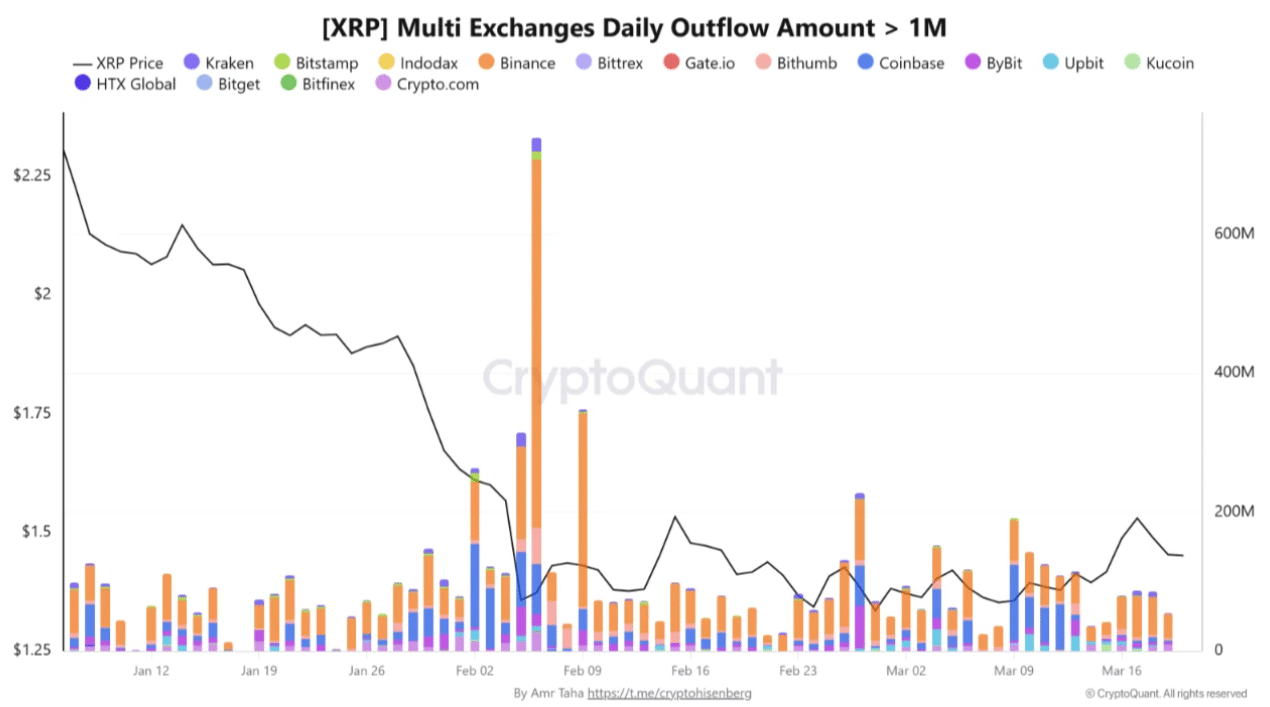
At press time, large outflows seemed to be dominating activity, with Binance leading across exchanges. Early February marked a key spike as 530 million XRP exited in one day, signaling strong whale movement.
Source: CryptoQuant

Following this surge, the altcoin’s price fell from above $2.20 towards the $1.30–$1.50 range, suggesting supply initially outweighed demand. As this pressure faded, daily outflows stabilized near 50 million XRP in March – A sign of more controlled positioning.

At the same time, transfer data revealed that over 1 million XRP transactions reinforced whale control.
Source: CryptoQuant

This pattern could mean that accumulation might be underway. However, sustained price strength will depend on consistent demand absorbing these large-scale movements.



Final Summary

  • Ripple [XRP] treasury strategy gained institutional traction through Evernorth’s SPAC structure, although sustained adoption will depends on consistent capital inflows.
  • Ripple whale outflows and rising large transfers alluded to accumulation trends.

Crypto di tendenza

Domande pertinenti

QWhat is the significance of Armada Acquisition Corp. II filing the S-4 in relation to Ripple's XRP treasury?

AThe S-4 filing registers the proposed merger with Evernorth Holdings, moving the Ripple XRP treasury deal closer to market approval and setting the legal path for Evernorth to enter public markets through a Nasdaq listing under XRPN.

QHow does Evernorth's XRP treasury model compare to MicroStrategy's Bitcoin approach?

AEvernorth's model takes cues from MicroStrategy's Bitcoin strategy but differs in depth and market positioning. While MicroStrategy holds a massive amount of BTC with a strong conviction multiple, XRP has lower institutional preference and captures a smaller share of capital flows, with Evernorth aiming to raise over $1 billion for XRP exposure.

QWhat on-chain activity suggests whale movement and accumulation for XRP?

ALarge outflows dominated activity, with a key spike of 530 million XRP exiting in one day in early February, followed by stabilized daily outflows of around 50 million XRP in March. Additionally, over 1 million XRP transfers indicate strong whale control, which could signal accumulation is underway.

QWhat factors will determine the sustained strength of XRP's price according to the article?

ASustained price strength will depend on consistent capital inflows rather than short-term bursts, and the ability of demand to absorb large-scale movements and outflows, as well as developing a stronger narrative beyond payments.

QWhat is Evernorth's strategy for growing XRP per share after launch?

AEvernorth's strategy shifts towards active application, using lending, DeFi yields, and validator participation to generate yield and grow XRP per share, moving beyond passive holding towards an active institutional framework.

Letture associate

Agent Race Ends, Super Workbench Takes Over

The era of fragmented AI agents is ending. Over the past month, China's tech giants—Tencent, Alibaba, and ByteDance—have simultaneously shifted strategy: instead of launching new, standalone AI agents, they are consolidating their various agent projects into unified "super workbenches." Tencent integrated its QClaw teams into WorkBuddy, a strategic product hailed as a potential third flagship after QQ and WeChat. Alibaba is merging its QoderWork, Wukong, and MuleRun agents into a new "Qianwen Office" platform under DingTalk's leadership. ByteDance rebranded its TRAE SOLO coding agent to TRAE Work, signaling a broader focus on workflow collaboration. This convergence marks a pivotal industry consensus. The initial exploration phase, where companies rapidly built numerous overlapping agents for different scenarios, proved costly and inefficient. With open-source tools eroding technical barriers, competition has shifted from agent creation to resource consolidation and cost control. Historically, platform wars are won not by creating more products, but by simplifying them—as seen with browsers unifying web access and super-apps consolidating services. Now, the "super workbench" aims to become the unified AI entry point for work. This reflects a deeper market realization: the primary audience for AI is no longer just programmers (a market in the tens of millions) but all knowledge workers (a market of billions). The real opportunity lies in augmenting everyday tasks—managing emails, documents, data, and meetings—across the entire workday. The core battleground is becoming control over the primary AI entry point that employees use daily. Tencent's WorkBuddy leverages WeChat and Tencent Docs; Alibaba's Qianwen Office taps into DingTalk's organizational data; ByteDance's TRAE Work integrates with Feishu's workflows. Whoever owns this "super workbench" gains strategic control over orchestrating enterprise data and APIs. This shift is redefining enterprise software. Traditional SaaS applications, valued for their user interfaces, will recede into the background. Their core functionalities will be exposed as standardized "Skills" or APIs for the super workbench's agents to invoke. Software value will shift from selling user seats to charging based on API calls and outcomes delivered. The evolution of agents is moving through clear stages: first as novel standalone products, then as consolidated primary work entry points, and finally as pervasive, invisible capabilities embedded into the digital fabric. The recent moves by major tech firms signal the transition from the first stage into the second, accelerating toward the third. In the end, the most successful agent technology may become invisible—like electricity or the HTTP protocol—a fundamental, unnamed infrastructure powering work itself.

marsbit5 min fa

Agent Race Ends, Super Workbench Takes Over

marsbit5 min fa

Michael Saylor: 110 Reasons to Oppose BIP-110

Michael Saylor presents 110 arguments against Bitcoin Improvement Proposal (BIP) 110, a soft fork aimed at restricting certain non-monetary data storage uses (like inscriptions) on the Bitcoin blockchain. He acknowledges the proponents' valid concerns—such as node costs, fee pressure, and preserving Bitcoin's monetary focus—but fundamentally disagrees with the proposed solution. Saylor argues that BIP 110 represents a dangerous precedent of using consensus rules to enforce value judgments on transaction validity, moving away from Bitcoin's core principles of neutrality and permissionless innovation. His key objections are organized into eleven categories: 1) It violates neutrality and hard consensus by banning currently valid transactions. 2) It fails to meet the high burden of proof required for a consensus change, lacking concrete data on the alleged crisis. 3) Its seven bundled technical restrictions are overly broad, targeting generic script functionalities and blocking future upgrade paths. 4) It sacrifices compatibility and future optionality by closing off designed upgrade hooks. 5) Its temporary rules add significant complexity (grandfathering, expiry states) without sufficient justification. 6) The economic and security impacts, particularly on miner revenue and fee markets, are uncertain and unmodeled. 7) Superior, market-based tools (fee markets, relay/mining policies) already exist to manage blockchain load. 8) It stifles innovation by creating a chilling effect for developers. 9) Its modified activation mechanism (55% threshold, forced signaling) is aggressive and risks network splits. 10) The precedent it sets—using consensus to suppress disliked but legal uses—is more dangerous than the problem it aims to solve. 11) A better path exists: improving measurements, refining resource-based policies, and allowing market forces to work. Saylor concludes that Bitcoin's strength lies in its neutral rules, open markets, and hard consensus. Changing these foundational elements to target specific use cases is an unnecessary and risky "iatrogenic" intervention. He advocates for guarding Bitcoin's neutrality rather than acting as its redeemer.

marsbit20 min fa

Michael Saylor: 110 Reasons to Oppose BIP-110

marsbit20 min fa

Trading

Spot

Articoli Popolari

Come comprare PUSH

Benvenuto in HTX.com! Abbiamo reso l'acquisto di Push Protocol (PUSH) semplice e conveniente. Segui la nostra guida passo passo per intraprendere il tuo viaggio nel mondo delle criptovalute.Step 1: Crea il tuo Account HTXUsa la tua email o numero di telefono per registrarti il tuo account gratuito su HTX. Vivi un'esperienza facile e sblocca tutte le funzionalità,Crea il mio accountStep 2: Vai in Acquista crypto e seleziona il tuo metodo di pagamentoCarta di credito/debito: utilizza la tua Visa o Mastercard per acquistare immediatamente Push ProtocolPUSH.Bilancio: Usa i fondi dal bilancio del tuo account HTX per fare trading senza problemi.Terze parti: abbiamo aggiunto metodi di pagamento molto utilizzati come Google Pay e Apple Pay per maggiore comodità.P2P: Fai trading direttamente con altri utenti HTX.Over-the-Counter (OTC): Offriamo servizi su misura e tassi di cambio competitivi per i trader.Step 3: Conserva Push Protocol (PUSH)Dopo aver acquistato Push Protocol (PUSH), conserva nel tuo account HTX. In alternativa, puoi inviare tramite trasferimento blockchain o scambiare per altre criptovalute.Step 4: Scambia Push Protocol (PUSH)Scambia facilmente Push Protocol (PUSH) nel mercato spot di HTX. Accedi al tuo account, seleziona la tua coppia di trading, esegui le tue operazioni e monitora in tempo reale. Offriamo un'esperienza user-friendly sia per chi ha appena iniziato che per i trader più esperti.

561 Totale visualizzazioniPubblicato il 2024.12.13Aggiornato il 2026.06.02

Come comprare PUSH

Discussioni

Benvenuto nella Community HTX. Qui puoi rimanere informato sugli ultimi sviluppi della piattaforma e accedere ad approfondimenti esperti sul mercato. Le opinioni degli utenti sul prezzo di PUSH PUSH sono presentate come di seguito.

活动图片