XRP Trades Like An Asset That’s Survived Its Hardest Trials — Is A Rally Coming?

bitcoinistPubblicato 2025-12-28Pubblicato ultima volta 2025-12-28

Introduzione

XRP is demonstrating resilience after enduring years of regulatory uncertainty and legal challenges, now trading like an asset that has weathered its hardest trials. The narrative has shifted as institutional inflows surge, with XRP-linked ETFs rapidly accumulating over $1 billion in assets under management without a single outflow day. This reflects growing confidence and a more mature market structure. Supply on exchanges is thinning, and long-term institutional holdings are reducing sell pressure. While the current price dip is attributed to broader market conditions, not XRP-specific issues, the fundamentals are strengthening. Institutions are accumulating XRP for its settlement capabilities, on-chain liquidity, and transaction speed, signaling a potential rally ahead.

The narrative surrounding XRP has undergone a fundamental transformation, and the token has begun to trade like an asset that has already endured its most punishing tests. Years of regulatory uncertainty, legal scrutiny, and prolonged underperformance have tempered speculation and reshaped its investor base, leaving behind a market that appears more resilient than reactive.

Why XRP No Longer Reacts To Every Negative Headline

XRP is starting to trade like an asset that has already endured its hardest trials after years of regulatory overhang, which forced it to mature earlier than most digital assets. An ambassador at AstraAIofficial, Winny, revealed on X that the ETFs linked to the token are now live, providing traditional investors with regulated exposure without the operational friction of wallets or exchanges.

At the same time, institutional inflows are rising, with managed assets tied to XRP surpassing $1 billion, a milestone that signals growing confidence. The supply on exchanges balances continues to thin, reinforcing the narrative. Long-term fund purchases don’t trade; they sit, which has changed the pressure dynamics, whether participants would admit to it or not. Most importantly, the regulatory clarity is finally improving, something that the altcoin has lacked for years.

Winny concluded that this is about the altcoin graduating into a different market structure. Meanwhile, all this dynamic doesn’t mean the market will explode tomorrow, but it does mean the fundamentals are quietly shifting, and patience pays.

Institutions Are Choosing The Altcoin For A Reason

Crypto analyst Xfinancebull has explained why it will be too late if no one believes in XRP. The narrative was that ETFs were priced in, but the funds became the fastest altcoin ETF in history to hit $1 billion in Assets Under Management (AUM), with no outflows, no red days, and just steady institutional-sized capital moving in with conviction.

The flow data shows that the funds have absorbed over $666 million in November, followed by another +$470 million in December, with no single outflow day. During the same period, Bitcoin and Ethereum saw hundreds of millions in net outflows, while XRP quietly stacked over 30 consecutive green flow days. Currently, 686 million and 740 million XRP are locked, quietly reducing supply in real-time.
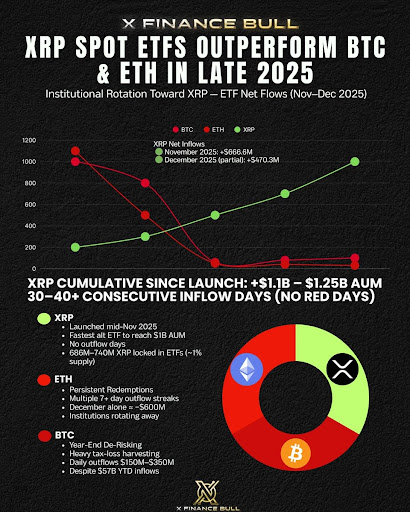
Institutions are flocking into the altcoin | Source: Chart from Xfinancebull on X

However, the reason the altcoin is being chosen is that it solves what institutions actually need, which are complexity-ready settlement, on-chain liquidity, and global transaction speed. XRP’s price is currently down because the entire market is under pressure; that move is macro, not a failure.

In Xfinancebull’s view, institutions are still accumulating the token with patience and intent. The markets often whisper before they move, but this time the data is screaming, and institutions are already stacked.

XRP trading at $1.84 on the 1D chart | Source: XRPUSDT on Tradingview.com

Domande pertinenti

QAccording to the article, why is XRP starting to trade like an asset that has endured its hardest trials?

AIt has been tempered by years of regulatory uncertainty, legal scrutiny, and prolonged underperformance, which has reshaped its investor base into a more resilient market. The launch of regulated ETFs and rising institutional inflows also signal a fundamental shift.

QWhat milestone did the ETFs linked to XRP achieve, as mentioned by the ambassador?

AThe ETFs became the fastest altcoin ETF in history to hit $1 billion in Assets Under Management (AUM).

QWhat key reason does the article give for institutions choosing to invest in XRP?

AInstitutions are choosing XRP because it solves their actual needs, which include complexity-ready settlement, on-chain liquidity, and global transaction speed.

QHow does the article describe the flow of capital into XRP funds compared to Bitcoin and Ethereum?

AThe XRP funds saw massive inflows with no outflows, including over $666 million in November and another $470 million in December, while Bitcoin and Ethereum experienced hundreds of millions in net outflows during the same period.

QWhat is the current state of XRP's supply on exchanges, and what is its effect?

AThe supply on exchanges is thinning, with 686 million and 740 million XRP locked, which quietly reduces the available supply in real-time and reinforces the asset's resilience.

Letture associate

The Gold Buy-on-the-Dip Guide: Watch Interest Rates, Not Just War

"Gold Buying Guide: Focus on Interest Rates, Not Just War" Four months ago, gold buyers likely didn't anticipate buying at a peak that even a war couldn't sustain. After hitting a record high of $5,596 on January 29, gold entered a bear market just 91 days later, its fastest decline since 2008. A key trigger was the Fed's hawkish shift, highlighting that monetary policy, not geopolitics, is the primary driver. The article argues that the traditional "buy gold in turmoil" script has changed. While the US-Iran conflict initially boosted prices, the sustained rally in oil prices heightened inflation fears, forcing central banks to maintain or consider tighter policy. Since gold yields no interest, higher rates increase its opportunity cost, eroding its appeal. This dynamic was evident when gold fell sharply on May 18 despite positive peace talks, as lower oil prices eased inflation and thus rate hike pressures. The recent sell-off is also part of a broader market deleveraging. Correlations between gold, Nasdaq, and Bitcoin spiked as leveraged investors sold liquid assets to cover losses, creating a synchronized downturn. Historically, gold bottoms align with policy shifts, not conflict resolutions. The 2008 and 2022 bear markets ended with shifts to extreme easing and peak inflation expectations, respectively. For potential buyers, the author suggests monitoring three signals: 1) Peak interest rate hike expectations, 2) Reopening of the Strait of Hormuz (to ease oil/inflation pressure), and 3) A return to net inflows for Gold ETFs, indicating the end of forced selling. While predicting the exact bottom is impossible, the author's personal strategy involves scaling into a position across price levels like $4000, $3700, and $3500, committing no more than 30% of the intended total allocation initially, and adding the remainder only if key signals emerge. The core conclusion: In turbulent times, watching interest rates is more crucial than watching wars.

marsbit8 min fa

The Gold Buy-on-the-Dip Guide: Watch Interest Rates, Not Just War

marsbit8 min fa

Recent On-Chain Review: No Clear Narrative Under U.S. Stock Market Pressure, Just Hype

This article analyzes the current state of the Solana meme coin and community token ecosystem, highlighting a market caught between two dominant forces: attention-based PvP and a gradual return to community-centric projects. The first part explores the "Attention PvP" dynamic, where success is driven by celebrity endorsements, viral events, and speed. Examples include $JOTCHUA, which surged after its meme creator's social media activity, and $WORLDCUP, which outperformed a similar Base chain project ($PITCH) largely due to influencer support. The recent "pump.fun GO" feature, allowing bounty tasks for token promotion, is critiqued for fostering sensationalist and often negative stunts—like people getting token tickers tattooed on their bodies for rewards—reminiscent of old internet shock content. In contrast, the article points to a resurgence of organic, community-driven tokens that survive market volatility through strong holder bases and shared ideology, not just hype. Influencer Ansem is cited, arguing that durable meme coins rely on communities willing to endure losses and promote their core message daily. Examples given are older tokens like $neet (anti-work ethos), $troll, $buttcoin, and $triplet, which have maintained relative price stability. A prime example of this community-build model is the new project $KINS, the token for the browser-based MMORPG Kintara. Its success stems not from advanced graphics but from consistently delivering updates, fostering player trust, and creating genuine engagement (e.g., in-game economies, events, property auctions). It has attracted a growing player base and even notable KOLs as participants, demonstrating that sustainable growth can come from building trust rather than orchestrating pumps. The article concludes by questioning whether the market is ultimately a game of mutual trust or mutual deception, expressing hope that such reflection might lead to a healthier ecosystem.

marsbit8 min fa

Recent On-Chain Review: No Clear Narrative Under U.S. Stock Market Pressure, Just Hype

marsbit8 min fa

On-Chain Scene on Opening Day: $20 Billion Already Staked, How Do On-Chain Contracts Know Who Wins?

On the opening day of the 2026 World Cup, over $2 billion had already been wagered on just the "tournament winner" contracts on platforms like Polymarket and Kalshi. This article explores how these blockchain-based prediction markets actually function once the games begin. It breaks down the massive volume and explains how single-game and tournament-long contracts are priced, with values moving between 1-99 cents to reflect implied probabilities. A key mechanism highlighted is "elimination zeroing," where a team's "champion yes" contract immediately settles to zero once they are mathematically eliminated. The core technical question answered is: how does a smart contract "know" who won a real-world match? The answer lies in oracles. The article details two primary paradigms: UMA's "optimistic oracle" (used by most of Polymarket), which allows a challenge period after a proposed result, and Chainlink's multi-source data aggregation (used by FIFA partners like ADI Predictstreet), which automates settlement with minimal dispute windows. Finally, the article injects a note of caution, citing research estimating that a significant portion of historical trading volume on these platforms might be "wash trading" to inflate numbers. It concludes by contrasting the legal status of these "event contracts" under CFTC rules in the U.S. versus traditional, state-regulated sports betting. As the tournament progresses, the real-time operation of this multi-billion dollar machine—its settlements, eliminations, and underlying mechanisms—becomes a story as compelling as the football itself.

marsbit23 min fa

On-Chain Scene on Opening Day: $20 Billion Already Staked, How Do On-Chain Contracts Know Who Wins?

marsbit23 min fa

Sequoia Dialogue with Jensen Huang: Computing Model Undergoes a 60-Year Transformation; You Won't Be Replaced by AI, But You Will Be Dimensionality-Reduced by 'Those Who Master AI'

NVIDIA founder and CEO Jensen Huang, in a conversation with Sequoia Capital's Konstantine Buhler, argues that we are witnessing the most significant computing shift in 60 years—from retrieval-based to generative computing. Instead of just storing and retrieving data, future systems will generate highly personalized content (text, images, video) on demand, powered by massive "AI factories." Huang envisions a global "intelligence network" that will envelop the planet, following the historical patterns of energy and communication grids. He outlines a five-layer investment framework: 1) Energy, 2) Chips/Computers, 3) Infrastructure (data centers), 4) AI Models, and 5) Applications. He predicts this ecosystem will reach a scale of $20 trillion annually. Crucially, Huang pushes back against fears of AI-driven job loss. He distinguishes between specific "tasks" (e.g., typing, analyzing images) and overall "jobs" (e.g., CEO, radiologist). While AI automates tasks, it increases efficiency and demand for the higher-value problem-solving aspects of professions, thus creating more jobs and "up-leveling" careers. The real risk, he asserts, is not being replaced by AI, but being outperformed by someone who effectively leverages it. He urges everyone to embrace AI as a tool for augmented capability and innovation.

marsbit1 h fa

Sequoia Dialogue with Jensen Huang: Computing Model Undergoes a 60-Year Transformation; You Won't Be Replaced by AI, But You Will Be Dimensionality-Reduced by 'Those Who Master AI'

marsbit1 h fa

Trading

Spot
Futures

Articoli Popolari

Come comprare BILL

Benvenuto in HTX.com! Abbiamo reso l'acquisto di Billions Network (BILL) semplice e conveniente. Segui la nostra guida passo passo per intraprendere il tuo viaggio nel mondo delle criptovalute.Step 1: Crea il tuo Account HTXUsa la tua email o numero di telefono per registrarti il tuo account gratuito su HTX. Vivi un'esperienza facile e sblocca tutte le funzionalità,Crea il mio accountStep 2: Vai in Acquista crypto e seleziona il tuo metodo di pagamentoCarta di credito/debito: utilizza la tua Visa o Mastercard per acquistare immediatamente Billions NetworkBILL.Bilancio: Usa i fondi dal bilancio del tuo account HTX per fare trading senza problemi.Terze parti: abbiamo aggiunto metodi di pagamento molto utilizzati come Google Pay e Apple Pay per maggiore comodità.P2P: Fai trading direttamente con altri utenti HTX.Over-the-Counter (OTC): Offriamo servizi su misura e tassi di cambio competitivi per i trader.Step 3: Conserva Billions Network (BILL)Dopo aver acquistato Billions Network (BILL), conserva nel tuo account HTX. In alternativa, puoi inviare tramite trasferimento blockchain o scambiare per altre criptovalute.Step 4: Scambia Billions Network (BILL)Scambia facilmente Billions Network (BILL) nel mercato spot di HTX. Accedi al tuo account, seleziona la tua coppia di trading, esegui le tue operazioni e monitora in tempo reale. Offriamo un'esperienza user-friendly sia per chi ha appena iniziato che per i trader più esperti.

206 Totale visualizzazioniPubblicato il 2026.05.07Aggiornato il 2026.06.02

Come comprare BILL

Cosa è ATWO

I. Introduzione al ProgettoArena Two è una piattaforma interattiva decentralizzata che consente ai fan di svolgere un ruolo attivo e tokenizzato nei risultati degli eventi in tempo reale. A differenza dei modelli di trasmissione tradizionali che riducono i fan a spettatori passivi, Arena Two sfrutta la tecnologia blockchain per consentire ai fan di votare direttamente in tempo reale e influenzare i risultati sul campo.II. Informazioni sul TokenNome del token: ATWO(Arena Two)III. Link CorrelatiSito web:https://arenatwo.com/Esploratori:https://basescan.org/token/0x499D35eBE6cEe9B2Ac35Fd003fcBbeeB9CFc7B32Twitter:https://x.com/arenatwoXNota: L'introduzione al progetto proviene dai materiali pubblicati o forniti dal team ufficiale del progetto, che è solo a scopo di riferimento e non costituisce consulenza sugli investimenti. HTX non si assume responsabilità per eventuali perdite dirette o indirette derivanti.

161 Totale visualizzazioniPubblicato il 2026.05.18Aggiornato il 2026.06.02

Cosa è ATWO

Come comprare ATWO

Benvenuto in HTX.com! Abbiamo reso l'acquisto di Arena Two (ATWO) semplice e conveniente. Segui la nostra guida passo passo per intraprendere il tuo viaggio nel mondo delle criptovalute.Step 1: Crea il tuo Account HTXUsa la tua email o numero di telefono per registrarti il tuo account gratuito su HTX. Vivi un'esperienza facile e sblocca tutte le funzionalità,Crea il mio accountStep 2: Vai in Acquista crypto e seleziona il tuo metodo di pagamentoCarta di credito/debito: utilizza la tua Visa o Mastercard per acquistare immediatamente Arena TwoATWO.Bilancio: Usa i fondi dal bilancio del tuo account HTX per fare trading senza problemi.Terze parti: abbiamo aggiunto metodi di pagamento molto utilizzati come Google Pay e Apple Pay per maggiore comodità.P2P: Fai trading direttamente con altri utenti HTX.Over-the-Counter (OTC): Offriamo servizi su misura e tassi di cambio competitivi per i trader.Step 3: Conserva Arena Two (ATWO)Dopo aver acquistato Arena Two (ATWO), conserva nel tuo account HTX. In alternativa, puoi inviare tramite trasferimento blockchain o scambiare per altre criptovalute.Step 4: Scambia Arena Two (ATWO)Scambia facilmente Arena Two (ATWO) nel mercato spot di HTX. Accedi al tuo account, seleziona la tua coppia di trading, esegui le tue operazioni e monitora in tempo reale. Offriamo un'esperienza user-friendly sia per chi ha appena iniziato che per i trader più esperti.

118 Totale visualizzazioniPubblicato il 2026.05.18Aggiornato il 2026.06.02

Come comprare ATWO

Discussioni

Benvenuto nella Community HTX. Qui puoi rimanere informato sugli ultimi sviluppi della piattaforma e accedere ad approfondimenti esperti sul mercato. Le opinioni degli utenti sul prezzo di A A sono presentate come di seguito.

活动图片














