XRP Retests $1.29 Support: Is $2 Still in Play or Will LiquidChain Capture the Momentum?

bitcoinistPubblicato 2026-02-06Pubblicato ultima volta 2026-02-06

Introduzione

XRP is currently retesting a key support level at $1.29, a critical point that will determine whether it can resume its upward trajectory toward $2.00 or face a deeper decline. The recent pullback is seen as a healthy consolidation after a strong rally, driven by profit-taking and broader market volatility. Technical indicators suggest that holding above $1.25 could pave the way for a run to $1.96 and beyond, while a drop below $1.10 may lead to a fall toward $0.85. Regulatory developments, including potential SEC leadership changes and ETF approvals, remain central to XRP's bullish narrative. Meanwhile, LiquidChain ($LIQUID) is emerging as a high-risk, high-reward alternative, positioning itself as a cross-chain liquidity solution integrating Bitcoin, Ethereum, and Solana. Having raised over $529K in its presale, it aims to address fragmentation in DeFi through specialized Layer-3 infrastructure. While XRP's focus remains tied to regulatory clarity and institutional adoption, LiquidChain offers a speculative bet on the future of interoperable decentralized finance.

Trusted Editorial content, reviewed by leading industry experts and seasoned editors. Ad Disclosure

Quick Facts:

  • ➡️ XRP’s dip to $1.29 is a technical retest of support; holding here is key for a potential run toward $2.00.
  • ➡️ Regulatory clarity (post-SEC changes) remains the main driver, with ETFs as the next potential spark to unlock institutional flows.
  • ➡️ Losing the $1.10 level would invalidate the bullish view, likely opening the trapdoor to the $0.85 region.
  • ➡️ LiquidChain offers a high-risk, high-reward alternative, aiming to unify liquidity across Bitcoin, Ethereum, and Solana through specialized L3 infrastructure.

XRP hit a wall.

After a blistering rally that momentarily silenced years of regulatory suppression, the asset is retracing to the $1.29 level.

The-1 year chart looks abysmal, but this goes for pretty much the entire market as a whole.
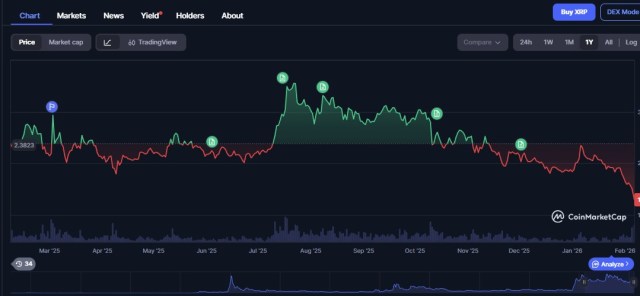
It’s a necessary cooldown. Traders are taking profit, and the market is digesting the broader implications of the impending SEC leadership change. While the dip has shaken out over-leveraged long positions, on-chain data suggests this isn’t a reversal, it’s likely just healthy consolidation.

What’s driving the volatility? A mix of macro rotation and simple technical exhaustion. The “regulatory relief” trade got crowded fast after the news of Gary Gensler’s potential exit broke.

Now, the market wants receipts, specifically, progress on the RLUSD stablecoin or confirmed ETF filings, to justify the next leg higher. This price action is a classic retest of previous resistance-turned-support. And frankly, that’s often exactly what an asset needs before attacking a psychological barrier like $2.00.

But crypto isn’t a zero-sum game between one asset and the dollar. As XRP churns, capital is starting to rotate into high-utility infrastructure plays solving different problems. Does XRP have the muscle to reclaim the $2 handle before year-end?

Or will liquidity siphon off into emerging Layer 3 protocols like LiquidChain ($LIQUID), which are positioning themselves (perhaps ambitiously) as the connective tissue of the next DeFi cycle?

$LIQUID is available here.

Technical Outlook: Why the $1.29 Retest Could Trigger a Run to $2

The drop to $1.29 puts XRP at a critical juncture.

This level lines up perfectly with the 0.382 Fibonacci retracement from the recent swing low, a high-probability zone for institutional accumulation. Even better, the Relative Strength Index (RSI) on the daily chart has reset. It dropped from ‘overbought’ (above 70) to a neutral 55, giving bulls room to maneuver without fighting immediate exhaustion signals.

Extended rallies need these cooling periods to build the structure for sustainable growth.

Fundamentally, the thesis for a $2 XRP remains intact, underpinned by the ‘SEC pivot’ narrative. With a pro-crypto administration likely taking the reins, the regulatory cloud that suppressed XRP price discovery for four years is finally lifting.

That changes the risk premium entirely. Plus, whispers of a Bitwise or Canary Capital ETF approval continue to circulate. If an XRP ETF application moves to the “acknowledged” phase, it could be the spark needed to shatter the $1.60 resistance wall.

Traders should monitor three distinct scenarios in the coming weeks:

  • The Bull Case: XRP holds support above $1.25, chops sideways for 5-7 days, then reclaims $1.50 on heavy volume. That validates $1.29 as a ‘higher low’ and opens the door to $1.96 and eventually $2.20.
  • The Base Case: We see a chop-fest. The asset trades in an accumulation range between $1.20 and $1.45, frustrating impatient retail traders while smart money absorbs supply.
  • The Bear Case (Invalidation): A daily close below $1.10 breaks the thesis. This invalidates the immediate bullish structure, risking a deeper flush down to the 200-day moving average near $0.85.

Keep an eye on volume. Declining volume on this pullback suggests the sellers are running out of steam, which favors the bulls.

LiquidChain Emerges as a High-Beta Alternative for Cross-Chain Liquidity

While XRP battles for dominance in cross-border payments, a different story is playing out in decentralized infrastructure. Investors hunting for high-beta opportunities, assets that tend to move faster than majors during a bull run, are looking at Layer 3 (L3) solutions.

That’s where LiquidChain ($LIQUID) comes in, pitching itself as a specialized fix for the fragmentation plaguing today’s multi-chain world.

Unlike XRP, which focuses on fiat-to-crypto bridging, LiquidChain operates as a ‘Cross-Chain Liquidity Layer.’ It fuses Bitcoin, Ethereum, and Solana liquidity into a single execution environment. The idea?

A ‘deploy-once’ architecture allowing developers to build apps that access users and capital across all three giants without the security risks of traditional wrapped assets. If interoperability becomes the theme of the next DeFi summer, this utility puts it in a prime position.

You can see the project’s early traction in the presale numbers. To date, LiquidChain has raised over $529K so far. The native token is currently priced at $0.01355, an entry level far below the established caps of legacy L1s. Join the presale here.
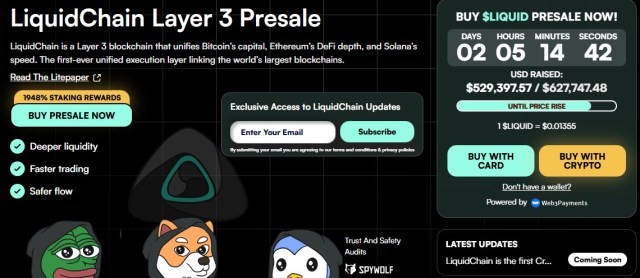
Moving from established majors like XRP to presale assets obviously carries risk. While LiquidChain offers a unified liquidity layer and verifiable settlement, it’s still early in its roadmap.

The potential for outsized returns comes with the usual dangers: regulatory uncertainty and the technical hurdles of executing a complex cross-chain VM. But for those with the stomach for it, the rotation into $LIQUID represents a bet on the plumbing that will power the next generation of dApps, distinct from Ripple’s payment-focused utility.

Buy $LIQUID here.

Disclaimer: This article is for informational purposes only and does not constitute financial advice. Cryptocurrency investments, particularly in presale projects and volatile assets like XRP, carry high risks. Readers should conduct their own independent research and consult with financial professionals before making investment decisions.

Editorial Process for bitcoinist is centered on delivering thoroughly researched, accurate, and unbiased content. We uphold strict sourcing standards, and each page undergoes diligent review by our team of top technology experts and seasoned editors. This process ensures the integrity, relevance, and value of our content for our readers.

patrubogdan

Follow

Full Profile

Related Posts

Bitcoin Teeters on Edge: Will $60K Hold or Is a V-Shape Recovery Imminent? $HYPER Keeps Pumping

Senator Lummis Urges Banks to Adopt Stablecoins Amidst CLARITY Act Delay, as Maxi Doge Turns Heads

$BTC Needs to Drop to $8K for Holdings Not to Cover Debt, Says Strategy, as $HYPER’s Presale Soars

Robinhood CEO Says Prediction Markets Will Soar as Bitcoin Hyper ($HYPER) Reaches $31.2M in Presale

Vitalik Buterin Cashes Out $6.6 Million In Ether After Early Signals

While Bitcoin And Ether Falter, XRP Optimism Stands Out: Analysts

Domande pertinenti

QWhat is the critical support level for XRP mentioned in the article, and why is it important?

AThe critical support level for XRP is $1.29. It is important because it represents a technical retest of previous resistance-turned-support and aligns with the 0.382 Fibonacci retracement level, making it a high-probability zone for institutional accumulation. Holding this level is key for a potential price run toward $2.00.

QAccording to the article, what is the main fundamental driver for XRP's price action?

AThe main fundamental driver for XRP's price action is regulatory clarity, specifically the potential changes at the SEC following Gary Gensler's anticipated exit. This 'regulatory relief' trade, along with the possibility of XRP ETF approvals, is seen as a major catalyst for unlocking institutional investment.

QWhat price level would invalidate the immediate bullish thesis for XRP?

AA daily close below the $1.10 level would invalidate the immediate bullish thesis for XRP. This break of support would likely trigger a deeper price decline toward the 200-day moving average, which is near $0.85.

QHow does LiquidChain ($LIQUID) differentiate itself from XRP in terms of utility?

ALiquidChain differentiates itself by focusing on cross-chain liquidity as a Layer 3 solution, whereas XRP focuses on cross-border payments. $LIQUID aims to unify liquidity across Bitcoin, Ethereum, and Solana through a 'deploy-once' architecture, allowing developers to build apps that access users and capital across all three chains.

QWhat was the amount raised in the LiquidChain presale and what is the current token price mentioned?

AThe LiquidChain presale had raised over $529,000 at the time of writing. The native $LIQUID token was being offered at a price of $0.01355 during its presale phase.

Letture associate

The Essence of AI Layoffs: Why More AI Adoption Leads to More Corporate Anxiety?

The author, awaiting potential inclusion on an 8000-person layoff list, analyzes the true nature of recent "AI-driven" layoffs. They argue that while AI use, particularly tools like Claude for code generation, has skyrocketed and boosted developer output (e.g., 2-5x more code commits), this has not translated into proportional business growth or revenue. The core issue is a misalignment between increased "Input" (code) and tangible "Outcomes" (user value, revenue). AI acts as a costly B2B SaaS, inflating operational expenses without guaranteed returns. Two key problems emerge: 1) The friction that once filtered out bad ideas is gone, as AI allows cheap pursuit of even weak concepts. 2) Organizational "alignment tax"—the difficulty of coordinating across teams—becomes crippling when development velocity outpaces consensus-building. Thus, layoffs serve two immediate purposes: 1) To offset ballooning AI costs (Token consumption) and maintain cash flow, as rising input costs without outcome growth destroys unit economics. 2) To reduce organizational bloat and alignment friction by simply removing teams, thereby speeding up execution in the short term. Therefore, these layoffs are fundamentally caused by AI, even if AI doesn't directly replace roles. They represent a painful correction until companies learn to convert AI-driven productivity into real business outcomes and streamline organizational coordination to match the new pace of work. The cycle will continue until this learning curve is mastered.

marsbit30 min fa

The Essence of AI Layoffs: Why More AI Adoption Leads to More Corporate Anxiety?

marsbit30 min fa

Can the Solana Foundation and Google's Collaboration on Pay.sh Bridge the Payment Link Between Web2 and Web3 in the Agent Economy?

Solana Foundation, in collaboration with Google Cloud, has launched Pay.sh, a payment gateway designed to bridge the gap between AI agents and enterprise-grade service infrastructure. The initiative aims to solve a key bottleneck in the "agent economy": existing payment systems are ill-suited for autonomous AI agents. Traditional methods like credit cards require human verification, while newer on-chain protocols like x402 and MPP create a separate, Web3-native system that raises barriers for service providers. Pay.sh functions as a universal payment layer. It allows users to fund a Solana wallet via credit card or stablecoin, which then acts as an identity and payment proxy for AI agents. When an agent needs to access a paid API service (e.g., Google Cloud, Alibaba Cloud), Pay.sh handles the transaction seamlessly. It leverages the HTTP 402 status code ("Payment Required") to initiate payments, intelligently choosing between one-time transfers (x402-style) or session-based authorizations (MPC-style) based on the service's billing model. This spares agents from manual account registration and API key management. A key feature for service providers is low integration effort. They can adopt Pay.sh by providing a declarative configuration file, enabling features like tiered pricing, free tiers, and automatic revenue splitting to multiple addresses (e.g., for royalties, cloud costs). Providers can also list their APIs in a central Pay Skill Registry for agent discovery. The collaboration with Google Cloud provides crucial infrastructure for API proxying, traffic routing, and compliance logging, aiming to keep agent activities within regulated boundaries. By connecting Web2 services with Web3 payment rails, Pay.sh positions the Solana wallet as a foundational identity and payment tool for AI agents, potentially driving more transaction volume to the Solana ecosystem. However, the report notes challenges. The service registry currently lacks robust vetting, risking exposure to unauthorized or malicious third-party APIs. Pay.sh also inherits security and compatibility risks from its underlying payment protocols (x402, MPC). Furthermore, adoption may be hindered by varying regional data privacy and payment compliance regulations among API providers. Despite these hurdles, Pay.sh represents a significant step towards integrating Web2 and Web3 for autonomous agent commerce.

marsbit37 min fa

Can the Solana Foundation and Google's Collaboration on Pay.sh Bridge the Payment Link Between Web2 and Web3 in the Agent Economy?

marsbit37 min fa

Bitcoin's Bull-Bear Cycle Indicator Turns Positive for the First Time in 7 Months: End of Bear Market or False Breakout?

Bitcoin's "Bull-Bear Market Cycle Indicator" from CryptoQuant has turned positive for the first time since October 2025. This gauge, based on the P&L Index relative to its 365-day moving average, suggests a potential shift from a bear market phase. Concurrently, the Bull Score Index rose to a neutral reading of 50 in late April. The indicator's move into positive territory follows a roughly 35% price rebound from a low near $60,000 in February to above $81,000. The recovery over approximately three months was faster than the 12-month period observed during the 2022 bear market. However, analysts caution against premature optimism, citing a historical precedent from March 2022. Back then, the Bull Score Index briefly hit 50, but it proved to be a false signal as Bitcoin's price subsequently plunged further. Structural differences exist in the current cycle, including consistent inflows into spot Bitcoin ETFs and an increase in large holder addresses. Yet, some models, referencing the four-year halving cycle, suggest a potential deeper bottom near $50,000 might still be possible around late 2026. In summary, while on-chain data shows marked improvement and the worst panic may be over, market participants remain cautious. A convincing trend reversal confirmation likely requires Bitcoin to sustainably break above key resistance, such as the 200-day moving average near $82,000.

marsbit44 min fa

Bitcoin's Bull-Bear Cycle Indicator Turns Positive for the First Time in 7 Months: End of Bear Market or False Breakout?

marsbit44 min fa

How to Automate Any Workflow with Claude Skills (Complete Tutorial)

This is a comprehensive guide to mastering Claude Skills, a feature for creating permanent, reusable instruction sets that automate specific workflows. Unlike simple saved prompts, Skills function like trained employees, delivering consistent, high-quality outputs by defining the entire task process, standards, error handling, and output format. The guide is structured in four phases: **Phase 1: Installation (5 minutes).** Skills are folders containing a `SKILL.md` file. The user is instructed to find a relevant Skill online, install it, test it on a real task, and compare its performance to one-off prompts. **Phase 2: Building Your First Custom Skill.** Start by rigorously defining the Skill's purpose, trigger phrases, and providing a concrete example of perfect output. The `SKILL.md` file has two parts: a YAML frontmatter with a specific name/description/triggers, and a detailed, step-by-step workflow written in natural language with examples and quality standards. **Phase 3: Testing & Optimization for Production.** Test the Skill in three scenarios: 1) a standard, common task; 2) edge cases with missing or conflicting data; and 3) a pressure test with maximum complexity. Any failure indicates a needed instruction. Implement a weekly optimization cycle to continuously refine the Skill based on real usage. **Phase 4: Building a Complete Skill Library.** The goal is to create a team of Skills for all repetitive tasks. Examples are given for industries like real estate, marketing, finance, consulting, and e-commerce. The user should list their tasks, prioritize them, and build one new Skill per week, maintaining a master document to track their library. The conclusion emphasizes the compounding time savings: ten Skills saving 30 minutes each per week reclaims over 260 hours (6.5 work weeks) per year, fundamentally transforming one's work system.

marsbit1 h fa

How to Automate Any Workflow with Claude Skills (Complete Tutorial)

marsbit1 h fa

Trading

Spot
Futures
活动图片





