XRP Ledger Is A ‘Ghost Chain,’ Chainlink Community Liaison Claims

bitcoinistPubblicato 2026-03-17Pubblicato ultima volta 2026-03-17

Introduzione

Chainlink Community Liaison Zach Rynes sparked a debate by labeling the XRP Ledger a "ghost chain," arguing its core investment thesis has failed. He contends that XRP's proposed role as a global bridge currency has been overtaken by stablecoins and modern interoperability infrastructure, which institutions now prefer. Rynes criticized XRPL's low adoption in tokenized assets and stablecoins, stating USD stablecoins have become the dominant bridge asset. He also accused Ripple of socializing costs to XRP holders while privatizing gains for shareholders. XRP advocates, like lawyer Bill Morgan, countered that Ripple and XRPL are separate entities and defended Ripple's business structure. XRP price was $1.4757 at the time of reporting.

A fresh clash between XRP critics and defenders broke out on X after Chainlink Community Liaison Zach Rynes (@ChainLinkGod) argued that the XRP investment thesis has failed to keep pace with how crypto markets and financial infrastructure have evolved. His central claim was blunt: the XRP Ledger is now a “ghost chain,” while the use case once pitched for XRP as a bridge asset has largely been overtaken by stablecoins and broader interoperability infrastructure.

Rynes framed the dispute around what he called the long-running retail thesis behind XRP. “The bizarre retail thesis of XRP is that it will become the global reserve currency that everything trades against, the so-called ‘XRP standard,’” he wrote. “Rather than trading Dollars for Euros directly, you would trade USD for XRP, and then XRP for EUR, because this makes payments supposedly more efficient.”

He argued that XRP supporters prefer to describe this not as a bid for reserve-currency status, but as a narrower “bridge currency” role. In his view, that distinction does not materially change the argument. He said the larger problem is that the market structure envisioned by early XRP advocates was built in other ways over the past decade.

“The XRP vision was created over a decade ago before we had modern 200K TPS high-throughput chains, programmable smart contracts, DeFi protocols, fiat-backed stablecoins, tokenized deposits, atomic DvP/PvP swaps, and cross-chain infra,” Rynes wrote. “If you listen to what the world’s largest financial institutions and market infrastructures like Swift, DTCC, JP Morgan, BlackRock, and many others are saying, you’ll find zero of them talking about the need for a ‘bridge currency.’ Rather, they talk about the need for connectivity, interoperability, privacy, compliance, and orchestration.”

That critique extended to XRP Ledger’s position in tokenization and on-chain finance. Rynes said XRPL “will become the dominant chain for tokenized real world assets” remains a popular belief among XRP holders despite what he described as weak adoption metrics. He called XRPL “a ghost chain with less than 1% RWA market share and under 0.01% of stablecoins,” arguing that this makes the idea of XRPL emerging as the primary settlement layer difficult to defend.

He also pointed to stablecoins as the practical winner in the bridge-asset debate. According to Rynes, “USD-backed stablecoins have become the dominant crypto-native ‘bridge currency’ for payments, trading, and finance,” and the industry has already built “everything XRP was supposed to be, without XRP.” He cited Hyperliquid as an example of crypto-native finance where positions across multiple markets are effectively denominated against dollar-backed stablecoins rather than XRP.

The second half of his argument focused less on ledger design and more on Ripple’s business model. Rynes alleged that Ripple “socializes its costs to XRP holders and privatizes gains for its equity shareholders,” saying XRP sales fund products whose revenue accrues to Ripple rather than directly to token holders. He made the same point about RLUSD, writing that around 90% of its supply sits on Ethereum and other chains, which in his telling creates little to no direct demand for XRP itself.

XRP Community Fires Back

Not everyone in the thread accepted that framing. XRP advocate and lawyer Bill Morgan pushed back on Rynes’ comparison between token buybacks and equity buybacks, calling it “a false equivalence because a token is nothing like a share and has no rights attached it like a share.” He also rejected the idea that Ripple and XRPL should be treated as one and the same, writing that “Ripple does not own the XRPL which is a fully decentralised public permissionless Blockchain.”

Morgan argued that Ripple had opted for a different structure through Evernorth, which he described as an independent vehicle designed to acquire XRP and offer institutions regulated exposure. He said that model was preferable to Ripple itself running a reserve that could draw regulatory scrutiny, especially given how the SEC previously pointed to Ripple’s efforts to support XRP’s price in litigation.

At press time, XRP traded at $1.4757.
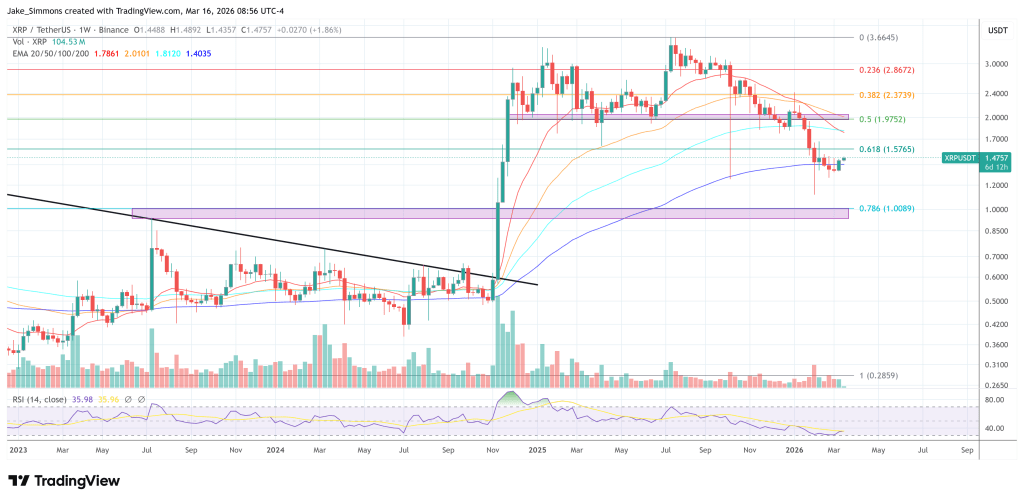
XRP rises back above the 200-week EMA, 1-week chart | Source: XRPUSDT on TradingView.com

Crypto di tendenza

Domande pertinenti

QWhat is the main criticism that Chainlink Community Liaison Zach Rynes makes about the XRP Ledger?

AZach Rynes criticizes the XRP Ledger as being a 'ghost chain' and argues that its original investment thesis as a bridge asset has been overtaken by stablecoins and modern interoperability infrastructure.

QAccording to Rynes, what has become the dominant 'bridge currency' in the crypto industry instead of XRP?

AAccording to Rynes, USD-backed stablecoins have become the dominant crypto-native 'bridge currency' for payments, trading, and finance.

QHow does Rynes describe the relationship between Ripple's business model and XRP holders?

ARynes alleges that Ripple 'socializes its costs to XRP holders and privatizes gains for its equity shareholders,' meaning XRP sales fund products whose revenue goes to Ripple rather than directly to token holders.

QWhat was Bill Morgan's key counterargument regarding the comparison between XRP tokens and company shares?

ABill Morgan argued that it is a 'false equivalence' to compare token buybacks to equity buybacks because a token is nothing like a share and has no rights attached to it like a share does.

QWhat reason did Bill Morgan give for Ripple using an independent vehicle like Evernorth instead of managing XRP directly?

AMorgan stated that using an independent vehicle like Evernorth was preferable to avoid regulatory scrutiny, especially since the SEC had previously pointed to Ripple's efforts to support XRP's price in litigation.

Letture associate

Analyzing the Impact of AI on Economic Growth and Productivity

**Title: Analyzing AI's Impact on Economic Growth and Productivity** This article examines three contrasting views on AI's influence on economic growth and productivity. **The Optimistic View** posits that AI, especially through automating R&D ("recursive self-improvement"), could dramatically accelerate growth, even triggering a technological "singularity" with explosive, potentially infinite, economic expansion. **The Moderate/Mainstream View** acknowledges AI's productivity benefits but emphasizes significant real-world constraints that could limit its impact. These include: limited cost savings per task, structural ceilings on which jobs and industries are "exposed" to AI, adoption bottlenecks (e.g., compute, energy, regulatory hurdles), and the "weak link" effect where non-automatable tasks cap overall gains. Consequently, the realized AI dividend may be far lower than optimistic projections, with estimates typically ranging from 0.1% to 1.3% annual productivity growth. **The Pessimistic View** stems from two strands. The first aligns with the moderate view but applies extremely conservative assumptions about task exposure and efficiency gains, yielding minimal projected impact. The second introduces a demand-side critique: if AI primarily replaces rather than augments labor, it could depress labor's share of income, weaken consumer demand, and create a "demand trap" that ultimately stifles growth, unless offset by redistribution policies. **The authors' assessment** is nuanced: * **Short-term (1-2 years):** AI will support growth primarily through investment spending, not significant productivity gains. * **Medium-term (3-5 years):** Three potential paths emerge based on AI demand and bottleneck severity: 1. **"Optimistic Path":** High demand, few bottlenecks. Rapid productivity gains but risk of major job displacement and social conflict without redistribution. 2. **"Moderate Path" (most likely):** High demand but significant, surmountable bottlenecks. Leads to moderate productivity gains, financial market volatility (K-shaped returns), and sectoral job losses. 3. **"Pessimistic Path":** Low demand or severe bottlenecks. Minimal productivity and growth impact, triggering financial market corrections but allowing a smoother societal transition with less labor disruption. * **Long-term:** AI holds potential for a major productivity revolution and prosperity. The conclusion stresses that no path is smooth. Technologically "optimistic" outcomes could be socially detrimental, while "pessimistic" technological diffusion might be more socially stable. Policymakers must monitor developments and prepare balanced responses to manage economic, financial, and social sustainability.

marsbit23 min fa

Analyzing the Impact of AI on Economic Growth and Productivity

marsbit23 min fa

The New Cold War is a Tech Stock War

The New Cold War is a Tech Stock War The article argues that the contemporary geopolitical and economic rivalry between the US and China represents a "New Cold War," but one fundamentally fought through technology and financial markets, not physical barriers or conventional trade. Historically, US dominance was secured through financial systems. The Soviet Union, reliant on the rigid "Transferable Ruble," was ultimately undermined by its dependency on the US dollar for oil trade. Later, Japan's semiconductor challenge was countered not just by tariffs (e.g., Plaza Accord, 301 investigations) but by binding it to US Treasury bonds. China presents a more complex, "embedded" challenger. While it holds vast dollar reserves and US debt like Japan, its industrial base is stronger and more diversified than the Soviet Union's. Surviving the initial 2018 trade war phase, the conflict has evolved into a "tech-financial war." The core battlefield is now the stock market. US tech stocks (AI, semiconductors) are treated as sovereign assets, buoyed by bipartisan national will. China is pushing to strengthen its own financial markets to convert industrial strength into financial power and fund its tech ambitions. Companies like ChangXin (semiconductors), Moonshot AI, and DJI compete not just for market share but as financial proxies for their respective systems. The new paradigm is moving from globally efficient monopolies (Apple, Google) towards companies that achieve monopolistic profits within their respective geopolitical spheres. This competition over "pricing power" and financial valuation in segmented markets defines the current era, making the stock market the primary arena for this tech-centric struggle.

marsbit32 min fa

The New Cold War is a Tech Stock War

marsbit32 min fa

RWA Weekly: Ten European Financial Institutions Establish Tokenized Asset Cooperative; Ondo Launches New Execution Network Ondo Network

RWA Weekly: European Banks Form Tokenized Asset Cooperative; Ondo Launches New Execution Network Ondo Network Covering July 24-31, 2026, the RWA sector saw a steady on-chain total value locked (TVL) of $36.8 billion, with holder count hitting a record high. However, stablecoin transfer volumes fell sharply (~30%), indicating low on-chain settlement demand. Key regulatory moves include South Korea advancing stablecoin legislation and a push to scrap crypto taxes, Kenya lowering capital requirements for stablecoin issuers, and Zimbabwe approving seven projects for its crypto sandbox. In project developments, BIS-led Project Agorá successfully tested cross-border payments with tokenized funds across six currencies. Ten major European financial institutions formed the RL1 blockchain cooperative to build tokenized asset infrastructure. Other notable updates: Aviva launched a tokenized dollar liquidity fund on XRPL, POSCO International tokenized commercial invoices on Injective, and a Brazilian farmer used tokenized cattle as collateral for a loan. Additional progress includes BNY Mellon migrating its core transfer agent operations to blockchain, Securitize gaining SEC investment advisor registration, and Tether’s compliant stablecoin USA₮ launching on Celo. Ondo Finance introduced Ondo Network, a new execution layer focused on speed and privacy, moving away from its initial chain plans. An analysis highlights that despite the growing scale of on-chain RWAs (~$32B), approximately 90% remain underutilized in DeFi, pointing to a critical challenge in unlocking liquidity and fostering real-world application beyond mere issuance.

marsbit33 min fa

RWA Weekly: Ten European Financial Institutions Establish Tokenized Asset Cooperative; Ondo Launches New Execution Network Ondo Network

marsbit33 min fa

Trading

Spot

Articoli Popolari

Cosa è XRP 2.0

XRP 2.0: Una Nuova Frontiera nel Paesaggio delle Criptovalute Introduzione a XRP 2.0 Nel mondo in continua evoluzione delle criptovalute, nuovi progetti emergono continuamente, cercando attenzione e adozione. Una tale iniziativa promettente è XRP 2.0, un nuovo progetto di criptovaluta progettato per sfruttare avanzate tecnologie blockchain e metodologie di crittografia robuste. Anche se il nome richiama alla mente l'XRP di Ripple, è fondamentale notare che XRP 2.0 opera in modo indipendente, concentrandosi sul miglioramento della sicurezza delle transazioni, della privacy e della scalabilità. Mentre il panorama finanziario digitale abbraccia sempre di più soluzioni decentralizzate, XRP 2.0 mira a contribuire in modo significativo al web3 e all'espansione generale dei progetti crypto. Cos'è XRP 2.0? Alla sua base, XRP 2.0 è un progetto di criptovaluta che mira a creare un ecosistema di valuta digitale sicuro e decentralizzato. La sua tecnologia fondamentale integra principi di blockchain sofisticati con tecniche di crittografia all'avanguardia. L'obiettivo principale di XRP 2.0 è quello di affermarsi come una piattaforma affidabile ed efficiente in grado di consentire un'esecuzione rapida delle transazioni, dando priorità a migliori protezioni della privacy per i suoi utenti. Il progetto è promosso come una soluzione a molte limitazioni affrontate dalle criptovalute esistenti, proponendo un sistema in grado di gestire un volume maggiore di transazioni con migliorata velocità e privacy. Questa versatilità pone XRP 2.0 come un significativo competitor in un mercato affollato di varie valute digitali. Chi è il Creatore di XRP 2.0? L'identità del creatore dietro XRP 2.0 è stata segnalata come 'Wilbur'. Tuttavia, i dettagli completi riguardanti Wilbur o l'entità associata rimangono sfuggenti. L'anonimato di molti creatori di criptovalute non è un fenomeno raro nel settore, spesso progettato per mantenere un certo grado di privacy e sicurezza. Chi sono gli Investitori di XRP 2.0? Al momento, informazioni specifiche relative alle fondazioni o organizzazioni di investimento a supporto di XRP 2.0 non sono disponibili pubblicamente. Nel settore delle criptovalute, il supporto di investitori rinomati può influenzare significativamente la credibilità e il successo di un progetto, tuttavia la trasparenza riguardo ai sostenitori finanziari di XRP 2.0 non è stata stabilita. Come Funziona XRP 2.0? XRP 2.0 si distingue per l'impiego di una combinazione di tecnologia blockchain e algoritmi di crittografia avanzati che garantiscono transazioni sicure e decentralizzate. La sua struttura innovativa include caratteristiche uniche progettate per promuovere il coinvolgimento degli utenti e ampliare le funzionalità oltre le transazioni convenzionali delle criptovalute. Tra queste caratteristiche, XRP 2.0 incorpora capacità alimentate da intelligenza artificiale, come funzionalità di testo in immagini e testo in voce. Queste aggiunte sono progettate per migliorare l'esperienza interattiva per gli utenti, promuovendo una maggiore applicabilità in vari settori. Unendo progressi tecnologici con design incentrati sugli utenti, XRP 2.0 mira a catturare l'attenzione di una vasta gamma di individui e aziende che cercano di integrare soluzioni di criptovaluta nei loro framework operativi. Cronologia di XRP 2.0 Comprendere XRP 2.0 richiede di esaminare i traguardi che hanno definito il suo percorso fino ad ora: 23 luglio 2023: XRP 2.0 viene introdotto come un nuovo progetto di criptovaluta, mirante a rivoluzionare le capacità di transazione sicura e decentralizzata nel dominio blockchain. 8 settembre 2023: Si verifica il lancio di un altro progetto, XRP20, marcando l'emergere di un token ERC-20 sulla blockchain di Ethereum che resta non correlato a XRP 2.0. 13 novembre 2023: Il ledger XRP subisce un significativo aggiornamento con il rilascio della versione 2.0.0 del software server rippled. È essenziale notare che questo sviluppo è scollegato dal progetto di criptovaluta XRP 2.0. Punti Chiave su XRP 2.0 Per distillare l'essenza di XRP 2.0, emergono diversi fattori critici: Caratteristiche Uniche: L'inclusione di funzionalità come il testo in immagini e testo in voce alimentato da intelligenza artificiale diversifica ulteriormente le potenziali applicazioni di XRP 2.0. Tecnologia Blockchain: Il framework utilizza meccanismi blockchain avanzati e protocolli di crittografia, garantendo un ambiente sicuro e decentralizzato per le transazioni. Scalabilità e Privacy: XRP 2.0 dà priorità a migliori protezioni della privacy nei processi di transazione e alla scalabilità necessaria per accogliere una base di utenti in crescita. Nessuna Affiliazione con Ripple: È importante notare che, nonostante il suo nome, XRP 2.0 non ha alcuna fedeltà o collaborazione con l'XRP di Ripple, distinguendo il proprio framework operativo e obiettivi all'interno dell'ecosistema delle criptovalute. Conclusione XRP 2.0 rappresenta un'ambiziosa venture nell'ambito delle criptovalute, mirante a offrire una combinazione di sicurezza, privacy ed efficienza nelle transazioni digitali. Integrando tecnologie sofisticate e caratteristiche user-friendly, il progetto si propone di ampliare gli orizzonti di ciò che le criptovalute possono realizzare nell'economia digitale odierna. Sebbene l'anonimato del suo creatore e la mancanza di investitori dichiarati possano sollevare domande per alcuni, il focus di XRP 2.0 su funzionalità avanzate e decentralizzazione ne amplifica l'appeal in un mercato crypto sempre più affollato. Man mano che il panorama delle criptovalute continua a evolversi, XRP 2.0 potrebbe emergere come un attore decisivo nell'espansione di soluzioni blockchain sicure e scalabili.

219 Totale visualizzazioniPubblicato il 2024.04.05Aggiornato il 2024.12.03

Cosa è XRP 2.0

Come comprare XRP

Benvenuto in HTX.com! Abbiamo reso l'acquisto di XRP (XRP) semplice e conveniente. Segui la nostra guida passo passo per intraprendere il tuo viaggio nel mondo delle criptovalute.Step 1: Crea il tuo Account HTXUsa la tua email o numero di telefono per registrarti il tuo account gratuito su HTX. Vivi un'esperienza facile e sblocca tutte le funzionalità,Crea il mio accountStep 2: Vai in Acquista crypto e seleziona il tuo metodo di pagamentoCarta di credito/debito: utilizza la tua Visa o Mastercard per acquistare immediatamente XRPXRP.Bilancio: Usa i fondi dal bilancio del tuo account HTX per fare trading senza problemi.Terze parti: abbiamo aggiunto metodi di pagamento molto utilizzati come Google Pay e Apple Pay per maggiore comodità.P2P: Fai trading direttamente con altri utenti HTX.Over-the-Counter (OTC): Offriamo servizi su misura e tassi di cambio competitivi per i trader.Step 3: Conserva XRP (XRP)Dopo aver acquistato XRP (XRP), conserva nel tuo account HTX. In alternativa, puoi inviare tramite trasferimento blockchain o scambiare per altre criptovalute.Step 4: Scambia XRP (XRP)Scambia facilmente XRP (XRP) nel mercato spot di HTX. Accedi al tuo account, seleziona la tua coppia di trading, esegui le tue operazioni e monitora in tempo reale. Offriamo un'esperienza user-friendly sia per chi ha appena iniziato che per i trader più esperti.

1.6k Totale visualizzazioniPubblicato il 2024.12.10Aggiornato il 2026.06.02

Come comprare XRP

Discussioni

Benvenuto nella Community HTX. Qui puoi rimanere informato sugli ultimi sviluppi della piattaforma e accedere ad approfondimenti esperti sul mercato. Le opinioni degli utenti sul prezzo di XRP XRP sono presentate come di seguito.

活动图片