XRP Ledger Hits No. 4 In RWA Rankings In Less Than A Year

bitcoinistPubblicato 2026-05-22Pubblicato ultima volta 2026-05-22

Introduzione

The XRP Ledger has rapidly risen to fourth place in RWA.xyz's network rankings for tokenized real-world assets in less than a year, now holding a total distributed RWA value of $4.1 billion. This positions XRPL behind only Canton, Ethereum, and Provenance, and ahead of networks like BNB Chain and Solana. The ledger's 30-day growth rate of 45.97% is the highest among the top ten, starkly contrasting with declines seen on other major networks. RippleX highlighted this as one of the fastest-growing RWA ecosystems, now hosting a diverse range of tokenized assets including US Treasuries, money market funds, and commercial paper. While Canton dominates the sector with an 83.73% market share ($313.6 billion), XRPL's ascent signals its emergence as a notable player in the competitive institutional tokenization market. Broader sector data shows distributed asset value at $33.87 billion, with US Treasury debt as the largest tokenized category at $15.3 billion.

XRP Ledger has moved into fourth place on RWA.xyz’s network rankings, according to RippleX, marking a rapid climb for the blockchain in the tokenized real-world asset sector. The move puts XRPL behind Canton, Ethereum and Provenance by total distributed RWA value, while placing it ahead of BNB Chain, zkSync Era, Solana, Stellar and Avalanche.

XRP Ledger Jumps To No. 4 In RWA Rankings

RippleX framed the milestone as one of the faster growth stories in tokenized assets. “In less than a year, XRP Ledger has climbed from the top 10 to #4 on the @RWA_xyz league table, making it one of the fastest-growing RWA ecosystems in the space,” the team wrote on X.

“Today, XRPL is home to a growing range of tokenized financial assets onchain, from US Treasuries and money market funds to commercial paper, structured credit, and more. Bringing assets onchain is an important milestone. Expanding what those assets can enable across financial markets is part of the broader opportunity ahead, and one the XRP community is building toward together,” Ripple added.

The RWA.xyz data places XRP Ledger at $4.1 billion in total distributed RWA value, with 302 listed RWAs and a 1.09% market share. The network’s 30-day growth rate stands out sharply among the top ten, rising 45.97% over the period. That compares with declines of 4.92% for Canton, 4.37% for Ethereum and 4.36% for BNB Chain, while Provenance rose 6.37%, Solana climbed 8.24%, Stellar gained 11.33% and Avalanche increased 39.29%.

Canton remains the dominant network in the table by a wide margin, with $313.6 billion in total value and an 83.73% market share. Ethereum ranks second with $19.0 billion and a 5.08% share, followed by Provenance with $18.0 billion and 4.80%. XRP Ledger’s fourth-place position therefore does not yet imply parity with the largest RWA networks by value, but it does show that XRPL has become a visible venue in an increasingly competitive institutional tokenization market.
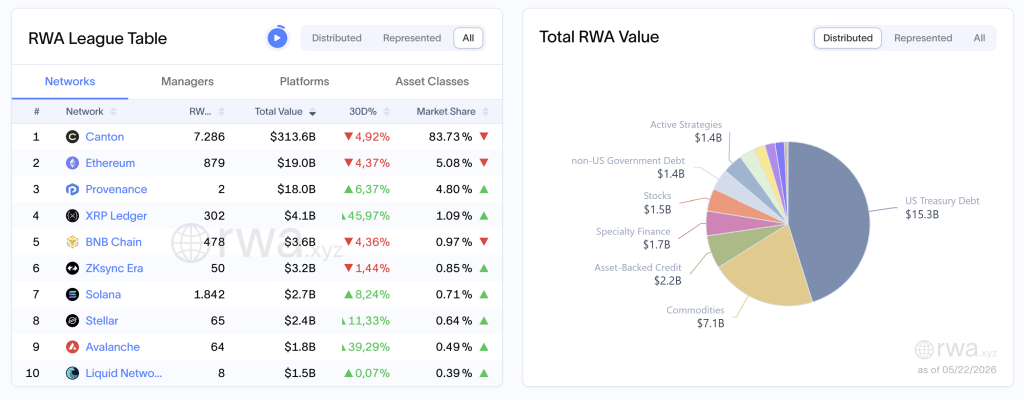
RWA ranking by networks | Source: X RWA.xyz

The broader market data from RWA.xyz shows the sector continuing to expand unevenly. Distributed asset value stood at $33.87 billion, up 1.77% over 30 days, while represented asset value was listed at $340.04 billion, down 2.98% over the same period. Total asset holders reached 800,067, up 8.04% from 30 days earlier. Stablecoin figures were substantially larger, with total stablecoin value at $305.08 billion and total stablecoin holders at 256.21 million.
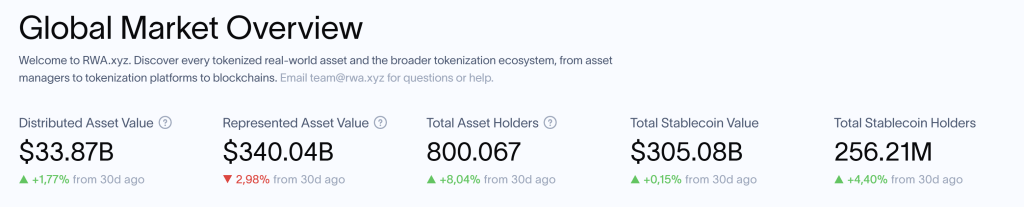
RWA globals market overview | Source: X RWA.xyz

The composition of distributed RWA values also shows where tokenization activity is currently concentrated. US Treasury debt accounted for $15.3 billion, the largest category shown, followed by commodities at $7.1 billion. Asset-backed credit stood at $2.2 billion, specialty finance at $1.7 billion, stocks at $1.5 billion, non-US government debt at $1.4 billion and active strategies at $1.4 billion.

At press time, XRP traded at $1.3596.
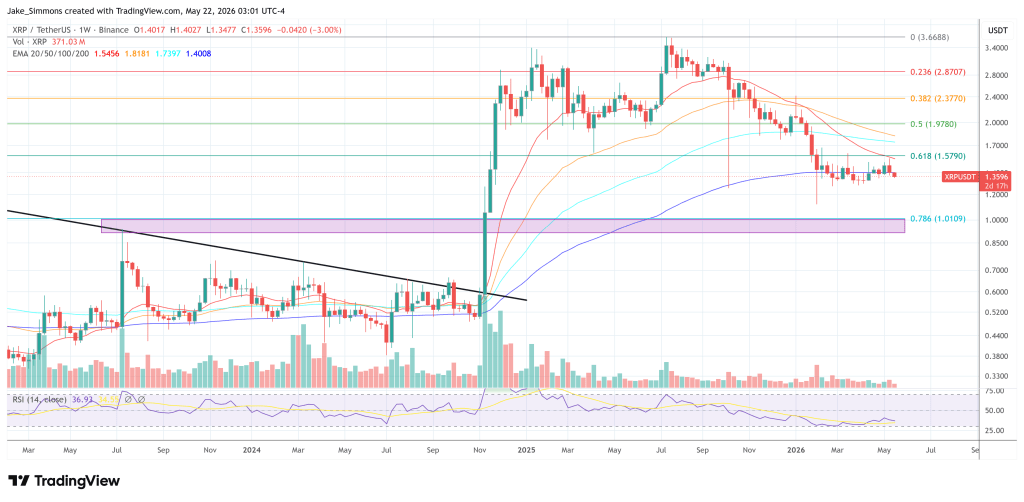
XRP bulls must break the 0.618 Fib, 1-week chart | Source: XRPUSDT on TradingView.com

Crypto di tendenza

Domande pertinenti

QAccording to the article, what position did XRP Ledger achieve in RWA.xyz's network rankings and what is its total distributed RWA value?

AXRP Ledger achieved the 4th position in RWA.xyz's network rankings, with a total distributed RWA value of $4.1 billion.

QWhat does RippleX highlight as one of the key characteristics of XRP Ledger's rise in the RWA rankings?

ARippleX highlights that XRP Ledger is one of the fastest-growing RWA ecosystems, having climbed from the top 10 to #4 in less than a year.

QHow does XRP Ledger's 30-day growth rate in distributed RWA value compare to other top networks like Ethereum and Canton?

AXRP Ledger's 30-day growth rate was a sharp increase of 45.97%. In contrast, Ethereum declined by 4.37% and Canton declined by 4.92% over the same period.

QWhat are the two largest categories of tokenized Real-World Assets by distributed value, according to the broader market data from RWA.xyz?

AThe two largest categories are US Treasury debt at $15.3 billion and commodities at $7.1 billion.

QDespite being ranked #4, why does the article state that XRP Ledger does not yet have parity with the largest RWA networks?

AIt does not have parity because the top networks like Canton, Ethereum, and Provenance have significantly larger total values and market shares. For example, Canton has $313.6 billion and an 83.73% share, while XRP Ledger has $4.1 billion and a 1.09% share.

Letture associate

Buyback and Burn: Just Empty Promises? The Unbridgeable Rights Gap Between Tokens and Equity

"Token Repurchase and Burn: An Empty Promise? The Unbridgeable Rights Gap Between Tokens and Equity" Holding company stock grants shareholders residual claim rights - a legally enforceable entitlement to remaining assets after all other obligations are paid. This comes with rights like voting, dividends, and a share in sale proceeds. Crypto protocols have long promised token holders similar benefits: governance participation and a share of future growth. However, this narrative is fundamentally flawed and built on voluntary promises, not enforceable legal rights. The core difference is that token holders lack any legally enforceable claim to a protocol's underlying value or revenues. Common mechanisms like using protocol revenue to buy back and burn tokens are purely discretionary; the team can alter or stop the policy at any time. Token holders have no legal recourse. This rights gap becomes critically apparent when protocols introduce traditional equity alongside tokens, as seen with Venice AI's $65M funding round. Equity investors hold legal contracts with rights to company assets and profits, while token holders' benefits depend entirely on the continued goodwill of the protocol's management. The acquisition of Houdini Swap, where equity holders were paid while token holders received nothing, starkly illustrates this disparity. Upcoming legislation like the CLARITY Act threatens to eliminate the regulatory gray area that has allowed this ambiguous "pseudo-equity" narrative. The Act would classify tokens as either digital commodities (regulated by CFTC) or investment contract assets/securities (regulated by SEC). Protocols aiming for the "digital commodity" classification would be explicitly prohibited from granting token holders any legal claim to corporate revenue, profits, or assets. Promising that tokens will appreciate from protocol profits would likely classify them as securities. Projects like Aave are attempting technical solutions, such as its automated, on-chain "Aavenomics 3.0" buyback mechanism. However, this remains code that the governance body could still vote to change, not an immutable legal contract. The industry faces a clear fork: either acknowledge tokens as digital commodities and stop promising economic rights tied to corporate profits, or formally register tokens as securities and bear the associated compliance burden. The decade-long narrative equating tokens with ownership is built on unenforceable promises. The entry of traditional equity investors with real legal rights exposes this foundational weakness, which may unravel with the next major funding deal.

Foresight News1 h fa

Buyback and Burn: Just Empty Promises? The Unbridgeable Rights Gap Between Tokens and Equity

Foresight News1 h fa

Navigating the World of Event Trading: Top 5 Prediction Markets for Every Type of User

The prediction market industry has grown significantly, with trading volumes exceeding $20 billion monthly by mid-2026, driven by sports, politics, and macroeconomics. Success now depends heavily on platform choice and execution logistics. This guide compares five leading networks: **Polymarket**: A high-volume, decentralized platform on Polygon, using USDC for international and crypto-native users. It offers diverse markets but lacks built-in risk tools. **Kalshi**: A CFTC-regulated U.S. exchange for institutional traders, using direct fiat. It leads in regulated volume, especially for major sports and economic events, but has limited contract listings. **Outpoll**: A CeDeFi platform for advanced traders, focusing on professional tools. It uniquely features built-in stop-loss/take-profit orders, 0.1% fees, and full API support, with settlement in USDC. **OG Predictive**: A CFTC-regulated, sports-focused platform from Crypto.com. It offers granular player props and a flat fee structure, appealing to long-term position traders. **Manifold Markets**: A play-money, no-KYC platform for casual users and developers. It allows user-generated markets on any topic with zero fees, serving as a sandbox for strategy testing. Key differentiators include regulatory models (regulated vs. decentralized), funding (fiat vs. crypto), order types, risk management features, API access, and mobile support. The conclusion emphasizes that in today's event trading, profitability hinges not just on accurate predictions but on optimizing execution through platform infrastructure, liquidity, fees, and risk tools.

TheNewsCrypto2 h fa

Navigating the World of Event Trading: Top 5 Prediction Markets for Every Type of User

TheNewsCrypto2 h fa

Trading

Spot

Articoli Popolari

Come comprare 4

Benvenuto in HTX.com! Abbiamo reso l'acquisto di 4 (4) semplice e conveniente. Segui la nostra guida passo passo per intraprendere il tuo viaggio nel mondo delle criptovalute.Step 1: Crea il tuo Account HTXUsa la tua email o numero di telefono per registrarti il tuo account gratuito su HTX. Vivi un'esperienza facile e sblocca tutte le funzionalità,Crea il mio accountStep 2: Vai in Acquista crypto e seleziona il tuo metodo di pagamentoCarta di credito/debito: utilizza la tua Visa o Mastercard per acquistare immediatamente 44.Bilancio: Usa i fondi dal bilancio del tuo account HTX per fare trading senza problemi.Terze parti: abbiamo aggiunto metodi di pagamento molto utilizzati come Google Pay e Apple Pay per maggiore comodità.P2P: Fai trading direttamente con altri utenti HTX.Over-the-Counter (OTC): Offriamo servizi su misura e tassi di cambio competitivi per i trader.Step 3: Conserva 4 (4)Dopo aver acquistato 4 (4), conserva nel tuo account HTX. In alternativa, puoi inviare tramite trasferimento blockchain o scambiare per altre criptovalute.Step 4: Scambia 4 (4)Scambia facilmente 4 (4) nel mercato spot di HTX. Accedi al tuo account, seleziona la tua coppia di trading, esegui le tue operazioni e monitora in tempo reale. Offriamo un'esperienza user-friendly sia per chi ha appena iniziato che per i trader più esperti.

385 Totale visualizzazioniPubblicato il 2025.10.20Aggiornato il 2026.06.02

Come comprare 4

Discussioni

Benvenuto nella Community HTX. Qui puoi rimanere informato sugli ultimi sviluppi della piattaforma e accedere ad approfondimenti esperti sul mercato. Le opinioni degli utenti sul prezzo di 4 4 sono presentate come di seguito.

活动图片