XRP Ledger Hard Fork In 8 Days? Upgrade Deadline Sparks Network Split Debate

bitcoinistPubblicato 2026-05-19Pubblicato ultima volta 2026-05-19

Introduzione

The XRP Ledger community is debating whether the mandatory v3.1.3 software upgrade constitutes a hard fork, with critics warning that nodes not updated before the May 27 deadline will be cut off from the network. The update includes a critical fix amendment, which, according to network rules, will automatically activate after a set period. Early data showed a majority of nodes had not upgraded, sparking concerns about a potential network split. Proponents argue the process is not a contentious fork but a standard "amendment blocking" security feature designed to protect network integrity by isolating outdated software. They emphasize that responsible node maintenance is required, and the mechanism ensures all participants correctly interpret transaction rules. Infrastructure experts also note that raw node counts may overstate the risk, as many inactive or non-critical nodes could update last-minute. The debate centers on governance and the operational health of the decentralized network.

The XRP Ledger community is debating whether an approaching v3.1.3 upgrade amounts to a hard fork after infrastructure operators warned that nodes failing to update before the fix amendment activates will no longer be able to communicate with the network.

The dispute erupted after XRPL validator operator Vet said version 3.1.3 of rippled had been available for more than a week, with 40% of the network upgraded at the time of his post (May 18). He warned that the fix amendment included in the release would become active in nine days and that “every node that hasn’t been updated to 3.1.3 will be unable to communicate to the network.”

In a later update, RippleX head of engineering J. Ayo Akinyele said 44% of the XRPL network had upgraded and urged node operators to move quickly, adding: “Only 8 days left before the fix amendment activates — don’t be left out!”

XRPL Hard Fork Debate Heats Up

According to XRPL.org, rippled is the reference server implementation of the XRP Ledger protocol. The 3.1.3 release introduces the fixCleanup3_1_3 amendment, a package of fixes for NFTs, Permissioned Domains, Vaults and the Lending Protocol. Because of the importance of those fixes, XRPL.org said the amendment’s default vote is set to “Yes.”

The “hard fork” framing came from critics who argued that, as of the early upgrade figures, a majority of network nodes were still on the path to being cut off. X user ScamDaddy wrote: “The XRPL will hard fork in 9 days. As of this moment, 60% of the network will be forked off.” The post then turned the argument into a governance challenge: “But who’s to say 3.1.3 should be XRP mainnet, Ripple? Vet? 60% is the majority after all!”

That framing drew pushback from XRPL community members who argued the mechanism is better understood as amendment blocking, not an accidental or contentious chain split. XRPL’s amendment system uses validator voting to approve protocol changes that affect transaction processing. According to XRPL.org, an amendment passes if it receives more than 80% support from trusted validators for two weeks, after which the change applies permanently to future ledger versions.

The technical consequence for outdated servers is still material. XRPL.org says amendment blocking is a security feature intended to protect data accuracy when old software no longer understands the active rules of the network. Servers running earlier versions without the amendment code cannot determine ledger validity, submit or process transactions, participate in consensus, or vote on future amendments; upgrading to a newer rippled version unblocks them.

Daniel Keller, Chief Technology Officer (CTO) for Eminence, a blockchain infrastructure company that runs a Full History Node for the XRP Ledger, argued that raw node counts may overstate the operational risk. “The only question is: how many of them actually matter to XRPL operations?” he wrote. “How many are abandoned? How many would just update a few hours late? How many are actually relevant infrastructure?”

Keller framed the cutoff as maintenance discipline rather than a decentralization failure: “Decentralisation does not mean dead weight gets carried. Running a node is a responsibility, not a participation trophy. If you can’t maintain infrastructure, you should get filtered out. That is network hygiene.”

Krippenreiter made a similar case, saying the negative connotation around “forking” can obscure XRPL’s design. “Forking has a negative connotation because it sounds like the network is less secure because of it, when in reality, at least on the XRP Ledger, the amendment block mechanism itself, ironically, is a security feature,” he wrote. “It is a security mechanism so that no transaction data or rules on XRPL are interpreted wrongly by any node that didn’t already update.”

At press time, XRP traded at $1.38.
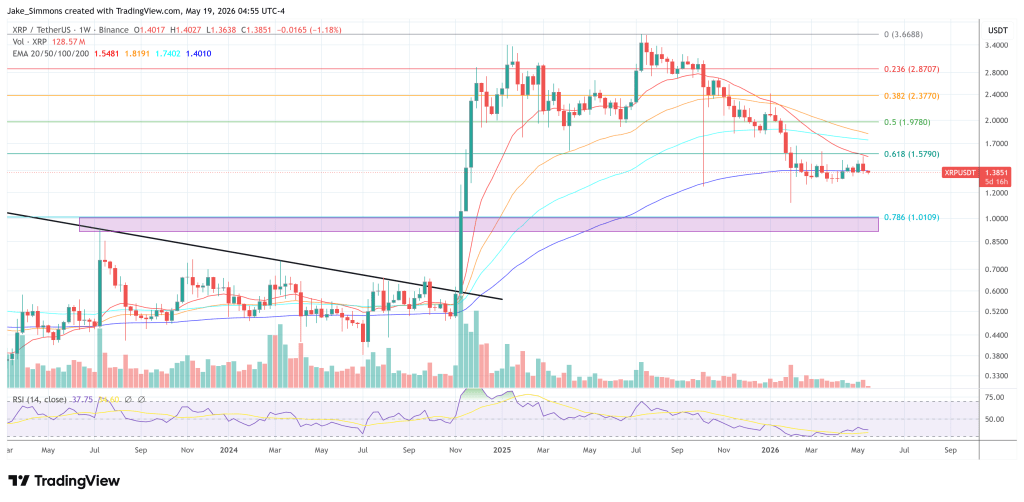
XRP bulls must break the 0.618 Fib, 1-week chart | Source: XRPUSDT on TradingView.com

Domande pertinenti

QWhat is the main debate in the XRP Ledger community regarding the v3.1.3 upgrade?

AThe debate is over whether the approaching v3.1.3 upgrade constitutes a hard fork that could split the network, or if it is better understood as a standard amendment blocking process, which is a security feature to protect data accuracy.

QWhat happens to nodes that fail to update to rippled version 3.1.3 before the fix amendment activates?

ANodes that have not been updated to version 3.1.3 will be unable to communicate with the network. They cannot determine ledger validity, submit or process transactions, participate in consensus, or vote on future amendments.

QWhat is the purpose of the fixCleanup3_1_3 amendment included in the rippled 3.1.3 release?

AThe fixCleanup3_1_3 amendment is a package of fixes for NFTs, Permissioned Domains, Vaults, and the Lending Protocol on the XRP Ledger.

QAccording to critics, why was the situation framed as a 'hard fork'?

ACritics framed it as a 'hard fork' because, based on early upgrade figures, a majority (60%) of network nodes were on a path to being cut off, which they argued could create a governance challenge about which chain should be considered the mainnet.

QHow do defenders of the process, like Daniel Keller, view the potential cutoff of outdated nodes?

ADefenders like Daniel Keller view the cutoff as necessary maintenance discipline and 'network hygiene,' arguing that decentralization does not mean carrying 'dead weight.' Running a node is a responsibility, and outdated infrastructure that cannot be maintained should be filtered out.

Letture associate

A Nation Blocks Chips, a Giant Buys a Nuclear Power Plant: Why It's Time to Seriously Consider DeAI

**Title: Great Powers Blockade Chips, Giants Buy Nuclear Plants: Why It's Time to Seriously Consider DeAI** In May 2026, the US closed loopholes for Chinese firms to acquire advanced NVIDIA chips via overseas subsidiaries. That same month, Kenya halted a $1B geothermal data center project involving Microsoft, fearing its immense energy consumption. Meanwhile, Huawei announced mass production of its Ascend AI chip. These disparate events underscore a new reality: the competition for computing power ("compute") has escalated beyond the tech industry, becoming a geopolitical and infrastructural battleground. A new era of oligopoly is forming, with control over the AI stack—from GPU chips (NVIDIA) and cloud platforms (AWS, Azure, Google Cloud) to foundational models (OpenAI, Anthropic)—concentrating in a few Western "AI Octopus" corporations. This centralization creates systemic risks: pricing power and platform lock-in for users, infrastructure fragility, and a widening "compute divide" that threatens to marginalize nations without independent AI capacity. An "AI Iron Curtain" is deepening through export controls. In response, some nations like Saudi Arabia and the UAE are investing heavily to buy compute power, aiming to transition from oil to AI economies. The EU seeks to triple its compute capacity by 2030 to reduce dependency. However, the spending gap is vast, with four US tech giants alone planning ~$750B in AI capex for 2026. The race is increasingly constrained by energy, with AI tasks consuming up to 1000x more power than web searches, pushing firms to even acquire nuclear plants. This landscape is fueling interest in Decentralized AI (DeAI). It proposes a third way: using open protocols to coordinate a global network of idle GPUs, independent developers, and data centers, creating an AI infrastructure without a single controlling entity. Leveraging blockchain and cryptographic verification, DeAI aims to break market concentration, disperse energy demands, reduce geopolitical dependencies, and enhance transparency. While still nascent in performance and stability, DeAI's core promise is not immediate superiority but providing a crucial alternative architecture to resist monopoly, censorship, and centralized power. As specialized AI hardware costs fall and open-source models flourish, the window to build this foundation is open. The very existence of such competition serves as a vital check against the inevitable abuse of concentrated power.

marsbit45 min fa

A Nation Blocks Chips, a Giant Buys a Nuclear Power Plant: Why It's Time to Seriously Consider DeAI

marsbit45 min fa

Outpoll Review: A Prediction Market Platform Built for Active Traders

Outpoll Review: A Prediction Market Platform Built for Active Traders In recent years, prediction markets have grown from a niche sector to a mainstream arena, attracting billions in trading volume and institutional capital. However, the user experience and tools for traders have not kept pace. Outpoll, a new global prediction market platform, aims to fill this gap by providing enhanced trading infrastructure for active and professional traders. Built on standard prediction market principles, Outpoll allows users to trade on the outcome of specific events. It uses fully collateralized contracts with USDC settlement, charges a competitive 0.1% fee per trade, and provides clear settlement rules upfront to minimize disputes. A key focus for Outpoll is its professional-grade trading tools. The platform supports limit and market orders, as well as take-profit and stop-loss orders for open positions—features uncommon in prediction markets. For automated trading, Outpoll offers comprehensive REST and WebSocket APIs, enabling portfolio management, price arbitrage, and integration with existing tools. The platform also features a creator-led market model, where approved experts and community leaders can create and manage markets for niche topics under platform supervision. Its integrated interface combines news feeds directly with trading functions, allowing users to monitor events and manage positions seamlessly. Outpoll launched with a native Android app (available on Google Play) and plans an iOS version later this year. In summary, Outpoll distinguishes itself with trader-focused tools, practical APIs, transparent and collateralized markets, integrated news, and an expanding creator program. For active traders, its advanced order types and API access alone make it a platform worth watching. Outpoll is now globally accessible via outpoll.com and Google Play.

marsbit53 min fa

Outpoll Review: A Prediction Market Platform Built for Active Traders

marsbit53 min fa

Bitwise: Crypto Becomes a Contrarian Investment, Three Logics to Understand the Current Market

**Summary** Matt Hougan, Bitwise's CIO, analyzes the current crypto market through three key lenses, arguing it has shifted from a momentum-driven to a contrarian investment. **1) Crypto Becomes a Contrarian Play:** The market is weak, with major assets like Bitcoin and Ethereum down significantly. Capital has moved to hot sectors like AI, leaving crypto as an "unloved" asset class. This transforms crypto investing from trend-following to a test of patience and fundamental analysis. Investors now favor projects with solid fundamentals (e.g., Hyperliquid) over speculative ones. **2) Regulatory Overhang:** The uncertain fate of the U.S. CLARITY Act, a major crypto regulatory framework, is a key headwind. With its passage in 2024 seen as far from guaranteed (estimates range from 30-55%), institutional capital remains on the sidelines, choosing less risky alternatives like AI stocks. The market needs clarity—whether the bill passes or fails—more than any specific outcome to move decisively. **3) Capital Rotates to New Fundamentals:** This cycle differs from past bear markets where money fled to Bitcoin. Now, capital seeks smaller assets with strong use cases. While major cryptos fell in May 2024, tokens like Hyperliquid (+72%), Zcash (+50%), and XLM (+44%) rallied on their specific fundamentals. This rotation confirms the new contrarian, fundamentals-driven logic and signals the bear market may be in its later stages. **Conclusion:** Short-term pressure persists due to regulatory uncertainty and competition from AI narratives. Investing in crypto now requires a contrarian mindset—acting against the crowd and focusing on fundamental value. Patience and targeting high-quality projects based on their merits are essential for capturing long-term gains.

marsbit1 h fa

Bitwise: Crypto Becomes a Contrarian Investment, Three Logics to Understand the Current Market

marsbit1 h fa

Trading

Spot
Futures
活动图片