XRP Ledger Gets AI Agent Payments Through Virtuals And t54

bitcoinistPubblicato 2026-03-21Pubblicato ultima volta 2026-03-21

Introduzione

Virtuals Protocol and t54 have integrated "agent commerce" into the XRP Ledger, enabling AI agents to autonomously transact using XRP and RLUSD. The system combines Virtuals' Agent Commerce Protocol (ACP) for commercial workflows—including escrowed jobs, evaluator-based verification, and programmable settlement—with t54's x402 facilitator, which handles payment verification and settlement without traditional API keys or custodial wallets. This infrastructure allows AI agents to programmatically pay for services via standard web requests, leveraging the HTTP 402 payment standard. The collaboration, supported by RippleX, aims to create a native financial environment for autonomous agents, addressing needs like verifiable identity and real-time risk assessment.

Virtuals Protocol and t54 have announced that they are bringing “agent commerce” to the XRP Ledger, a move that would let AI agents transact natively using escrowed jobs, evaluator-based verification and programmable settlement.

The announcement was delivered through coordinated posts from Virtuals, t54 and RippleX rather than a visible standalone press release. Virtuals wrote via X:

“Virtuals is powering agent commerce on XRPL. $95B+ in cumulative transaction volume. 75+ regulatory licenses across global markets. The ledger built from day one for payments is now extending into agent commerce. Together with t54, Virtuals is bringing the commerce infrastructure for agents to transact natively on the XRPL.”

While RippleX only commented: “Agent Commerce is Coming,” t54 added: “Agent commerce is coming to the XRPL. With Virtuals, agents can transact autonomously: escrowed jobs, verification through evaluators, and programmable settlement. Using t54’s x402 facilitator, agents can already natively pay in XRP and RLUSD.”

AI Agents Can Now Pay In XRP And RLUSD

Under the hood, the architecture appears to split cleanly across two layers. Virtuals brings the commerce logic through its Agent Commerce Protocol, or ACP. t54 brings the payment rail through its x402 facilitator, which its documentation describes as infrastructure that “verifies and settles presigned payment transactions” so an API can charge per request “without API keys, custodial wallets, or custom payment glue.” In the same documentation set, t54 shows support for XRP payments and IOU-style assets, including RLUSD.

That matters because x402 is not just a product name inside this announcement. Coinbase describes x402 as an open payment protocol built around the dormant HTTP 402 “Payment Required” status code, designed to let APIs, websites and autonomous agents pay programmatically for access over standard web requests.

In practice, this means an agent can hit a paid endpoint, receive payment requirements, sign a transaction, and have the facilitator submit and settle it on-ledger without the old account-and-session model that most API monetization still relies on.

Virtuals’ role is to give those payments a commercial workflow instead of a raw transfer. In its whitepaper, the protocol describes ACP as a framework for “secure, transparent, and verifiable commerce between autonomous AI agents.”

The mechanics line up closely with RippleX’s summary on X: buyer and provider agents can create jobs, lock payment into smart-contract escrow, route approval through either the buyer or an optional evaluator, and release funds only after successful evaluation.

t54 has been making a broader institutional case for this market since its February seed round, which included strategic participation from Ripple and Virtuals Ventures. At the time, founder Chandler Fang said existing finance rails were built around human actors and now need “agent-native financial primitives” such as verifiable identity, real-time risk assessment and programmable accountability.

At press time, XRP traded at $1.44.
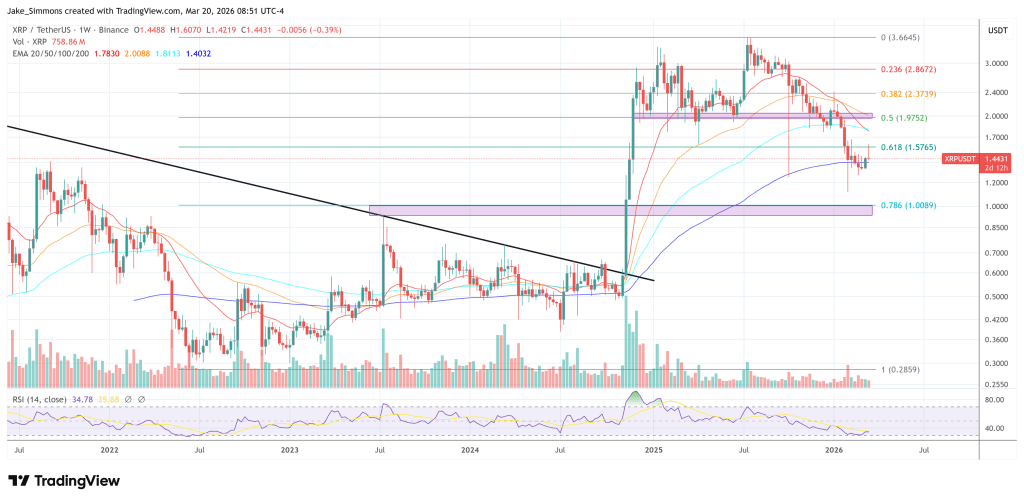
XRP must rise above the 0.618 Fib, 1-week chart | Source: XRPUSDT on TradingView.com

Domande pertinenti

QWhat is the main announcement made by Virtuals Protocol and t54 regarding the XRP Ledger?

AVirtuals Protocol and t54 are bringing 'agent commerce' to the XRP Ledger, enabling AI agents to transact natively using escrowed jobs, evaluator-based verification, and programmable settlement.

QWhich two key technologies are involved in this new agent commerce infrastructure on XRPL?

AVirtuals provides the commerce logic through its Agent Commerce Protocol (ACP), and t54 provides the payment rail through its x402 facilitator.

QWhat cryptocurrencies can AI agents use to pay natively via the t54 x402 facilitator?

AAI agents can natively pay in XRP and RLUSD using the t54 x402 facilitator.

QWhat is the purpose of the x402 payment protocol as described by Coinbase?

ACoinbase describes x402 as an open payment protocol built around the HTTP 402 'Payment Required' status code, designed to allow APIs, websites, and autonomous agents to pay programmatically for access over standard web requests without traditional account-and-session models.

QWhat was Ripple's involvement in t54's February seed round?

ARipple, along with Virtuals Ventures, participated strategically in t54's seed round in February.

Letture associate

Why Do You Always Lose Money on Polymarket? Because You're Betting on News, While the Pros Read the Rules

Why do you always lose money on Polymarket? Because you bet on news, while the pros study the rules. This article explains how top traders ("che tou") profit by meticulously analyzing market rules, not just predicting events. Polymarket, a prediction market platform, often sees disputes over event outcomes due to ambiguous rule wording. For instance, a market asking "Who will be the leader of Venezuela by the end of 2026?" was misinterpreted by many who bet on Delcy Rodríguez, assuming she held power. However, the rules specified "officially holds" as the formally appointed, sworn-in individual. Since Nicolás Maduro was still recognized as president officially, he won the market—even being in prison. To resolve such disputes, Polymarket uses a decentralized arbitration system via UMA protocol. The process involves: 1. Proposal: Anyone can propose a market outcome by staking 750 USDC, earning 5 USDC if unchallenged. 2. Dispute: A 2-hour window allows challenges with a 750 USDC stake; successful challengers earn 250 USDC. 3. Discussion: A 48-hour period on UMA Discord for evidence and debate. 4. Voting: UMA token holders vote in two 24-hour phases (blind then public). Outcomes require >65% consensus and 5M tokens voted; otherwise, four re-votes occur before Polymarket intervention. 5. Settlement: Results are final and automatic. Unlike traditional courts, Polymarket’s system lacks separation between arbitrators and stakeholders—voters often hold market positions, creating conflicts of interest. This leads to herd mentality in discussions and non-transparent outcomes without explanatory rulings, preventing precedent formation. Thus, success on Polymarket hinges on deep rule interpretation, not just event prediction, exploiting gaps between reality and contractual wording.

marsbit35 min fa

Why Do You Always Lose Money on Polymarket? Because You're Betting on News, While the Pros Read the Rules

marsbit35 min fa

DeepSeek Funding: Liang Wenfeng's 'Realist' Pivot

DeepSeek, a leading Chinese AI company, has initiated its first external funding round, aiming to raise at least $300 million at a valuation of no less than $10 billion. This move marks a significant shift from its founder Liang Wenfeng’s previous idealistic stance of rejecting external capital to maintain independence. Despite strong financial backing from its parent company, quantitative trading firm幻方量化 (Huanfang Quant), which provided an estimated $700 million in revenue in 2025 alone, DeepSeek faces mounting challenges. Key issues include a 15-month gap in major model updates, delays in its flagship V4 release, and the loss of several core researchers to competitors offering significantly higher compensation. The company is also undergoing a strategic pivot by migrating its infrastructure from NVIDIA’s CUDA to Huawei’s Ascend platform, a move aligned with China’s push for technological self-reliance amid U.S. export controls. However, DeepSeek lags behind rivals like智谱AI and MiniMax—both now publicly listed—in areas such as product ecosystem, multimodal capabilities, and commercialization. The funding round, though relatively small in scale, is seen as a way to establish a market-validated valuation anchor, making employee stock options more competitive and facilitating talent retention. It also signals DeepSeek’s transition from a pure research-oriented organization to a commercially-driven player in the global AI ecosystem.

marsbit1 h fa

DeepSeek Funding: Liang Wenfeng's 'Realist' Pivot

marsbit1 h fa

Trading

Spot
Futures
活动图片