XRP Ledger Adds Military-Grade Security Via Payments Engine Standard

bitcoinistPubblicato 2025-12-18Pubblicato ultima volta 2025-12-18

Introduzione

Ripple has published the first formal specification for the XRP Ledger’s Payment Engine, developed with formal methods firm Common Prefix. This document aims to provide a canonical reference for payment behavior and cross-asset transfers on the ledger, moving beyond empirical success to mathematical certainty. The initiative addresses the limitations of relying solely on the C++ codebase as the source of truth, which makes it difficult to distinguish intentional design from historical behavior. As the ledger prepares for more complex features—like lending, batch transactions, and decentralized exchange upgrades—this specification ensures clarity and safety. The specification focuses on the Payment Engine and plans to extend to the Consensus Protocol, described as non-negotiable for network safety. Ripple aims to create both human-readable reference and machine-verifiable models to enable formal verification by 2026. The goal is to shift from "code-as-truth" to "mathematics-as-truth," enhancing security and enabling advanced features. The XRP community has welcomed the announcement as a major step toward military-grade security and protocol reliability.

Ripple has published the first formal specification of the XRP Ledger’s Payment Engine, positioning it as a foundational upgrade for protocol safety as XRPL moves into a more feature-dense era. The document was released in partnership with formal methods firm Common Prefix and is intended to become a canonical reference for how payments and cross-asset value transfer behave on-ledger.

The motivation is straightforward, and Ripple does not sugarcoat it. XRPL has operated for more than a decade without downtime, but the team argues that a long track record is still not the same as provable correctness. In the DEV Community post published Dec. 17 under the RippleX Developers banner, the authors write that “to prepare the ledger for the next generation of complex features, we must move beyond empirical success to mathematical certainty.”

A Turning Point For XRP Ledger Security

That is the tone throughout: less victory lap, more engineering debt disclosure. For much of XRPL’s life, the C++ implementation (xrpld) has effectively acted as the only definitive source of truth for core behavior. Ripple’s post calls out a practical problem with that model: “The code tells us, in very precise C++ terms, what it does. It does not always tell us why.” In other words, when code is the spec, it becomes difficult to separate intentional design choices from historical behavior that simply persisted because nothing broke.

That gap starts to matter more as new amendments arrive. Ripple points directly to a pipeline of complex features — including lending, DEX-related work tied to Multi-Purpose Tokens (MPTs), batch transactions, and permissioned DEX concepts — and warns that the number of possible system states expands quickly as new modules “weave into the decades-old logic of the ledger.”

The published specification is hosted on GitHub and labeled as work in progress, but it is already framed as a serious technical artifact: “a technical specification document intended for developers implementing or verifying XRPL payment system behavior.” It also spells out the heart of the system in plain language: the Payment Engine is what “figures out how value should travel and then carries out those moves,” enabling payments to draw across “trust lines, MPTs, order books, AMMs, and direct XRP.”

The deeper point, though, is what this enables next. Ripple’s post lays out a two-part target. First, a human-readable specification that reduces ambiguity and becomes the canonical reference for builders and researchers. Second, a machine-verifiable model — a mathematical representation of the spec — that can support mechanical proofs about system properties and whether proposed changes violate core safety guarantees.

It is also explicit about scope discipline. Ripple argues that specifying the entire ledger in one shot is not realistic: “It would be prohibitively expensive and time-consuming to specify the entire system at once.” So the work focuses on what it describes as the two most critical and complex components: the Payment Engine and the Consensus Protocol.

Consensus, in particular, is framed as non-negotiable infrastructure. Ripple describes it as “the heart of the ledger,” adding: “Its correctness is non-negotiable and underpins the safety and liveness of the entire network.”

The stated objective is to formally model the mechanism to prove properties such as liveness, safety, and finality. On timing, Ripple is clear that this is the starting line, not the finish. After publishing the Payment Engine specification, the team says it intends to begin formal verification work on the Payment Engine and the Consensus Protocol in 2026.

The closing line captures the direction of travel: “The shift from code-as-truth to mathematics-as-truth is underway.”

In the XRP community, the announcement landed with predictable euphoria. “Absolute freaking game changer! ... Aerospace & military grade security incoming,” wrote XRPL validator and community member Vet, adding: “The XRP Ledger is receiving its first formal specification for the payments engine. By mathematically specifying key protocol components [...] Basically, this is the enabler for the endboss of audits AND for other things like complex features or client diversity.”

At press time, XRP traded at $1.83.
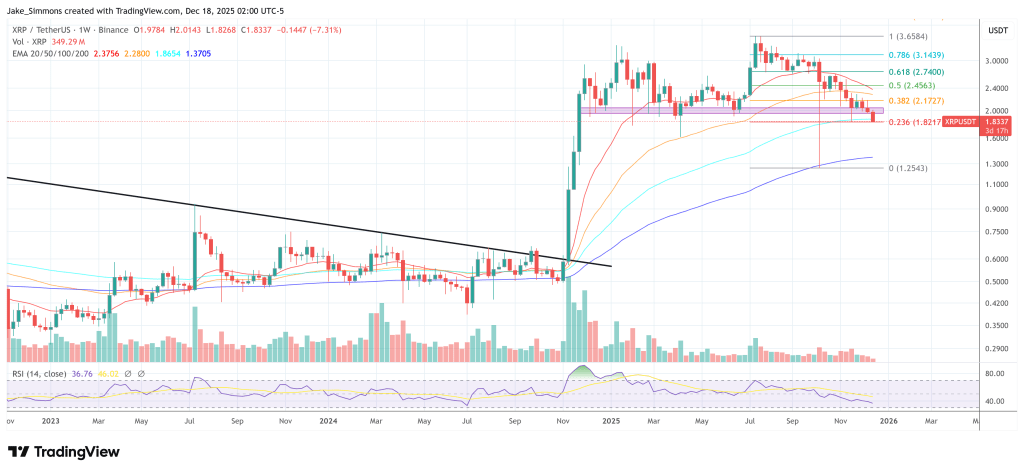
XRP falls below support zone, 1-week chart | Source: XRPUSDT on TradingView.com

Crypto di tendenza

Domande pertinenti

QWhat is the main purpose of Ripple publishing the first formal specification of the XRP Ledger's Payment Engine?

AThe main purpose is to provide a foundational upgrade for protocol safety, moving beyond empirical success to mathematical certainty, and to serve as a canonical reference for how payments and cross-asset value transfer behave on-ledger as the XRPL introduces more complex features.

QWhich two critical components does Ripple's specification work focus on, and why?

AThe work focuses on the Payment Engine and the Consensus Protocol because specifying the entire ledger at once would be prohibitively expensive and time-consuming. These are described as the two most critical and complex components, with consensus being non-negotiable infrastructure that underpins the entire network's safety and liveness.

QWhat practical problem does Ripple identify with having the C++ code (xrpld) as the only definitive source of truth?

AThe code precisely tells what it does in C++ terms but does not always explain why, making it difficult to separate intentional design choices from historical behavior that simply because nothing broke, which becomes a greater issue as new amendments and complex features are added.

QWhat are the two parts of Ripple's target for the XRP Ledger specification?

AFirst, a human-readable specification that reduces ambiguity and becomes the canonical reference for builders and researchers. Second, a machine-verifiable model—a mathematical representation—that can support mechanical proofs about system properties and whether proposed changes violate core safety guarantees.

QWhen does Ripple intend to begin formal verification work on the Payment Engine and Consensus Protocol?

ARipple intends to begin the formal verification work on the Payment Engine and the Consensus Protocol in 2026.

Letture associate

L2 'Recalibration': When L1 Becomes Its Own Rollup, What Is Ethereum's Endgame?

The article discusses the evolving relationship between Ethereum's Layer 1 (L1) and Layer 2 (L2) solutions, moving beyond the initial "L2 for scaling" model. As Ethereum L1 itself scales (increasing Gas Limit, statelessness, zkEVM), the unique value proposition of L2s shifts from merely providing cheap execution to offering differentiated features like application-specific optimization, privacy, and flexible governance. The piece explores three key themes: 1. **L2's New Role:** L2s are transitioning from a pure scaling technology to a spectrum of execution environments with varying degrees of security inheritance from Ethereum L1. 2. **Interoperability as State Trust:** Solving L2 fragmentation is less about cross-chain bridges and more about enabling faster, trust-minimized state verification between environments. This involves initiatives like faster L1 finality, intent-based architectures (Open Intents Framework), and native account abstraction. 3. **Blurring Layers:** With the potential integration of zk-proofs into L1 validation (making L1 akin to its own "Rollup") and the concept of "Native Rollups," the rigid boundary between L1 and L2 may fade. The future could be a unified system with multiple execution domains (for DeFi, gaming, privacy, etc.) sharing a common security, settlement, and state framework. In conclusion, Ethereum's goal is not to abandon L2s or re-centralize everything on L1, but to re-integrate the fragmented user experience—liquidity, accounts, applications—while preserving the scaling benefits of a multi-environment ecosystem. The endgame is a cohesive "one chain" feeling for users, powered by diverse but securely interconnected execution layers.

marsbit21 min fa

L2 'Recalibration': When L1 Becomes Its Own Rollup, What Is Ethereum's Endgame?

marsbit21 min fa

The Encryption Bill Clarity's Challenge: A Thorny Path of Bipartisan Compromise in the U.S.

U.S. lawmakers are attempting to advance the Clarity Act, a significant crypto market structure bill, but its path is fraught with partisan hurdles. The process has been rocky since January, when a prior bipartisan deal in the Senate Banking Committee was upended. A key compromise in May on "yield" issues allowed the bill to move forward in committee, but only with the conditional support of two Democratic senators, Angela Alsobrooks and Ruben Gallego. They emphasized that their final vote depends on reaching an agreement on ethics provisions for elected officials. Ultimately, the Senate Agriculture Committee passed its version along party lines without Democratic support. As Republicans push for a full Senate vote in July, the demand for strong ethics language has expanded beyond Democrats. Additional controversies surround provisions related to yields (aligning some Republicans with large banks) and developer protections (opposed by enforcement agencies). Core concerns about illicit finance and consumer protection remain central to the debate. Despite consensus on the need for legislation, achieving the necessary bipartisan compromise is proving difficult. While momentum exists—including recent meetings between senators and White House officials—a reconciled bill text faces skepticism. Senator Gallego has stated that without ethics terms acceptable to Democrats, they will not provide the needed votes. The immediate goals for the crypto community in Congress are unclear: a symbolic Senate vote before the August recess, eventual passage into law by 2026, or forging a final compromise framework. The arduous, vote-by-vote effort to build bipartisan support continues, mirroring the traditional legislative grind the industry must now navigate.

Foresight News1 h fa

The Encryption Bill Clarity's Challenge: A Thorny Path of Bipartisan Compromise in the U.S.

Foresight News1 h fa

Trading

Spot

Articoli Popolari

Cosa è XRP 2.0

XRP 2.0: Una Nuova Frontiera nel Paesaggio delle Criptovalute Introduzione a XRP 2.0 Nel mondo in continua evoluzione delle criptovalute, nuovi progetti emergono continuamente, cercando attenzione e adozione. Una tale iniziativa promettente è XRP 2.0, un nuovo progetto di criptovaluta progettato per sfruttare avanzate tecnologie blockchain e metodologie di crittografia robuste. Anche se il nome richiama alla mente l'XRP di Ripple, è fondamentale notare che XRP 2.0 opera in modo indipendente, concentrandosi sul miglioramento della sicurezza delle transazioni, della privacy e della scalabilità. Mentre il panorama finanziario digitale abbraccia sempre di più soluzioni decentralizzate, XRP 2.0 mira a contribuire in modo significativo al web3 e all'espansione generale dei progetti crypto. Cos'è XRP 2.0? Alla sua base, XRP 2.0 è un progetto di criptovaluta che mira a creare un ecosistema di valuta digitale sicuro e decentralizzato. La sua tecnologia fondamentale integra principi di blockchain sofisticati con tecniche di crittografia all'avanguardia. L'obiettivo principale di XRP 2.0 è quello di affermarsi come una piattaforma affidabile ed efficiente in grado di consentire un'esecuzione rapida delle transazioni, dando priorità a migliori protezioni della privacy per i suoi utenti. Il progetto è promosso come una soluzione a molte limitazioni affrontate dalle criptovalute esistenti, proponendo un sistema in grado di gestire un volume maggiore di transazioni con migliorata velocità e privacy. Questa versatilità pone XRP 2.0 come un significativo competitor in un mercato affollato di varie valute digitali. Chi è il Creatore di XRP 2.0? L'identità del creatore dietro XRP 2.0 è stata segnalata come 'Wilbur'. Tuttavia, i dettagli completi riguardanti Wilbur o l'entità associata rimangono sfuggenti. L'anonimato di molti creatori di criptovalute non è un fenomeno raro nel settore, spesso progettato per mantenere un certo grado di privacy e sicurezza. Chi sono gli Investitori di XRP 2.0? Al momento, informazioni specifiche relative alle fondazioni o organizzazioni di investimento a supporto di XRP 2.0 non sono disponibili pubblicamente. Nel settore delle criptovalute, il supporto di investitori rinomati può influenzare significativamente la credibilità e il successo di un progetto, tuttavia la trasparenza riguardo ai sostenitori finanziari di XRP 2.0 non è stata stabilita. Come Funziona XRP 2.0? XRP 2.0 si distingue per l'impiego di una combinazione di tecnologia blockchain e algoritmi di crittografia avanzati che garantiscono transazioni sicure e decentralizzate. La sua struttura innovativa include caratteristiche uniche progettate per promuovere il coinvolgimento degli utenti e ampliare le funzionalità oltre le transazioni convenzionali delle criptovalute. Tra queste caratteristiche, XRP 2.0 incorpora capacità alimentate da intelligenza artificiale, come funzionalità di testo in immagini e testo in voce. Queste aggiunte sono progettate per migliorare l'esperienza interattiva per gli utenti, promuovendo una maggiore applicabilità in vari settori. Unendo progressi tecnologici con design incentrati sugli utenti, XRP 2.0 mira a catturare l'attenzione di una vasta gamma di individui e aziende che cercano di integrare soluzioni di criptovaluta nei loro framework operativi. Cronologia di XRP 2.0 Comprendere XRP 2.0 richiede di esaminare i traguardi che hanno definito il suo percorso fino ad ora: 23 luglio 2023: XRP 2.0 viene introdotto come un nuovo progetto di criptovaluta, mirante a rivoluzionare le capacità di transazione sicura e decentralizzata nel dominio blockchain. 8 settembre 2023: Si verifica il lancio di un altro progetto, XRP20, marcando l'emergere di un token ERC-20 sulla blockchain di Ethereum che resta non correlato a XRP 2.0. 13 novembre 2023: Il ledger XRP subisce un significativo aggiornamento con il rilascio della versione 2.0.0 del software server rippled. È essenziale notare che questo sviluppo è scollegato dal progetto di criptovaluta XRP 2.0. Punti Chiave su XRP 2.0 Per distillare l'essenza di XRP 2.0, emergono diversi fattori critici: Caratteristiche Uniche: L'inclusione di funzionalità come il testo in immagini e testo in voce alimentato da intelligenza artificiale diversifica ulteriormente le potenziali applicazioni di XRP 2.0. Tecnologia Blockchain: Il framework utilizza meccanismi blockchain avanzati e protocolli di crittografia, garantendo un ambiente sicuro e decentralizzato per le transazioni. Scalabilità e Privacy: XRP 2.0 dà priorità a migliori protezioni della privacy nei processi di transazione e alla scalabilità necessaria per accogliere una base di utenti in crescita. Nessuna Affiliazione con Ripple: È importante notare che, nonostante il suo nome, XRP 2.0 non ha alcuna fedeltà o collaborazione con l'XRP di Ripple, distinguendo il proprio framework operativo e obiettivi all'interno dell'ecosistema delle criptovalute. Conclusione XRP 2.0 rappresenta un'ambiziosa venture nell'ambito delle criptovalute, mirante a offrire una combinazione di sicurezza, privacy ed efficienza nelle transazioni digitali. Integrando tecnologie sofisticate e caratteristiche user-friendly, il progetto si propone di ampliare gli orizzonti di ciò che le criptovalute possono realizzare nell'economia digitale odierna. Sebbene l'anonimato del suo creatore e la mancanza di investitori dichiarati possano sollevare domande per alcuni, il focus di XRP 2.0 su funzionalità avanzate e decentralizzazione ne amplifica l'appeal in un mercato crypto sempre più affollato. Man mano che il panorama delle criptovalute continua a evolversi, XRP 2.0 potrebbe emergere come un attore decisivo nell'espansione di soluzioni blockchain sicure e scalabili.

199 Totale visualizzazioniPubblicato il 2024.04.05Aggiornato il 2024.12.03

Cosa è XRP 2.0

Come comprare XRP

Benvenuto in HTX.com! Abbiamo reso l'acquisto di XRP (XRP) semplice e conveniente. Segui la nostra guida passo passo per intraprendere il tuo viaggio nel mondo delle criptovalute.Step 1: Crea il tuo Account HTXUsa la tua email o numero di telefono per registrarti il tuo account gratuito su HTX. Vivi un'esperienza facile e sblocca tutte le funzionalità,Crea il mio accountStep 2: Vai in Acquista crypto e seleziona il tuo metodo di pagamentoCarta di credito/debito: utilizza la tua Visa o Mastercard per acquistare immediatamente XRPXRP.Bilancio: Usa i fondi dal bilancio del tuo account HTX per fare trading senza problemi.Terze parti: abbiamo aggiunto metodi di pagamento molto utilizzati come Google Pay e Apple Pay per maggiore comodità.P2P: Fai trading direttamente con altri utenti HTX.Over-the-Counter (OTC): Offriamo servizi su misura e tassi di cambio competitivi per i trader.Step 3: Conserva XRP (XRP)Dopo aver acquistato XRP (XRP), conserva nel tuo account HTX. In alternativa, puoi inviare tramite trasferimento blockchain o scambiare per altre criptovalute.Step 4: Scambia XRP (XRP)Scambia facilmente XRP (XRP) nel mercato spot di HTX. Accedi al tuo account, seleziona la tua coppia di trading, esegui le tue operazioni e monitora in tempo reale. Offriamo un'esperienza user-friendly sia per chi ha appena iniziato che per i trader più esperti.

1.6k Totale visualizzazioniPubblicato il 2024.12.10Aggiornato il 2026.06.02

Come comprare XRP

Discussioni

Benvenuto nella Community HTX. Qui puoi rimanere informato sugli ultimi sviluppi della piattaforma e accedere ad approfondimenti esperti sul mercato. Le opinioni degli utenti sul prezzo di XRP XRP sono presentate come di seguito.

活动图片