XRP Builder Funding Shifts In 2026 As Ripple Backs New Model

bitcoinistPubblicato 2026-02-28Pubblicato ultima volta 2026-02-28

Introduzione

Ripple is shifting its funding model for the XRP Ledger (XRPL) ecosystem in 2026, moving from a centralized structure to a more distributed network involving DAOs, independent hubs, universities, and venture partners. Over $550 million has been deployed since 2017 to support nearly 200 projects. The new approach includes the FinTech Builder Program for institutional-grade financial applications, expanded accelerator partnerships, and community-led initiatives like XAO DAO. Regional expansion includes a dedicated APAC hub and university collaborations. The goal is to provide builders with diverse funding channels and reduce reliance on Ripple as the sole gatekeeper.

Ripple is reshaping how builders on the XRP Ledger get funded in 2026, arguing that the ecosystem has reached a point where support needs to flow through more than Ripple-linked programs alone. The change matters because it signals a deliberate move away from a relatively centralized funding structure toward a broader network of DAOs, independent hubs, universities and venture partners.

In its latest ecosystem update, Ripple said more than $550 million has already been deployed into XRPL initiatives since 2017, spanning non-equity grants, builder incentives, strategic partnerships and growth programs. Since 2021, those efforts have included hackathons, builder bounties, XRPL Grants and the XRPL Accelerator, with nearly 200 projects supported across areas including payments, DeFi, tokenization, AI, gaming, e-commerce and enterprise finance.

XRP Ledger Enters New Phase

The core message is that 2026 marks a structural pivot. Ripple said ecosystem funding has historically flowed through Ripple-supported channels, but that the next phase will lean on a “more distributed model” in which independent organizations, regional hubs, venture firms and community-led initiatives take on a larger role. The company framed the objective as giving builders “multiple channels” to access capital and support, rather than relying on a single gatekeeper.

At the center of that shift is a new FinTech Builder Program aimed at startups building institutional-grade financial applications on XRPL. Ripple said the program will focus on use cases including stablecoin payments, credit infrastructure, tokenization and regulated financial services, while offering more than a traditional grants track. According to the post, founders will get support “across the entire development lifecycle,” from product design through market launch, with help on XRPL integration, strategy and partnerships.

Ripple also outlined a wider support stack around that program. That includes expanded accelerator partnerships with venture firms and startup platforms, regional startup competitions, and builder awards meant to help projects after hackathons or competitions, when early traction still needs a bridge to something durable. The emphasis throughout is less on one-off experimentation and more on getting teams to production-ready financial products.

The more interesting signal, though, may be where decision-making starts to move. Ripple highlighted XAO DAO as a hybrid DAO built for XRPL that will fund developers, community builders and early-stage ideas through microgrants. It said the DAO is designed to “amplify community voice” and create feedback loops where members submit proposals, vote on priorities and help steer the ecosystem’s direction.

In parallel, XRPL Commons is positioned as an independent pillar of support, with Ripple explicitly saying the aim is to ensure that “no single organization becomes the sole gatekeeper” for ecosystem funding.

Other pieces of the 2026 map point to geographic and institutional expansion. Ripple said XRP Asia is being developed as a dedicated APAC hub with a long-term plan for localized funding and regional ecosystem growth.

UDAX, first launched with UC Berkeley in fall 2025, is set to expand this year to Fundação Getulio Vargas in São Paulo, Oxford in the summer, and Berkeley again in the fall. Ripple also pointed to growing venture participation from firms including Dragonfly, Pantera, Franklin Templeton and Tenity as another sign that XRPL is trying to mature from grant-backed experimentation into a venue for fundable, production-scale startups.

At press time, XRP traded at $1.3773.
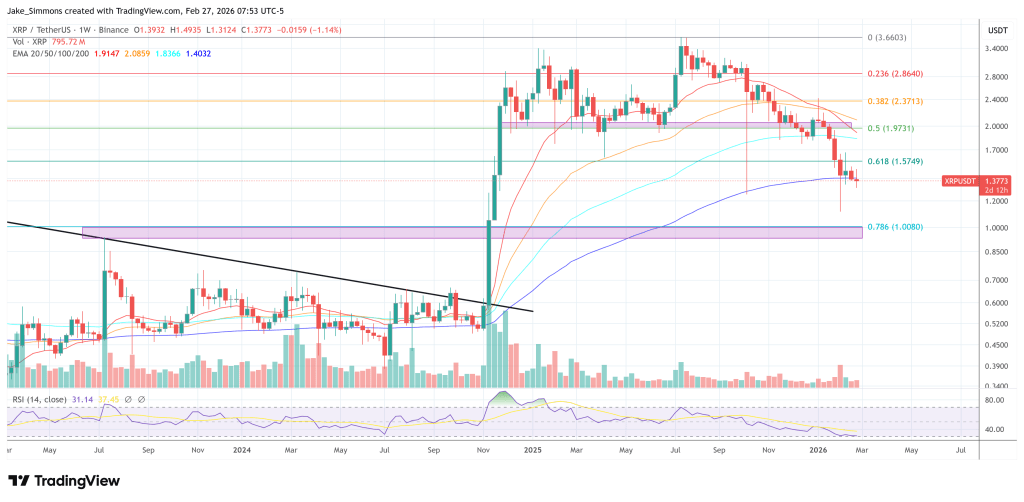
XRP falls below the 200-week EMA agan, 1-week chart | Source: XRPUSDT on TradingView.com

Crypto di tendenza

Letture associate

9.42 Million Retail Investors Compete for Changxin Technology, Who Got Allotted?

Evergreen Technology's IPO subscription results are now available. On July 20, the domestic memory chip giant announced the offline preliminary allotment results and online lottery results for its IPO. A total of approximately 9.43 million retail investors participated in the online subscription, generating 770,000 winning lots with a final winning rate of about 0.4714%, setting a record for new shares on the STAR Market. After triggering a clawback mechanism from institutional to retail investors, the online retail allocation was significantly increased to 3.851 billion shares. Simultaneously, 285 institutional investors participated in the offline subscription, ultimately receiving 2.173 billion shares at an allotment rate of approximately 0.1756%. Leading insurers and public funds were among the major recipients. Notably, Liang Wenfeng, founder of the major AI model company DeepSeek, through his quantitative investment firms Ningbo Huanfang Quantitative and Zhejiang Jiuzhang Asset, secured the largest share among private funds, with a total allotment worth approximately 175 million yuan. Estimates suggest potential profits could reach 730 million yuan if Evergreen Technology's market capitalization reaches 3 trillion yuan post-listing. The company is expected to list on July 27 and could become the highest-valued tech stock on the A-share market, with various brokerages providing valuations ranging from 1 trillion to over 4 trillion yuan. However, recent significant corrections in global tech stocks may impact its post-listing performance. (Character count: 1,196)

marsbit29 min fa

9.42 Million Retail Investors Compete for Changxin Technology, Who Got Allotted?

marsbit29 min fa

L2 'Recalibration': When L1 Becomes Its Own Rollup, What Is Ethereum's Endgame?

The article discusses the evolving relationship between Ethereum's Layer 1 (L1) and Layer 2 (L2) solutions, moving beyond the initial "L2 for scaling" model. As Ethereum L1 itself scales (increasing Gas Limit, statelessness, zkEVM), the unique value proposition of L2s shifts from merely providing cheap execution to offering differentiated features like application-specific optimization, privacy, and flexible governance. The piece explores three key themes: 1. **L2's New Role:** L2s are transitioning from a pure scaling technology to a spectrum of execution environments with varying degrees of security inheritance from Ethereum L1. 2. **Interoperability as State Trust:** Solving L2 fragmentation is less about cross-chain bridges and more about enabling faster, trust-minimized state verification between environments. This involves initiatives like faster L1 finality, intent-based architectures (Open Intents Framework), and native account abstraction. 3. **Blurring Layers:** With the potential integration of zk-proofs into L1 validation (making L1 akin to its own "Rollup") and the concept of "Native Rollups," the rigid boundary between L1 and L2 may fade. The future could be a unified system with multiple execution domains (for DeFi, gaming, privacy, etc.) sharing a common security, settlement, and state framework. In conclusion, Ethereum's goal is not to abandon L2s or re-centralize everything on L1, but to re-integrate the fragmented user experience—liquidity, accounts, applications—while preserving the scaling benefits of a multi-environment ecosystem. The endgame is a cohesive "one chain" feeling for users, powered by diverse but securely interconnected execution layers.

marsbit1 h fa

L2 'Recalibration': When L1 Becomes Its Own Rollup, What Is Ethereum's Endgame?

marsbit1 h fa

Trading

Spot

Articoli Popolari

Come comprare T

Benvenuto in HTX.com! Abbiamo reso l'acquisto di Threshold Network Token (T) semplice e conveniente. Segui la nostra guida passo passo per intraprendere il tuo viaggio nel mondo delle criptovalute.Step 1: Crea il tuo Account HTXUsa la tua email o numero di telefono per registrarti il tuo account gratuito su HTX. Vivi un'esperienza facile e sblocca tutte le funzionalità,Crea il mio accountStep 2: Vai in Acquista crypto e seleziona il tuo metodo di pagamentoCarta di credito/debito: utilizza la tua Visa o Mastercard per acquistare immediatamente Threshold Network TokenT.Bilancio: Usa i fondi dal bilancio del tuo account HTX per fare trading senza problemi.Terze parti: abbiamo aggiunto metodi di pagamento molto utilizzati come Google Pay e Apple Pay per maggiore comodità.P2P: Fai trading direttamente con altri utenti HTX.Over-the-Counter (OTC): Offriamo servizi su misura e tassi di cambio competitivi per i trader.Step 3: Conserva Threshold Network Token (T)Dopo aver acquistato Threshold Network Token (T), conserva nel tuo account HTX. In alternativa, puoi inviare tramite trasferimento blockchain o scambiare per altre criptovalute.Step 4: Scambia Threshold Network Token (T)Scambia facilmente Threshold Network Token (T) nel mercato spot di HTX. Accedi al tuo account, seleziona la tua coppia di trading, esegui le tue operazioni e monitora in tempo reale. Offriamo un'esperienza user-friendly sia per chi ha appena iniziato che per i trader più esperti.

448 Totale visualizzazioniPubblicato il 2024.12.10Aggiornato il 2026.06.02

Come comprare T

Discussioni

Benvenuto nella Community HTX. Qui puoi rimanere informato sugli ultimi sviluppi della piattaforma e accedere ad approfondimenti esperti sul mercato. Le opinioni degli utenti sul prezzo di T T sono presentate come di seguito.

活动图片