x402 Wish List

marsbitPubblicato 2026-03-17Pubblicato ultima volta 2026-03-17

Introduzione

"x402 Wish List" explores the potential of x402 as a micro-payment and data aggregation protocol, based on a Galaxy Research report. It highlights a use case where an AI agent uses x402 to query weather data, book trips, and manage payments to various data sources. The author envisions x402 enabling new business models, such as pay-per-use "Skills Endpoints" for AI agents, replacing fixed fees with usage-based pricing. Other proposed applications include curated data streams for niche crypto news, aggregated ecosystem metrics, a tracker for media prediction performance, and a security/audit incident aggregator. The summary concludes by questioning the economic viability of micro-payments at scale and the legal challenges of data sourcing, noting that x402 V2's revenue-sharing features could help align incentives between data aggregators and original providers.

Written by: David Christopher

Compiled by: Block unicorn

While reading the recent report from Galaxy Research, I gained one of the clearest perspectives on the future value of x402.

One example caught my attention: a smart agent helping a user book a trip, querying high-quality weather data via x402 to find the best dates and destination, providing flight and hotel options, and then passing all the information to the booking process. Each query is equivalent to a micro-payment. Each data source gets paid. The smart agent integrates all the information and finally makes a booking decision.

What impressed me was the perfect combination of x402 with data aggregation and management. Someone integrates decentralized data sources into proprietary data, making it more useful than any single supplier, and sells access via x402. Data managers only bear the integration cost once. Callers pay per query. Everyone benefits (provided the data volume is large enough, which we will discuss later).
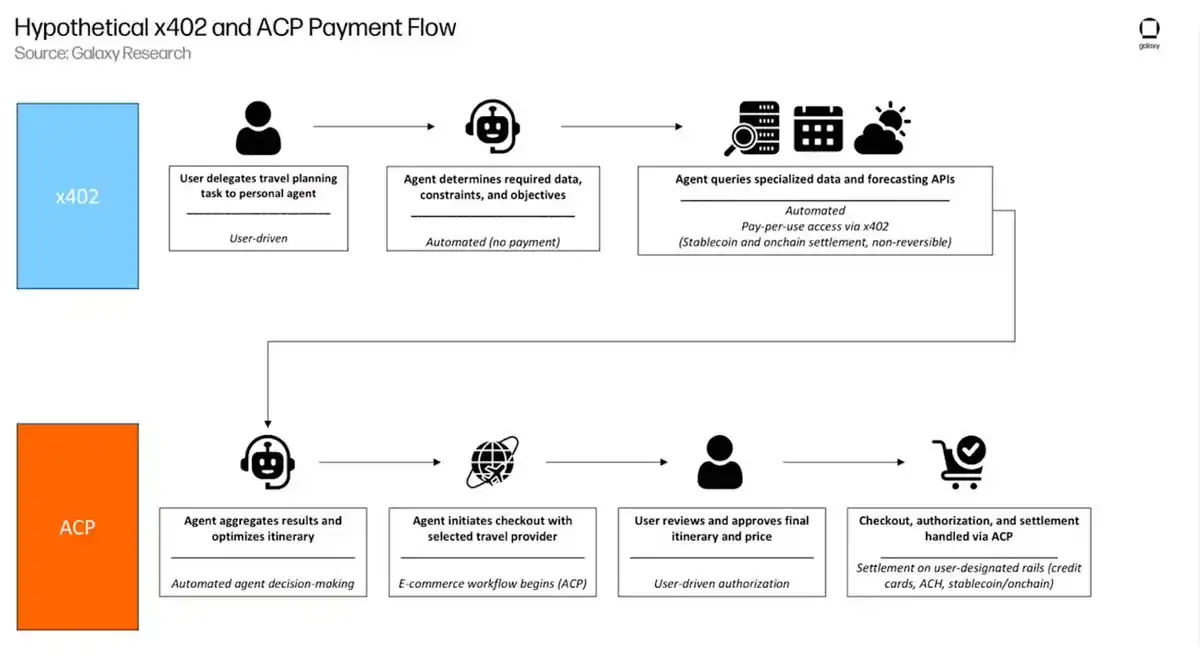
From Galaxy Research

Before such services become widespread, I still believe x402 is in its infancy. If you are a developer hoping to use x402 for development but struggling for inspiration, here are some theoretical products I would rush to try if I could use them immediately!

Skills Endpoint

Skills are carefully crafted sets of instructions written by humans for AI agents to perform specific tasks.

Currently, most skills markets adopt a fixed fee model: permanent access is priced at $5, $15, and $20 respectively. This model creates a misalignment of incentives. Occasional users overpay, while power users underpay, and skill creators cannot capture value proportional to usage. A truly useful skill, like a truly useful advisor (if such a thing exists), should be worth far more than a one-time $15.

x402 offers an alternative. Skill creators can publish their work through an x402 interface and price it based on reality: pay-per-use (one-time use), monthly subscription (a new feature in x402 V2), or both. The payment system supports both models. A skill called thousands of times a month can generate ongoing revenue for the creator. Less frequently used skills do not require users to pay upfront.

Niche Crypto News Aggregation Package

Crypto news is scattered across platforms like Twitter, Telegram groups, podcasts, RSS feeds, and Substacks. The problem is even more challenging if you want to track a specific ecosystem. Tracking all the dynamics of Sui or Starknet means monitoring a dozen sources and checking daily.

An ecosystem-specific x402 data stream can solve this. Someone aggregates Twitter user feeds, articles from website RSS feeds, and Telegram messages into a curated information stream for a specific ecosystem via an API. The agent queries: "What happened on Starknet in the last 24 hours?" and receives a structured reply. No more switching between tabs and apps.

Aggregated Ecosystem Data

Developer activity has always been difficult to measure accurately.

Electric Capital's annual report and its continuously updated dashboard are excellent open-source resources, but they also have limitations. For example, I just looked at the ecosystems with the top developer growth over the past year, and the results showed PancakeSwap, Monad, and Aleo. Of course, this is because I only filtered on one metric—but it also reflects a broader problem: developer activity data in the crypto space is very fragmented, and no single data source provides the complete picture.

If there were an x402 data source that aggregated Electric Capital data, GitHub activity, Artemis metrics, and protocol-specific data sources into a quality-weighted developer activity stream, it would fill a real gap. Agent query: "What has Solana's developer momentum been like over the past quarter?" and gets more useful information than raw commit counts.

Newsletter and Podcast Performance Tracker

An idea I would personally use: a service that clearly tracks the viewpoints proposed in podcasts or newsletters and measures their development over time.

Citron does something similar for the stock market, releasing scorecards for its annual predictions and their performance at the end of the year. But for most newsletters and podcasts, if you want to know if a media outlet's predictions have yielded returns over time, you have to research manually.

An x402 service could fill this gap by benchmarking a media outlet's predictions. Just provide the newsletter or podcast, and it tracks every prediction, adds timestamps, follows subsequent price movements, and scores the media outlet's past performance. Agent query: "How has X's asset predictions performed over the past year?" and gets a verified answer.

Security and Audit Tracker

Protocols often don't proactively announce when they are attacked. And the news cycle moves fast; if you weren't online the day the exploit happened, you might have completely missed it. By the time you need to take action, an event that should have been highly concerning is already buried under weeks of news coverage.

The situation with security reviews isn't much better. Audit reports are scattered across auditors' websites, protocol documentation, and GitHub repositories. Checking a protocol's audit history is more difficult than it should be.

It would be great to have an x402 information stream that aggregates this information into a queryable endpoint, where users could pay a few extra cents to access it before deciding on yield allocation, especially when operating through an agent interface.

Is This Really Feasible?

Everything I mentioned above faces two questions: Can the economics support the building of these streams? Can they be developed legally?

From an economic perspective, history is not optimistic. Pay-per-item models have struggled since the early days of the internet. The cognitive cost of deciding whether something is worth paying for often exceeds the cost of the payment itself. This is why the internet shifted to subscription models: predictable billing, avoiding decision fatigue, and reducing churn.

But agents change this. You top up your wallet, the agent spends on your behalf, and you top up again when the balance is low. API credits work similarly. The question shifts from "Is this few cents worth it?" to "Can the endpoint provider recoup costs at scale?" This depends on traffic volume.

In terms of legality, x402 handles payment and metering. It doesn't change the copyright issues of upstream data. If you're using licensed APIs, public data, or first-party X402 endpoints, then it's straightforward product development. But if you rely on web scraping or operate in the gray areas of terms of service, persistence and scale may be limited. Once upstream providers notice and object, you're in dangerous territory.

x402 V2 introduces dynamic payment routing, enabling revenue sharing. Data managers can return a portion of the revenue to the original data providers, aligning incentives and turning potential terms-of-service conflicts into partnerships, though this does reduce profit margins.

Whether both the economics and legality can hold up at scale remains to be seen. But if they do, these are the data streams I would pay to use.

Whether this economic and legal mechanism can work simultaneously at scale remains to be seen. But if it does, these are the data streams I would pay to use.


Domande pertinenti

QWhat is the core value proposition of x402 as described in the article?

AThe article presents x402's core value proposition as a perfect fit for data aggregation and management. It enables the monetization of data through micro-payments per query, allowing data sources to be compensated, data to be bundled into more useful proprietary sets, and accessed on-demand without large upfront costs.

QHow does x402 change the economic model for 'Skills' compared to traditional marketplaces?

ATraditional skills marketplaces use a fixed-fee model (e.g., $5, $15 for permanent access), which misaligns incentives. x402 offers an alternative with pay-per-use fees and/or monthly subscriptions (a V2 feature), allowing creators to earn ongoing revenue proportional to usage instead of a one-time fee.

QWhat problem does a niche crypto news aggregation package via x402 solve?

AIt solves the problem of crypto news being scattered across platforms like Twitter, Telegram, podcasts, and RSS feeds. An x402 data stream can aggregate these disparate sources into a single, structured feed for a specific ecosystem, allowing a user or agent to query for events without switching between apps.

QWhat are the two major challenges for the feasibility of the x402 data streams mentioned in the article?

AThe two major challenges are economic viability (whether the economics can support the teams building these streams) and legality (whether they can be built legally, especially concerning data sourcing issues like web scraping and terms of service conflicts).

QHow does x402 V2's dynamic payment routing attempt to address legal concerns?

Ax402 V2's dynamic payment routing enables revenue sharing. Data managers can send a portion of the proceeds back to the original data providers, which helps align incentives and can turn potential terms-of-service conflicts into cooperative partnerships, though it may reduce profit margins.

Letture associate

AI Agent Completely Transforms Web3 Gaming: From the Rugpull Bakery Bot Controversy to the New 2026 Agent Paradigm

This article explores how the AI Agent paradigm is fundamentally transforming Web3 gaming, moving from a disruptive force to a core, legitimized element. It begins with the controversy in the competitive baking game Rugpull Bakery, where automated scripts caused fairness issues. Instead of banning them, the developers integrated AI Agents into the official gameplay by providing technical documentation (skill.md, agent.json), marking a shift towards "Agentic Gaming." The piece outlines three primary implementation models for AI Agents in Web3 games by 2026: 1. **Autonomous Competitors & Economic Entities:** AI Agents act as independent players with unique strategies. Examples include TEN Protocol's poker agents, AI Arena's trainable NFT fighters, and Satoshi Strike Force's "Digital Athletes" trained on player data. The Somnia blockchain is highlighted as a dedicated "Agentic L1" infrastructure supporting this model at scale. 2. **Modular Infrastructure & Programmable Environments:** This model, exemplified by EVE Frontier, allows AI Agents to program game world logic itself. Using "Smart Assemblies" (e.g., Smart Turrets, Smart Gates), Agents can modify shared economic and physical rules on-chain, creating dynamic, player/AI-built worlds. The ERC-8183 standard further enables these automated entities to hire other AI services for complex tasks. 3. **Hybrid Companions & Dynamic Adaptation:** Here, AI serves as a collaborative partner. In Parallel Colony, highly autonomous AI Avatars work alongside human players who provide high-level guidance. Illuvium plans to use AI to make NPCs dynamic and responsive, creating personalized, emergent narratives for each player. The conclusion posits that Web3 gaming has reached a "post-human" inflection point. Blockchains' transparency and programmability, combined with new standards and infrastructure like Somnia, make integrating and governing AI Agents not just viable but essential. The future lies in a symbiotic digital order where players transition from manual laborers to commanders and partners of algorithmic intelligence.

marsbit16 min fa

AI Agent Completely Transforms Web3 Gaming: From the Rugpull Bakery Bot Controversy to the New 2026 Agent Paradigm

marsbit16 min fa

Saylor's Purchase of 1550 Bitcoin Is a Bad Trade

**Title: Saylor's Purchase of 1,550 Bitcoins Was a Bad Trade** The article critically analyzes Strategy's recent move of selling 32 bitcoins followed by a much larger purchase of 1,550 bitcoins. While appearing bullish, the author argues this trade is detrimental to MSTR shareholders. The core argument revolves around the concept of "breakeven modified Net Asset Value (mNAV)," a key metric for Strategy. To increase Bitcoin per share (BPS) for MSTR holders, Strategy must issue new shares at a premium high enough that the funds raised can buy more bitcoin than the bitcoin backing each existing share. Currently, this breakeven mNAV is estimated at 1.30. The recent trade failed on two counts: 1. The shares for the $181 million raise were issued at an mNAV *below* the 1.30 breakeven point. Selling "cheap" shares to buy bitcoin actually *reduces* BPS. 2. Only $101.3 million of the raised funds were used to buy bitcoin; the rest went to boost the company's dollar reserves. The breakeven mNAV calculation assumes *100%* of proceeds are used for bitcoin purchases. Diverting funds, even if mNAV were high, dilutes BPS. The result is an estimated 0.19% decrease in Bitcoin per share for MSTR holders. In exchange, Strategy merely extended its operational runway for its dollar reserves from ~6.3 months to 7 months. The author interprets this as Strategy prioritizing the survival and development of its STRC business over its stated core goal of increasing MSTR's BPS. This constitutes a gamble: if sacrificing MSTR value leads to improved market sentiment and a recovery in STRC's price (and thus mNAV), the whole system could work. If not, Strategy may be forced into a cycle of further diluting MSTR to stay afloat, potentially leading to deferred STRC dividends or corporate decline. The article concludes with a hope for price recovery for Bitcoin, MSTR, and STRC.

Foresight News26 min fa

Saylor's Purchase of 1550 Bitcoin Is a Bad Trade

Foresight News26 min fa

The AI Bear Market Lasting Two Days Is Over; Why Did Funds Buy Back Storage Stocks First?

After a severe two-day selloff in early June that erased over $1 trillion from U.S. chip stock market value, capital is flowing back first to the memory sector. The correction was not driven by a collapse in AI demand but rather a market reassessment of high expectations. Stocks like Broadcom faced selling pressure despite strong AI revenue guidance, signaling a shift in focus from who has an "AI story" to who can most rapidly translate AI demand into verifiable profits and earnings per share (EPS). Memory companies, such as Micron and SK Hynix, are leading the recovery because their EPS growth is more immediately verifiable. The AI server boom directly increases demand for high-bandwidth memory (HBM) and high-capacity server DRAM, tightening supply and driving up contract prices for conventional DRAM and NAND Flash. This price increase, coupled with a shift to higher-margin products, flows directly into near-term revenue and profitability, as evidenced in recent earnings reports. In contrast, other AI semiconductor segments like GPUs, ASICs, and optical modules, while central to the long-term AI infrastructure story, face longer and less certain paths to EPS validation. Their growth depends more on future product cycles, customer adoption timelines, and capital expenditure plans. The rebound in memory stocks highlights a market preference for assets with shorter, more transparent EPS conversion cycles following the recent de-risking phase. However, this does not negate the potential of other AI hardware segments should they provide clearer near-term order visibility. The episode has raised the validation bar for all AI-related investments.

marsbit26 min fa

The AI Bear Market Lasting Two Days Is Over; Why Did Funds Buy Back Storage Stocks First?

marsbit26 min fa

Trading

Spot
Futures
活动图片