X Tightens Promotion Rules: Is the Wild West Era of Crypto Twitter Marketing Over?

marsbitPubblicato 2026-02-25Pubblicato ultima volta 2026-02-25

Introduzione

X, the platform formerly known as Twitter, is systematically tightening its rules on promotional content and automated activity, particularly targeting the crypto community. Over the past five months, it has implemented six major policy changes. These include removing 1.7 million spam bots, banning "InfoFi" applications that reward users for posting, cracking down on accounts using automation/AI, and introducing a mandatory "Paid Promotion" disclosure label for sponsored content. It has specifically prohibited undisclosed ads for prediction markets and restricted automated API replies. These actions dismantle key, previously free, marketing channels for crypto: incentivized posting, undisclosed influencer promotions, and automated engagement. Consequently, user acquisition costs are expected to rise as organic reach diminishes. The platform is simultaneously favoring paid advertising, having relaxed its policies for crypto ads in many regions. This shift forces a recalibration of the crypto influencer economy, moving from hidden endorsements to transparent, performance-based advertising. While this may lead to a cleaner information environment for users, it signals the end of an era of unregulated "wild" marketing on the platform, making visibility a paid privilege.

Author: David, Deep Tide TechFlow

On February 21, X's product lead Nikita Bier publicly demanded in a post that the poster add a disclaimer stating it was a paid promotion, otherwise the account would be suspended.

This post came from the account @infodexx, with content ranking the "Most Valuable Startups in 2025," placing the prediction market platform Kalshi second with an $11 billion valuation.

The post garnered over 420,000 views, but the poster's bio stated "Kalshi partner," and the post itself initially had no paid promotion label.
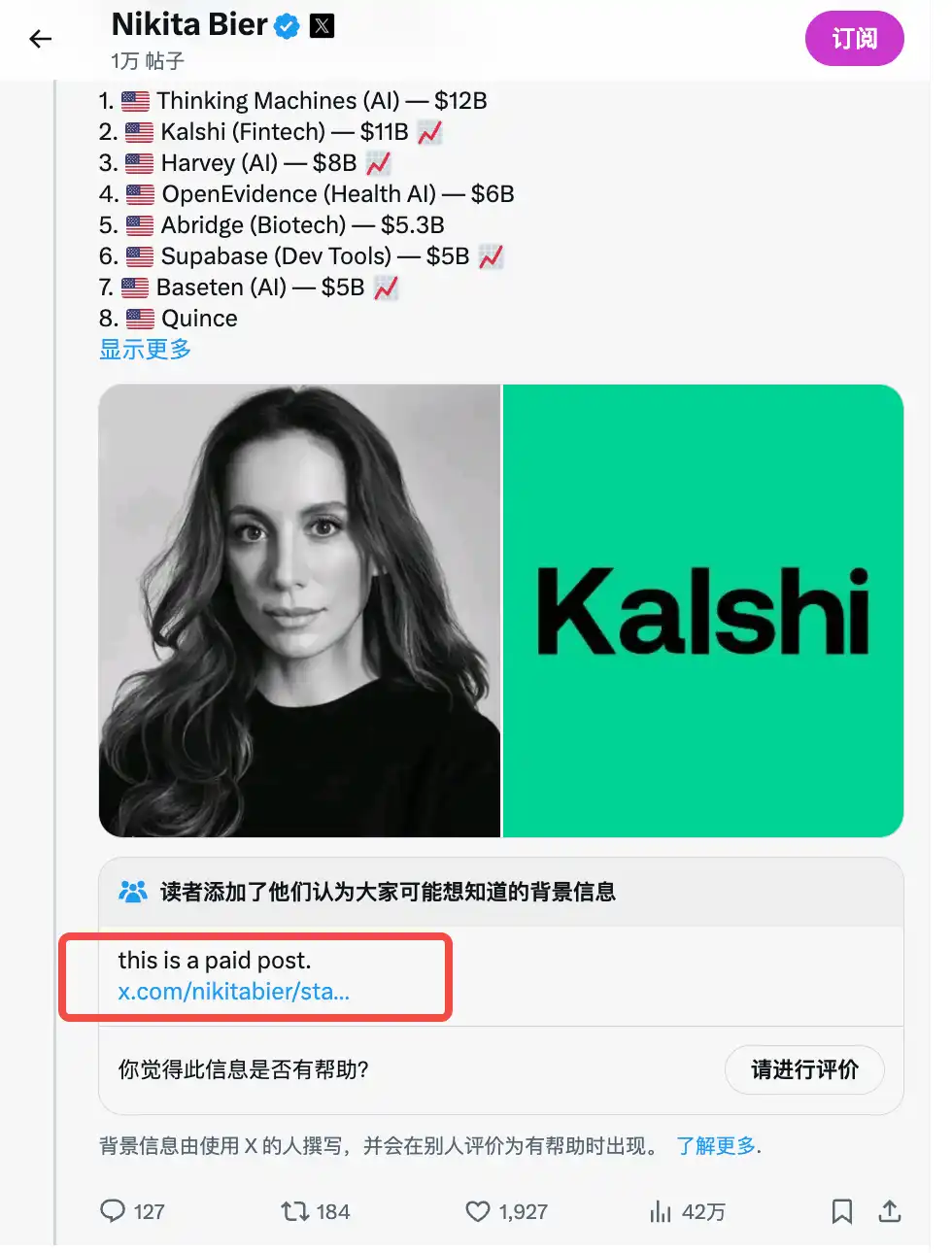
Subsequently, a user flagged it as commercial promotion content—essentially an ad—through X's Community Notes feature (a user-collaborative fact-checking mechanism where approved notes are displayed directly below the post).

Bier then announced that X would launch a set of paid promotion disclosure features the following week, requiring all posts with paid partnerships to be labeled, with violators facing account suspension.

The poster later added a context note to the original post, indicating it was a paid promotion.

Mandatory disclosure is just the latest step in this round of adjustments.

Over the past five months, X has successively cleaned up 1.7 million spam bot accounts, banned API access for InfoFi-type applications, launched anti-automation detection mechanisms, and restricted programmatic reply interfaces...

Although these actions occurred at different points in time, when pieced together, they form a clear timeline.

The wild marketing era on Crypto Twitter is perhaps being ended by the platform itself.

6 Major Cuts in 5 Months, Hitting the Artery of Crypto Marketing

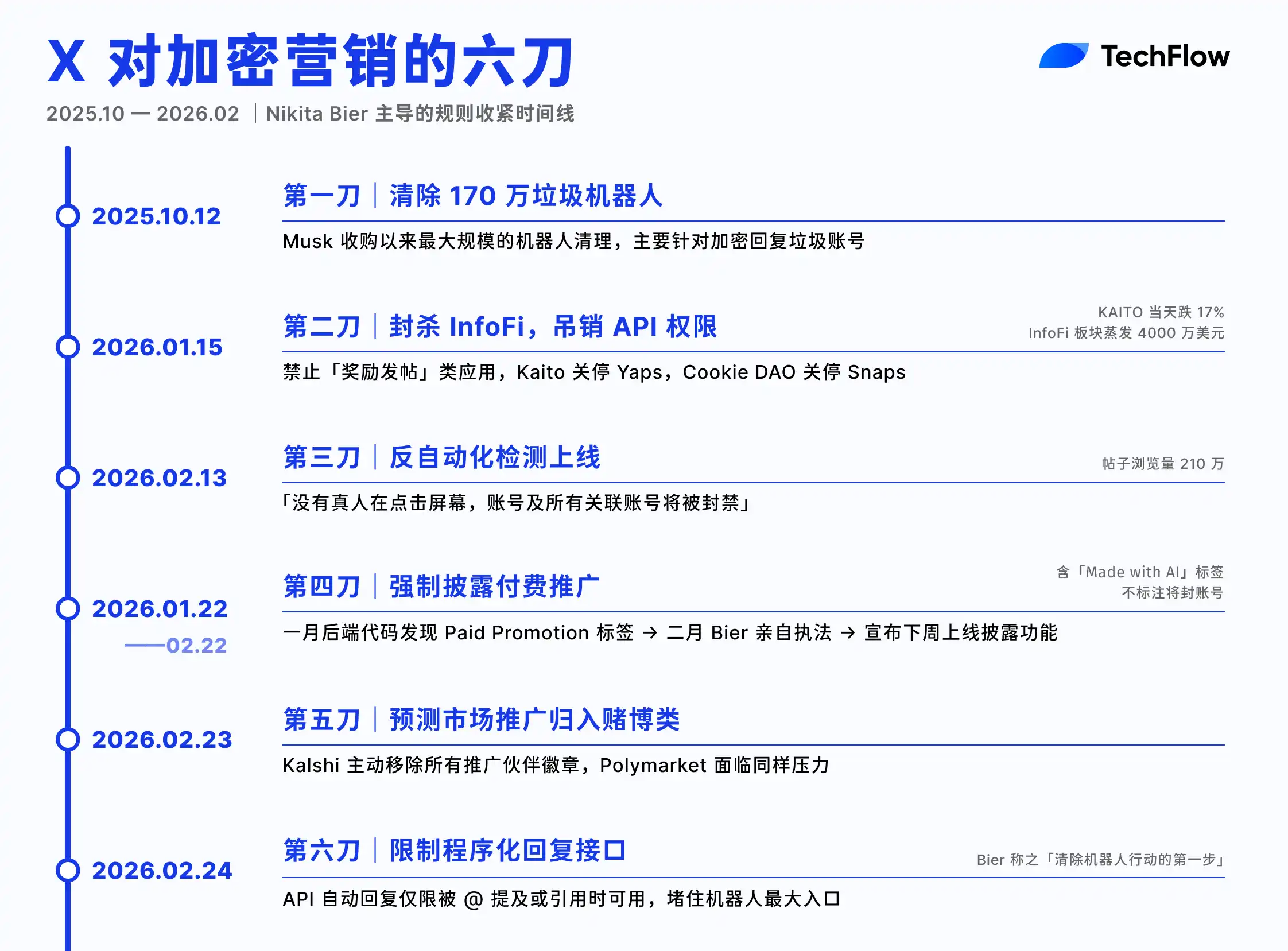
X's changes to marketing rules have delivered six significant, overt blows over the past 5 months. We have compiled the key timeline and major events of these rule changes as follows:
First Cut: Spam Bots

In October 2025, Bier announced that X had removed 1.7 million reply spam bots in one week, the largest cleanup since Musk's acquisition. The primary targets were crypto-related automated accounts, familiar to anyone who has scrolled through crypto posts on X:

Scam links instantly replying under popular posts, fake accounts impersonating Elon Musk, and repetitive "gm" bots.

Removing 1.7 million was just the first step; the underlying issue was much larger.

Second Cut: InfoFi and the "Post-to-Earn" Model

The proliferation of these bots was largely due to InfoFi.

Third-party platforms tracked users' posts and interactions on X and rewarded them with tokens or points. The original intent was to incentivize valuable information production, but when posting itself could earn money, it evolved into quantity over quality. Bot farms and AI-generated批量 replies quickly dominated the leaderboards.

At its peak, the largest project, Kaito, had over 157,000 active users on its Yaps product. By January 9, 2026, CryptoQuant detected 7.75 million crypto-related posts on X in a single day, 12 times the normal level.

On January 15, 2026, Bier announced changes to the developer API policy, prohibiting all applications that "reward users for posting on X," immediately revoking relevant API access.

Kaito subsequently shut down Yaps, its token KAITO fell about 17% that day; Cookie DAO shut down a similar product, Snaps; the entire InfoFi sector lost approximately $40 million in market cap in one day.

(Reference reading: X Pulls the Rug, the Era of 'Farming with Your Mouth' Ends)

Third Cut: Accounts Simulating Human Operations

On February 13, Bier announced the launch of a new round of automation detection.

If no real person is clicking the screen, the account and all associated accounts may be banned. This cut is aimed not just at traditional bots, but at all accounts operated via scripts, automation tools, or AI agents.

Bier stated that X would support compliant agent use cases in the future, but recommended developers pause integrations until rules are clear, using the official API if necessary.

Fourth Cut: Stealth Ads

The first three cuts dealt with automation and spam. The fourth cut targeted a larger gray area: paid promotions without disclosure.

Anyone familiar with Crypto Twitter knows this has been an industry standard in the crypto space.

In September 2025, on-chain investigator ZachXBT publicly released a spreadsheet listing the promotion rates and receiving wallet addresses of over 200 crypto KOLs. About 160 had accepted promotions, but fewer than 5 had labeled their posts as "ad."
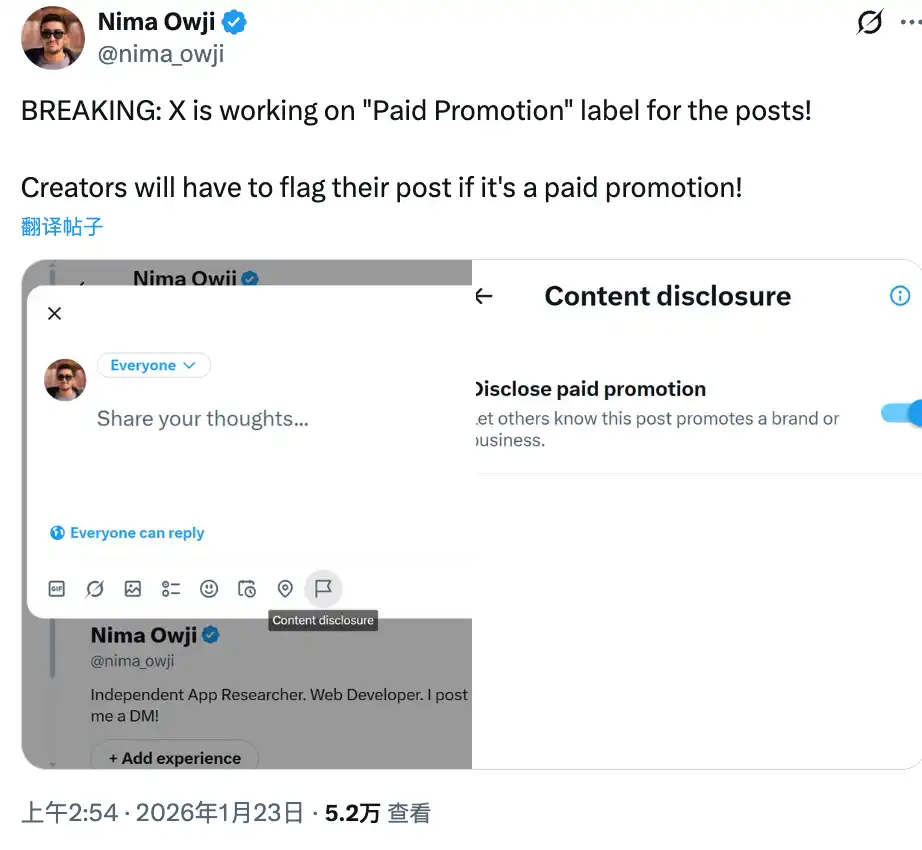
On January 22, app researcher Nima Owji discovered a Paid Promotion label feature under development in X's backend code. Creators would need to check if a post was a paid promotion when posting, and the label would be displayed directly on the post.

By February 21, when Bier personally intervened in the Kalshi post, this feature was ready for launch. He also announced a "Made with AI" label, requiring AI-generated content to be labeled.

Fifth Cut: Prediction Market Promotion

Following the disclosure feature announcement, X updated its paid partnership policy, explicitly categorizing prediction markets (like Kalshi and Polymarket) as gambling products, and comprehensively banning undisclosed related advertising.

Kalshi proactively removed its promotion partner badge on X on February 23, its spokesperson stating the enforcement was too difficult, as users easily misinterpreted accounts with the badge as being officially endorsed by Kalshi.

Sixth Cut: Programmatic Replies

The final cut landed on February 24. The X developer platform announced restrictions on automated replies sent via API.

Programmatic replies are only permitted if the original post @mentions or quotes the account. Product lead Bier called this the first step in clearing out bots, first plugging the biggest entry point.

After these six cuts—targeting bots, incentive mechanisms, automation tools, stealth ads, specific category promotions, and programmatic interfaces—X's control over crypto content has progressed layer by layer.

Combined, the entire marketing infrastructure that Crypto Twitter has relied on for operation over the past few years has been systematically dismantled.

X Rejects Free Riders, Welcomes Paying Customers

These rule changes combined are altering the cost structure of crypto marketing. In recent years, the main ways crypto projects acquired customers on X were through three free channels:

  1. InfoFi platforms incentivizing users to post for visibility,
  2. KOLs accepting stealth promotions without ad labels,
  3. Automation tools批量引流 under hot posts.

Now, all three channels are restricted or closed. Meanwhile, X's algorithm is widening the visibility gap between paid and free accounts.

Premium users receive a 2x to 4x weighting boost in the For You feed and reply排序. Some creators testing found that after March 2025, the median interaction for non-Premium accounts posting links had dropped to nearly zero.

The organic reach of crypto content萎缩 earlier. Crypto trader Lisa Edwards posted an analysis in December 2025 stating that after an algorithm update that month, the reach rate of posts containing symbols like BTC and ETH dropped by about 80%.

Simultaneously, as free channels are blocked, paid channels are opening.

X's policy on crypto ads has actually been loosening. According to X's official ad policy update log, since 2024, DeFi product ads have been approved, blockchain game ads opened in the US and Brazil, and the applicable markets for crypto exchange and wallet ads expanded from over a dozen original countries to include Denmark, Israel, Netherlands, Portugal, Ghana, Kenya, etc.

According to AWISEE statistics, X's crypto ad approval rate is about 60%, the highest among major platforms; Meta's is about 50%, and Google's is lower and explicitly bans DeFi ads.

On one side, free distribution is being systematically compressed; on the other, paid advertising categories and markets are continuously expanding. This is the monetization path all content platforms have taken:

First, cultivate a free content ecosystem to attract users and creators. Once network effects are established and creators become dependent on the platform, gradually tighten organic distribution, directing traffic to paid channels.

Facebook did the exact same thing to brand pages in 2014, with organic reach plummeting from double digits to single digits, forcing brands to shift from content operations to ad spending.

What X is doing to crypto content is essentially the same playbook.

Who Pays the Bill? Who Gets Eliminated?

With free channels cut, the bill will ultimately be分摊 across every role in the industry. This has at least three layers of impact on crypto marketing.

First, customer acquisition costs rise.

Before, a crypto project could rely on InfoFi points to incentivize tens of thousands of people to create buzz for it on X. Now that path is gone.

Formal KOL promotions will become more transparent with the disclosure feature, but posts labeled "ad" will have lower trust and engagement rates. Project teams will either increase budgets to compensate or accept reduced effectiveness.

Second, the KOL economy is repriced.

Data exposed by ZachXBT last year showed over 160 KOLs accepted promotions but almost none disclosed, with single post rates ranging from hundreds to $60,000. After mandatory disclosure, the room for operations that "look like organic content but are actually ads" is compressed. KOL pricing logic will shift from "I can help you伪装成 organic content" to "How much conversion can my labeled ad still drive?".

The former is priced on information asymmetry, the latter on performance.

For the industry, this might not be a bad thing, but短期内 a batch of KOLs and agencies surviving in the gray area will be eliminated.

Third, platform dependency risk is repriced.

Bier's exact words when banning InfoFi were,建议被封的开发者 "go to Threads and Bluesky to pivot."

A platform's product lead openly advising developers to go to competitors indicates X doesn't mind crypto projects分流, and might even be actively pushing them. After this round of changes, for project teams and KOLs, putting all social assets on X alone is no longer conservative, but risky.

For ordinary users, this isn't all bad news.

Before, scrolling through Crypto Twitter, six out of ten posts might have been paid for, but none would tell you. After the disclosure feature launches, users can at least distinguish between promotions and genuine opinions. The information environment becomes cleaner, and the cost of judgment decreases.

Of course, the timing of the rule tightening also coincides with a bear market.

Bear markets themselves compress marketing budgets; fewer projects are willing to spend on promotion, so the information flow naturally quiets down. Whether the clean environment is due to the rules or the冷清 will only be truly tested when the bull market returns.

Regardless, whether for project teams, KOLs, or ordinary creators, the price of admission to be seen on Crypto Twitter is now rising.

The logic of this business was "whoever is loudest wins"; in the future, it will become "whoever is willing to pay gets a voice."


Domande pertinenti

QWhat major actions has X taken in the past five months to tighten its promotion rules, particularly affecting crypto marketing?

AX has implemented six key changes: 1) Cleared 1.7 million spam bot accounts in October 2025; 2) Banned 'earn-to-post' applications (InfoFi) by revoking their access in January 2026; 3) Introduced new automation detection targeting scripted or AI-operated accounts in February 2026; 4) Enforced mandatory disclosure for paid promotions; 5) Classified prediction markets as gambling and banned undisclosed ads for them; 6) Restricted automated API replies unless the original post mentions the account.

QHow did the crackdown on InfoFi applications impact the crypto market?

AThe ban on InfoFi applications, which rewarded users for content creation with tokens or points, led to the shutdown of major platforms like Kaito's Yaps and Cookie DAO's Snaps. The entire InfoFi sector lost approximately $40 million in market capitalization in a single day, with Kaito's token (KAITO) dropping around 17%.

QWhat is the new requirement for paid promotions on X, and what are the consequences for non-compliance?

AX now requires all posts involving paid partnerships to be clearly labeled as 'Paid Promotion.' Failure to disclose such partnerships will result in account suspension. This policy aims to increase transparency and reduce undisclosed advertising, particularly prevalent in crypto marketing.

QHow has X's algorithm change affected the visibility of free versus paid accounts?

AX's algorithm now gives Premium accounts a 2 to 4 times weighting boost in the 'For You' feed and reply rankings. Non-Premium accounts posting links have seen their median engagement drop to nearly zero since March 2025. Additionally, posts containing crypto symbols like BTC or ETH experienced an 80% decrease in organic reach after a December 2025 algorithm update.

QWhat broader implications do these rule changes have for crypto marketers and KOLs?

AThe changes are increasing customer acquisition costs by closing free marketing channels like InfoFi and undisclosed KOL promotions. KOLs must now shift from pricing based on disguising ads as organic content to pricing based on measurable conversion rates. This transparency may push out KOLs and agencies that relied on ambiguous practices, while encouraging a more honest and effect-based marketing economy.

Letture associate

KOL's Perspective: Why Is SOL Set to Rise from This Point?

**Summary: Why SOL is Positioned for Growth at This Level** The article argues that SOL is poised for an upward move from its current price point, citing several key factors. Primarily, SOL has just broken out of a 4-month consolidation phase. This breakout signals a return of risk appetite to the broader crypto market, as SOL is seen as a key indicator of overall crypto health. The token's ownership has reportedly shifted from short-term traders and tourists to long-term accumulators, leading to low volume. Any meaningful increase in trading activity could thus trigger significant upward momentum. Fundamental strengths include strong institutional adoption, integration with DeFi and RWAs (Real-World Assets), and the potential benefits from the Clarity Act. Despite its high volatility—having dropped 70% from its all-time high but still up 12x from its bear market low—SOL is highlighted as one of the few tokens from the last cycle to reach new highs. It boasts a robust ecosystem of applications, users, and protocols. Future catalysts include the expected influx of AI developers following the Miami Accelerate conference, which focused on AI on Solana. Furthermore, Solana is positioned as the premier chain for memecoin activity, a trend expected to continue and drive network usage and fees. The article concludes that recent price action reflects a healthy transfer to long-term holders, setting the stage for growth.

marsbit28 min fa

KOL's Perspective: Why Is SOL Set to Rise from This Point?

marsbit28 min fa

Those Pre-Bitcoin PoW Protocols Have Recently Been Reimplemented

This article details a recent surge in replicating pre-Bitcoin Proof-of-Work (PoW) protocols, specifically focusing on Hal Finney's 2004 RPOW (Reusable Proofs of Work). Within five days in May 2026, multiple independent builders in the Bitcoin/cypherpunk community launched projects inspired by this early electronic cash proposal. The initiative began with Fred Krueger's `rpow2.com`, a centralized but auditable system that replaced RPOW's original IBM 4758 hardware with Ed25519 signatures. Initially a faithful replica, it later adopted Bitcoin-like features (21M supply cap, difficulty adjustment) and a controversial 5.24% founder allocation. This sparked rapid forks, including `rpow4.com` which incorporated full Bitcoin parameters, a prediction market (`rpowmarket.com`), and a DEX (`rpow2swap.com`). Concurrently, Mike In Space created a prototype of Wei Dai's 1998 b-money proposal (`b-money.replit.app`), pushing the historical exploration even further back. The article contrasts these centralized, server-dependent experiments with Bitcoin's core innovation of decentralized, trustless consensus. It also highlights a parallel development: the `HASH` project on Ethereum, which uses smart contract hooks to enable a purely fair-launch, browser-mineable PoW token with 0% allocations to team or VCs. The collective activity is framed as a meme-driven, educational exploration of cypherpunk history rather than a serious financial movement, with all projects heavily disclaiming any investment value.

marsbit33 min fa

Those Pre-Bitcoin PoW Protocols Have Recently Been Reimplemented

marsbit33 min fa

South Korean Exchanges 'Battle' Regulators, Challenging the Boundaries of Enforcement and Legislation

South Korea's cryptocurrency industry is engaged in a rare, direct confrontation with regulators. The Financial Intelligence Unit (FIU), the primary anti-money laundering (AML) watchdog, has recently imposed heavy penalties on major exchanges like Upbit and Bithumb for alleged violations involving unregistered overseas VASPs and AML procedures. However, exchanges are now actively challenging these actions in court and through industry associations. In a significant shift, the Seoul Administrative Court ruled in favor of Upbit's operator, Dunamu, overturning part of an FIU-ordered business suspension. The court found the FIU's penalty criteria and justification insufficiently clear. Similarly, the court suspended the enforcement of a six-month business suspension against Bithumb pending a final ruling, citing potential irreversible harm to the exchange. Beyond legal battles, the industry is contesting proposed legislative amendments. The Digital Asset eXchange Alliance (DAXA) strongly opposes a draft rule that would mandate Suspicious Transaction Reports (STRs) for all crypto transfers over 10 million KRW (~$6,800). DAXA argues this "poison pill" clause violates legal principles and would overwhelm the STR system, increasing reports from 63,000 to an estimated 5.45 million annually for major exchanges, thereby crippling effective AML monitoring. This conflict highlights a structural tension in South Korea's crypto governance: comprehensive digital asset laws are still developing, while regulators rely heavily on AML enforcement. The industry's move from passive compliance to active legal and legislative challenges signifies a new phase, pressing for clearer rules and more proportionate enforcement. While short-term disputes may intensify, this clash could ultimately lead to a more mature and sustainable regulatory framework for South Korea's vibrant crypto market.

marsbit1 h fa

South Korean Exchanges 'Battle' Regulators, Challenging the Boundaries of Enforcement and Legislation

marsbit1 h fa

After 50x Storage Surge, Justin Sun Always Looks to the Next Decade

Sun Yuchen, known for his controversial stunts like a $30 million lunch with Warren Buffett (canceled due to a kidney stone) and eating a $6.2 million duct-taped banana, is often overshadowed by a significant fact: his decade-long track record of spotting major investment trends. In 2016, he famously advised young people to invest in Bitcoin, Nvidia, Tesla, and Tencent instead of buying property. A hypothetical $20,000 investment in Nvidia and Tesla from that list would now be worth over 50 million RMB. His latest major call was on November 6, 2025, predicting a "50x storage opportunity" tied to the AI boom, which materialized with Sandisk's stock surging nearly 50-fold by 2026. Looking ahead, Sun now focuses on the next frontier: Physical AI. He identifies four key areas: 1. **Embodied AI/Robotics**: He sees this reaching its "iPhone moment," with companies like UBTech and Galaxy General leading in commercialization. 2. **Drones**: Viewed as the first commercially viable form of Physical AI, revolutionizing sectors from warfare (e.g., AeroVironment's Switchblade) to logistics. 3. **Spatial Computing**: Beyond VR, it's about AI understanding physical space, a foundational technology for robotics and autonomous systems, exemplified by Apple's Vision Pro. 4. **Space Exploration**: After a 2025 suborbital flight with Blue Origin, Sun advocates for space as the ultimate frontier, discussing blockchain's potential role in space asset management and data transactions. His investment philosophy involves betting on entire, inevitable trends rather than single companies. For robotics, he sees Tesla (the body/manufacturer) and Nvidia (the brain/AI platform) as complementary plays. In defense drones, he highlights companies making tanks obsolete (AeroVironment) and those augmenting fighter jets (Kratos). For space, he participated in Blue Origin's flight and anticipates SpaceX's potential IPO to redefine the sector's valuation. Sun Yuchen's vision frames the next two decades not as a revolution in information flow (like the internet), but in the fundamental operation of the physical world through AI-powered robots, autonomous systems, and spatial intelligence, ultimately extending human and AI activity into space. While many still focus on conventional assets, he continues to look toward the next technological horizon.

marsbit2 h fa

After 50x Storage Surge, Justin Sun Always Looks to the Next Decade

marsbit2 h fa

Trading

Spot
Futures

Articoli Popolari

Come comprare ERA

Benvenuto in HTX.com! Abbiamo reso l'acquisto di Caldera (ERA) semplice e conveniente. Segui la nostra guida passo passo per intraprendere il tuo viaggio nel mondo delle criptovalute.Step 1: Crea il tuo Account HTXUsa la tua email o numero di telefono per registrarti il tuo account gratuito su HTX. Vivi un'esperienza facile e sblocca tutte le funzionalità,Crea il mio accountStep 2: Vai in Acquista crypto e seleziona il tuo metodo di pagamentoCarta di credito/debito: utilizza la tua Visa o Mastercard per acquistare immediatamente CalderaERA.Bilancio: Usa i fondi dal bilancio del tuo account HTX per fare trading senza problemi.Terze parti: abbiamo aggiunto metodi di pagamento molto utilizzati come Google Pay e Apple Pay per maggiore comodità.P2P: Fai trading direttamente con altri utenti HTX.Over-the-Counter (OTC): Offriamo servizi su misura e tassi di cambio competitivi per i trader.Step 3: Conserva Caldera (ERA)Dopo aver acquistato Caldera (ERA), conserva nel tuo account HTX. In alternativa, puoi inviare tramite trasferimento blockchain o scambiare per altre criptovalute.Step 4: Scambia Caldera (ERA)Scambia facilmente Caldera (ERA) nel mercato spot di HTX. Accedi al tuo account, seleziona la tua coppia di trading, esegui le tue operazioni e monitora in tempo reale. Offriamo un'esperienza user-friendly sia per chi ha appena iniziato che per i trader più esperti.

330 Totale visualizzazioniPubblicato il 2025.07.17Aggiornato il 2025.07.17

Come comprare ERA

Discussioni

Benvenuto nella Community HTX. Qui puoi rimanere informato sugli ultimi sviluppi della piattaforma e accedere ad approfondimenti esperti sul mercato. Le opinioni degli utenti sul prezzo di ERA ERA sono presentate come di seguito.

活动图片












