WSJ: Fake Websites, Fake Trades, Real Promotion: Polymarket's Traffic Scam

marsbitPubblicato 2026-06-23Pubblicato ultima volta 2026-06-23

Introduzione

The Wall Street Journal investigation reveals that prediction market platform Polymarket hired dozens of creators, primarily students, to produce and disseminate deceptive promotional content on social media. These creators used fake, near-identical clone websites (like "poiymarket.com") to simulate placing bets and winning large sums—totaling $1.9 million in fake wagers and nearly $900,000 in fake winnings across over 1,100 analyzed videos—without disclosing their paid partnership with Polymarket, as required by federal advertising regulations. The videos, often promoting unrealistic "free money" claims, were amplified by a coordinated "army" of social media accounts managed by a marketing contractor to target U.S. users, despite Polymarket's crypto platform being barred from serving the U.S. since a 2022 settlement. Polymarket stated it is committed to fair and transparent markets and plans a comprehensive audit of its promotional content. The article also notes internal discussions about potentially overturning the 2022 settlement to reintroduce its crypto platform in the U.S.

Original article from WSJ, by Katherine Long, Caitlin Ostroff, Neil Mehta and Brenna T. Smith

Compiled by|Odaily Planet Daily Qin Xiaofeng(@QinXiaofeng 888 )

Editor's Note: A recent Wall Street Journal investigation found that prediction market platform Polymarket paid dozens of creators to make fake trades and profit videos on simulated websites, and used social media "water armies" for viral marketing to attract U.S. users. None of these videos disclosed the paid relationships as required by federal regulations, and the "handsome returns" shown were entirely fabricated. Polymarket stated it is committed to maintaining accurate, fair, and transparent markets and plans to conduct a comprehensive audit of its promotional content.

The following is the WSJ investigation article, compiled by Odaily Planet Daily. Enjoy~

————————

From George Makihara's videos, it appeared he had a lucrative side hustle: placing bets on Polymarket.

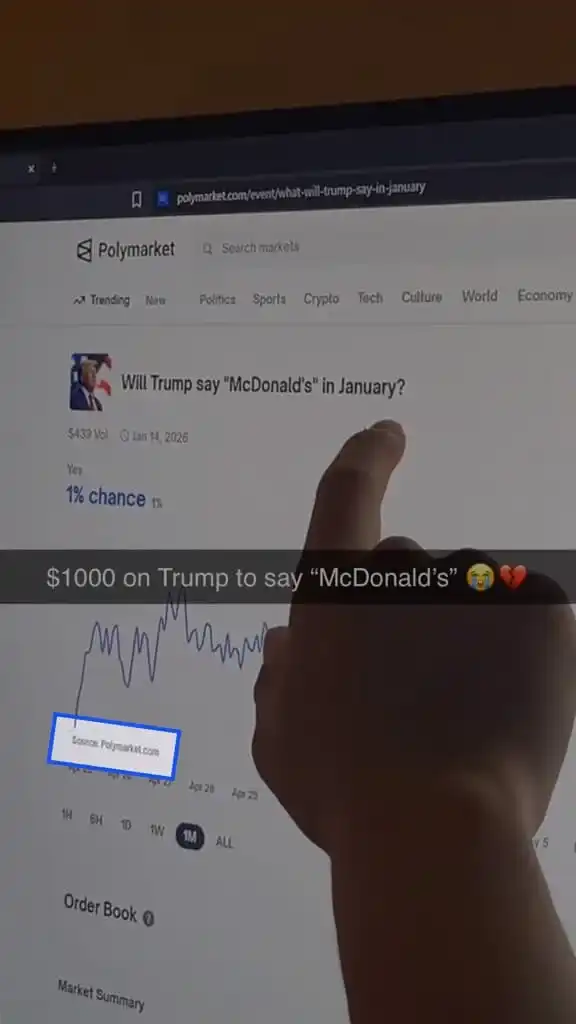
In January of this year, this college student posted a video showing he won $100,000 by betting that President Trump would publicly say the word "McDonald's" that month.

According to his videos, from January to mid-May, George Makihara seemingly placed 145 bets on the Polymarket website – with a total amount close to $410,000.

But according to a Wall Street Journal investigation, none of those trades were real.

George Makihara jumps when Trump says the word "McDonald's"; however, Trump never publicly said that phrase that month, this video was filmed two months ago

Based on the Journal's analysis of over 1,100 videos, related instructional materials, and interviews with creators who have worked with the company, George Makihara is one of dozens of creators paid by Polymarket, mostly college students, who film themselves making fake trades and sometimes showcasing fake profits. George Makihara declined to comment.

Public data shows that on Polymarket's actual website in January, over 50 accounts participated in the "McDonald's" bet. All of these accounts lost money.

To attract users to its unregulated platform, Polymarket flooded social media with videos like George Makihara's that appear genuine at first glance. In reality, Polymarket created near-perfect clones of its website and then instructed creators to make simulated trades on these virtual sites, while concealing that they were paid by Polymarket.

To make the videos go viral, Polymarket recruited a social media "army" to duplicate and repost the creators' content. Even though this New York-based company has been banned from offering its core crypto platform services in the U.S. since 2022, these social media creators, paid for their work, specifically targeted U.S. users – who can still access the site via virtual private networks (VPNs).

Polymarket said in a statement, "the company is committed to maintaining accurate, fair, and transparent markets. We are part of a fast-growing industry and are constantly evaluating how to improve how we engage and earn the trust of our audience." The company said it plans to conduct a comprehensive review of its existing promotional content.

Polymarket hired and worked closely with a marketing contractor to promote the site. In a message reviewed by the Journal, the contractor told its social media "army" to focus on reposting content from 10 Polymarket creators, including George Makihara. These creators initially did not label themselves as paid partners of Polymarket, though one provided a $20 referral code in their social media bio. After the Journal began asking the company about the marketing operation, these creators started adding "@polymarket partner" labels to their bios.

The Journal reviewed 1,105 videos posted between late December 2025 and mid-May by 10 creators endorsed by Polymarket's contractor. In 70% of the videos, the creators placed bets; clues in the videos indicate all these bets – totaling $1.9 million – were fake. Most videos just showed the betting process, but 118 videos showed creators reacting to winning, collectively winning nearly $900,000 in prizes – actually from fake trades; if you had actually placed those bets, you would have lost over $166,000.(Note: Polymarket has a data partnership with Dow Jones & Company, publisher of the Wall Street Journal. The Journal used only public data in this analysis.)

According to creators who have worked with the company, Polymarket instructed creators not to disclose they were paid. They said compensation typically accumulated to between $2,000 and $3,000 per month.

Investigating Fake Trades

One of the earliest videos showing signs of fake trades was posted to social media in June 2025, filmed at Polymarket's New York office. Someone placed a $100,000 bet that Powell would say "good afternoon" at a press conference, with a caption calling the bet a "valid manhood test."

The Journal investigation found over a dozen differences between the real Polymarket website and the simulated one.
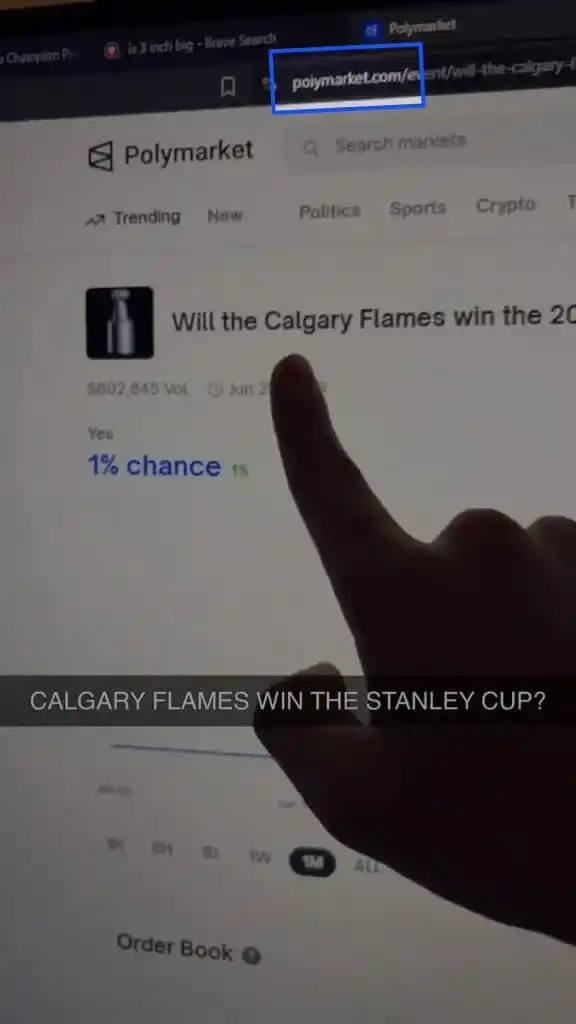
The fake simulated website was called "poiymarket.com"; when the "i" was capitalized, it was indistinguishable from polymarket.com. According to a person familiar with the matter, the site was built by Polymarket. Price charts on the site were labeled as sourced from "Polymarket.com." But Polymarket's real official website does not display any source information.
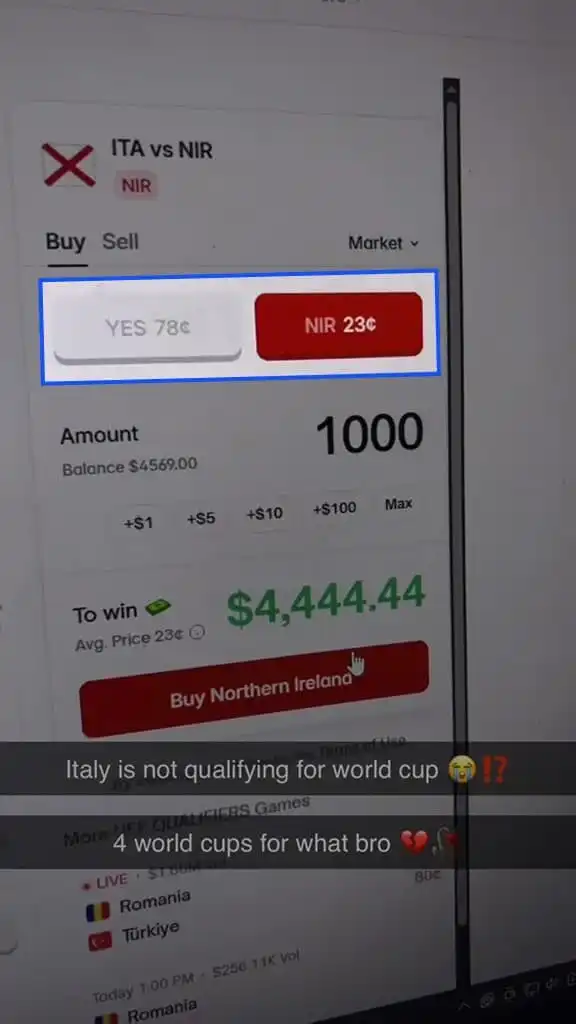
Additionally, the fake website sometimes had errors. For example, buttons would show "YES" and "NIR," while the real site has "YES" and "NO."
Several videos reviewed by the Journal also briefly flashed URL addresses, revealing the sites were test environments for Polymarket engineers. After the Journal contacted Polymarket for comment, the fake "poiymarket" website was taken down.

Federal advertising law requires brands to make truthful claims in their promotions and requires individuals paid to endorse products to disclose their connections; though there remains some gray area about what is permissible. Commodity laws governing prediction markets also prohibit deceptive and misleading conduct.

A spokesperson for the Federal Trade Commission, which enforces advertising laws, declined to comment on the Journal's findings, citing the agency's policy of not commenting on potential investigations.

Razeen Khan, a California college student who worked as a Polymarket creator for several months until March, compared the videos to fast-food commercials – where the food looks more appealing than it actually is.

"We're showing what actually happens," he said. "You're still going to buy that burger."

Creators said they would send finished videos to Polymarket for approval. If a video wasn't engaging enough or was obviously fake, Polymarket would ask for a reshoot.

Haian Nguyen was one of Polymarket's top-performing creators, filming her trades on the platform from a bedroom in San Francisco. In a video posted to Instagram, Haian Nguyen celebrated winning $60,000 after betting Trump would say "Olympics."

In another video of her dancing on a beach by the Golden Gate Bridge, the text overlay read "Polymarket funds my life."

Haian Nguyen declined to comment and cleared all videos from her profile after the Journal contacted her.

These promotional videos all followed the same template: the creator opens Polymarket, places a bet, and calls the profit "free money." Dozens of social media creators posted videos in nearly identical formats. According to creators who have worked with the company and a recruitment site, Polymarket sent creators bullet-pointed talking points.

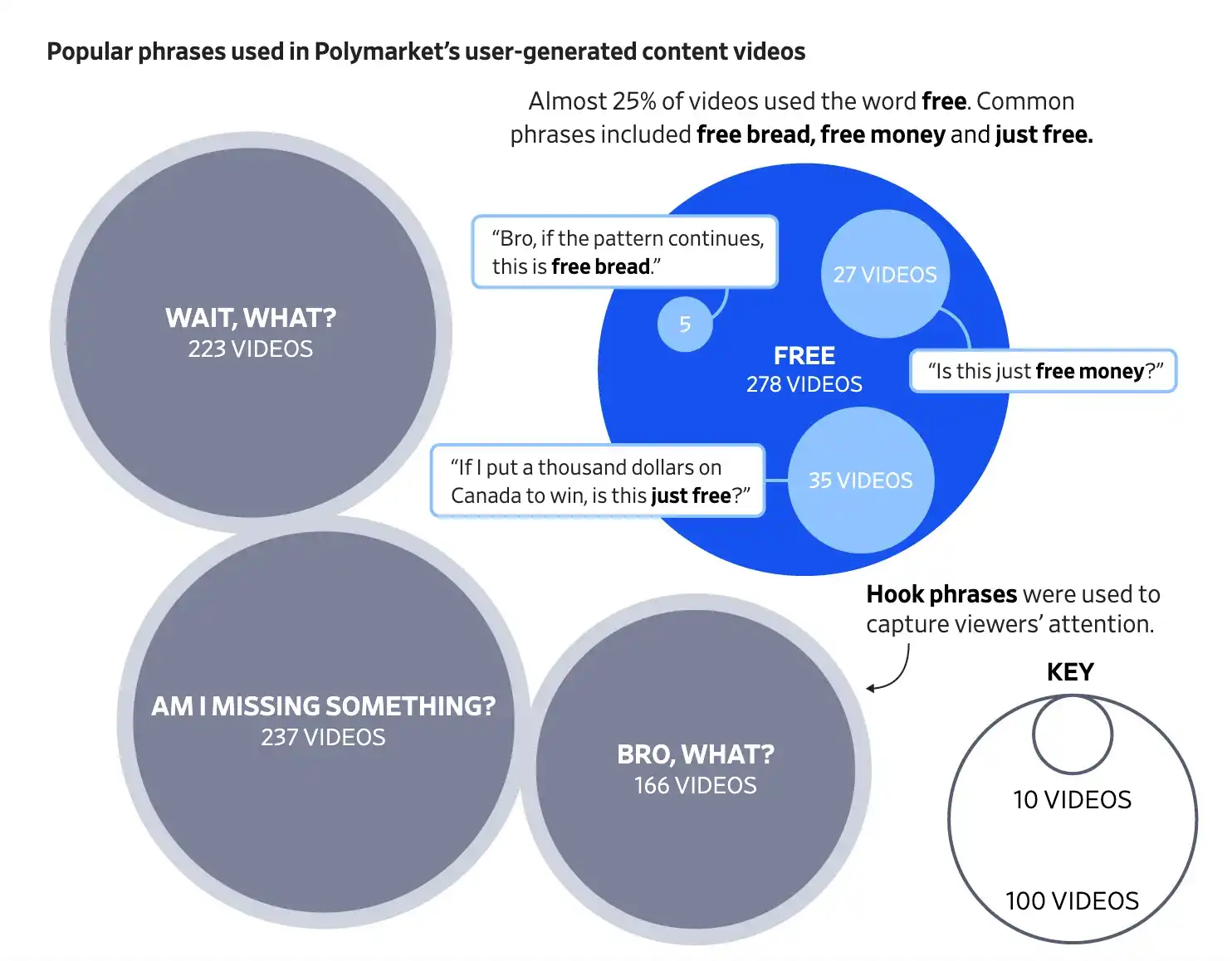
Common catchphrases in Polymarket user-generated content videos were:

Nearly 25% of videos used the word "free." Common phrases included "free bread," "free money," and "just free."

  • "Bro, if this trend continues, this is free bread." – 27 videos
  • "Wait, what?" – 223 videos
  • Free – 278 videos
  • "Isn't this free money?"
  • "If I bet a thousand dollars on Canada to win, isn't this free?" – 35 videos
  • "Am I missing something?" – 237 videos
  • "Bro, what?" – 166 videos
  • "Wait" – 100 videos

Source: Wall Street Journal analysis of 1,105 Polymarket creator videos on TikTok

The U.S. Commodity Futures Trading Commission (CFTC), which regulates prediction markets, has previously taken enforcement actions against companies using simulated trades to market products and making unrealistic profit promises.

The Trump administration has taken a permissive stance on regulating prediction markets. The CFTC has filed multiple lawsuits to stop states from regulating and taxing prediction markets. Trump recently posted on Truth Social that it is "critical" the CFTC has exclusive jurisdiction over prediction markets so they can flourish, calling politicians who want states to regulate them "scum." Trump's son, Donald Trump Jr., is an investor in Polymarket and a paid adviser to rival Kalshi.

A White House spokesperson said there was no conflict of interest and that Trump's actions were in the best interest of the American public. A CFTC spokesperson, in response to the Journal's reporting, said it is important to bring offshore prediction markets back to the U.S. so regulators can oversee them more effectively.

The Hype Machine

For Polymarket, virality is everything.

According to two people familiar with his thinking, founder Shayne Coplan told Polymarket's growth team to make the company impossible to ignore online. His close friend since high school, Matthew Modabber, oversees Polymarket's growth as chief marketing officer.

In 2024, Matthew Modabber (left) with Polymarket founder Shayne Coplan (right)

Polymarket is striving to attract more trading volume than its main competitor – the U.S.-regulated prediction market Kalshi. Polymarket was initially ahead; for most of 2025, both grew in sync; but in recent months, Kalshi has taken the lead. According to data provider The Block, last month Kalshi's trading volume was roughly double that of Polymarket.
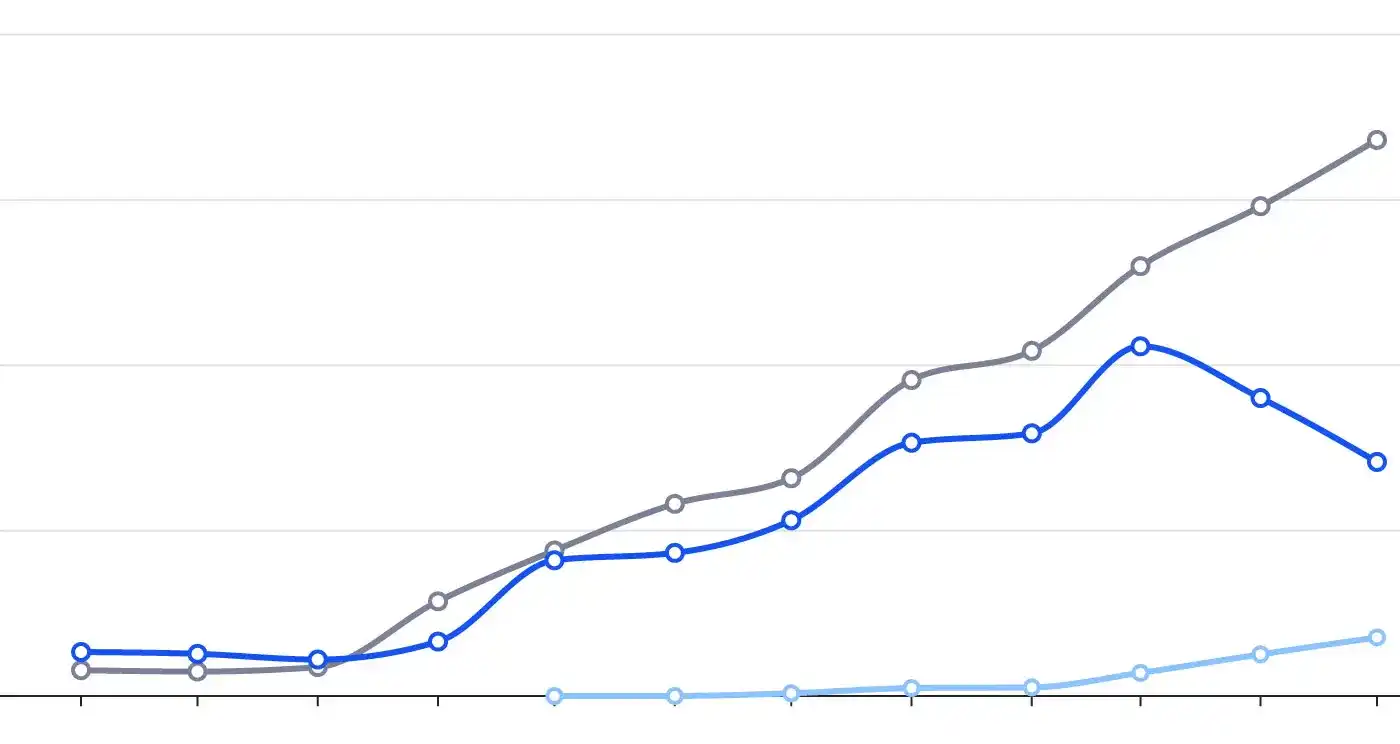
Monthly Trading Volume of Prediction Markets, data as of end of May 2026; Source: The Block

In 2022, Polymarket settled allegations of operating an unregistered options exchange, agreeing to stop offering its crypto-based trading services to U.S. customers and formally re-registering in Panama. Late last year, it launched a regulated U.S. version, available only as a mobile app. The app's trading volume is only a fraction of the offshore crypto exchange.

According to a person familiar with the matter, Polymarket is now seeking to overturn the outcome of the 2022 settlement and bring its crypto platform back to the U.S.

In the meantime, it is turning to social media to draw Americans to Polymarket.

Polymarket's Social Media "Army"

Polymarket's strategy leverages three groups of social media producers to portray the platform as a source of quick, easy money, gaining viral attention.

  • Streamers: Online personalities stream for hours on platforms like Twitch and Kick, discussing Polymarket and sometimes trading.
  • Creators: Social media users, mostly college students, make short videos talking about or trading on Polymarket.
  • Editors (known domestically as "slicers"): People around the world – especially teens in Asia – repost videos from streamers and creators.
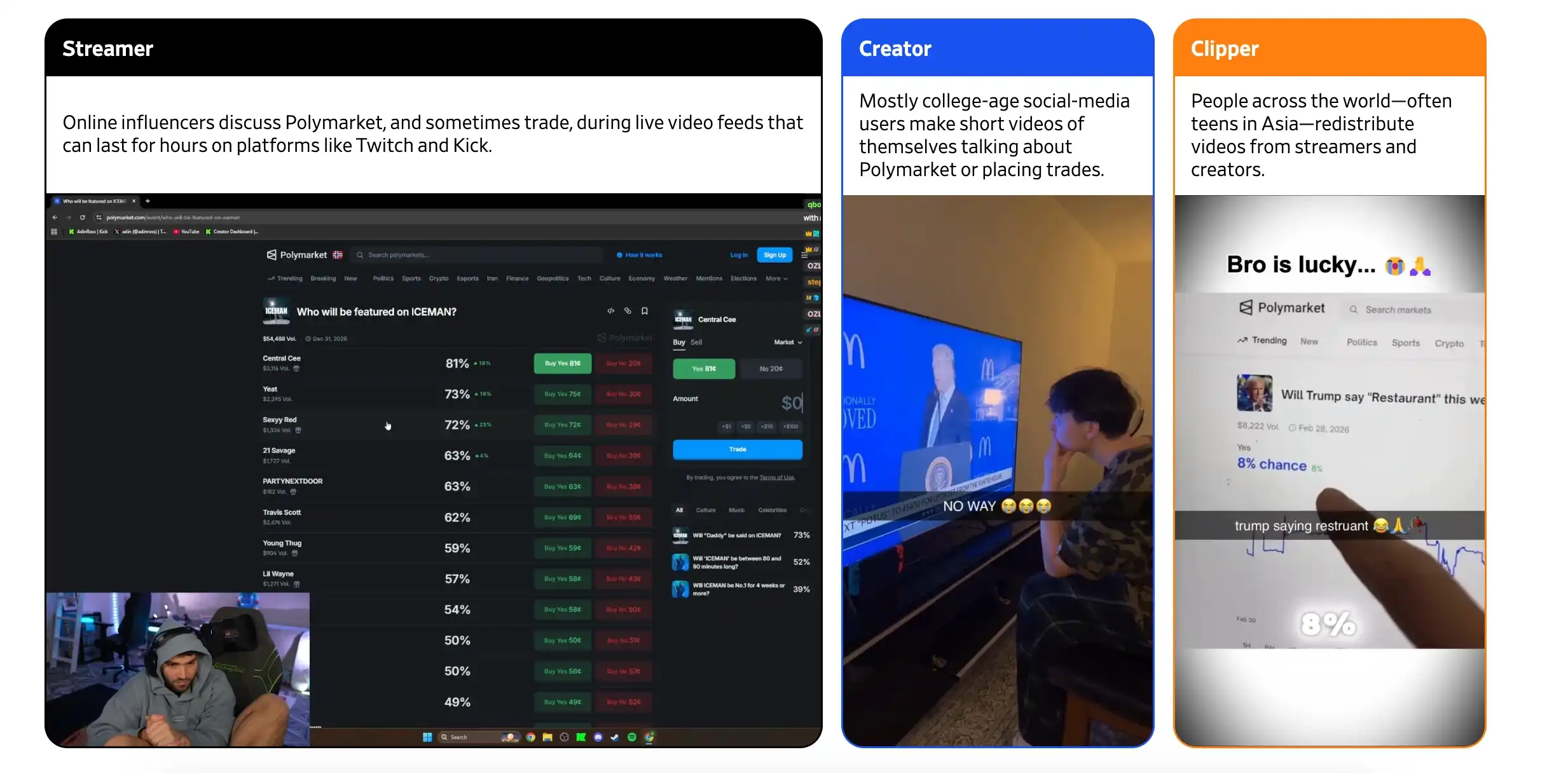
Polymarket hired marketing company Virality to manage the "slicer" team. Their promotional campaigns targeted Americans: according to instructional materials, as of early June, the slicer team could only get paid if at least 60% of their audience was U.S.-based.

Polymarket publicly distances itself from these ads. Based on the Journal's review of nearly 20,000 messages in a chat group for Polymarket's online content creator contractors, as well as instructional files and videos prepared for them, Virality asked the slicer team's posts to look "personal and natural."

"Everyone, if your account name contains 'Polymarket,' please rename and delete as soon as possible," a Virality employee told a group of slicers in the group chat. "Continued use would violate our guidelines and could lead to submissions being rejected. Not even 'poly' is allowed, change that too." Virality declined to comment.

Virality's editing promotion campaigns brought significant results.

A video posted by a Polymarket creator on TikTok had only received 151 views by mid-May. The slicer team reposted his video using secondary accounts, but most reposts were virtually unnoticed, with minimal view counts. But Polymarket works with many video editors to increase the odds of its videos going viral. Eventually, one video would always break through.

According to analytics provider Tubular, Polymarket's viral editing promotion campaigns have accumulated over 140 million views on TikTok, YouTube, and Instagram combined.

A TikTok U.S. spokesperson said several accounts identified by the Journal and other related accounts had been restricted for violating platform rules. A YouTube spokesperson said creators and brands must comply with legal obligations, otherwise YouTube may take action against them. A Meta spokesperson said while the platform requires creators to disclose if they are paid to promote or endorse products, it could not confirm if these specific contents violated its policies, as it had not independently verified whether these creators were paid by Polymarket.

Influencer Livestream Endorsements

Polymarket and Virality targeted dozens of videos by Adin Ross for promotion. Ross is a 25-year-old "manosphere" influencer with millions of followers. According to a person familiar with the negotiations, Ross has a multi-million dollar deal with Polymarket, averaging about half an hour per week browsing Polymarket and commenting on potential trades during his livestreams.

In at least five videos, Ross pointed out how he could trade on the platform using inside information.

In one promotional video, Ross said he could easily use inside information to trade on the release date of rapper Drake's (an acquaintance of Ross) upcoming new album.

Representatives for Ross and Drake declined to comment.

Internal materials show Polymarket and Virality promoted videos showcasing how easy it is to engage in insider trading on the platform. Polymarket has paid editors to promote at least 19 videos discussing opportunities to manipulate the market using insider information or other means.

Polymarket stated it "prohibits trading based on information obtained through theft, unlawful insider information, or in breach of trust, confidentiality, or other legal obligations." It added, "Polymarket's market integrity framework includes trade monitoring, on-chain transparency, reporting channels, and escalation processes to detect, review, and respond to suspicious activity. Where appropriate, we cooperate with regulators and law enforcement to maintain the integrity of our markets."

As the World Cup approached, some of Polymarket's creators turned to filming themselves trading on the company's newly launched, CFTC-regulated U.S. app.

Initially, these trades also looked legitimate. The app interface shown in social media videos was almost identical to that of Polymarket's U.S. app.

But a closer look revealed differences. For example, a market on the official app was "26 World Cup," while on the simulated Polymarket U.S. app it was "2026 FIFA World Cup."

The fake simulated trades continued.

Crypto di tendenza

Domande pertinenti

QAccording to the WSJ investigation, how did Polymarket attract U.S. users to its platform despite being barred from the U.S. market?

APolymarket hired dozens of creators, mostly college students, to create videos showing fake trades and profits on simulated websites. These videos were then virally promoted by a social media army, specifically targeting U.S. audiences who could still access the site via VPN.

QWhat were some of the key differences between the fake 'poiymarket' simulation website and the real Polymarket website as identified in the article?

AKey differences included the fake URL (poiymarket.com vs polymarket.com), the fake site attributing price charts to 'Polymarket.com' (whereas the real site showed no source), occasional typos on buttons like 'NIR' instead of 'NO', and the fake site sometimes showing URLs for test environments used by Polymarket engineers.

QWhat actions did Polymarket announce it would take in response to the WSJ's findings about its promotional activities?

APolymarket stated it was committed to maintaining accurate, fair, and transparent markets and announced plans to conduct a comprehensive audit of its existing promotional content.

QHow much fake winnings and losses were shown in the 1105 videos analyzed by The Wall Street Journal, and what was the actual outcome for those bets if placed on the real platform?

AThe videos showed creators placing fake bets totaling $1.9 million, with 118 videos depicting fake wins of nearly $900,000. If those bets had actually been placed on the real Polymarket platform, they would have resulted in losses of over $166,000.

QWhat was the role of the marketing firm Virality in Polymarket's promotional strategy, and what specific requirement did it have for the 'slicer' team's content?

AVirality was hired by Polymarket to manage a 'slicer' team that reposted and promoted creator videos. Virality required that the slicer team's posts appear 'personal and natural' and specifically mandated that their accounts must not contain 'Polymarket' or even 'poly' in the username. Furthermore, to get paid, the slicers' content needed to have an audience with at least 60% U.S. users.

Letture associate

Farewell to Speculation: The Graham Moment of the Crypto Industry

"Farewell to Speculation: The Graham Moment for the Crypto Industry" The article draws a parallel between today's cryptocurrency market and the speculative, unregulated US stock market of the 1920s. That era lacked mandatory corporate disclosure, enabling rampant manipulation and turning stocks into gambling tools. The 1929 crash led to foundational reforms: the Securities Acts of 1933/34 mandated transparent, audited financial reporting, and Benjamin Graham's "Security Analysis" provided a framework for fundamental valuation. Together, they created modern investing, requiring both reliable data and a methodology to value assets. Similarly, the crypto market is currently driven by narratives and speculation. However, it possesses a key advantage: unlike 1920s corporations, blockchain protocols have inherently transparent, on-chain data for revenue, treasury, and activity. The core obstacle is not transparency, but the lack of legal claim to that value. Due to regulatory uncertainty (primarily the Howey Test), most tokens are deliberately stripped of economic rights like profit-sharing to avoid being classified as securities. This creates a paradox where protocols generate revenue, but token holders have no right to it. The turning point, argues the author, is imminent US legislation. The already-passed GENIUS Act provides a framework for stablecoins. The crucial CLARITY Act, currently in advanced legislative stages, aims to clearly categorize digital assets and define their regulatory treatment (SEC vs. CFTC). This would allow developers to legally design tokens with enforceable economic rights, such as profit distribution. If passed, this would enable a shift from speculation to fundamental investment. Analysis would focus on protocol revenue sustainability, network effects, valuation multiples, and the specific rights encoded in a token's contract—mirroring traditional equity analysis. The article notes significant legislative hurdles and timelines (1-3 years for rulemaking post-passage), but emphasizes the direction is set. A deeper challenge remains: building decentralized, legally enforceable governance and ownership structures to protect token holder rights, akin to corporate law. This will be a core development focus. The transformation applies mainly to revenue-generating protocol tokens, not to assets like Bitcoin (digital gold). The article concludes that the industry's question has evolved from "can tokens create value?" to "who gets to allocate that value?". Solving the latter, as in the 1920s, will mark crypto's transition to a legitimate asset class for fundamental investment.

Foresight News9 min fa

Farewell to Speculation: The Graham Moment of the Crypto Industry

Foresight News9 min fa

Quantum Computing "Manhattan Project" Unveiled: Is the Encryption Industry at a Critical Turning Point?

"Quantum Computing 'Manhattan Project' Launched: Is the Crypto Industry at a Critical Juncture?" On June 22, former U.S. President Donald Trump signed two executive orders. The first mandates all federal agencies upgrade their cryptographic systems to new, quantum-resistant standards by 2030. The second orders the Department of Energy to lead the development of a national quantum computer, signaling a shift from laboratory research to a state-enforced national agenda. This creates a hard deadline. A powerful quantum computer could break current encryption. The threat is compounded by "harvest now, decrypt later" attacks, where encrypted data is stored today for future decryption. Federal agencies must appoint migration officers and complete post-quantum cryptography (PQC) upgrades for key establishment by 2030 and digital signatures by 2031. Procurement rules will also be changed, forcing government contractors to comply. The crypto industry faces a direct threat. Bitcoin's ECDSA signatures are theoretically vulnerable. Research indicates millions of Bitcoin with exposed public keys are at risk if quantum computers advance. While projects like Bitcoin Quantum testnets and efforts by Ethereum, Solana, NEAR, and Zcash are exploring quantum-resistant solutions, achieving consensus in decentralized networks remains a major challenge. The centralized U.S. government has started a 5-year countdown. For decentralized crypto networks, the real test is whether they can complete this anti-quantum upgrade before the theoretical threat becomes a practical reality.

Foresight News31 min fa

Quantum Computing "Manhattan Project" Unveiled: Is the Encryption Industry at a Critical Turning Point?

Foresight News31 min fa

Coin Stock Barometer丨BitMine's Total Assets and Investment Reach $10.7 Billion, Exceeding ~$9.3 Billion Floating Loss; Strategy Buys Only 520 BTC, Strive Adds Positions Against the Trend (June 23)

This article provides a weekly market update on "coin-equity" trends, focusing on listed companies holding major cryptocurrencies. Key highlights include: **General Market Trends:** Global equities, particularly in the US, Japan, and South Korea, faced significant sell-offs, led by large tech and AI-related stocks. Analysts cite profit-taking and a shift from hype-driven to performance-driven valuation for AI companies. Market focus is on upcoming Micron Technology's earnings. **Cryptocurrency Treasury Updates:** * **Bitcoin (BTC):** Net weekly BTC purchases by listed companies (excluding miners) totaled approximately $86 million, down 13.97% from the prior week. Strategy (formerly MicroStrategy) purchased only 520 BTC for ~$34.9 million, while Strive Asset Management increased its holdings by 759 BTC for ~$50 million. Other notable actions include Mara Holdings adding 1,000 BTC and Capital B shareholders approving a massive financing plan (up to ~$1.2 trillion) to potentially expand its Bitcoin reserves. * **Ethereum (ETH):** BitMine emerged as the largest corporate ETH treasury, holding 5.67 million ETH (4.7% of supply). It purchased an additional 52,203 ETH ($92 million) in the past week. Sharplink completed a $75 million private placement to fund further ETH accumulation and stock buybacks. * **Solana (SOL):** The top five listed companies hold over 15.7 million SOL combined. However, Solmate Infrastructure, a SOL treasury firm, faces a lawsuit from its largest external shareholder alleging board misconduct and self-dealing. * **Other:** Updates include Canton Strategic's $50 million stock buyback plan and Lite Strategy's $1 million strategic investment in LitVM, a Layer-2 network for Litecoin. The article notes that while crypto treasury firms continue fundraising and accumulation, their stocks may struggle to rise against the broader market downturn until Q4.

marsbit45 min fa

Coin Stock Barometer丨BitMine's Total Assets and Investment Reach $10.7 Billion, Exceeding ~$9.3 Billion Floating Loss; Strategy Buys Only 520 BTC, Strive Adds Positions Against the Trend (June 23)

marsbit45 min fa

Trading

Spot
Futures

Articoli Popolari

Cosa è $S$

Comprendere SPERO: Una Panoramica Completa Introduzione a SPERO Mentre il panorama dell'innovazione continua a evolversi, l'emergere delle tecnologie web3 e dei progetti di criptovaluta gioca un ruolo fondamentale nel plasmare il futuro digitale. Un progetto che ha attirato l'attenzione in questo campo dinamico è SPERO, denotato come SPERO,$$s$. Questo articolo mira a raccogliere e presentare informazioni dettagliate su SPERO, per aiutare gli appassionati e gli investitori a comprendere le sue basi, obiettivi e innovazioni nei domini web3 e crypto. Che cos'è SPERO,$$s$? SPERO,$$s$ è un progetto unico all'interno dello spazio crypto che cerca di sfruttare i principi della decentralizzazione e della tecnologia blockchain per creare un ecosistema che promuove l'impegno, l'utilità e l'inclusione finanziaria. Il progetto è progettato per facilitare interazioni peer-to-peer in modi nuovi, fornendo agli utenti soluzioni e servizi finanziari innovativi. Al suo interno, SPERO,$$s$ mira a responsabilizzare gli individui fornendo strumenti e piattaforme che migliorano l'esperienza dell'utente nello spazio delle criptovalute. Questo include la possibilità di metodi di transazione più flessibili, la promozione di iniziative guidate dalla comunità e la creazione di percorsi per opportunità finanziarie attraverso applicazioni decentralizzate (dApps). La visione sottostante di SPERO,$$s$ ruota attorno all'inclusività, cercando di colmare le lacune all'interno della finanza tradizionale mentre sfrutta i vantaggi della tecnologia blockchain. Chi è il Creatore di SPERO,$$s$? L'identità del creatore di SPERO,$$s$ rimane piuttosto oscura, poiché ci sono risorse pubblicamente disponibili limitate che forniscono informazioni dettagliate sul suo fondatore o fondatori. Questa mancanza di trasparenza può derivare dall'impegno del progetto per la decentralizzazione—un ethos che molti progetti web3 condividono, dando priorità ai contributi collettivi rispetto al riconoscimento individuale. Centrando le discussioni attorno alla comunità e ai suoi obiettivi collettivi, SPERO,$$s$ incarna l'essenza dell'empowerment senza mettere in evidenza individui specifici. Pertanto, comprendere l'etica e la missione di SPERO rimane più importante che identificare un creatore singolo. Chi sono gli Investitori di SPERO,$$s$? SPERO,$$s$ è supportato da una varietà di investitori che vanno dai capitalisti di rischio agli investitori angelici dedicati a promuovere l'innovazione nel settore crypto. Il focus di questi investitori generalmente si allinea con la missione di SPERO—dando priorità a progetti che promettono avanzamenti tecnologici sociali, inclusività finanziaria e governance decentralizzata. Queste fondazioni di investitori sono tipicamente interessate a progetti che non solo offrono prodotti innovativi, ma contribuiscono anche positivamente alla comunità blockchain e ai suoi ecosistemi. Il supporto di questi investitori rafforza SPERO,$$s$ come un concorrente degno di nota nel dominio in rapida evoluzione dei progetti crypto. Come Funziona SPERO,$$s$? SPERO,$$s$ impiega un framework multifunzionale che lo distingue dai progetti di criptovaluta convenzionali. Ecco alcune delle caratteristiche chiave che sottolineano la sua unicità e innovazione: Governance Decentralizzata: SPERO,$$s$ integra modelli di governance decentralizzati, responsabilizzando gli utenti a partecipare attivamente ai processi decisionali riguardanti il futuro del progetto. Questo approccio favorisce un senso di proprietà e responsabilità tra i membri della comunità. Utilità del Token: SPERO,$$s$ utilizza il proprio token di criptovaluta, progettato per servire varie funzioni all'interno dell'ecosistema. Questi token abilitano transazioni, premi e la facilitazione dei servizi offerti sulla piattaforma, migliorando l'impegno e l'utilità complessivi. Architettura Stratificata: L'architettura tecnica di SPERO,$$s$ supporta la modularità e la scalabilità, consentendo un'integrazione fluida di funzionalità e applicazioni aggiuntive man mano che il progetto evolve. Questa adattabilità è fondamentale per mantenere la rilevanza nel panorama crypto in continua evoluzione. Coinvolgimento della Comunità: Il progetto enfatizza iniziative guidate dalla comunità, impiegando meccanismi che incentivano la collaborazione e il feedback. Nutrendo una comunità forte, SPERO,$$s$ può affrontare meglio le esigenze degli utenti e adattarsi alle tendenze di mercato. Focus sull'Inclusione: Offrendo basse commissioni di transazione e interfacce user-friendly, SPERO,$$s$ mira ad attrarre una base utenti diversificata, inclusi individui che potrebbero non aver precedentemente interagito nello spazio crypto. Questo impegno per l'inclusione si allinea con la sua missione generale di empowerment attraverso l'accessibilità. Cronologia di SPERO,$$s$ Comprendere la storia di un progetto fornisce preziose intuizioni sulla sua traiettoria di sviluppo e sui traguardi. Di seguito è riportata una cronologia suggerita che mappa eventi significativi nell'evoluzione di SPERO,$$s$: Fase di Concettualizzazione e Ideazione: Le idee iniziali che formano la base di SPERO,$$s$ sono state concepite, allineandosi strettamente con i principi di decentralizzazione e focus sulla comunità all'interno dell'industria blockchain. Lancio del Whitepaper del Progetto: Dopo la fase concettuale, è stato rilasciato un whitepaper completo che dettaglia la visione, gli obiettivi e l'infrastruttura tecnologica di SPERO,$$s$ per suscitare interesse e feedback dalla comunità. Costruzione della Comunità e Prime Interazioni: Sono stati effettuati sforzi attivi di outreach per costruire una comunità di early adopters e potenziali investitori, facilitando discussioni attorno agli obiettivi del progetto e ottenendo supporto. Evento di Generazione del Token: SPERO,$$s$ ha condotto un evento di generazione del token (TGE) per distribuire i propri token nativi ai primi sostenitori e stabilire una liquidità iniziale all'interno dell'ecosistema. Lancio della Prima dApp: La prima applicazione decentralizzata (dApp) associata a SPERO,$$s$ è stata attivata, consentendo agli utenti di interagire con le funzionalità principali della piattaforma. Sviluppo Continuo e Partnership: Aggiornamenti e miglioramenti continui alle offerte del progetto, inclusi partnership strategiche con altri attori nello spazio blockchain, hanno plasmato SPERO,$$s$ in un concorrente competitivo e in evoluzione nel mercato crypto. Conclusione SPERO,$$s$ rappresenta una testimonianza del potenziale del web3 e delle criptovalute di rivoluzionare i sistemi finanziari e responsabilizzare gli individui. Con un impegno per la governance decentralizzata, il coinvolgimento della comunità e funzionalità progettate in modo innovativo, apre la strada verso un panorama finanziario più inclusivo. Come per qualsiasi investimento nello spazio crypto in rapida evoluzione, si incoraggiano potenziali investitori e utenti a ricercare approfonditamente e a impegnarsi in modo riflessivo con gli sviluppi in corso all'interno di SPERO,$$s$. Il progetto mostra lo spirito innovativo dell'industria crypto, invitando a ulteriori esplorazioni delle sue innumerevoli possibilità. Mentre il percorso di SPERO,$$s$ è ancora in fase di sviluppo, i suoi principi fondamentali potrebbero effettivamente influenzare il futuro di come interagiamo con la tecnologia, la finanza e tra di noi in ecosistemi digitali interconnessi.

87 Totale visualizzazioniPubblicato il 2024.12.17Aggiornato il 2024.12.17

Cosa è $S$

Cosa è AGENT S

Agent S: Il Futuro dell'Interazione Autonoma in Web3 Introduzione Nel panorama in continua evoluzione di Web3 e criptovalute, le innovazioni stanno costantemente ridefinendo il modo in cui gli individui interagiscono con le piattaforme digitali. Uno di questi progetti pionieristici, Agent S, promette di rivoluzionare l'interazione uomo-computer attraverso il suo framework agentico aperto. Aprendo la strada a interazioni autonome, Agent S mira a semplificare compiti complessi, offrendo applicazioni trasformative nell'intelligenza artificiale (AI). Questa esplorazione dettagliata approfondirà le complessità del progetto, le sue caratteristiche uniche e le implicazioni per il dominio delle criptovalute. Cos'è Agent S? Agent S si presenta come un innovativo framework agentico aperto, progettato specificamente per affrontare tre sfide fondamentali nell'automazione dei compiti informatici: Acquisizione di Conoscenze Specifiche del Dominio: Il framework apprende in modo intelligente da varie fonti di conoscenza esterne ed esperienze interne. Questo approccio duale gli consente di costruire un ricco repository di conoscenze specifiche del dominio, migliorando le sue prestazioni nell'esecuzione dei compiti. Pianificazione su Lungo Orizzonte di Compiti: Agent S impiega una pianificazione gerarchica potenziata dall'esperienza, un approccio strategico che facilita la suddivisione e l'esecuzione efficiente di compiti complessi. Questa caratteristica migliora significativamente la sua capacità di gestire più sottocompiti in modo efficiente ed efficace. Gestione di Interfacce Dinamiche e Non Uniformi: Il progetto introduce l'Interfaccia Agente-Computer (ACI), una soluzione innovativa che migliora l'interazione tra agenti e utenti. Utilizzando Modelli Linguistici Multimodali di Grandi Dimensioni (MLLM), Agent S può navigare e manipolare senza sforzo diverse interfacce grafiche utente. Attraverso queste caratteristiche pionieristiche, Agent S fornisce un framework robusto che affronta le complessità coinvolte nell'automazione dell'interazione umana con le macchine, preparando il terreno per innumerevoli applicazioni nell'AI e oltre. Chi è il Creatore di Agent S? Sebbene il concetto di Agent S sia fondamentalmente innovativo, informazioni specifiche sul suo creatore rimangono elusive. Il creatore è attualmente sconosciuto, il che evidenzia sia la fase embrionale del progetto sia la scelta strategica di mantenere i membri fondatori sotto anonimato. Indipendentemente dall'anonimato, l'attenzione rimane sulle capacità e sul potenziale del framework. Chi sono gli Investitori di Agent S? Poiché Agent S è relativamente nuovo nell'ecosistema crittografico, informazioni dettagliate riguardanti i suoi investitori e sostenitori finanziari non sono documentate esplicitamente. La mancanza di approfondimenti pubblicamente disponibili sulle fondazioni di investimento o sulle organizzazioni che supportano il progetto solleva interrogativi sulla sua struttura di finanziamento e sulla roadmap di sviluppo. Comprendere il supporto è cruciale per valutare la sostenibilità del progetto e il suo potenziale impatto sul mercato. Come Funziona Agent S? Al centro di Agent S si trova una tecnologia all'avanguardia che gli consente di funzionare efficacemente in contesti diversi. Il suo modello operativo è costruito attorno a diverse caratteristiche chiave: Interazione Uomo-Computer Simile a Quella Umana: Il framework offre una pianificazione AI avanzata, cercando di rendere le interazioni con i computer più intuitive. Mimando il comportamento umano nell'esecuzione dei compiti, promette di elevare le esperienze degli utenti. Memoria Narrativa: Utilizzata per sfruttare esperienze di alto livello, Agent S utilizza la memoria narrativa per tenere traccia delle storie dei compiti, migliorando così i suoi processi decisionali. Memoria Episodica: Questa caratteristica fornisce agli utenti una guida passo-passo, consentendo al framework di offrire supporto contestuale mentre i compiti si sviluppano. Supporto per OpenACI: Con la capacità di funzionare localmente, Agent S consente agli utenti di mantenere il controllo sulle proprie interazioni e flussi di lavoro, allineandosi con l'etica decentralizzata di Web3. Facile Integrazione con API Esterne: La sua versatilità e compatibilità con varie piattaforme AI garantiscono che Agent S possa adattarsi senza problemi agli ecosistemi tecnologici esistenti, rendendolo una scelta attraente per sviluppatori e organizzazioni. Queste funzionalità contribuiscono collettivamente alla posizione unica di Agent S all'interno dello spazio crittografico, poiché automatizza compiti complessi e multi-fase con un intervento umano minimo. Man mano che il progetto evolve, le sue potenziali applicazioni in Web3 potrebbero ridefinire il modo in cui si svolgono le interazioni digitali. Cronologia di Agent S Lo sviluppo e le tappe di Agent S possono essere riassunti in una cronologia che evidenzia i suoi eventi significativi: 27 Settembre 2024: Il concetto di Agent S è stato lanciato in un documento di ricerca completo intitolato “Un Framework Agentico Aperto che Usa i Computer Come un Umano”, mostrando le basi per il progetto. 10 Ottobre 2024: Il documento di ricerca è stato reso pubblicamente disponibile su arXiv, offrendo un'esplorazione approfondita del framework e della sua valutazione delle prestazioni basata sul benchmark OSWorld. 12 Ottobre 2024: È stata rilasciata una presentazione video, fornendo un'idea visiva delle capacità e delle caratteristiche di Agent S, coinvolgendo ulteriormente potenziali utenti e investitori. Questi indicatori nella cronologia non solo illustrano i progressi di Agent S, ma indicano anche il suo impegno per la trasparenza e il coinvolgimento della comunità. Punti Chiave su Agent S Man mano che il framework Agent S continua a evolversi, diversi attributi chiave si distinguono, sottolineando la sua natura innovativa e il potenziale: Framework Innovativo: Progettato per fornire un uso intuitivo dei computer simile all'interazione umana, Agent S porta un approccio nuovo all'automazione dei compiti. Interazione Autonoma: La capacità di interagire autonomamente con i computer attraverso GUI segna un passo avanti verso soluzioni informatiche più intelligenti ed efficienti. Automazione di Compiti Complessi: Con la sua metodologia robusta, può automatizzare compiti complessi e multi-fase, rendendo i processi più veloci e meno soggetti a errori. Miglioramento Continuo: I meccanismi di apprendimento consentono ad Agent S di migliorare dalle esperienze passate, migliorando continuamente le sue prestazioni e la sua efficacia. Versatilità: La sua adattabilità attraverso diversi ambienti operativi come OSWorld e WindowsAgentArena garantisce che possa servire un'ampia gamma di applicazioni. Man mano che Agent S si posiziona nel panorama di Web3 e delle criptovalute, il suo potenziale per migliorare le capacità di interazione e automatizzare i processi segna un significativo avanzamento nelle tecnologie AI. Attraverso il suo framework innovativo, Agent S esemplifica il futuro delle interazioni digitali, promettendo un'esperienza più fluida ed efficiente per gli utenti in vari settori. Conclusione Agent S rappresenta un audace passo avanti nell'unione tra AI e Web3, con la capacità di ridefinire il modo in cui interagiamo con la tecnologia. Sebbene sia ancora nelle sue fasi iniziali, le possibilità per la sua applicazione sono vaste e coinvolgenti. Attraverso il suo framework completo che affronta sfide critiche, Agent S mira a portare le interazioni autonome al centro dell'esperienza digitale. Man mano che ci addentriamo nei regni delle criptovalute e della decentralizzazione, progetti come Agent S giocheranno senza dubbio un ruolo cruciale nel plasmare il futuro della tecnologia e della collaborazione uomo-computer.

554 Totale visualizzazioniPubblicato il 2025.01.14Aggiornato il 2025.01.14

Cosa è AGENT S

Come comprare S

Benvenuto in HTX.com! Abbiamo reso l'acquisto di Sonic (S) semplice e conveniente. Segui la nostra guida passo passo per intraprendere il tuo viaggio nel mondo delle criptovalute.Step 1: Crea il tuo Account HTXUsa la tua email o numero di telefono per registrarti il tuo account gratuito su HTX. Vivi un'esperienza facile e sblocca tutte le funzionalità,Crea il mio accountStep 2: Vai in Acquista crypto e seleziona il tuo metodo di pagamentoCarta di credito/debito: utilizza la tua Visa o Mastercard per acquistare immediatamente SonicS.Bilancio: Usa i fondi dal bilancio del tuo account HTX per fare trading senza problemi.Terze parti: abbiamo aggiunto metodi di pagamento molto utilizzati come Google Pay e Apple Pay per maggiore comodità.P2P: Fai trading direttamente con altri utenti HTX.Over-the-Counter (OTC): Offriamo servizi su misura e tassi di cambio competitivi per i trader.Step 3: Conserva Sonic (S)Dopo aver acquistato Sonic (S), conserva nel tuo account HTX. In alternativa, puoi inviare tramite trasferimento blockchain o scambiare per altre criptovalute.Step 4: Scambia Sonic (S)Scambia facilmente Sonic (S) nel mercato spot di HTX. Accedi al tuo account, seleziona la tua coppia di trading, esegui le tue operazioni e monitora in tempo reale. Offriamo un'esperienza user-friendly sia per chi ha appena iniziato che per i trader più esperti.

1.1k Totale visualizzazioniPubblicato il 2025.01.15Aggiornato il 2026.06.02

Come comprare S

Discussioni

Benvenuto nella Community HTX. Qui puoi rimanere informato sugli ultimi sviluppi della piattaforma e accedere ad approfondimenti esperti sul mercato. Le opinioni degli utenti sul prezzo di S S sono presentate come di seguito.

活动图片