Wrapped Real-World Assets (RWA)

marsbitPubblicato 2026-02-10Pubblicato ultima volta 2026-02-10

Introduzione

Packaged Real-World Assets (RWAs) are a contentious yet pragmatic approach to bringing traditional assets on-chain. Unlike native RWAs, where ownership and transfers are fully on-chain and legally recognized, packaged RWAs use tokens as representations of off-chain assets held by custodians, SPVs, or brokers. This often draws criticism from crypto purists who prioritize trust minimization, as packaged RWAs reintroduce intermediaries and traditional legal frameworks. The core issue lies in ownership: some tokens provide legal ownership, while others only offer price exposure without actual asset ownership. Packaged RWAs are not ideal but serve as a bridge for institutional capital that cannot immediately adopt fully native on-chain systems due to existing legal and operational constraints. Key challenges include proving the existence and uniqueness of underlying assets without double-counting, and ensuring timely updates to reflect real-time market conditions. The solution is not full transparency—which could expose sensitive data—but verifiable constraints: proving critical facts like collateralization and asset backing without disclosing everything. Effective packaged RWAs require three elements: clear legal rights, independent verification (not just issuer-controlled dashboards), and high-frequency updates to ensure accuracy. They are a transitional tool, not the end goal, and must evolve with better validation, privacy-preserving proofs, and real-time attestations to ga...

Author: Zeus

Compiled: Block unicorn

Wrapped RWA (where tokens merely serve as a 'wrapper' or representation of traditional assets, rather than on-chain ownership) might be the most criticized asset class in the cryptocurrency space, and I have some understanding of this. If you grew up in a world that prioritizes trust minimization, anything involving custodians, special purpose vehicles (SPVs), brokers, registries, and cumbersome paperwork feels like a step backward. It feels like traditional finance (TradFi) is sneaking in through the back door, bringing a token along. This reaction is understandable. However, institutions operate very differently from cryptocurrency; they can't just abandon decades of legal and risk frameworks overnight. I'm not saying wrapped RWA are perfect. I mean, sometimes they are the only way for real capital to consider coming on-chain. This is not the ultimate goal, nor the ideal solution, but just... reality.

When people hear 'tokenized RWA,' the word 'tokenized' carries a weight it shouldn't. It sounds like the problem is solved. But it's not. The real, important question is simple: what do you own? In some cases, you own legal ownership, the kind that courts recognize. In others, you merely have price exposure; you bear the price fluctuations but don't own the asset itself. Many debates about RWA are actually just talking past each other because this distinction is never openly discussed, and we're still in an awkward learning phase...

Broadly speaking, there are two paths. Native RWA is the cleanest version. Ownership exists on-chain, transfers happen on-chain, the blockchain is the source of truth. Everyone loves this idea. The key is that the legal world must agree that on-chain records actually matter, and this is more difficult than the crypto Twitter sphere is willing to admit. Wrapped RWA takes a more pragmatic path. The assets still operate on traditional rails, ownership lies with a custodian, SPV, or broker, and the token becomes the interface. Wrapped doesn't imply bad. It just means the blockchain isn't the entire universe yet.

This is where the crypto crowd starts rolling their eyes. 'It's just a wrapper.' 'You still have to trust intermediaries.' 'If it's not fully on-chain, what's the point?' Yes, there's truth to that. If your token essentially just says 'trust us,' then you're not really building a financial system; you're just issuing digital receipts. So, the real question isn't whether wrapped RWA should exist, but whether they can go beyond the surface and become something truly verifiable.

The tricky part is the balance between privacy and verification. Institutions hold information that cannot be made public arbitrarily, such as holdings, counterparties, pricing models, and client data. This isn't transparency; it's asking for trouble, susceptible to front-running or attacks. But swinging to the other extreme is also not good. If all information is secret and unverifiable, then wrapped RWA devolve into a 'trust us' infrastructure. The goal is not total transparency, but credible constraints. Proving what truly matters without exposing everything.

Currently, most wrapped RWA architectures suffer from the same two flaws. First, proving that the assets actually exist and are not double-counted. If a token claims to be backed by bonds, loans, or real estate, you need to confirm its existence, that it's properly custodied where it should be, and that it hasn't been secretly rehypothecated. If the proof is just a PDF or a static dashboard, that's... not ideal. Second, proving the timeliness of information. Off-chain markets move fast. If asset information changes daily, but you only update it monthly, you're taking on time-lag risk, whether you like it or not.

A better approach is actually simple: protect sensitive information, but ensure key facts are verifiable. Update proofs frequently so they actually mean something. Make the verification process scalable without manual copy-pasting of spreadsheets. You don't need to disclose everything to prove things like whether a pool is over-collateralized, whether bonds are still held at the custodian, whether assets aren't double-counted, or whether a portfolio complies with its rules. If you can reliably prove these things, then wrapped RWA won't feel like 'trust us,' but rather 'check the proof.'

To be honest, good wrapped RWA boils down to three basic elements: clear legal rights, so you know what you own and under which law; independent verification, not just a dashboard run by the issuer; and timeliness, meaning update frequency high enough to reflect reality. Missing any one of these, the whole structure quickly becomes shaky.

The balanced view is actually simple. When assets can truly flow end-to-end on-chain, native RWA is cleaner. When that's not possible, representative RWA is more realistic. The misconception is to see representative RWA either as obviously fake assets or as the obvious future. They are neither. They are just a bridge. If the next generation of RWA can achieve better verification, faster proofs, and mechanisms that protect privacy while enabling oversight, then this bridge will truly become solid.

Also, I want to make it clear that I don't claim to be an authority on this. I'm not an expert, and I'm very open to other perspectives and angles. RWA sits at the intersection of law, finance, and cryptocurrency, and no one has fully mastered it yet. That's precisely the point.

Domande pertinenti

QWhat is the main difference between native RWA and wrapped RWA according to the article?

ANative RWA has ownership that exists on-chain, with the blockchain serving as the source of truth, while wrapped RWA involves traditional off-chain ownership held by custodians or SPVs, with tokens merely acting as a representation or interface.

QWhy does the author argue that wrapped RWA are sometimes necessary despite their drawbacks?

AThe author argues that wrapped RWA are sometimes the only way for real-world capital to consider coming on-chain, as institutions cannot immediately abandon decades of legal and risk frameworks, making them a pragmatic bridge to reality.

QWhat are the two main flaws in the architecture of most wrapped RWA mentioned in the article?

AThe two main flaws are: 1) The inability to reliably prove that the underlying asset exists and is not double-counted, and 2) The lack of timeliness in information updates, leading to time-lag risks in a fast-moving off-chain market.

QWhat three basic elements does the author suggest are essential for a well-designed wrapped RWA?

AThe three essential elements are: 1) Clear legal rights defining what is owned and under which law, 2) Independent verification beyond issuer-operated dashboards, and 3) Timeliness with sufficiently high update frequency to reflect real-world conditions.

QHow does the article suggest balancing privacy and verification in wrapped RWA systems?

AThe article suggests that instead of full transparency, wrapped RWA should focus on credible constraints—protecting sensitive information while ensuring key facts are verifiable, such as proving assets are not double-counted or over-collateralized without exposing all data.

Letture associate

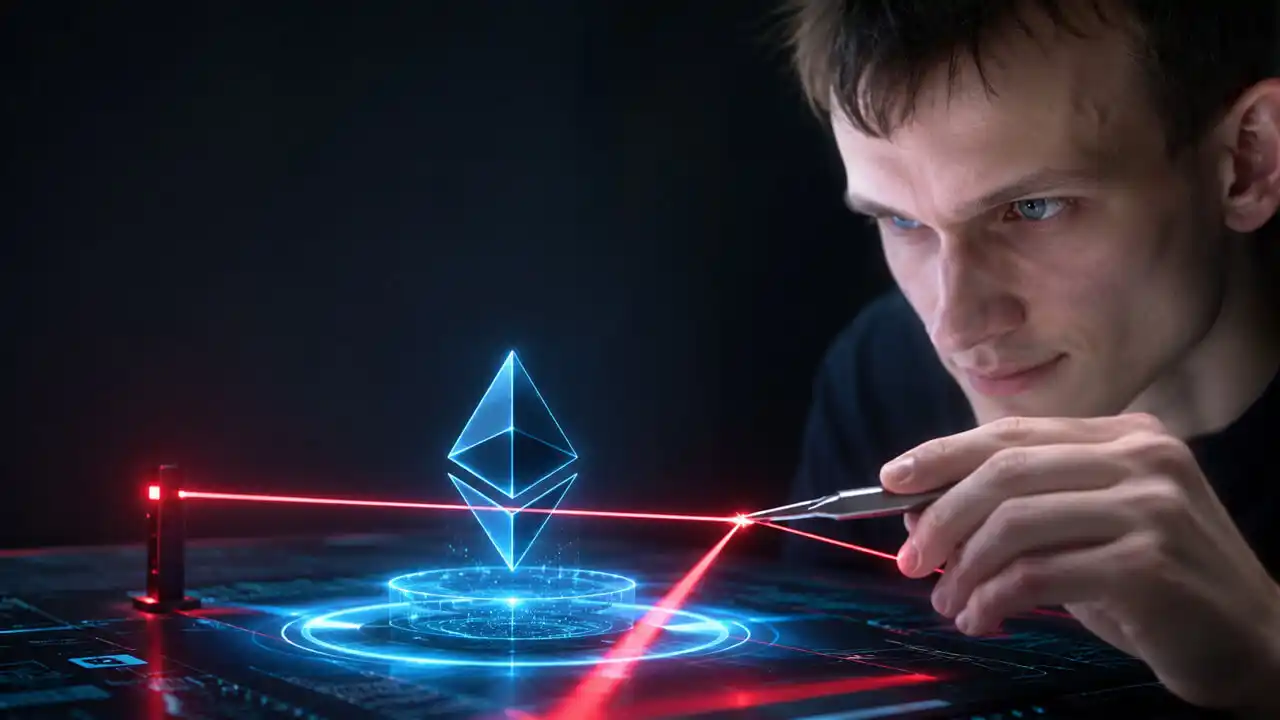
Breaking the DeFi Cascading Liquidation Curse: Vitalik Proposes a New Solution

Vitalik Buterin has proposed a new DeFi design to eliminate the automatic liquidation mechanism that causes market instability during sharp downturns. The current system, used by protocols like Aave, triggers forced sales when collateral value falls below a threshold, often exacerbating price drops and creating systemic selling pressure. Buterin's alternative model is based on splitting an asset like ETH into two synthetic option-like tokens, P and N, pegged to a price index. Their combined value always equals one ETH. Instead of sudden liquidation, a position's value gradually drifts from its target peg if the market moves. Users must proactively rebalance their holdings to maintain their desired exposure, transferring the management burden from the protocol to the user or automated tools. A key advantage is the reduced reliance on real-time oracles. Pricing decisions are deferred until contract expiry, allowing for more robust, fault-tolerant oracle designs. This removes a clear liquidation threshold that speculators can target for manipulation or MEV extraction. However, significant challenges remain. Frequent rebalancing could incur high slippage and transaction costs, necessitating new liquidity provider models. The design is better suited for hedging instruments than for stablecoins requiring a rigid 1:1 peg. While not an immediate replacement for existing systems, the proposal challenges the foundational assumption that instantaneous forced liquidation is an unavoidable necessity in DeFi, opening the door for fundamentally different risk management architectures.

marsbit1 min fa

Breaking the DeFi Cascading Liquidation Curse: Vitalik Proposes a New Solution

marsbit1 min fa

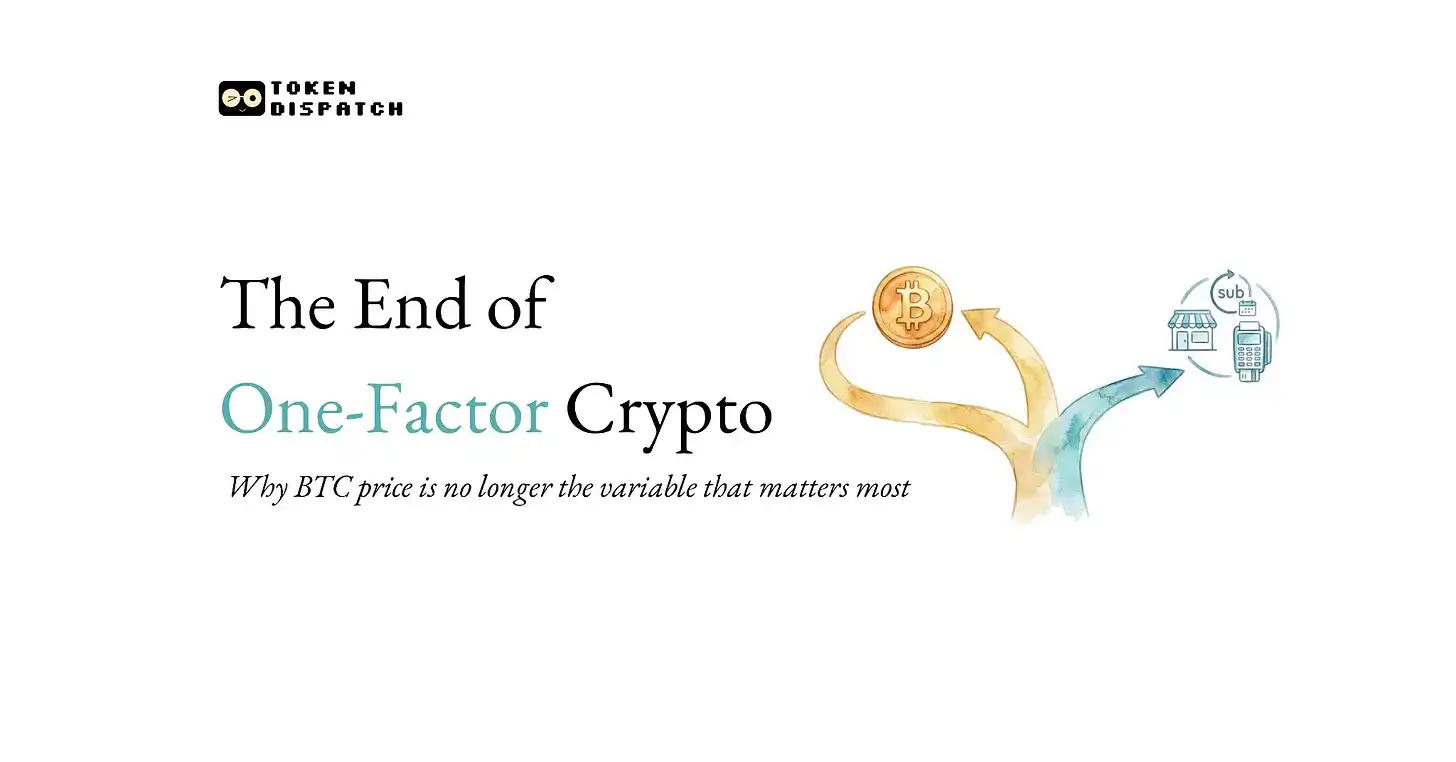
The End of Single-Factor Cryptography

The article "The End of Single-Factor Crypto" posits a fundamental shift in the cryptocurrency ecosystem. It argues the era where crypto asset valuations were predominantly driven by, and correlated with, Bitcoin's price is ending. The space is bifurcating into two distinct economies: endogenous and exogenous. The endogenous economy represents traditional crypto, where token and project values are directly tied to crypto market prices. The emerging exogenous economy comprises projects and businesses that may utilize blockchain technology or tokens but derive their fundamental value from external, non-crypto factors like consumer demand, subscription revenue, or real-world utility. Examples include AI inference platforms like Venice, fintech lenders using blockchain for efficiency, and stablecoin/payment infrastructure companies acquired by giants like Mastercard and Stripe. This shift means investment analysis must change. For exogenous assets, evaluating traditional business fundamentals—such as revenue streams, unit economics, and competitive moats—becomes more critical than tracking Bitcoin charts. While endogenous assets like Bitcoin remain relevant, the growth of the exogenous category is driven by measurable demand independent of crypto price cycles, paving the way for a new, more diversified market phase. Consequently, crypto is evolving from a single-factor, reflexive asset class into a multifaceted ecosystem with varied drivers and investment theses.

marsbit2 min fa

The End of Single-Factor Cryptography

marsbit2 min fa

Morning Post | Bitmine Plans to Raise $300 Million Through Preferred Stock Issuance; Polymarket Accuses Kalshi of Commercial Espionage

ChainCatcher's Daily Crypto Brief: Key developments from the past 24 hours include significant funding moves, regulatory actions, and market predictions. Bitmine announced a $300 million preferred stock fundraising. Polymarket accused rival prediction platform Kalshi of corporate espionage, citing numerous suspicious coincidences in product launches, a claim Kalshi strongly denied. The U.S. Department of Justice, in a joint "Disruption Week" anti-fraud operation with companies like Coinbase and Meta, froze over $3.8 million in cryptocurrency linked to scams. In infrastructure news, Macau completed its integration with the multi-central bank digital currency bridge, mBridge, aiming to build efficient cross-border payment channels. Cosmos Labs acquired the block explorer Mintscan. Market-wise, Geoffrey Kendrick, Standard Chartered's Head of Digital Assets Research, stated Bitcoin is nearing a bottom around $63,000, maintaining a year-end target of $100,000. He noted stability in U.S. spot Bitcoin ETF holdings. Ahead of SpaceX's anticipated IPO, internal insiders at Rocket Lab (RKLB) sold over $18.41 million in stock. In tokenization, Goldman Sachs partnered with Apex and Archax to launch a tokenized real estate fund. The meme token tracker GMGN reported the top trending tokens: on Ethereum, HEX, SHIB, LINK, PEPE, mUSD; on Solana, TROLL, swarms, WORLDCUP, neet, Buttcoin; and on Base, PEPE, toby, ODDS, ELSA, SKI.

链捕手16 min fa

Morning Post | Bitmine Plans to Raise $300 Million Through Preferred Stock Issuance; Polymarket Accuses Kalshi of Commercial Espionage

链捕手16 min fa

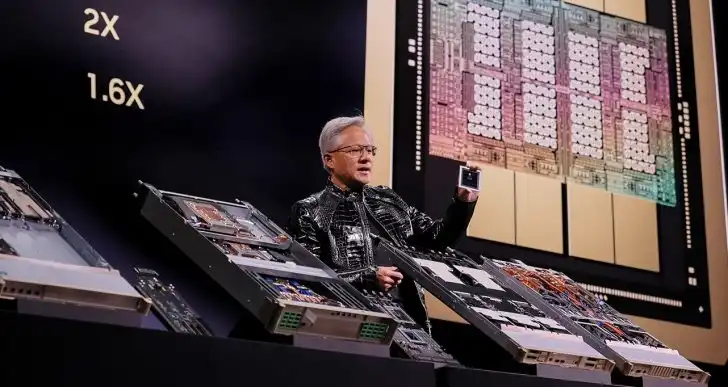
55TB to 28TB? The Rumor and Panic Behind Rubin's Memory Being Halved

Title: 55TB to 28TB? The Rumor and Panic Behind the Potential Halving of Rubin's Memory. On June 4th, a report from SemiAnalysis suggested NVIDIA's next-gen Vera Rubin NVL72 AI rack may ship with roughly 28TB of SOCAMM DRAM per rack instead of the anticipated 55TB, primarily using 96GB modules. This sparked a market panic, causing Micron's stock to drop over 10% on fears of halved memory demand. However, the article argues this panic is misguided for several key reasons. First, SOCAMM modules are socketed and upgradeable, not soldered. Lower initial configuration doesn't mean permanent demand loss. Second, the primary driver is a severe 2026 LPDDR5X supply shortage, not diminished need. NVIDIA is likely prioritizing rack shipments with available components. Third, with fixed total LPDDR5X supply, using less per rack could allow NVIDIA to ship *more* racks, not necessarily reducing overall memory orders. Micron's sharp drop was also attributed to a broader semiconductor sell-off triggered by Broadcom's earnings, with the SemiAnalysis report providing a convenient narrative for profit-taking after Micron's massive rally. In summary: the report on lower default configurations is likely accurate, but interpreting it as a demand collapse is wrong. The real risk for Micron lies in its reportedly minimal HBM4 share for Rubin, not in potentially flexible SOCAMM demand. The sell-off appears more like a correction amplified by coinciding negative catalysts.

marsbit33 min fa

55TB to 28TB? The Rumor and Panic Behind Rubin's Memory Being Halved

marsbit33 min fa

Exclusive from Yingke | Tang Wenbin's 'Yuanli Lingji' Merges with Logistics Robotics Company, and Secures Investment from Zhipu, SenseTime, Jieyue, and Others

Exclusive report: Embodied AI company "Yuanli Lingji" recently completed a new round of financing from major AI model firms including Zhipu AI, Stepfun, and SenseTime, alongside continued investments from industrial backers like Huaqin and SAIC Hengxu. Founded in March 2025 by Tang Wenbin, former co-founder and CTO of Megvii, Yuanli Lingji is a general-purpose embodied AI model company. In a notable move, the company has merged with logistics robotics firm "Atomix" (formerly known as Yuanli Juhe) through a share acquisition. Atomix, which originated from Megvii's logistics robotics business led by Tang in 2016 and was spun off in July 2024, has grown to become the world's second-largest supplier of pallet shuttle robots, with annual revenue nearing 1 billion RMB and over 500 projects globally for clients like Uniqlo and CATL. This merger aims to break the industry's "data deadlock" by combining Atomix's extensive real-world operational data from more than 20 countries with Yuanli Lingji's model training capabilities. The company's embodied AI model "DM0" utilizes a cross-domain training approach, integrating internet semantics, autonomous driving rules, and robotics data to achieve hardware-agnostic, precise manipulation even with a compact 2.4B parameter size. The collective investment from key AI players and the strategic merger signal a shift in the competitive landscape, as major model companies pivot from language tokens to physical actions ("from Token to Action"). The industry is entering a consolidation phase where hardware, AI models, data, and application scenarios converge to scale embodied intelligence, a trend mirrored by recent moves from giants like ByteDance and Skild AI.

marsbit41 min fa

Exclusive from Yingke | Tang Wenbin's 'Yuanli Lingji' Merges with Logistics Robotics Company, and Secures Investment from Zhipu, SenseTime, Jieyue, and Others

marsbit41 min fa

Trading

Spot
Futures

Articoli Popolari

Come comprare ZEUS

Benvenuto in HTX.com! Abbiamo reso l'acquisto di Zeus Network (ZEUS) semplice e conveniente. Segui la nostra guida passo passo per intraprendere il tuo viaggio nel mondo delle criptovalute.Step 1: Crea il tuo Account HTXUsa la tua email o numero di telefono per registrarti il tuo account gratuito su HTX. Vivi un'esperienza facile e sblocca tutte le funzionalità,Crea il mio accountStep 2: Vai in Acquista crypto e seleziona il tuo metodo di pagamentoCarta di credito/debito: utilizza la tua Visa o Mastercard per acquistare immediatamente Zeus NetworkZEUS.Bilancio: Usa i fondi dal bilancio del tuo account HTX per fare trading senza problemi.Terze parti: abbiamo aggiunto metodi di pagamento molto utilizzati come Google Pay e Apple Pay per maggiore comodità.P2P: Fai trading direttamente con altri utenti HTX.Over-the-Counter (OTC): Offriamo servizi su misura e tassi di cambio competitivi per i trader.Step 3: Conserva Zeus Network (ZEUS)Dopo aver acquistato Zeus Network (ZEUS), conserva nel tuo account HTX. In alternativa, puoi inviare tramite trasferimento blockchain o scambiare per altre criptovalute.Step 4: Scambia Zeus Network (ZEUS)Scambia facilmente Zeus Network (ZEUS) nel mercato spot di HTX. Accedi al tuo account, seleziona la tua coppia di trading, esegui le tue operazioni e monitora in tempo reale. Offriamo un'esperienza user-friendly sia per chi ha appena iniziato che per i trader più esperti.

91 Totale visualizzazioniPubblicato il 2024.12.13Aggiornato il 2026.06.02

Come comprare ZEUS

Discussioni

Benvenuto nella Community HTX. Qui puoi rimanere informato sugli ultimi sviluppi della piattaforma e accedere ad approfondimenti esperti sul mercato. Le opinioni degli utenti sul prezzo di ZEUS ZEUS sono presentate come di seguito.

活动图片