World Liberty proposes using 5% of treasury to boost its stablecoin

cointelegraphPubblicato 2025-12-18Pubblicato ultima volta 2025-12-18

Introduzione

World Liberty Financial, backed by the Trump family, has proposed allocating 5% of its WLFI token treasury—worth approximately $120 million—to expand the supply of its USD1 stablecoin. The goal is to increase adoption and competitiveness in the stablecoin market by forming new CeFi and DeFi partnerships. The team argues that a larger USD1 circulation would drive demand for WLFI-governed services and strengthen the ecosystem. The proposal is currently under community vote, with initial responses showing slight opposition. USD1, launched in March, is the seventh-largest USD-pegged stablecoin with a $2.74 billion market cap, but still trails significantly behind competitors like PayPal’s PYUSD.

Trump family-backed World Liberty Financial has proposed using 5% of the project’s WLFI token treasury to grow the supply of its stablecoin USD1.

The proposal was posted to the World Liberty Financial governance forum on Wednesday, with the team highlighting the importance of increasing USD1 supply to keep up with “an increasingly competitive stablecoin landscape.”

The proposal outlines that the additional supply would help spread “USD1 use cases across select high-profile CeFi & DeFi partnerships,” with increased adoption helping to create more “value capture” opportunities in the WLFI ecosystem.

“As USD1 grows, more users, platforms, institutions, and chains integrate with World Liberty Financial infrastructure. This increases the scale and influence of the network governed by WLFI holders,” the team said.

“More USD1 in circulation leads to more demand for WLFI-governed services, integrations, liquidity incentives, and ecosystem programs,” it added.
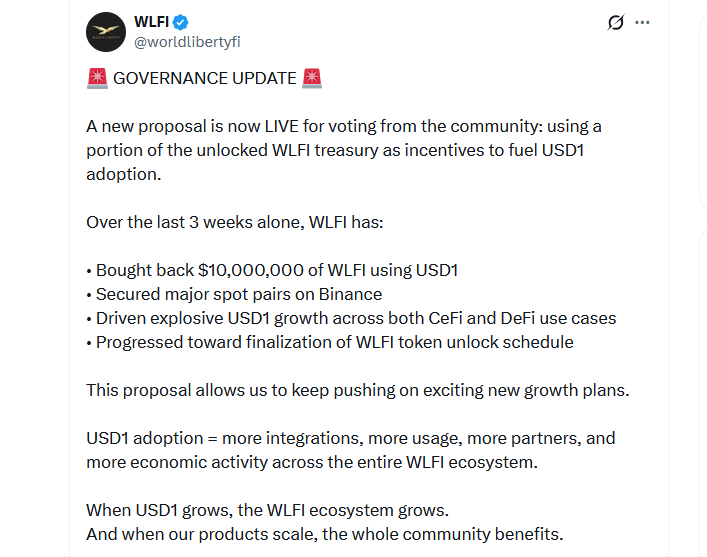
Source: World Liberty Financial

World Liberty Financial’s WLFI token started trading on exchanges in September. Leading up to the launch, the project indicated that 19.96 billion of the total WLFI supply would be allocated to the treasury. At current prices, that total sum is worth almost $2.4 billion, with a 5% unlock equating to around $120 million.

The team outlined three potential voting options in the proposal: for, against or abstain. The vote is now live, but it is not explicitly clear how the voting is taking place.

Related: Binance mulls new US strategy, CZ potentially reducing stake: Report

The reaction to the proposal is currently mixed, with “against” slightly edging out those who indicate they support the proposal.
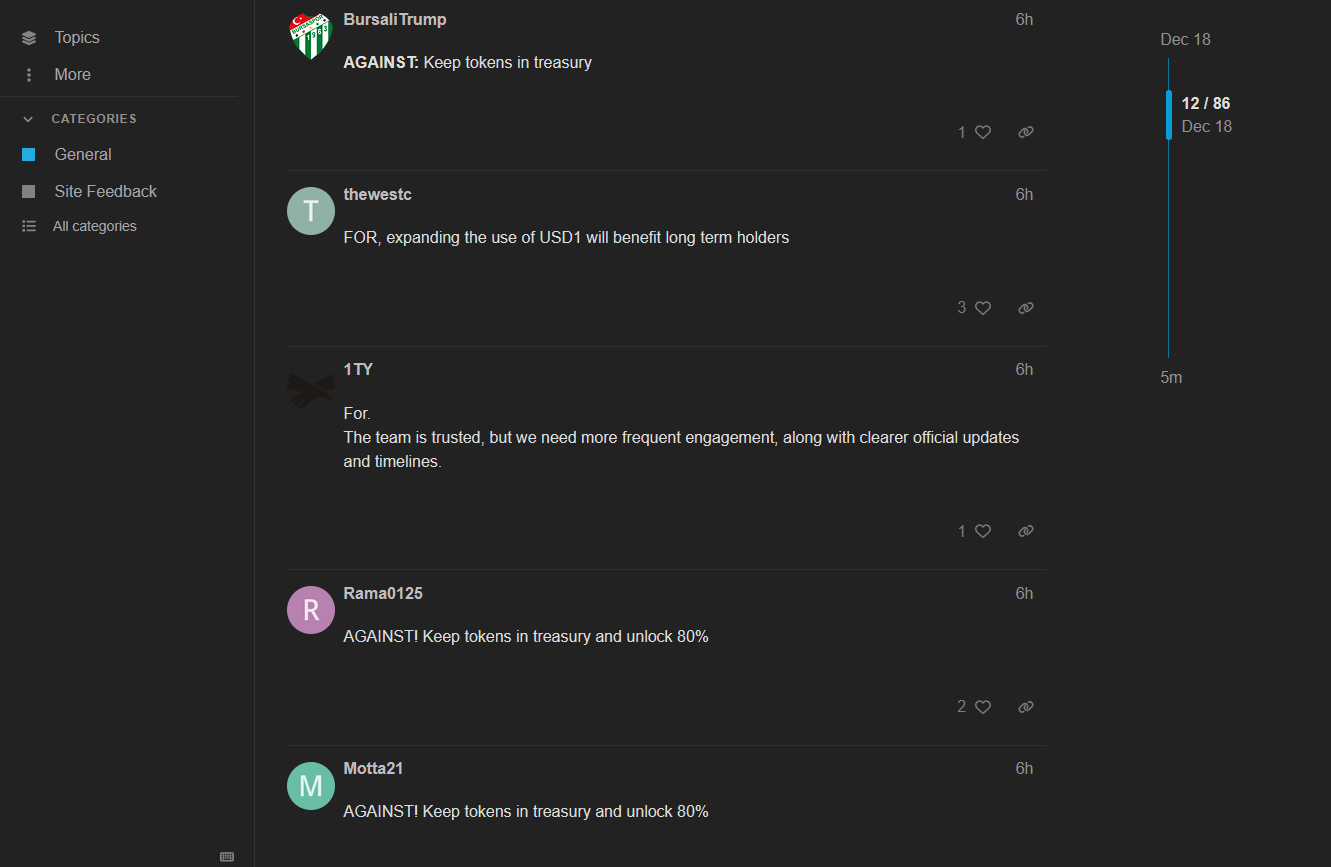
Community responses to the proposal. Source: World Liberty Financial

The project’s stablecoin launched in March and has a market cap of $2.74 billion according to CoinGecko data, making it the seventh-largest USD-pegged stablecoin on the market.

The 5% treasury unlock may help spur growth of the asset; however, it has a lot of catching up to do if it wants to displace competitors, with sixth-placed PYUSD from PayPal having a market cap $1.1 billion larger than USD1.

Magazine: Big questions: Would Bitcoin survive a 10-year power outage?

Letture associate

The Verdict in Choi Tae-won's Divorce Case: Revealing the Inheritance Undercurrent Behind SK Hynix's Trillion-Won Empire

SK Group Chairman Chey Tae-won's high-profile divorce case, involving a record 1.38 trillion won settlement, has drawn attention to the succession plans for Korea's second-largest conglomerate, especially its crown jewel, SK hynix. Unlike traditional chaebol scripts centered on the eldest son, Chey's three children from his marriage to former President Roh Tae-woo's daughter, Roh Soh-yeong, are carving distinct, non-traditional paths. Eldest daughter Chey Yun-jung (b. 1989) is seen as the most evident successor. With a scientific and consulting background, she holds executive roles at SK bioscience and SK Inc.'s growth support department, focusing on future strategy and biopharma. Her marriage is to an AI infrastructure entrepreneur, not a traditional business alliance. Second daughter Chey Min-jung (b. 1991) took a unique route, voluntarily serving as a South Korean naval officer, including an anti-piracy deployment. She later worked on policy and strategy for SK hynix in Washington D.C. before co-founding an AI-driven healthcare startup. She married a former U.S. Marine Corps officer, connecting her to U.S. defense and policy circles—networks crucial for a global semiconductor giant. The only son, Chey In-geun (b. 1995), who studied physics like his father, worked briefly at SK E&S before joining McKinsey. Despite fitting the traditional "heir" profile as the eldest son, he remains silent and holds no public position or shares in SK, suggesting the old succession playbook is obsolete. As SK hynix's valuation soars, becoming a geopolitical asset in the AI era, the heirs' legitimacy is no longer automatic. They must prove themselves in fields like AI biotech, global policy, and strategic consulting. Their marriages also reflect new elite networks in tech and defense, not old political alliances. Their inheritance is the complex challenge of navigating a globalized, tech-driven world, not just a corporate throne.

marsbit11 h fa

The Verdict in Choi Tae-won's Divorce Case: Revealing the Inheritance Undercurrent Behind SK Hynix's Trillion-Won Empire

marsbit11 h fa

From OpenSea to OpenRouter: Is Alex Atallah Repeating His 'Exit at the Peak' Playbook?

From OpenSea to OpenRouter: Is Alex Atallah Repeating His "Exit at the Peak" Playbook? According to the Wall Street Journal, payments giant Stripe is in talks to acquire the AI model aggregation platform OpenRouter in a potential deal valuing the company near $100 billion. This would mark founder Alex Atallah's second creation of a company reaching a $100 billion valuation, following his co-founding of NFT marketplace OpenSea. OpenRouter, founded just over three years ago, has grown rapidly by acting as a unified gateway for developers to access over 400 AI models. It currently has about 10 million users and processes over 200 trillion tokens monthly. While the platform's annualized revenue is around $50 million, its valuation has skyrocketed from $1.3 billion in March 2026. The potential acquisition by Stripe, a company OpenRouter's founder once likened it to, represents a major expansion into AI infrastructure for the payments leader. This move echoes Atallah's previous timing with OpenSea, where he departed before the NFT market's significant downturn. For OpenRouter, selling now may be strategic. Despite its scale, its business model—charging a 5-5.5% fee on AI inference calls—faces pressure from competition, open-source models, and potential price wars among model providers, limiting its profitability narrative for an IPO. A key asset for potential acquirers like Stripe is OpenRouter's vast repository of real-world AI usage data, which offers unique insights into model performance and developer preferences that are difficult to replicate. Whether this potential deal signifies a new valuation benchmark for AI infrastructure or another market peak signal remains to be seen.

链捕手11 h fa

From OpenSea to OpenRouter: Is Alex Atallah Repeating His 'Exit at the Peak' Playbook?

链捕手11 h fa

Trading

Spot
活动图片




