World Liberty Financial says, ‘We are nowhere near liquidation’ – But fears remain

ambcryptoPubblicato 2026-04-10Pubblicato ultima volta 2026-04-10

Introduzione

World Liberty Financial (WLFI), backed by the Trump family, has dismissed concerns over its borrowing activities as unfounded "FUD." The DeFi project admitted to being a major borrower and supplier on WLFI Markets, using 5 billion WLFI tokens (worth $429 million) from its treasury as collateral to borrow over $75 million in USDC. This move drained the platform’s liquidity and raised fears of bad debt and contagion risk. WLFI defended its actions, stating it is "nowhere near liquidation" and can supply more collateral if needed. Additionally, concerns persist over upcoming token unlocks, with 70% of WLFI supply still locked. The token has dropped 15% amid the uncertainty, and analysts warn unlocks could trigger further selling pressure.

The Trump family-backed World Liberty Financial [WLFI] has dismissed recent criticism against its borrowing spree as a ‘wrong FUD.’

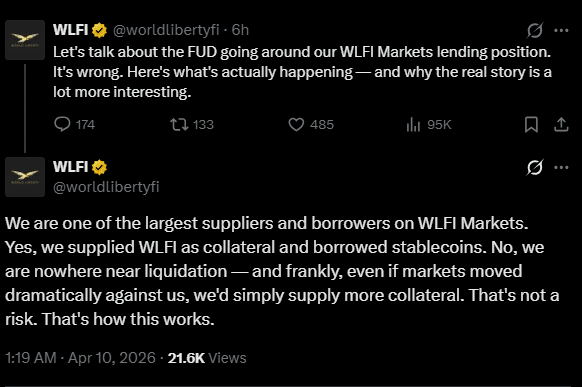
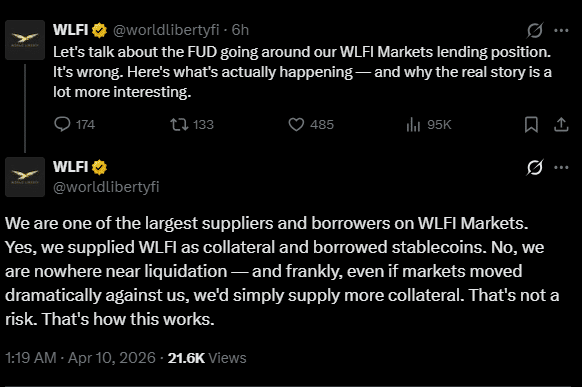
The DeFi project admitted that it is one of the largest suppliers and borrowers on the Dolomite-powered WLFI Markets.
Source: X/WLFI

According to the project, the ongoing liquidation fears were unwarranted, adding that,

We are nowhere near liquidation — and frankly, even if markets moved dramatically against us, we’d simply supply more collateral.

WLFI team countered that whatever they are doing is ‘not risk,’ reminding critics that ‘that’s how this works.’

Why the community is uneasy with WLFI

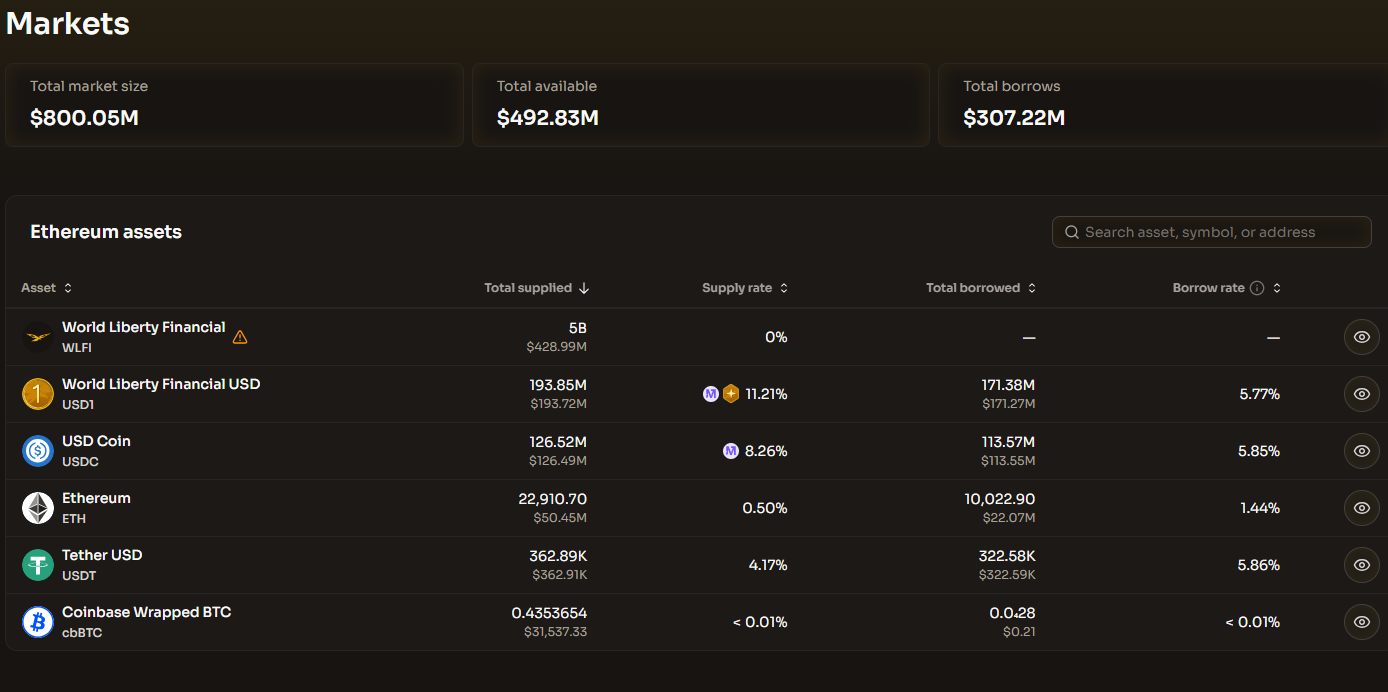
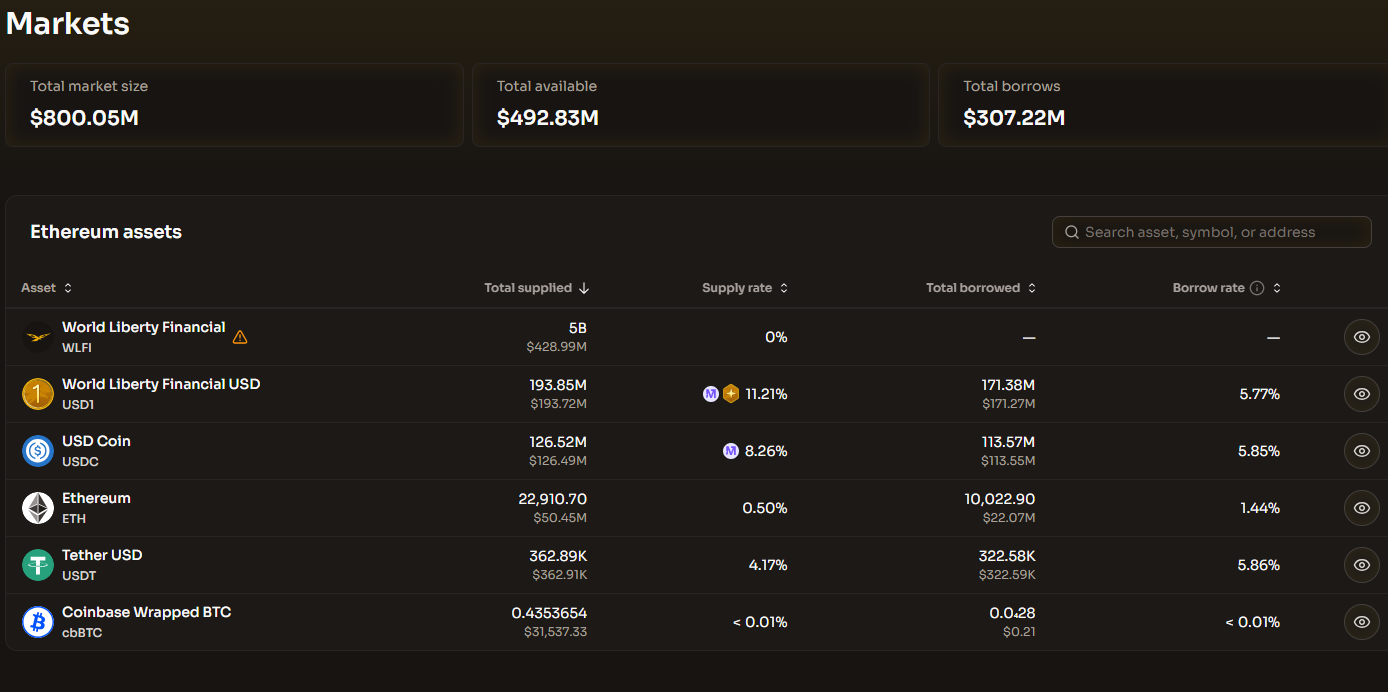
The community backlash against the DeFi project began after on-chain data revealed that it deposited 3 billion WLFI tokens as collateral into the lending platform WLFI Markets.

As of writing, the collateral was increased to 5 billion WLFI tokens (worth $429M), all from its treasury.
Source: WLFI

Against this collateral, the project borrowed over $75 million of USDC. The result? This drove WLFI Markets’ USDC lending rates to a lucrative 13.5%, but also drained the liquidity pool.

Consequently, those who invested in Dolomite couldn’t withdraw their funds unless the largest borrower, WLFI, repaid the loan.

This sparked more outcry as analysts warned that this could end up being a bad debt. Additionally, it could trigger contagion risk for WLFI token holders, as one user puts it,

Don’t be exit liquidity for Trump’s cartel: Those loans will likely never be repaid. When Trump leaves office, or even after the midterms if Republicans lose, $WLFI will dump, and Dolomite will be stuck with bad bet.

In its defense, the project said it took the massive loan to drive “outsized, compelling yield for everyone.”
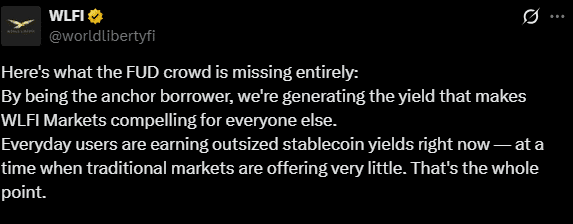
Source: X

Will the unlocks crash WLFI?

Another contention was uncertainty on WLFI token unlocks, especially for early and long-term investors to recoup their investment.

However, the project clarified that there will be a vote next week for a ‘structured, phased approach’ for the unlocks.

Currently, about 70% of the WLFI supply is locked, and only 31 billion tokens are circulating out of the max supply of 100 billion. Amid the rising scrutiny on the project, the early investors will likely dump their holdings when they are unlocked.

In the past three days, the altcoin has dropped by 15% to a yearly low of $0.081 as the FUD intensified. Unless there is a strong incentive to hold the token, the expected unlocks could send WLFI lower.


Final Summary

  • World Liberty Financial clarified that its massive loan, borrowed against 5 billion WLFI tokens, was not a risk, but ‘how things work.’
  • Market watchers warned that the proposed WLFI unlocks could add more selling pressure on the altcoin.


Crypto di tendenza

Domande pertinenti

QWhat is World Liberty Financial's response to the recent criticism regarding its borrowing activities?

AWorld Liberty Financial dismissed the criticism as 'wrong FUD' and stated that their actions are 'not risk' but rather 'how this works.' They emphasized they are nowhere near liquidation and could supply more collateral if needed.

QHow much in USDC did WLFI borrow against its collateral, and what was the impact on the lending platform?

AWLFI borrowed over $75 million in USDC against 5 billion WLFI tokens (worth $429 million) as collateral. This drove the USDC lending rates on WLFI Markets to 13.5% but drained the liquidity pool, preventing other investors from withdrawing their funds.

QWhy is the community concerned about WLFI's token unlocks?

AThe community is concerned because about 70% of the WLFI supply is locked, and early investors might dump their holdings when tokens are unlocked, potentially causing the price to drop further. The token has already fallen 15% to a yearly low due to ongoing FUD.

QWhat did critics warn could happen if WLFI's token price drops significantly?

ACritics warned that if the WLFI token price dumps, especially after political events like Trump leaving office or Republicans losing midterms, it could result in bad debt for Dolomite and contagion risk for token holders, as the loans might never be repaid.

QWhat action does WLFI plan to take regarding the unlocked tokens?

AWLFI plans to hold a vote next week for a 'structured, phased approach' to manage the token unlocks, aiming to address concerns and potentially mitigate selling pressure on the altcoin.

Letture associate

Agent Race Ends, Super Workbench Takes Over

The era of fragmented AI agents is ending. Over the past month, China's tech giants—Tencent, Alibaba, and ByteDance—have simultaneously shifted strategy: instead of launching new, standalone AI agents, they are consolidating their various agent projects into unified "super workbenches." Tencent integrated its QClaw teams into WorkBuddy, a strategic product hailed as a potential third flagship after QQ and WeChat. Alibaba is merging its QoderWork, Wukong, and MuleRun agents into a new "Qianwen Office" platform under DingTalk's leadership. ByteDance rebranded its TRAE SOLO coding agent to TRAE Work, signaling a broader focus on workflow collaboration. This convergence marks a pivotal industry consensus. The initial exploration phase, where companies rapidly built numerous overlapping agents for different scenarios, proved costly and inefficient. With open-source tools eroding technical barriers, competition has shifted from agent creation to resource consolidation and cost control. Historically, platform wars are won not by creating more products, but by simplifying them—as seen with browsers unifying web access and super-apps consolidating services. Now, the "super workbench" aims to become the unified AI entry point for work. This reflects a deeper market realization: the primary audience for AI is no longer just programmers (a market in the tens of millions) but all knowledge workers (a market of billions). The real opportunity lies in augmenting everyday tasks—managing emails, documents, data, and meetings—across the entire workday. The core battleground is becoming control over the primary AI entry point that employees use daily. Tencent's WorkBuddy leverages WeChat and Tencent Docs; Alibaba's Qianwen Office taps into DingTalk's organizational data; ByteDance's TRAE Work integrates with Feishu's workflows. Whoever owns this "super workbench" gains strategic control over orchestrating enterprise data and APIs. This shift is redefining enterprise software. Traditional SaaS applications, valued for their user interfaces, will recede into the background. Their core functionalities will be exposed as standardized "Skills" or APIs for the super workbench's agents to invoke. Software value will shift from selling user seats to charging based on API calls and outcomes delivered. The evolution of agents is moving through clear stages: first as novel standalone products, then as consolidated primary work entry points, and finally as pervasive, invisible capabilities embedded into the digital fabric. The recent moves by major tech firms signal the transition from the first stage into the second, accelerating toward the third. In the end, the most successful agent technology may become invisible—like electricity or the HTTP protocol—a fundamental, unnamed infrastructure powering work itself.

marsbit14 min fa

Agent Race Ends, Super Workbench Takes Over

marsbit14 min fa

Michael Saylor: 110 Reasons to Oppose BIP-110

Michael Saylor presents 110 arguments against Bitcoin Improvement Proposal (BIP) 110, a soft fork aimed at restricting certain non-monetary data storage uses (like inscriptions) on the Bitcoin blockchain. He acknowledges the proponents' valid concerns—such as node costs, fee pressure, and preserving Bitcoin's monetary focus—but fundamentally disagrees with the proposed solution. Saylor argues that BIP 110 represents a dangerous precedent of using consensus rules to enforce value judgments on transaction validity, moving away from Bitcoin's core principles of neutrality and permissionless innovation. His key objections are organized into eleven categories: 1) It violates neutrality and hard consensus by banning currently valid transactions. 2) It fails to meet the high burden of proof required for a consensus change, lacking concrete data on the alleged crisis. 3) Its seven bundled technical restrictions are overly broad, targeting generic script functionalities and blocking future upgrade paths. 4) It sacrifices compatibility and future optionality by closing off designed upgrade hooks. 5) Its temporary rules add significant complexity (grandfathering, expiry states) without sufficient justification. 6) The economic and security impacts, particularly on miner revenue and fee markets, are uncertain and unmodeled. 7) Superior, market-based tools (fee markets, relay/mining policies) already exist to manage blockchain load. 8) It stifles innovation by creating a chilling effect for developers. 9) Its modified activation mechanism (55% threshold, forced signaling) is aggressive and risks network splits. 10) The precedent it sets—using consensus to suppress disliked but legal uses—is more dangerous than the problem it aims to solve. 11) A better path exists: improving measurements, refining resource-based policies, and allowing market forces to work. Saylor concludes that Bitcoin's strength lies in its neutral rules, open markets, and hard consensus. Changing these foundational elements to target specific use cases is an unnecessary and risky "iatrogenic" intervention. He advocates for guarding Bitcoin's neutrality rather than acting as its redeemer.

marsbit29 min fa

Michael Saylor: 110 Reasons to Oppose BIP-110

marsbit29 min fa

Trading

Spot

Articoli Popolari

Come comprare WLFI

Benvenuto in HTX.com! Abbiamo reso l'acquisto di Official World Liberty Financial (WLFI) semplice e conveniente. Segui la nostra guida passo passo per intraprendere il tuo viaggio nel mondo delle criptovalute.Step 1: Crea il tuo Account HTXUsa la tua email o numero di telefono per registrarti il tuo account gratuito su HTX. Vivi un'esperienza facile e sblocca tutte le funzionalità,Crea il mio accountStep 2: Vai in Acquista crypto e seleziona il tuo metodo di pagamentoCarta di credito/debito: utilizza la tua Visa o Mastercard per acquistare immediatamente Official World Liberty FinancialWLFI.Bilancio: Usa i fondi dal bilancio del tuo account HTX per fare trading senza problemi.Terze parti: abbiamo aggiunto metodi di pagamento molto utilizzati come Google Pay e Apple Pay per maggiore comodità.P2P: Fai trading direttamente con altri utenti HTX.Over-the-Counter (OTC): Offriamo servizi su misura e tassi di cambio competitivi per i trader.Step 3: Conserva Official World Liberty Financial (WLFI)Dopo aver acquistato Official World Liberty Financial (WLFI), conserva nel tuo account HTX. In alternativa, puoi inviare tramite trasferimento blockchain o scambiare per altre criptovalute.Step 4: Scambia Official World Liberty Financial (WLFI)Scambia facilmente Official World Liberty Financial (WLFI) nel mercato spot di HTX. Accedi al tuo account, seleziona la tua coppia di trading, esegui le tue operazioni e monitora in tempo reale. Offriamo un'esperienza user-friendly sia per chi ha appena iniziato che per i trader più esperti.

520 Totale visualizzazioniPubblicato il 2025.09.01Aggiornato il 2026.06.02

Come comprare WLFI

Discussioni

Benvenuto nella Community HTX. Qui puoi rimanere informato sugli ultimi sviluppi della piattaforma e accedere ad approfondimenti esperti sul mercato. Le opinioni degli utenti sul prezzo di WLFI WLFI sono presentate come di seguito.

活动图片









