World Cup 'Stress Test': How to Interpret the Development Prospects of Prediction Markets Next Year?

marsbitPubblicato 2025-12-25Pubblicato ultima volta 2025-12-25

Introduzione

Summary: The 2026 FIFA World Cup is set to be a major stress test for the prediction market industry, which has moved from niche experimentation to mainstream adoption in 2025. Growth is now driven by distribution through major platforms like Robinhood, DraftKings, and FanDuel, rather than pure product innovation. The key constraint is no longer demand but the ability to operate at scale within strict regulatory frameworks, particularly in the US where the CFTC and state regulators are actively defining legal boundaries. The industry is bifurcating: compliant, licensed platforms are focusing on regulatory design and geographic rollout strategies, while crypto-native platforms like Polymarket are seeking legitimacy through acquisitions and enhanced controls. The 2026 World Cup will test infrastructure on liquidity, settlement integrity, and compliance under peak load. The long-term winners will be those that combine deep liquidity, regulatory trust, and seamless user experience, likely within larger financial super-apps.

Editor's Note: In 2025, prediction markets accelerated into the mainstream: brokers, sports platforms, and crypto products entered simultaneously, proving demand is validated. The true watershed is no longer product innovation, but the ability to scale within a regulatory framework.

This article, using global regulatory comparisons, the divergence between on-chain and compliant paths, and the 2026 World Cup as a "system-level stress test," points out that prediction markets are entering an elimination stage centered on compliance, settlement, and distribution. The winners will be platforms that can operate stably under peak load and strong regulation.

The original text follows:

The U.S. event contract market accelerated significantly in 2025, resonating with the approach of a "generational" catalyst.


Kalshi's valuation doubled to $11 billion, and Polymarket is reportedly also seeking a higher valuation; meanwhile, mass-market platforms—including DraftKings, FanDuel, and Robinhood—are launching compliant prediction products ahead of the 2026 FIFA World Cup (to be hosted in North America). Robinhood estimates the events market has brought in approximately $300 million in annualized revenue, becoming its fastest-growing business line, showing that "opinion-based trading" is entering the financial mainstream at scale.

However, this growth is colliding head-on with regulatory reality. As platforms prepare for the participation peak driven by the World Cup, prediction markets are no longer just a product issue but increasingly a problem of "regulatory design." In reality, teams are shifting their focus from simply meeting user demand to legal qualification, jurisdictional boundaries, and the design of settlement terms. The importance of compliance capabilities and distribution partnerships is gradually becoming as crucial as liquidity; the competitive landscape is also shaped more by "who can scale operations within the permitted framework" rather than who can list the most markets.

The Intertwining Forces of Regulation

The U.S. Commodity Futures Trading Commission (CFTC) only allows a narrow category of event contracts tied to economic indicators, while judging other types as unacceptable gambling. In September 2023, the CFTC blocked Kalshi's attempt to list political futures; but a subsequent court challenge granted limited approval for presidential election-related contracts.


At the state level, regulatory attitudes are tougher towards "sports-like" markets. In December 2025, Connecticut's gaming regulator issued cease-and-desist orders to Kalshi, Robinhood, and Crypto.com, determining their sports event contracts constituted unlicensed gambling; Nevada also sought judicial action to halt similar products, forcing relevant platforms to delist in the state.

In response, established giants like FanDuel and DraftKings restrict prediction products to jurisdictions "without legal sports betting," highlighting that distribution strategy is now led by regulatory boundaries rather than user demand. The core implication is clear: scale is determined not by product innovation, but by regulatory tolerance. Contract design, settlement terms, marketing wording, and geographical rollout paths are being systematically engineered to pass legal qualification reviews; platforms that can operate within accepted regulatory frameworks will gain more lasting advantages. In this market, regulatory clarity itself forms a moat, while uncertainty directly limits growth.
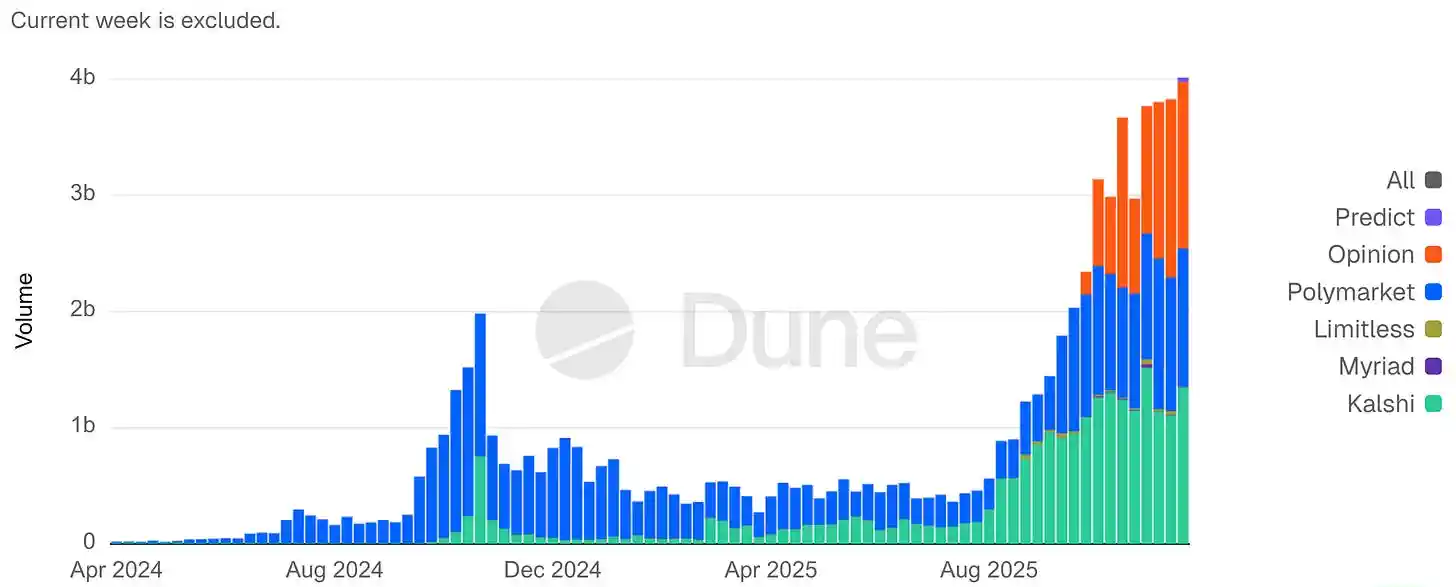
Weekly Prediction Market Notional Volume
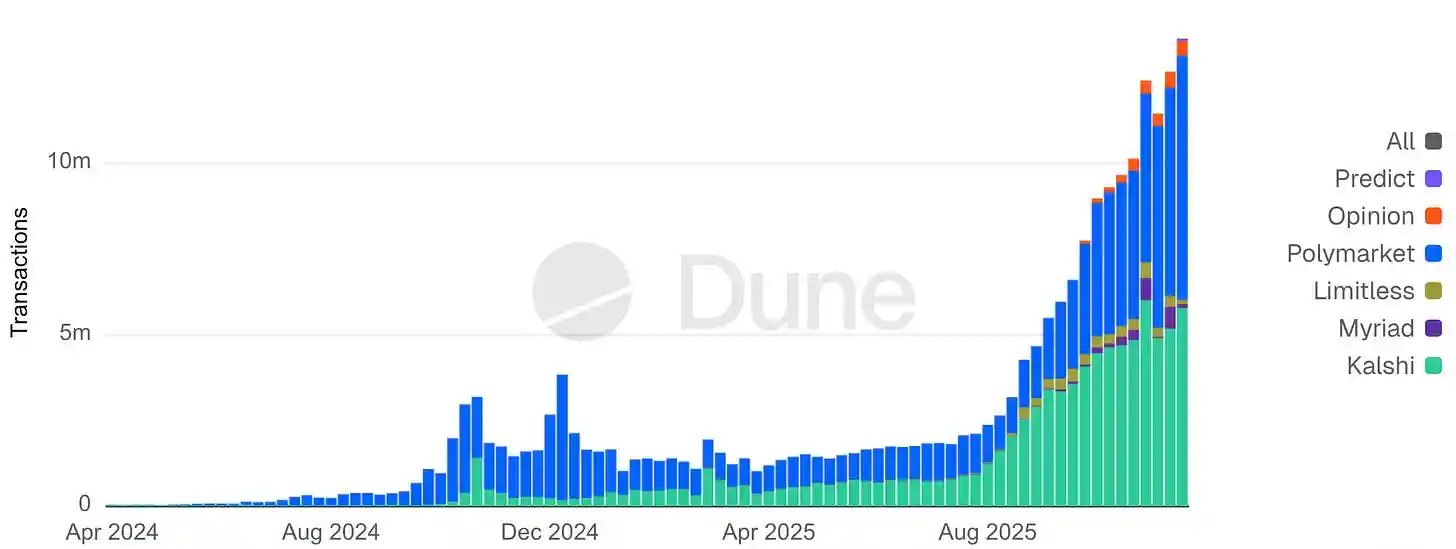
Weekly Prediction Market Transactions

Global Comparable Cases

Outside the U.S., mature betting platforms and newer licensing regimes indicate that event-based markets can achieve liquidity under gambling regulation, but their economics and product boundaries are significantly constrained. The UK's Betfair Exchange proves market depth is possible within a gambling license framework, though strict consumer protection rules limit profitability. Betting in Asian markets is mostly state-monopolized or handled by offshore platforms, reflecting strong underlying demand but also long accompanied by enforcement and fairness challenges. Latin America is moving towards formalization: Brazil opened a regulated betting market in January 2025, attempting to transform a long-standing gray area into a taxed, regulated activity.

The overall cross-regional trend is consistent: regulation is plugging loopholes. Sweepstakes and social casino models relying on "free tokens + prize mechanisms" have been restricted or banned in multiple jurisdictions, significantly raising the compliance bar for any product skirting the edges of gambling. The global direction is stricter regulation, not tolerance of gray areas.

On-Chain Platforms vs. Compliance

Decentralized prediction markets once traded faster, global access for a lack of compliance. Take crypto platform Polymarket as an example: it was fined $1.4 million by the CFTC in January 2022 for unregistered event swaps and forced to geoblock U.S. users. Polymarket subsequently pivoted: strengthening internal controls (bringing in a former CFTC advisor) and acquiring a licensed entity in 2025, allowing it to return to the U.S. in a test form in November 2025. Its trading volume surged—reportedly reaching $3.6 billion in bets on a single election issue in 2024, with monthly volume hitting $2.6 billion by end-2024; and it attracted blue-chip investors at a valuation of around $12 billion in 2025.

On-chain platforms rely on oracles for rapid market creation and settlement but face a speed vs. fairness trade-off: governance and oracle disputes can delay results, and anonymity raises concerns about manipulation or insider trading. Regulators remain vigilant: even if the code is decentralized, organizers and liquidity providers can still be enforcement targets (the Polymarket case is an example). The 2026 challenge is: to combine the innovation of 24/7 global markets and crypto instant settlement with sufficient compliance, without sacrificing openness.

User Behavior & Trading Trends

In 2025, prediction markets surged simultaneously in both sports and non-sports events. Industry estimates show total notional volume expanded more than tenfold compared to 2024, reaching about $13 billion per month by end-2025. Sports markets became the main "trading engine," with frequent events driving continuous small trades; political and macro markets were "capital magnets," with fewer but larger trades.

Structural differences are clear: on Kalshi, sports contracts contribute most cumulative volume, reflecting the repeated participation of entertainment-focused users; but open interest is more concentrated in politics and economics, meaning heavier single positions. On Polymarket, political markets similarly dominate open interest, despite lower trading frequency. Conclusion: sports maximize turnover, non-sports concentrate risk.

This forms two types of participants:

Sports users: More like "flow traders," frequent small amounts, driven by entertainment and habit;

Political/Macro users: More like "capital allocators," few but large trades, seeking information advantage, hedging, or narrative influence.

Platforms thus face a dual optimization:既要维持流量参与,又要为资本驱动型市场提供可信与公正.

This also explains risk concentration points: controversies in 2025 mainly appeared in non-sports, including opposition from U.S. college sports regulators to contracts related to student-athletes. Platforms quickly delisted related contracts, indicating governance risk rises with capital concentration and information sensitivity, not pure volume growth. Long-term growth depends on the ability to operate high-impact non-sports markets without touching regulatory or reputational red lines.

2026 World Cup: System-Level Stress Test

The FIFA World Cup, co-hosted by the United States, Canada, and Mexico, should be seen as a full-stack stress test for event trading and compliant betting infrastructure. Historical analogies show:

The 1994 U.S. World Cup primarily tested physical infrastructure and venues; the 1996 Atlanta Olympics shifted the critical path to communications, information distribution, and emergency response. IBM's "Info '96" centralized timing and results, telecoms expanded cellular networks, Motorola deployed large-scale radio systems; the Centennial Olympic Park bombing on July 27, 1996, highlighted the importance of systems shifting from throughput to integrity and resilience under pressure.

The 2026 pressure points will clearly enter the digital + financial coupling layer: the tournament expands to 48 teams, 104 matches, 16 cities, with multiple concentrated bursts of attention and trading flow over about five weeks. The global betting scale for the 2022 World Cup was widely estimated at hundreds of billions of dollars, with peak windows bringing extreme short-term liquidity and settlement loads.


The North American compliant轨道 will carry a larger proportion of activity—38 U.S. states plus Washington D.C. and Puerto Rico have legalized sports betting to varying degrees, more funds will flow through KYC, payment, and monitoring systems rather than offshore channels. App-based distribution further tightens the coupling: live streaming, real-time contracts, deposits, and withdrawals are often completed within a single mobile session.

For event contracts/prediction markets, observable operational pressure points include: liquidity concentration and volatility during match windows; settlement integrity (data delays, dispute resolution); federal/state product and jurisdictional design; scalability of KYC/AML/responsible gambling/withdrawals under peak demand.

The same regulatory and tech stack will be tested again by the 2028 Los Angeles Olympics, so the 2026 World Cup is more of a screening event: it may trigger regulatory intervention, platform consolidation, or market exits, distinguishing infrastructure built for阶段性峰值 from platforms that are sustainable, compliant, and scalable.

Payment & Settlement Innovation

Stablecoins are transitioning from speculative assets to operational infrastructure. Most crypto-native prediction markets use USD stablecoins for deposits and settlements, and regulated platforms are also testing similar channels. In December 2025, Visa launched a pilot in the U.S., allowing banks to use Circle's USDC for on-chain settlement 7x24, building on cross-border stablecoin experiments since 2023. In event-driven markets, stablecoins (where allowed) offer instant access, global coverage, and settlement advantages matching continuous trading hours.

In practice, stablecoins act more like settlement middleware: users see them as faster deposit/withdrawal tools; operators benefit from lower failure rates, improved liquidity management, near-instant settlement. Therefore, stablecoin policy has second-order effects on prediction markets: restricting stablecoin channels increases friction, slows withdrawals; regulatory clarity favors deep integration with mainstream betting and brokerage platforms.

But there is resistance. Christine Lagarde warned in 2025 about the monetary stability risks of private stablecoins and reiterated support for a digital euro; the European Central Bank also highlighted in its November 2025 Financial Stability Review that stablecoin expansion could weaken bank funding sources and interfere with policy transmission. 2026 is more likely to see gradual integration: more betting accepts stablecoin deposits, payment institutions bridge cards to crypto, while strengthening licensing, reserve audits, and disclosure, rather than full endorsement of native crypto payment rails.

Macro Liquidity Background

Evaluating the 2025 boom requires skepticism: easy money amplifies speculation. The Fed's shift to end quantitative tightening in late 2025, or a slight improvement in liquidity in 2026, affects risk appetite more than adoption direction. For prediction markets, liquidity affects participation intensity: ample funds → amplified trading; tightening → marginal speculation cools.

But the 2025 growth occurred in a high-interest-rate environment, suggesting prediction markets are not primarily driven by liquidity. A more reasonable framework is to see macro liquidity as an accelerator, not an engine. Long-term factors—mainstream distribution by brokers/betting firms, product simplification, rising cultural acceptance—better explain baseline adoption. Monetary conditions affect amplitude, not occurrence.

"Missing Element": Super App Distribution & Moats

The key悬念 is: Who controls the user interface for integrated trading/betting?

A consensus is forming: distribution is king, the real moat lies in super app-style user relationships.

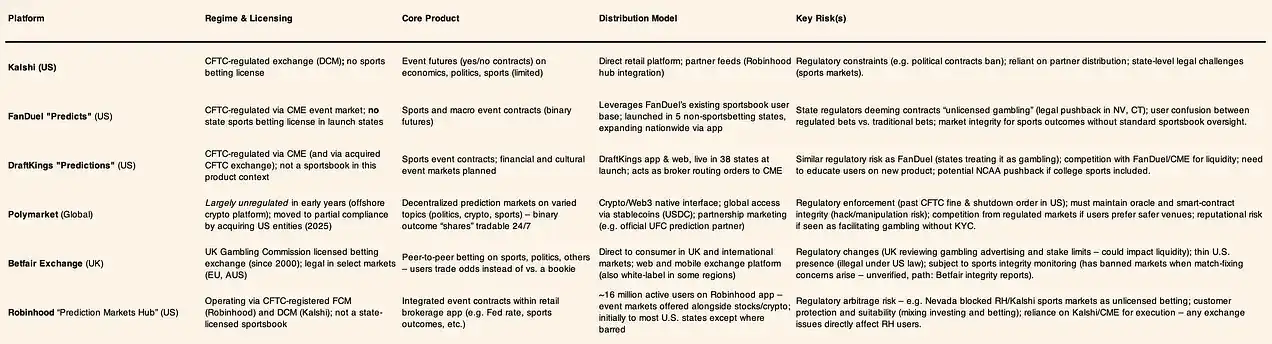
This drives intense collaboration: exchanges want retail users (e.g., CME Group partnering with FanDuel/DraftKings), consumer platforms want differentiated content (e.g., Robinhood partnering with Kalshi, DraftKings acquiring a small CFTC exchange).

The model resembles comprehensive brokerage: stocks, options, crypto, event contracts listed side-by-side, users don't leave the platform.

Prediction markets are异常 sensitive to liquidity and trust: thin markets fail quickly, depth compounds. Platforms with existing users, low acquisition costs, ready KYC, and funding channels naturally outperform independent venues needing to build depth from scratch. Therefore, it's more like options trading than social networks: depth and reliability trump novelty. This is also why the "feature vs. product" debate is increasingly decided by distribution, not technology.

Robinhood's early success supports this: it launched event trading to some active traders in 2025, volume grew rapidly; ARK Invest estimated its recurring revenue reached $300 million by year-end. The moat comparison is clear: independent prediction markets (however innovative) struggle against incumbent users. For example, FanDuel has 12 million+ users, integrated CME event contracts, and quickly built liquidity and trust in 5 states; DraftKings replicated a similar path in 38 states. In contrast, Kalshi and Polymarket spent years building depth from scratch and are now more actively seeking distribution partnerships (Robinhood, Underdog Fantasy, even UFC).

Possible outcome: a few large aggregation platforms gain network effects and regulatory endorsement; small platforms either specialize (e.g., crypto-only events) or get acquired. Meanwhile, fintech and media super app convergence is approaching: PayPal, Cash App may list prediction markets alongside payments, stocks in the future; Apple, Amazon, ESPN explored sports betting collaborations in 2023–25, potentially evolving into broader event trading. The real "missing element" might be the moment a tech giant fully embeds prediction markets into a super app—combining news, betting, and investment into one, creating a moat few can match.

Until then, the user lock-in race among exchanges, betting companies, and brokers will continue. The key question for 2026 is: Will prediction markets become a feature within large financial apps, or continue to exist as independent verticals? Early evidence points to integration.


But regulators may also be wary of super apps that seamlessly switch between investment and betting. The ultimate winners will be platforms that can convince both users and regulators—their moat comes not just from technology and liquidity, but from compliance, trust, and experience.
Opinion Trade (Opinion Labs): A Macro-First On-Chain Challenger

Opinion Trade (launched by Opinion Labs) positions itself as a "macro-first" on-chain prediction trading platform, its market form closer to a dashboard for rates and commodities rather than an entertainment-event-dominated betting product. The platform launched on BNB Chain on October 24, 2025. As of November 17, 2025, cumulative notional volume exceeded $3.1 billion, with an early-stage average daily notional volume of about $132.5 million.
During the period November 11–17, weekly notional volume was about $1.5 billion, ranking among the top prediction market platforms; as of November 17, its open interest reached $60.9 million, still trailing Kalshi and Polymarket at that time.

On the infrastructure front, Opinion Labs announced a partnership with Brevis in December 2025, introducing a zero-knowledge proof verification mechanism into the settlement process, aiming to reduce the trust gap in market outcome determination. The company also disclosed completion of a $5 million seed funding round led by YZi Labs (formerly Binance Labs), with participation from other investors, providing not only financial support but also forming a tight strategic connection with the BNB ecosystem.


Additionally, the platform's explicit geoblocking of the U.S. and other restricted jurisdictions highlights a core trade-off facing on-chain prediction markets in 2025–2026: how to achieve rapid global liquidity aggregation under regulatory boundary constraints.

Consumer Prediction Markets as "ICO 2.0" Distribution Channels

Sport.Fun (formerly Football.Fun) provides a concrete case study of how consumer prediction markets are evolving into a new generation of token distribution infrastructure. This emerging "ICO 2.0" model is directly embedded into consumer applications with real revenue. Sport.Fun launched on Base in August 2025, initially focusing on match trading similar to football fantasy play, later expanding to NFL-related markets.


As of the end of 2025, Sport.Fun disclosed cumulative trading volume exceeding $90 million, with platform revenue over $10 million, showing clear product-market fit was validated before any public token offering.

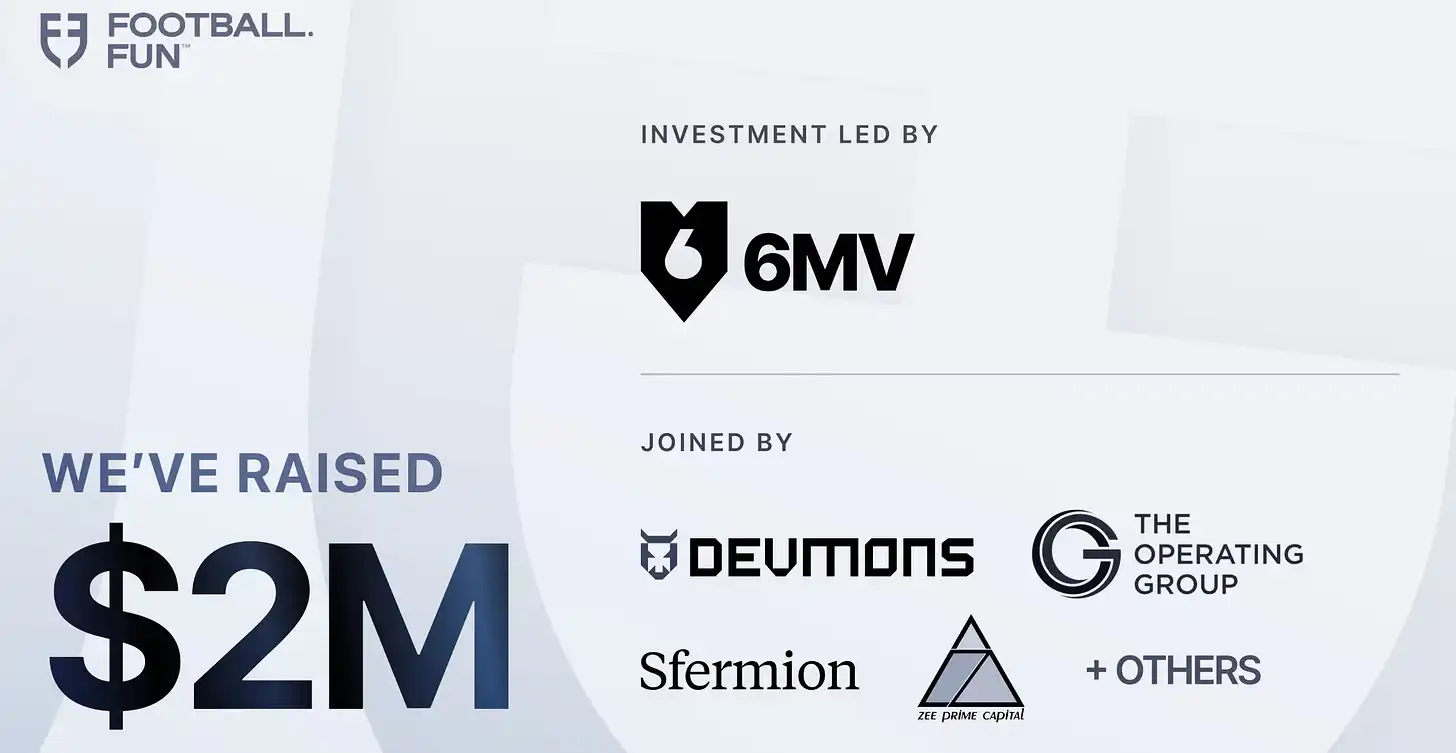
The company completed a $2 million seed funding round led by 6th Man Ventures, with participation from Zee Prime Capital, Sfermion, and Devmons. This investor structure reflects rising interest in consumer-facing crypto applications—projects combining financial primitives with entertaining participation methods, rather than just betting on underlying infrastructure. More importantly, this funding came after user activity and monetization were proven,颠覆了 early ICO cycles' traditional sequence of "sell token first, find users later."
Sport.Fun's public token offering further confirms this shift.

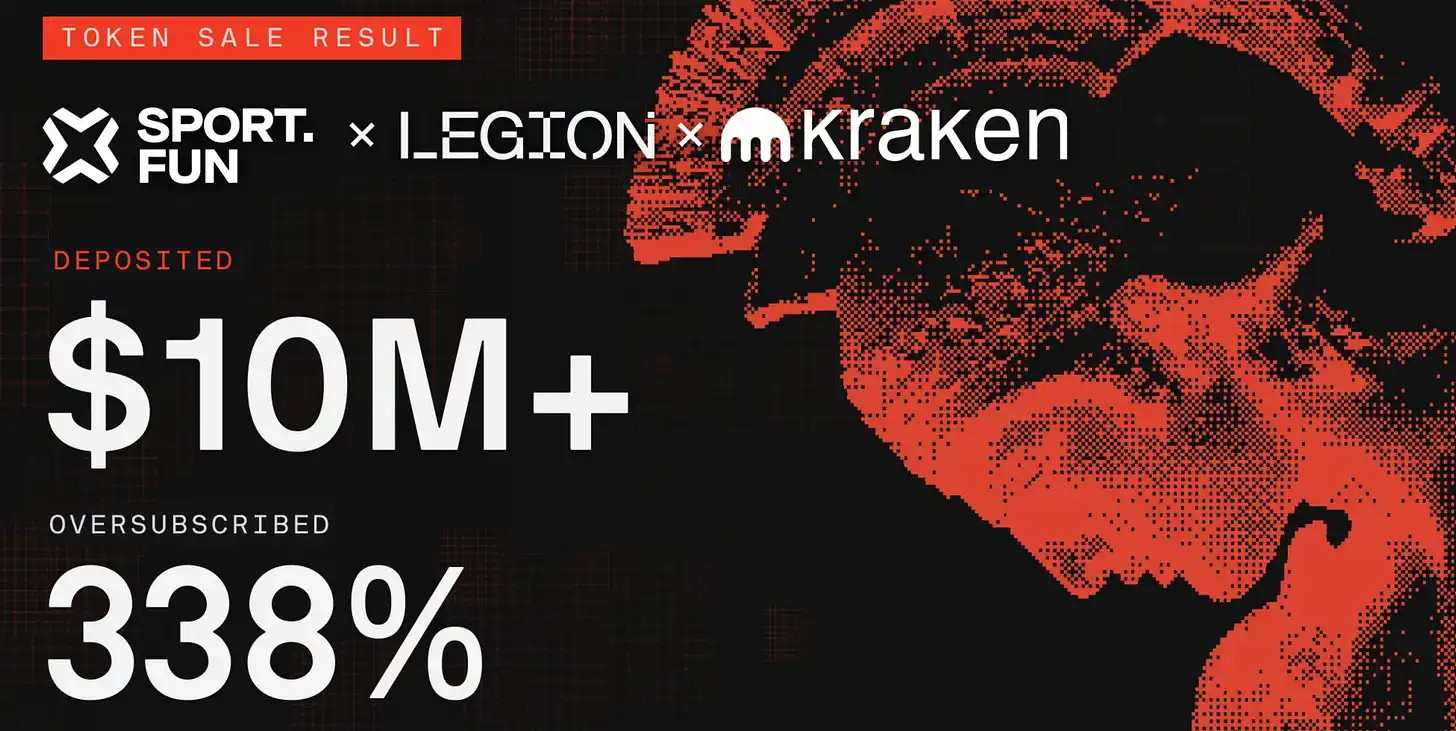
The $FUN public sale took place from December 16 to 18, 2025, conducted via the Kraken Launch platform, combined with a contribution and seniority-oriented Legion distribution path. The sale attracted over 4,600 participants, with cumulative subscription amounts exceeding $10 million; average participation per wallet was about $2,200. Demand was about 330% oversubscribed relative to the $3 million soft cap.
最终募资 $4.5 million, with tokens priced at $0.06, corresponding to a fully diluted valuation (FDV) of $60 million; after exercising the greenshoe option to expand, a total of 75 million tokens were sold.
The token economic model was designed to balance liquidity and post-listing stability.

According to the安排, 50% of the tokens will be unlocked at the Token Generation Event (TGE) in January 2026, with the remainder released linearly over 6 months. This structure is significantly different from the "immediate full unlock" common in early ICO cycles, reflecting lessons learned and corrections from past volatility-driven price collapses. Functionally, this token offering resembles less a pure speculative fundraising and more a natural extension of an existing consumer market—allowing users already active on the platform to "invest" in the product they are using.

Conclusion

By the end of 2025, prediction markets had moved from marginalized experiments to a credible, mass-market category. Their growth动力 came from mainstream channel distribution, product simplification, and clearly visible user demand. The core constraint is no longer "whether adopted," but how to design within the regulatory framework: legal qualification, settlement integrity, and cross-jurisdictional compliance determine who can achieve scale.

The FIFA World Cup should not be simply understood as a growth narrative, but more as a system-level stress test under peak load—a comprehensive examination of liquidity, operational capability, and regulatory resilience. Platforms that can pass this test without triggering enforcement risks or suffering reputational damage will define the next phase of industry consolidation; those that fail will accelerate the industry's concentration towards higher standards, stronger regulation, and fewer but larger winners.


Domande pertinenti

QWhat is the main challenge facing prediction markets as they approach the 2026 FIFA World Cup, according to the article?

AThe main challenge is no longer product innovation, but the ability to scale within a regulatory framework. The 2026 World Cup is seen as a 'system-level stress test' that will separate platforms that can operate stably under peak load and strong regulation from those that cannot.

QHow does the regulatory landscape in the United States differ between federal and state levels for prediction markets?

AAt the federal level, the CFTC only allows a narrow category of event contracts tied to economic indicators, blocking others as unacceptable gambling. At the state level, regulators are more aggressive against 'sports-like' markets, with states like Connecticut and Nevada issuing cease-and-desist orders and legal actions, forcing platforms to delist products.

QWhat key difference in user behavior is observed between sports and non-sports (e.g., political) prediction markets?

ASports users act more like 'flow traders,' making frequent, small bets driven by entertainment and habit. Political/macro users act more like 'capital allocators,' making fewer but larger bets, seeking information advantage, hedging, or narrative influence.

QWhat role do stablecoins play in the evolution of prediction markets, and what are the potential regulatory hurdles?

AStablecoins are transitioning from speculative assets to operational infrastructure, offering instant deposits/withdrawals, global reach, and settlement advantages that match continuous trading hours. However, regulators like the ECB have warned about their risks to monetary stability, and their adoption may face hurdles through increased licensing, reserve audits, and disclosure requirements rather than full endorsement.

QWhy does the article suggest that 'distribution is king' and what is the likely future for independent prediction market platforms?

ADistribution is considered the true moat because prediction markets are highly sensitive to liquidity and trust. Platforms with existing users, low customer acquisition costs, and ready-made KYC and funding channels have a natural advantage. The likely future is integration, where prediction markets become a feature within large financial super-apps, leading to industry consolidation where smaller platforms either specialize or are acquired.

Letture associate

Google and Amazon Simultaneously Invest Heavily in a Competitor: The Most Absurd Business Logic of the AI Era Is Becoming Reality

In a span of four days, Amazon announced an additional $25 billion investment, and Google pledged up to $40 billion—both direct competitors pouring over $65 billion into the same AI startup, Anthropic. Rather than a typical venture capital move, this signals the latest escalation in the cloud wars. The core of the deal is not equity but compute pre-orders: Anthropic must spend the majority of these funds on AWS and Google Cloud services and chips, effectively locking in massive future compute consumption. This reflects a shift in cloud market dynamics—enterprises now choose cloud providers based on which hosts the best AI models, not just price or stability. With OpenAI deeply tied to Microsoft, Anthropic’s Claude has become the only viable strategic asset for Google and Amazon to remain competitive. Anthropic’s annualized revenue has surged to $30 billion, and it is expanding into verticals like biotech, positioning itself as a cross-industry AI infrastructure layer. However, this funding comes with constraints: Anthropic’s independence is challenged as it balances two rival investors, its safety-first narrative faces pressure from regulatory scrutiny, and its path to IPO introduces new financial pressures. Globally, this accelerates a "tri-polar" closed-loop structure in AI infrastructure, with Microsoft-OpenAI, Google-Anthropic, and Amazon-Anthropic forming exclusive model-cloud alliances. In contrast, China’s landscape differs—investments like Alibaba and Tencent backing open-source model firm DeepSeek reflect a more decoupled approach, though closed-source models from major cloud providers still dominate. The $65 billion bet is ultimately about securing a seat at the table in an AI-defined future—where missing the model layer means losing the cloud war.

marsbit14 min fa

Google and Amazon Simultaneously Invest Heavily in a Competitor: The Most Absurd Business Logic of the AI Era Is Becoming Reality

marsbit14 min fa

Computing Power Constrained, Why Did DeepSeek-V4 Open Source?

DeepSeek-V4 has been released as a preview open-source model, featuring 1 million tokens of context length as a baseline capability—previously a premium feature locked behind enterprise paywalls by major overseas AI firms. The official announcement, however, openly acknowledges computational constraints, particularly limited service throughput for the high-end DeepSeek-V4-Pro version due to restricted high-end computing power. Rather than competing on pure scale, DeepSeek adopts a pragmatic approach that balances algorithmic innovation with hardware realities in China’s AI ecosystem. The V4-Pro model uses a highly sparse architecture with 1.6T total parameters but only activates 49B during inference. It performs strongly in agentic coding, knowledge-intensive tasks, and STEM reasoning, competing closely with top-tier closed models like Gemini Pro 3.1 and Claude Opus 4.6 in certain scenarios. A key strategic product is the Flash edition, with 284B total parameters but only 13B activated—making it cost-effective and accessible for mid- and low-tier hardware, including domestic AI chips from Huawei (Ascend), Cambricon, and Hygon. This design supports broader adoption across developers and SMEs while stimulating China's domestic semiconductor ecosystem. Despite facing talent outflow and intense competition in user traffic—with rivals like Doubao and Qianwen leading in monthly active users—DeepSeek has maintained technical momentum. The release also comes amid reports of a new funding round targeting a valuation exceeding $10 billion, potentially setting a new record in China’s LLM sector. Ultimately, DeepSeek-V4 represents a shift toward open yet realistic infrastructure development in the constrained compute landscape of Chinese AI, emphasizing engineering efficiency and domestic hardware compatibility over pure model scale.

marsbit51 min fa

Computing Power Constrained, Why Did DeepSeek-V4 Open Source?

marsbit51 min fa

Trading

Spot
Futures

Articoli Popolari

Cosa è $S$

Comprendere SPERO: Una Panoramica Completa Introduzione a SPERO Mentre il panorama dell'innovazione continua a evolversi, l'emergere delle tecnologie web3 e dei progetti di criptovaluta gioca un ruolo fondamentale nel plasmare il futuro digitale. Un progetto che ha attirato l'attenzione in questo campo dinamico è SPERO, denotato come SPERO,$$s$. Questo articolo mira a raccogliere e presentare informazioni dettagliate su SPERO, per aiutare gli appassionati e gli investitori a comprendere le sue basi, obiettivi e innovazioni nei domini web3 e crypto. Che cos'è SPERO,$$s$? SPERO,$$s$ è un progetto unico all'interno dello spazio crypto che cerca di sfruttare i principi della decentralizzazione e della tecnologia blockchain per creare un ecosistema che promuove l'impegno, l'utilità e l'inclusione finanziaria. Il progetto è progettato per facilitare interazioni peer-to-peer in modi nuovi, fornendo agli utenti soluzioni e servizi finanziari innovativi. Al suo interno, SPERO,$$s$ mira a responsabilizzare gli individui fornendo strumenti e piattaforme che migliorano l'esperienza dell'utente nello spazio delle criptovalute. Questo include la possibilità di metodi di transazione più flessibili, la promozione di iniziative guidate dalla comunità e la creazione di percorsi per opportunità finanziarie attraverso applicazioni decentralizzate (dApps). La visione sottostante di SPERO,$$s$ ruota attorno all'inclusività, cercando di colmare le lacune all'interno della finanza tradizionale mentre sfrutta i vantaggi della tecnologia blockchain. Chi è il Creatore di SPERO,$$s$? L'identità del creatore di SPERO,$$s$ rimane piuttosto oscura, poiché ci sono risorse pubblicamente disponibili limitate che forniscono informazioni dettagliate sul suo fondatore o fondatori. Questa mancanza di trasparenza può derivare dall'impegno del progetto per la decentralizzazione—un ethos che molti progetti web3 condividono, dando priorità ai contributi collettivi rispetto al riconoscimento individuale. Centrando le discussioni attorno alla comunità e ai suoi obiettivi collettivi, SPERO,$$s$ incarna l'essenza dell'empowerment senza mettere in evidenza individui specifici. Pertanto, comprendere l'etica e la missione di SPERO rimane più importante che identificare un creatore singolo. Chi sono gli Investitori di SPERO,$$s$? SPERO,$$s$ è supportato da una varietà di investitori che vanno dai capitalisti di rischio agli investitori angelici dedicati a promuovere l'innovazione nel settore crypto. Il focus di questi investitori generalmente si allinea con la missione di SPERO—dando priorità a progetti che promettono avanzamenti tecnologici sociali, inclusività finanziaria e governance decentralizzata. Queste fondazioni di investitori sono tipicamente interessate a progetti che non solo offrono prodotti innovativi, ma contribuiscono anche positivamente alla comunità blockchain e ai suoi ecosistemi. Il supporto di questi investitori rafforza SPERO,$$s$ come un concorrente degno di nota nel dominio in rapida evoluzione dei progetti crypto. Come Funziona SPERO,$$s$? SPERO,$$s$ impiega un framework multifunzionale che lo distingue dai progetti di criptovaluta convenzionali. Ecco alcune delle caratteristiche chiave che sottolineano la sua unicità e innovazione: Governance Decentralizzata: SPERO,$$s$ integra modelli di governance decentralizzati, responsabilizzando gli utenti a partecipare attivamente ai processi decisionali riguardanti il futuro del progetto. Questo approccio favorisce un senso di proprietà e responsabilità tra i membri della comunità. Utilità del Token: SPERO,$$s$ utilizza il proprio token di criptovaluta, progettato per servire varie funzioni all'interno dell'ecosistema. Questi token abilitano transazioni, premi e la facilitazione dei servizi offerti sulla piattaforma, migliorando l'impegno e l'utilità complessivi. Architettura Stratificata: L'architettura tecnica di SPERO,$$s$ supporta la modularità e la scalabilità, consentendo un'integrazione fluida di funzionalità e applicazioni aggiuntive man mano che il progetto evolve. Questa adattabilità è fondamentale per mantenere la rilevanza nel panorama crypto in continua evoluzione. Coinvolgimento della Comunità: Il progetto enfatizza iniziative guidate dalla comunità, impiegando meccanismi che incentivano la collaborazione e il feedback. Nutrendo una comunità forte, SPERO,$$s$ può affrontare meglio le esigenze degli utenti e adattarsi alle tendenze di mercato. Focus sull'Inclusione: Offrendo basse commissioni di transazione e interfacce user-friendly, SPERO,$$s$ mira ad attrarre una base utenti diversificata, inclusi individui che potrebbero non aver precedentemente interagito nello spazio crypto. Questo impegno per l'inclusione si allinea con la sua missione generale di empowerment attraverso l'accessibilità. Cronologia di SPERO,$$s$ Comprendere la storia di un progetto fornisce preziose intuizioni sulla sua traiettoria di sviluppo e sui traguardi. Di seguito è riportata una cronologia suggerita che mappa eventi significativi nell'evoluzione di SPERO,$$s$: Fase di Concettualizzazione e Ideazione: Le idee iniziali che formano la base di SPERO,$$s$ sono state concepite, allineandosi strettamente con i principi di decentralizzazione e focus sulla comunità all'interno dell'industria blockchain. Lancio del Whitepaper del Progetto: Dopo la fase concettuale, è stato rilasciato un whitepaper completo che dettaglia la visione, gli obiettivi e l'infrastruttura tecnologica di SPERO,$$s$ per suscitare interesse e feedback dalla comunità. Costruzione della Comunità e Prime Interazioni: Sono stati effettuati sforzi attivi di outreach per costruire una comunità di early adopters e potenziali investitori, facilitando discussioni attorno agli obiettivi del progetto e ottenendo supporto. Evento di Generazione del Token: SPERO,$$s$ ha condotto un evento di generazione del token (TGE) per distribuire i propri token nativi ai primi sostenitori e stabilire una liquidità iniziale all'interno dell'ecosistema. Lancio della Prima dApp: La prima applicazione decentralizzata (dApp) associata a SPERO,$$s$ è stata attivata, consentendo agli utenti di interagire con le funzionalità principali della piattaforma. Sviluppo Continuo e Partnership: Aggiornamenti e miglioramenti continui alle offerte del progetto, inclusi partnership strategiche con altri attori nello spazio blockchain, hanno plasmato SPERO,$$s$ in un concorrente competitivo e in evoluzione nel mercato crypto. Conclusione SPERO,$$s$ rappresenta una testimonianza del potenziale del web3 e delle criptovalute di rivoluzionare i sistemi finanziari e responsabilizzare gli individui. Con un impegno per la governance decentralizzata, il coinvolgimento della comunità e funzionalità progettate in modo innovativo, apre la strada verso un panorama finanziario più inclusivo. Come per qualsiasi investimento nello spazio crypto in rapida evoluzione, si incoraggiano potenziali investitori e utenti a ricercare approfonditamente e a impegnarsi in modo riflessivo con gli sviluppi in corso all'interno di SPERO,$$s$. Il progetto mostra lo spirito innovativo dell'industria crypto, invitando a ulteriori esplorazioni delle sue innumerevoli possibilità. Mentre il percorso di SPERO,$$s$ è ancora in fase di sviluppo, i suoi principi fondamentali potrebbero effettivamente influenzare il futuro di come interagiamo con la tecnologia, la finanza e tra di noi in ecosistemi digitali interconnessi.

75 Totale visualizzazioniPubblicato il 2024.12.17Aggiornato il 2024.12.17

Cosa è $S$

Cosa è AGENT S

Agent S: Il Futuro dell'Interazione Autonoma in Web3 Introduzione Nel panorama in continua evoluzione di Web3 e criptovalute, le innovazioni stanno costantemente ridefinendo il modo in cui gli individui interagiscono con le piattaforme digitali. Uno di questi progetti pionieristici, Agent S, promette di rivoluzionare l'interazione uomo-computer attraverso il suo framework agentico aperto. Aprendo la strada a interazioni autonome, Agent S mira a semplificare compiti complessi, offrendo applicazioni trasformative nell'intelligenza artificiale (AI). Questa esplorazione dettagliata approfondirà le complessità del progetto, le sue caratteristiche uniche e le implicazioni per il dominio delle criptovalute. Cos'è Agent S? Agent S si presenta come un innovativo framework agentico aperto, progettato specificamente per affrontare tre sfide fondamentali nell'automazione dei compiti informatici: Acquisizione di Conoscenze Specifiche del Dominio: Il framework apprende in modo intelligente da varie fonti di conoscenza esterne ed esperienze interne. Questo approccio duale gli consente di costruire un ricco repository di conoscenze specifiche del dominio, migliorando le sue prestazioni nell'esecuzione dei compiti. Pianificazione su Lungo Orizzonte di Compiti: Agent S impiega una pianificazione gerarchica potenziata dall'esperienza, un approccio strategico che facilita la suddivisione e l'esecuzione efficiente di compiti complessi. Questa caratteristica migliora significativamente la sua capacità di gestire più sottocompiti in modo efficiente ed efficace. Gestione di Interfacce Dinamiche e Non Uniformi: Il progetto introduce l'Interfaccia Agente-Computer (ACI), una soluzione innovativa che migliora l'interazione tra agenti e utenti. Utilizzando Modelli Linguistici Multimodali di Grandi Dimensioni (MLLM), Agent S può navigare e manipolare senza sforzo diverse interfacce grafiche utente. Attraverso queste caratteristiche pionieristiche, Agent S fornisce un framework robusto che affronta le complessità coinvolte nell'automazione dell'interazione umana con le macchine, preparando il terreno per innumerevoli applicazioni nell'AI e oltre. Chi è il Creatore di Agent S? Sebbene il concetto di Agent S sia fondamentalmente innovativo, informazioni specifiche sul suo creatore rimangono elusive. Il creatore è attualmente sconosciuto, il che evidenzia sia la fase embrionale del progetto sia la scelta strategica di mantenere i membri fondatori sotto anonimato. Indipendentemente dall'anonimato, l'attenzione rimane sulle capacità e sul potenziale del framework. Chi sono gli Investitori di Agent S? Poiché Agent S è relativamente nuovo nell'ecosistema crittografico, informazioni dettagliate riguardanti i suoi investitori e sostenitori finanziari non sono documentate esplicitamente. La mancanza di approfondimenti pubblicamente disponibili sulle fondazioni di investimento o sulle organizzazioni che supportano il progetto solleva interrogativi sulla sua struttura di finanziamento e sulla roadmap di sviluppo. Comprendere il supporto è cruciale per valutare la sostenibilità del progetto e il suo potenziale impatto sul mercato. Come Funziona Agent S? Al centro di Agent S si trova una tecnologia all'avanguardia che gli consente di funzionare efficacemente in contesti diversi. Il suo modello operativo è costruito attorno a diverse caratteristiche chiave: Interazione Uomo-Computer Simile a Quella Umana: Il framework offre una pianificazione AI avanzata, cercando di rendere le interazioni con i computer più intuitive. Mimando il comportamento umano nell'esecuzione dei compiti, promette di elevare le esperienze degli utenti. Memoria Narrativa: Utilizzata per sfruttare esperienze di alto livello, Agent S utilizza la memoria narrativa per tenere traccia delle storie dei compiti, migliorando così i suoi processi decisionali. Memoria Episodica: Questa caratteristica fornisce agli utenti una guida passo-passo, consentendo al framework di offrire supporto contestuale mentre i compiti si sviluppano. Supporto per OpenACI: Con la capacità di funzionare localmente, Agent S consente agli utenti di mantenere il controllo sulle proprie interazioni e flussi di lavoro, allineandosi con l'etica decentralizzata di Web3. Facile Integrazione con API Esterne: La sua versatilità e compatibilità con varie piattaforme AI garantiscono che Agent S possa adattarsi senza problemi agli ecosistemi tecnologici esistenti, rendendolo una scelta attraente per sviluppatori e organizzazioni. Queste funzionalità contribuiscono collettivamente alla posizione unica di Agent S all'interno dello spazio crittografico, poiché automatizza compiti complessi e multi-fase con un intervento umano minimo. Man mano che il progetto evolve, le sue potenziali applicazioni in Web3 potrebbero ridefinire il modo in cui si svolgono le interazioni digitali. Cronologia di Agent S Lo sviluppo e le tappe di Agent S possono essere riassunti in una cronologia che evidenzia i suoi eventi significativi: 27 Settembre 2024: Il concetto di Agent S è stato lanciato in un documento di ricerca completo intitolato “Un Framework Agentico Aperto che Usa i Computer Come un Umano”, mostrando le basi per il progetto. 10 Ottobre 2024: Il documento di ricerca è stato reso pubblicamente disponibile su arXiv, offrendo un'esplorazione approfondita del framework e della sua valutazione delle prestazioni basata sul benchmark OSWorld. 12 Ottobre 2024: È stata rilasciata una presentazione video, fornendo un'idea visiva delle capacità e delle caratteristiche di Agent S, coinvolgendo ulteriormente potenziali utenti e investitori. Questi indicatori nella cronologia non solo illustrano i progressi di Agent S, ma indicano anche il suo impegno per la trasparenza e il coinvolgimento della comunità. Punti Chiave su Agent S Man mano che il framework Agent S continua a evolversi, diversi attributi chiave si distinguono, sottolineando la sua natura innovativa e il potenziale: Framework Innovativo: Progettato per fornire un uso intuitivo dei computer simile all'interazione umana, Agent S porta un approccio nuovo all'automazione dei compiti. Interazione Autonoma: La capacità di interagire autonomamente con i computer attraverso GUI segna un passo avanti verso soluzioni informatiche più intelligenti ed efficienti. Automazione di Compiti Complessi: Con la sua metodologia robusta, può automatizzare compiti complessi e multi-fase, rendendo i processi più veloci e meno soggetti a errori. Miglioramento Continuo: I meccanismi di apprendimento consentono ad Agent S di migliorare dalle esperienze passate, migliorando continuamente le sue prestazioni e la sua efficacia. Versatilità: La sua adattabilità attraverso diversi ambienti operativi come OSWorld e WindowsAgentArena garantisce che possa servire un'ampia gamma di applicazioni. Man mano che Agent S si posiziona nel panorama di Web3 e delle criptovalute, il suo potenziale per migliorare le capacità di interazione e automatizzare i processi segna un significativo avanzamento nelle tecnologie AI. Attraverso il suo framework innovativo, Agent S esemplifica il futuro delle interazioni digitali, promettendo un'esperienza più fluida ed efficiente per gli utenti in vari settori. Conclusione Agent S rappresenta un audace passo avanti nell'unione tra AI e Web3, con la capacità di ridefinire il modo in cui interagiamo con la tecnologia. Sebbene sia ancora nelle sue fasi iniziali, le possibilità per la sua applicazione sono vaste e coinvolgenti. Attraverso il suo framework completo che affronta sfide critiche, Agent S mira a portare le interazioni autonome al centro dell'esperienza digitale. Man mano che ci addentriamo nei regni delle criptovalute e della decentralizzazione, progetti come Agent S giocheranno senza dubbio un ruolo cruciale nel plasmare il futuro della tecnologia e della collaborazione uomo-computer.

421 Totale visualizzazioniPubblicato il 2025.01.14Aggiornato il 2025.01.14

Cosa è AGENT S

Come comprare S

Benvenuto in HTX.com! Abbiamo reso l'acquisto di Sonic (S) semplice e conveniente. Segui la nostra guida passo passo per intraprendere il tuo viaggio nel mondo delle criptovalute.Step 1: Crea il tuo Account HTXUsa la tua email o numero di telefono per registrarti il tuo account gratuito su HTX. Vivi un'esperienza facile e sblocca tutte le funzionalità,Crea il mio accountStep 2: Vai in Acquista crypto e seleziona il tuo metodo di pagamentoCarta di credito/debito: utilizza la tua Visa o Mastercard per acquistare immediatamente SonicS.Bilancio: Usa i fondi dal bilancio del tuo account HTX per fare trading senza problemi.Terze parti: abbiamo aggiunto metodi di pagamento molto utilizzati come Google Pay e Apple Pay per maggiore comodità.P2P: Fai trading direttamente con altri utenti HTX.Over-the-Counter (OTC): Offriamo servizi su misura e tassi di cambio competitivi per i trader.Step 3: Conserva Sonic (S)Dopo aver acquistato Sonic (S), conserva nel tuo account HTX. In alternativa, puoi inviare tramite trasferimento blockchain o scambiare per altre criptovalute.Step 4: Scambia Sonic (S)Scambia facilmente Sonic (S) nel mercato spot di HTX. Accedi al tuo account, seleziona la tua coppia di trading, esegui le tue operazioni e monitora in tempo reale. Offriamo un'esperienza user-friendly sia per chi ha appena iniziato che per i trader più esperti.

836 Totale visualizzazioniPubblicato il 2025.01.15Aggiornato il 2025.03.21

Come comprare S

Discussioni

Benvenuto nella Community HTX. Qui puoi rimanere informato sugli ultimi sviluppi della piattaforma e accedere ad approfondimenti esperti sul mercato. Le opinioni degli utenti sul prezzo di S S sono presentate come di seguito.

活动图片