With One Sentence, It Built a 9-Person Travel Website; Altman: The Name ChatGPT Work Was Too Small

marsbitPubblicato 2026-07-27Pubblicato ultima volta 2026-07-27

Introduzione

OpenAI CEO Sam Altman demonstrates the new capabilities of ChatGPT Work by using it to plan a long weekend trip for himself and eight friends. With a single spoken command on his phone, ChatGPT Work leveraged Altman's chat history to generate three travel ideas, built a full-stack website for the group to discuss and decide on options, and even drafted a Gmail message for him to send. Altman and other OpenAI executives, including Greg Brockman, suggest the "Work" name undersells its scope, positioning it more as a personal AGI assistant. The article details the underlying features enabling this, such as the Sites function for creating interactive web applications, Plugins for connecting to external services like Gmail and Google Drive, and Scheduled Tasks for automating recurring actions. It highlights a shift from ChatGPT merely providing answers to autonomously executing complex, multi-step projects across both work and personal life, with users primarily responsible for setting goals, reviewing outputs, and approving key actions. The integration across web, desktop, and mobile allows the smartphone to act as a "remote control" for these AI agents. However, the technology still requires human oversight for permissions, sensitive data, and final approvals.

Even Altman thinks the name ChatGPT Work was too small?

ChatGPT Work is amazing, and the name "work" undersells it.
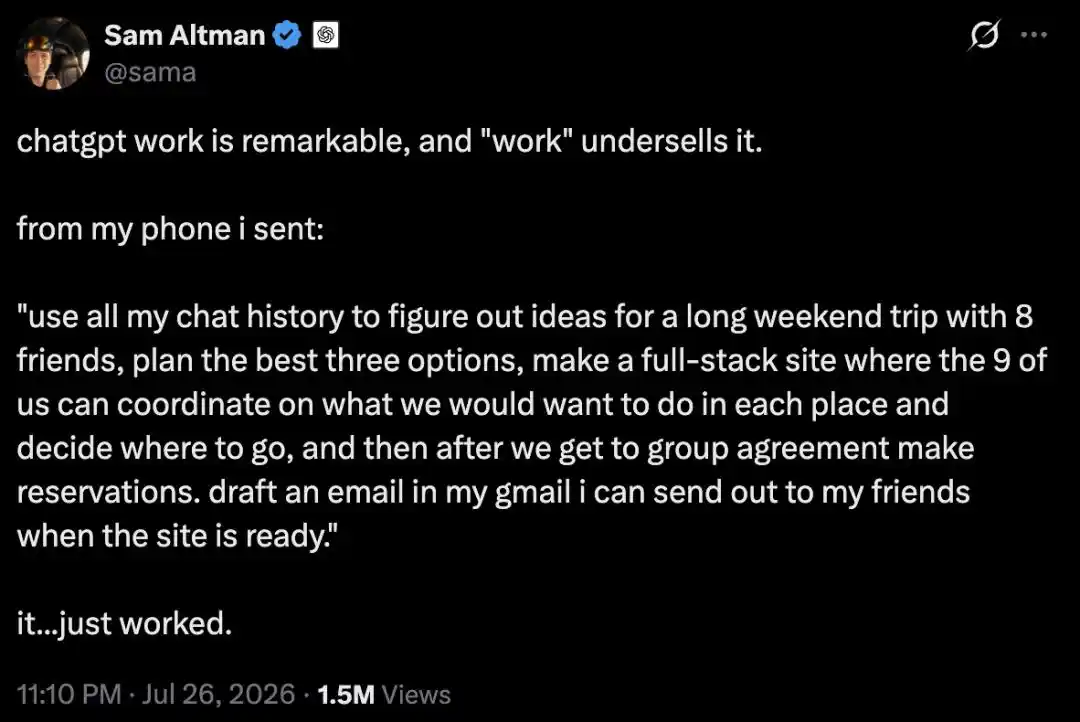
Late on July 26th, Altman said this on X.

Before posting, he had just used his phone to have ChatGPT plan a long weekend trip for himself and 8 friends.

His instruction was like this:

Use my entire chat history to come up with ideas for a long weekend trip for me and 8 friends, plan out the top three best options, build a full-stack website where we 9 can discuss what we want to do in each place, decide where to go, and then make bookings after everyone agrees. Also, draft an email in my Gmail so I can send it to my friends once the site is ready.

Altman said, it just ran and worked.

Tibo Sottiaux, head of Codex and Work, retweeted this post.

He said ChatGPT now handles about twenty things for him every day: negotiating internet bills with providers, unsubscribing from spam emails, searching for product discounts.

None of these are work-related, but Work handles them all.

It's precisely because of this that Tibo joked on X a few days ago, wondering if ChatGPT Work should be renamed to "ChatGPT HelpMeWithEverything."

OpenAI President Greg Brockman retweeted Tibo's post, saying ChatGPT is increasingly becoming your personal AGI.

Less than a month since the product launch, three executives have spoken out in succession.

What they want to say is the same thing: The name "Work" is a bit "too narrow," ChatGPT Work is targeting more than just your job.

Say One Sentence to Your Phone, and It Builds a 9-Person Travel Website

If we break down Altman's instruction, ChatGPT helped him do five completely different types of tasks.

"Use all chat history to find ideas": This instruction starts with Altman's entire chat history—what he likes, where he's been, who he's played with.

"Plan the best three options": Based on this chat history, have ChatGPT generate three selectable plans.

"Build a full-stack website": For the 9 people to coordinate what they want to do and decide where to go.

"Booking": Make reservations after everyone reaches a consensus.

"Draft an email": Draft an email in Altman's Gmail to send to his friends once the website is ready.

From searching memory, generating plans, building a site, waiting for consensus, to finally landing as a sendable email—saying one sentence to his phone, ChatGPT can handle all these for him.

These five tasks span three types of work: retrieving from memory, building an interactive website from scratch, and writing a pending email in his mailbox.

From Giving You Answers to Completing Tasks

If it were a year ago, asking AI to plan a trip for 9 people would at best get you an itinerary.

Now, it can build you a website that all 9 people can access, voice opinions, and modify plans.

The feature supporting this action is called Sites, which entered public beta alongside ChatGPT Work.

Its official positioning is to turn outcomes or ideas into interactive sites and web applications, shareable with a team or everyone via a URL. It's suitable for real-time dashboards, project progress trackers, release schedules, prototypes, internal portals, and interactive reports.

More crucially, pages aren't set in stone after creation. When the referenced data changes, ChatGPT can automatically go back and update the content.
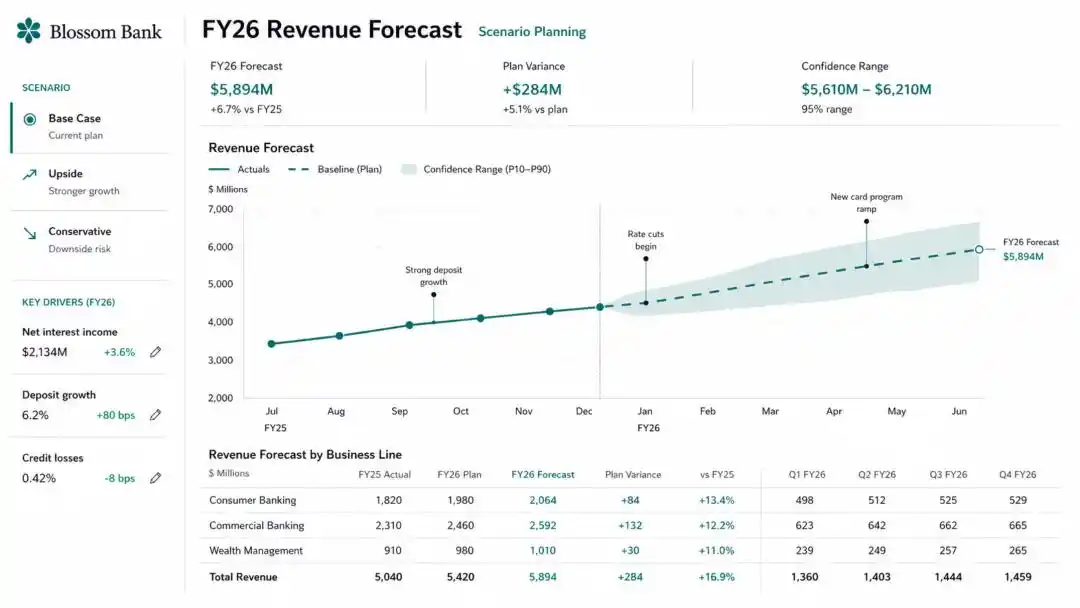
Official Sites example: An interactive revenue forecast dashboard that updates automatically when underlying data changes.

Building a shareable app with one prompt is something engineers could already do.

What stood in the way for ordinary people was the series of barriers: writing code, deployment, configuring domains. Now, AI has smoothed them all out.

What Made It Work Are These Capabilities of ChatGPT Work

On July 9th, OpenAI launched the agent ChatGPT Work, specializing in tasks that are time-consuming, multi-step, and require a final deliverable.

For complex projects, it breaks them down into smaller steps and completes them, capable of running for hours if needed.
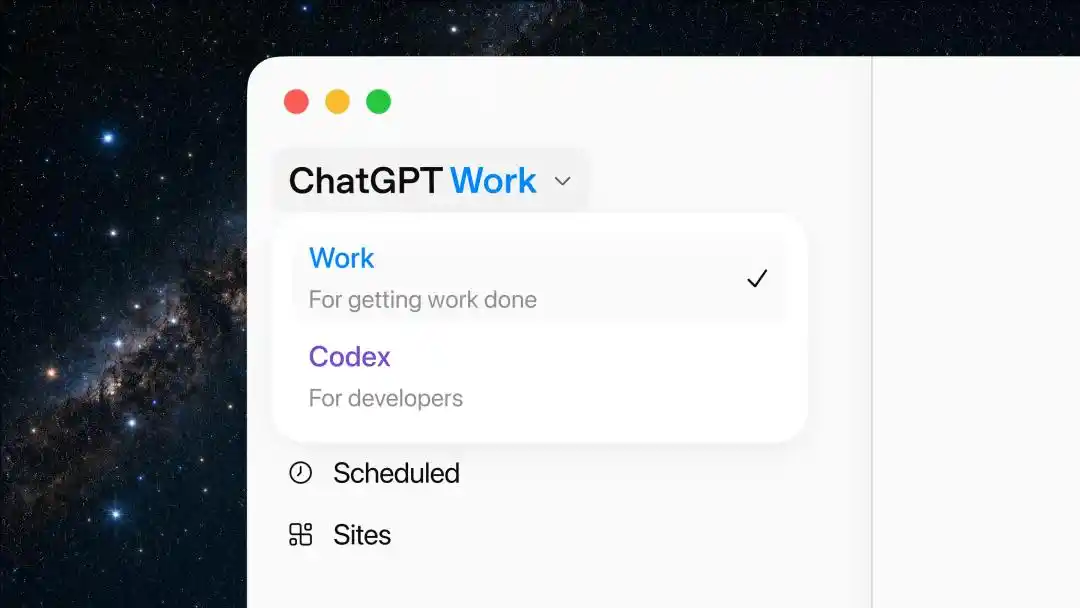
ChatGPT desktop menu, with Work listed alongside Codex, Scheduled, and Sites.

Its foundation is Codex technology, powered by the GPT-5.6 model released the same day. Several other capabilities were also updated:

Plugins connect ChatGPT to external systems like Gmail, Calendar, Google Drive, Slack. You can also use @mentions in prompts to direct it to fetch data from specified apps.

Sites is responsible for website building, providing real-time dashboards, project trackers, and interactive reports.

Complementary features include Scheduled Tasks and automatic review: Scheduled Tasks run repeatedly on a plan or trigger; automatic review checks critical actions before they happen to prevent sensitive information from being inadvertently sent out.
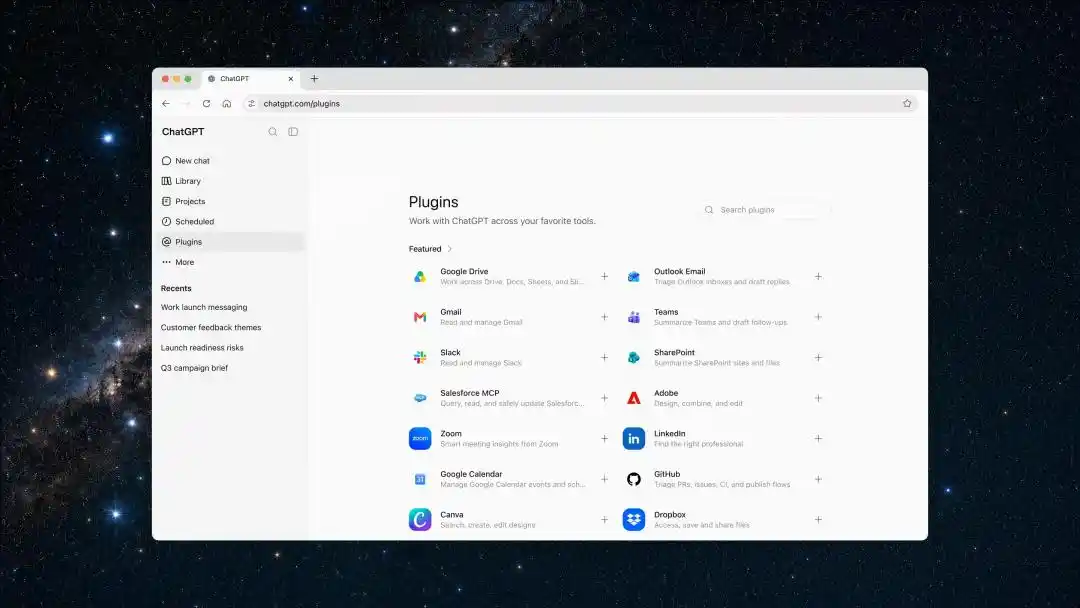
ChatGPT plugin directory, already integrated with tools like Google Drive, Gmail, Teams, Slack, Salesforce.

Codex now has over 5 million weekly users, with over 1 million of them not using it for coding at all: this product was initially an AI coding agent for developers.

OpenAI concluded that the capability fully supports a broader range of tasks.

OpenAI's internal adoption rate speaks volumes: Almost 100% of OpenAI's teams, including finance and sales, are using Work and Codex.

Throw the Most Annoying Chores to ChatGPT Work, It Handles Them All

After ChatGPT Work was launched, Graham Barlow from TechRadar threw his pile of most dreaded life chores at it.

After a week of use, the results surprised him.

For example, asking it to book a restaurant for a wedding anniversary got him three decent options—and that was the simplest task.

Planning a vacation, Graham threw in dates, budget, and family requirements. It researched destinations, compared flights and accommodations, created a cost sheet, made an itinerary, and even listed a separate checklist showing what was booked and what wasn't, updating as things progressed. It would also check existing bookings in his Gmail.

What Graham appreciated most was the transparency of the entire process: what it was doing, what sources it was referencing, every step was viewable.

Managing home renovation, it compared quotes, looked at blueprints and product specs, scheduled timelines, and tracked pending decisions.

Graham found the most useful feature to be scheduling his family's week.

Making this work relied on the aforementioned Scheduled Tasks feature.
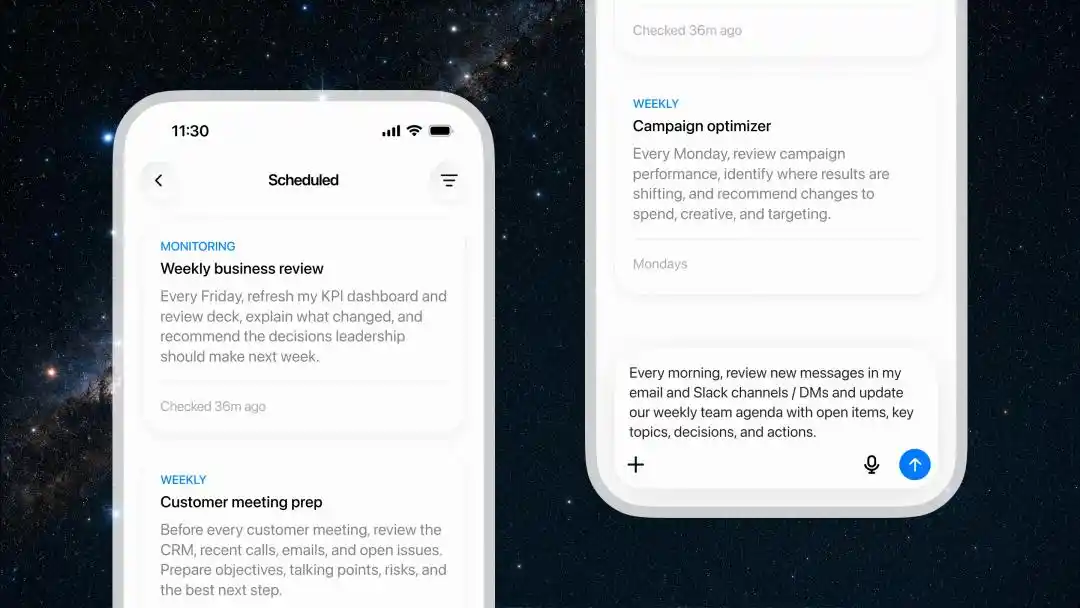
Mobile Scheduled Tasks interface, can execute repeatedly on a schedule or continuously monitor for changes.

ChatGPT had an old weakness: it couldn't automatically do things on a schedule; if you didn't ask, it wouldn't act. Now it can run repeatedly on a plan or monitor something for changes.

After connecting his calendar and email, Graham set up a scheduled task to automatically generate the family's weekly plan every Sunday night, with reminders for any changes mid-week. For example, school events for the kids are easiest to miss; as long as the school sent an email, it wouldn't be overlooked.

After testing it out, Graham's feeling was that even an ordinary personal matter could be complex enough to warrant using an agent.

He also saw a new way to use ChatGPT Work: letting it oversee a matter from start to finish, regardless of whether it's work-related or not.

The Phone Has Become the Agent's Remote Control

In the whole chain, Altman only did three things: described the goal, reviewed the plans, approved key actions.

All three were judgment calls; execution was entirely handed over to ChatGPT.
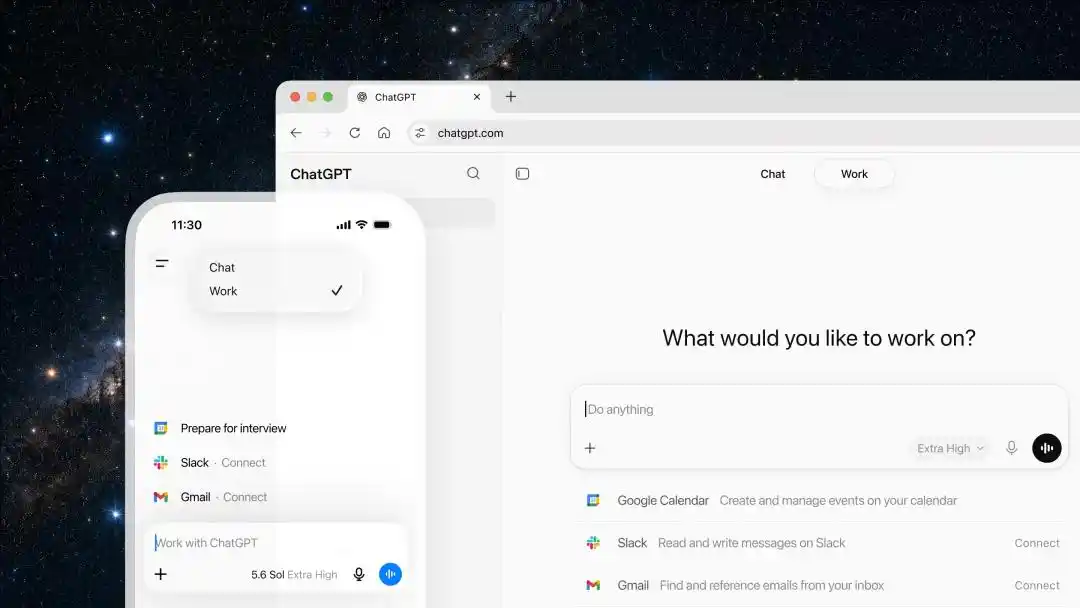
Official demo of ChatGPT Work desktop and mobile, integrated with Google Calendar, Slack, and Gmail.

So, on the execution side, where are AI's boundaries?

The first boundary is what it can read.

Altman wrote "use my entire chat history" in his instruction, but this is just his request; it doesn't mean the system can actually do that.

The official stance on Memory has always been integrating useful context from chats, files, and connected apps, not promising to read all history line by line. Users can also turn it off at any time.

As for what Work can access, when it asks you, whether it needs your approval before acting—these are also decided by you and the workspace admin. It doesn't have default access to all your accounts.

The second boundary is what it can do.

Altman had ChatGPT Work draft an email for him; he wanted a draft, which ultimately needed his review and sending.

The example email-related prompt on OpenAI's Work product page is written exactly like that: Find emails needing replies, summarize each, draft a reply, save as unsent, wait for human review. The official release also states that key actions involving connected tools require approval before execution.

Another detail worth noting: Altman sent this instruction from his phone.

The phone's role is changing; it's becoming the agent's remote control.

The web and mobile versions of Work run in the cloud, with three-end session synchronization: You start a task on the go, review drafts on the go, glance at progress between meetings, return to your desk, open the web version, and can continue pushing the same matter forward.

Barlow's judgment is: ChatGPT is starting to become a place where you can continuously advance a project at any time.

And that project might mostly have nothing to do with work.

Brockman says ChatGPT is increasingly becoming your personal AGI.

If this vision is truly to be realized, the hardest step might not be whether the model is smart enough or if there's enough computing power.

Authorization, payment, personal data... none of these points requiring human decisions have been eliminated yet.

References:

https://x.com/sama/status/2081396796174282900

https://x.com/gdb/status/2081458174662726009

https://x.com/thsottiaux/status/2081444811647963244

https://x.com/thsottiaux/status/2079731272797372425

https://t.co/zUQfWra6in

This article is from the WeChat public account "New Zhiyuan", author: ASI Apocalypse

Crypto di tendenza

Domande pertinenti

QAccording to the article, what specific travel planning tasks did Sam Altman ask ChatGPT Work to perform with a single prompt?

ASam Altman asked ChatGPT Work to: 1) Use his entire chat history to generate ideas for a long weekend trip for himself and 8 friends; 2) Plan the top three best options; 3) Build a full-stack website for the 9 people to discuss each destination and decide where to go; 4) Handle bookings after consensus was reached; and 5) Draft an email in his Gmail to send the website link to friends.

QWhat is the 'Sites' feature in ChatGPT Work, as described in the article?

AThe 'Sites' feature allows users to turn ideas or outcomes into interactive websites and web applications with a shareable URL. It is suitable for creating live dashboards, project trackers, launch schedules, prototypes, internal portals, and interactive reports. A key feature is that the content can be automatically updated by ChatGPT when the underlying data changes.

QHow does the 'Scheduled Tasks' functionality improve ChatGPT Work's utility for personal life management, according to the example in the article?

AThe 'Scheduled Tasks' functionality allows ChatGPT Work to execute tasks on a recurring schedule or monitor for specific changes. The article gives the example of a user setting a task for ChatGPT to automatically generate the family's weekly schedule every Sunday night by checking connected calendars and emails, and sending reminders if school events (noted in emails) are added or changed.

QWhat point are OpenAI executives (Altman, Sottiaux, Brockman) making by suggesting that 'ChatGPT Work' might be too narrow a name?

AThe executives are suggesting that 'ChatGPT Work' is too narrow because the AI agent's capabilities extend far beyond just work-related tasks. They highlight its use in complex personal life management, such as trip planning, negotiating bills, managing subscriptions, home renovation coordination, and family scheduling, indicating it is becoming a general-purpose personal assistant or 'personal AGI'.

QWhat are the two main boundaries or limitations mentioned regarding what ChatGPT Work can actually do when performing tasks?

AThe two main boundaries are: 1) **Access Boundaries**: Work does not necessarily read a user's *entire* chat history by default; it synthesizes useful context from chats, files, and connected apps based on user-controlled settings. Access to connected tools is also managed by the user or workspace admin. 2) **Action Boundaries**: For critical actions, especially involving external tools (like sending an email), Work typically requires user approval. It often drafts content (like an email reply) but leaves it unsent for human review and final authorization.

Letture associate

Saeed Al-Marri: How Tokenization Unlocks New Opportunities for Shipping Funds

Said Al-Marri: How Tokenization Opens New Opportunities for Shipping Funds For centuries, commercial shipping has been a capital-intensive asset class limited to institutional funds and shipping dynasties. Said bin Saleh Al-Marri, CEO of Ethra Invest and Ethra Ship, aims to break down these barriers by combining Real World Asset (RWA) tokenization with conservative private equity principles. This bridges decentralized finance (DeFi) with the physical realities of global trade. Tokenization allows fractional ownership of ships on a blockchain, giving smaller investors access to previously inaccessible markets. However, Al-Marri warns it is not a regulatory loophole or a cure for asset illiquidity. The core physical risks are isolated in Special Purpose Vehicles (SPVs) for qualified investors. While tokenization enhances transparency and ownership record-keeping, Al-Marri stresses that a liquid secondary market depends on transparent asset valuation and must not interfere with ship operations managed by professionals. Regarding legal enforcement, smart contracts cannot physically seize a ship. Legal recourse still relies on traditional maritime courts, ship mortgages, and flag state laws, with blockchain records needing to mirror legal ownership in the SPV perfectly. Beyond ownership, the industry faces administrative hurdles like paper-based bills of lading. Al-Marri argues the bottleneck is legal and operational standardization, not technology. He advocates for a hybrid model combining digital trade documents and programmable settlements with support from regulated financial institutions, rather than a full crypto replacement for tools like Letters of Credit. A major challenge is decarbonizing the global fleet by 2050. Transitioning to green fuels requires massive upfront investment. Al-Marri emphasizes a conservative, holistic approach to underwriting these projects, evaluating technology, fuel availability, safety, and resale value. Investments must be justified under conservative forecasts, not just optimistic ones. By combining pragmatic risk management with digital infrastructure, leaders like Al-Marri show that the evolution of maritime finance is about mobilizing capital to build a modernized and sustainable global fleet, not just putting ships on a blockchain.

cryptonews.ru7 min fa

Saeed Al-Marri: How Tokenization Unlocks New Opportunities for Shipping Funds

cryptonews.ru7 min fa

Six Years Later, UNI Finally Welcomes Its Own "Buyback Bull"

After years of debate, Uniswap's UNI token has finally entered a 'buyback bull' phase following the long-awaited activation of its fee-switch mechanism. The UNIfication proposal, executed in December 2025, redirected a portion of protocol fees from select pools and Unichain sequencer revenue into a treasury (TokenJar) dedicated to buying back and permanently burning UNI. Initial market reaction was muted due to modest early burn rates. A significant shift occurred in July 2026 with the launch of Robinhood Chain. Uniswap's immediate deployment there skyrocketed trading volume, making it a top fee-generator. Subsequently, governance votes extended the fee mechanism to v4 pools and Robinhood Chain, causing protocol revenue to nearly triple. Daily funds directed to UNI burns rose sharply, with Robinhood Chain contributing over half. This transitioned UNI's narrative from a governance token to a cash-flow asset backed by a perpetual automatic buyer. UNI's price, which had languished around $2.30 in early June, nearly doubled to approach $4.60 by late July. Analysts credit this to the tangible cash flow from fees rather than mere speculation. Unlike many newer projects where buybacks are offset by large investor unlocks, UNI's six-year history has resulted in a widely distributed and relatively clean supply, allowing the buyback pressure to effectively impact the secondary market. The key test will be whether trading activity, particularly on Robinhood Chain, sustains after its initial gas subsidies expire.

marsbit12 min fa

Six Years Later, UNI Finally Welcomes Its Own "Buyback Bull"

marsbit12 min fa

Only 153 Venture Capital Firms Invested in July: Is the Crypto VC Industry Experiencing a 'Mass Extinction'?

In July 2026, only 153 unique venture capital firms participated in disclosed crypto funding rounds, marking the lowest monthly count since November 2020. This figure represents an 87% decline from the peak of 1,177 firms in 2022. Overall, the first seven months of 2026 saw crypto projects raise approximately $11.78 billion across 481 rounds. This crypto VC contraction contrasts sharply with the broader venture capital landscape, where global VC investment reached a record $560.4 billion in H1 2026, heavily fueled by major AI company financings. This shift in capital allocation has drawn funds away from the crypto sector. Within crypto, funding is highly concentrated. Trading platforms, prediction markets, and payment sectors absorbed 53% of the total capital. While early-stage deals remain frequent, the largest sums flow to a few late-stage rounds and mergers & acquisitions, which surged to $7.23 billion in Q2 2026. The market is consolidating around top funds like a16z crypto and Dragonfly, which successfully raised new multi-billion dollar funds, while many smaller firms have retreated. Analysts describe this as a "great extinction" for crypto VCs, where capital is becoming more selective, favoring proven business models and assets over early-stage speculation. This raises the bar for project quality, funding efficiency, and viable exit paths.

marsbit33 min fa

Only 153 Venture Capital Firms Invested in July: Is the Crypto VC Industry Experiencing a 'Mass Extinction'?

marsbit33 min fa

Trading

Spot

Articoli Popolari

Come comprare ONE

Benvenuto in HTX.com! Abbiamo reso l'acquisto di Harmony (ONE) semplice e conveniente. Segui la nostra guida passo passo per intraprendere il tuo viaggio nel mondo delle criptovalute.Step 1: Crea il tuo Account HTXUsa la tua email o numero di telefono per registrarti il tuo account gratuito su HTX. Vivi un'esperienza facile e sblocca tutte le funzionalità,Crea il mio accountStep 2: Vai in Acquista crypto e seleziona il tuo metodo di pagamentoCarta di credito/debito: utilizza la tua Visa o Mastercard per acquistare immediatamente HarmonyONE.Bilancio: Usa i fondi dal bilancio del tuo account HTX per fare trading senza problemi.Terze parti: abbiamo aggiunto metodi di pagamento molto utilizzati come Google Pay e Apple Pay per maggiore comodità.P2P: Fai trading direttamente con altri utenti HTX.Over-the-Counter (OTC): Offriamo servizi su misura e tassi di cambio competitivi per i trader.Step 3: Conserva Harmony (ONE)Dopo aver acquistato Harmony (ONE), conserva nel tuo account HTX. In alternativa, puoi inviare tramite trasferimento blockchain o scambiare per altre criptovalute.Step 4: Scambia Harmony (ONE)Scambia facilmente Harmony (ONE) nel mercato spot di HTX. Accedi al tuo account, seleziona la tua coppia di trading, esegui le tue operazioni e monitora in tempo reale. Offriamo un'esperienza user-friendly sia per chi ha appena iniziato che per i trader più esperti.

368 Totale visualizzazioniPubblicato il 2024.12.12Aggiornato il 2026.06.02

Come comprare ONE

Discussioni

Benvenuto nella Community HTX. Qui puoi rimanere informato sugli ultimi sviluppi della piattaforma e accedere ad approfondimenti esperti sul mercato. Le opinioni degli utenti sul prezzo di ONE ONE sono presentate come di seguito.

活动图片