With $950 Million in Revenue, How Does Pump.fun Use $3 Million to 'Vote' for the Next Viral Meme?

比推Pubblicato 2026-01-20Pubblicato ultima volta 2026-01-20

Introduzione

Pump.fun, a leading platform in the Meme token space with over $950 million in historical revenue, has launched an investment division called Pump Fund. The fund will invest $3 million in total across 12 new tokens launched on its platform, allocating $250,000 per token at a valuation of $10 million each. In addition to financial support, selected projects will receive mentorship from Pump.fun’s founders and other resources. The initiative is part of a new "Build in Public (BiP)" hackathon, which encourages founders to publicly develop products after launching a token on Pump.fun. Participants must hold at least 10% of their token supply and are encouraged to actively engage with the community via social media and live streams. The selection process prioritizes organic growth and long-term sustainability over marketing hype. The application period opened on January 19 and will run for 30 days, with the first winners announced by February 18. The program is designed to identify and support promising Meme tokens with real utility and community backing, offering a new path for early-stage projects to gain traction.

Author: Azuma

Original Title: Pump.fun Launches Direct Investment, Spending $3 Million to Buy 12 New Memes


On the morning of January 20, Pump.fun officially announced the launch of its investment division, Pump Fund. Pump Fund will initiate its first project, the Build in Public (BiP) Hackathon, this month, investing $3 million in 12 new tokens issued through the platform, with $250,000 allocated to each token at a valuation of $10 million. In addition to financial support, Pump.fun will also provide professional guidance from its founders and other substantial resources.

As the project with the strongest revenue-generating capability in the entire Meme sector, this is the first time Pump.fun has openly expressed its support for specific Meme tokens through official channels, using real money (the attitude may be more important than the scale of funding). Therefore, the selected tokens are highly likely to become the frontrunners in the Meme sector in the coming period.

Pump.fun's Revenue-Generating Capability

Pump.fun's staggering revenue-generating ability is no secret. Data compiled by analyst Adam (@Adam_Tehc) on Dune shows that Pump.fun's historical total revenue has reached $954.8 million. Although daily revenue has significantly declined as the Meme hype cooled down, it still amounts to hundreds of thousands of dollars per day.
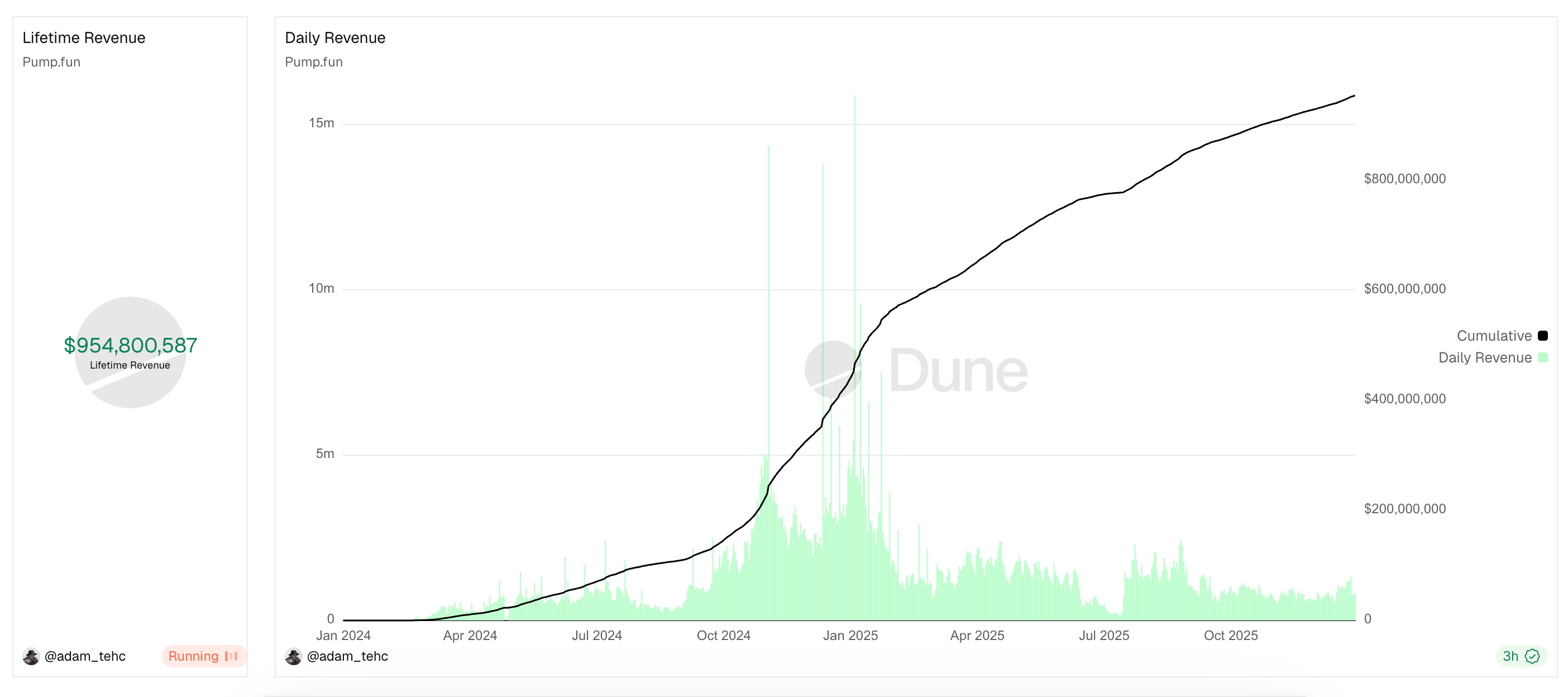
With massive real money at hand, Pump.fun is exploring other ways to give back to the ecosystem beyond PUMP token buybacks. Pump Fund and its affiliated BiP Hackathon are Pump.fun's latest attempts.

BiP Hackathon Details

According to the description on the BiP Hackathon's dedicated page, the project aims to support founders who issue tokens on Pump.fun and publicly build products. Unlike traditional hackathons where participants rely on VCs or judges for evaluation to compete for prizes, the BiP Hackathon intends to introduce token performance as a variable, allowing the market to determine whether a project is worth advancing, while enabling users to become the earliest investors.

When discussing this key difference, Pump.fun founder Alon stated in an X post: "Before Pump.fun, my co-founder and I tried many different ideas. Consumer finance, DeFi, SocialFi, NFTs—but all failed. One of the biggest problems we encountered was how difficult it was to get our products in front of users. Trying to reach the right audience was an extremely tedious task..."

Specifically, the BiP Hackathon requires:

  • Participants must issue a token on Pump.fun and then publicly build a product;

  • Participants must also hold at least 10% of the token supply to align interests;

  • Finally, the event strongly encourages founders to speak publicly on social media like X or livestream on Pump.fun to maintain effective communication with the community.

As for the types of projects, Pump.fun has not set any restrictions; they are not even limited to cryptocurrency-related products. Projects from different market stages and various verticals can participate.

Regarding how the 12 winning projects will ultimately be selected, Pump.fun did not provide specific rules but highlighted two key principles: first, organic user growth and genuine appeal are preferred over connections and flashy promotions; second, in addition to the appeal of the product itself/social media presence, the event will also assess the long-term sustainability of the projects.

Key Timelines to Watch

According to the BiP Hackathon's schedule, the application process opened on January 19. Participants are required to launch their tokens at the time of application and begin public building (including livestreaming development progress, regularly sharing updates, and maintaining community interaction). The application window will remain open for 30 days. On February 18, Pump.fun will announce the first batch of winning projects and provide funding (at least one will be announced). Considering that some projects may require more time to gain market attention and demonstrate appeal, the program will continue to operate long-term.

So the timeline is clear: if you want to spot potential opportunities among this batch of Meme tokens, you need to start paying attention to newly issued tokens on Pump.fun from now on, especially those with the Pump Fund or BiP labels. Although the first batch of winning tokens won't be announced until 30 days later, tokens likely to be selected by Pump.fun will undoubtedly show competitiveness well before that.

Overall, while Pump.fun's event may not be enough to drive a collective rebound in Meme market sentiment, it can at least contribute some new tokens with clearer evaluation dimensions.


Twitter:https://twitter.com/BitpushNewsCN

Bitpush TG Discussion Group:https://t.me/BitPushCommunity

Bitpush TG Subscription: https://t.me/bitpush

Original link:https://www.bitpush.news/articles/7604435

Crypto di tendenza

Domande pertinenti

QWhat is the total historical revenue of Pump.fun as mentioned in the article?

AThe total historical revenue of Pump.fun is $954.8 million.

QWhat is the name of the new investment department launched by Pump.fun and what is its first project?

AThe new investment department is called Pump Fund, and its first project is the Build in Public (BiP) hackathon.

QHow much funding will Pump.fun provide to each of the 12 selected tokens in the BiP hackathon, and what valuation does this correspond to?

APump.fun will invest $250,000 in each of the 12 selected tokens, corresponding to a valuation of $10 million per token.

QAccording to the article, what are the two main principles Pump.fun will use to select the winning projects for the BiP hackathon?

AThe two main principles are: 1) Natural user growth and genuine appeal are favored over connections and flashy marketing. 2) The long-term sustainability of the project will be evaluated in addition to the product's appeal and social media presence.

QWhen did the application window for the BiP hackathon open, and when will the first batch of winning projects be announced?

AThe application window opened on January 19th and will be open for 30 days. The first batch of winning projects will be announced on February 18th.

Letture associate

7 Months After the Collapse of Huiwang, Southeast Asia's Escrow Platforms Undergo a Major Reshuffle

Following the collapse of Huione Pay—dubbed the "Alipay of Southeast Asia"—seven months ago, the region's underground financial guarantee platform sector is undergoing a significant reshuffle. This power vacuum has been swiftly filled by emerging platforms such as XinBi, Tiger/Navigator, JinBei (renamed JinBo), Dali/Tiancheng, and FullyLight. These platforms, operating largely via Telegram and offering services like escrow for illicit transactions, have absorbed the vast user base and markets left behind by Huione. While positioning themselves as "trust intermediaries," their primary clientele consists of networks involved in online scams, money laundering, illegal gambling, and even human trafficking. For instance, the Tiger/Navigator platform explicitly provides "escrow" services for kidnapping-for-ransom operations ("强押车交易"). Data underscores the immense scale: Huione alone processed over $103 billion in cryptocurrency payments and facilitated over $31 billion through its escrow market before its downfall, linking it to Cambodia's notorious Prince Group. Since its collapse, competitors have seen explosive growth. For example, the XinBi platform has accumulated over $1.6 billion in total USDT revenue, while platforms like NewPay, OkPay (under Dali), and FullyLight Wallet collectively processed over $4.8 billion in USDT in a single year. This ecosystem thrives in regions like Cambodia and Myanmar, where regulatory gaps allow these platforms to act as critical financial infrastructure for sprawling cybercrime industries, from scam compounds to online casinos. The article concludes that the moniker "Southeast Asian Alipay" is a misnomer, obscuring the platforms' fundamental role in enabling serious criminal enterprises rather than representing legitimate financial innovation.

Odaily星球日报3 min fa

7 Months After the Collapse of Huiwang, Southeast Asia's Escrow Platforms Undergo a Major Reshuffle

Odaily星球日报3 min fa

The Changing Landscape: What Are Crypto VCs Experiencing?

Title: The Shifting Landscape of Crypto Venture Capital The era of dedicated crypto venture capital funds is undergoing a significant transformation. Once essential for navigating the sector's complexity and high risk, these specialized funds are now facing an identity crisis as the market matures. This shift mirrors historical patterns in other specialized investment classes like cleantech and SPACs, where initial information advantages dissipate as technologies become mainstream and integrated into existing industry frameworks. The article argues that crypto is reaching a critical inflection point, transitioning from a "building phase" to an "integration phase." Major players like Stripe, BlackRock, and Visa now engage with crypto not for its novel mechanics but as a foundational financial infrastructure. Their needs—regulatory compliance, banking partnerships, distribution channels—align with traditional fintech, a domain easily understood by large, generalist funds like Sequoia and Founders Fund. This evolution creates a "barbell effect" within the VC landscape. On one end are massive, diversified platforms that can incorporate crypto as one vertical among many. On the other are small, nimble funds focused on niche, experimental projects. The middle ground—medium-sized dedicated crypto funds—is being squeezed out. Their typical fund size makes it impossible to generate sufficient returns solely from early-stage crypto bets, yet they cannot compete with giants for later-stage deals. Consequently, leading crypto-native firms like Paradigm and Framework Ventures are expanding into AI, robotics, and other sectors, driven partly by LP pressure for better returns amid a broader VC DPI crisis. Others, like Dragonfly and a16z, have narrowed their crypto focus predominantly to financial infrastructure like stablecoins, reframing the sector's core narrative. For crypto entrepreneurs, this consolidation presents challenges. While generalist funds offer larger checks and broader resources, crypto projects now compete fiercely with AI for attention and capital within these firms. Furthermore, the long-term, non-commercial foundational work that built the ecosystem—funded by dedicated crypto VCs—is less likely to attract generalist capital focused on direct returns. The conclusion is that "crypto investor" as a standalone category is becoming obsolete, akin to "internet investor." Crypto is becoming a baseline infrastructure layer. The future will see a barbell structure: large-scale growth financing handled by generalist funds, while pioneering, speculative projects are funded by small, specialized vehicles. The dedicated crypto funds of the 2017-2021 boom, which incubated core infrastructure, are giving way to this new, bifurcated reality.

Foresight News21 min fa

The Changing Landscape: What Are Crypto VCs Experiencing?

Foresight News21 min fa

As Consensus Accelerates, What Are Young Investors Betting On?

Title: As Consensus Forms Faster, What Are Young Investors Betting On? In the rapid evolution of tech investment, a new generation of young investors is navigating a landscape where AI, robotics, commercial aerospace, and quantum computing are advancing simultaneously. Traditional investment logic based on financial models is giving way to a need for deep technical understanding and the ability to act before industry consensus forms. An analysis of trends from the "WAIC FUTURE TECH" list of young investment leaders reveals key shifts in focus. The first major trend is the movement of AI from the digital screen into the physical world. Investment is shifting from large language models and chatbots towards embodied AI, robotics, AI hardware, and edge computing. While demonstrations generate excitement, the real challenge lies in achieving scalable, reliable, and cost-effective delivery in complex real-world environments like factories and logistics. Success depends not just on algorithms but on the integration of sensors, actuators, and control systems. Second, the competitive focus for large models is moving beyond raw capability toward building an "intelligence flywheel." The goal is to create self-reinforcing systems where user interaction generates data, improving the model, which in turn enhances the user experience and attracts more engagement. Companies that successfully embed AI into workflows to create these closed-loop systems can build lasting value that isn't easily erased by the next model upgrade. Third, facing a potential bottleneck in high-quality human-generated data, investors are looking at new underlying technologies. Reinforcement learning and self-play, as demonstrated by AlphaGo Zero, offer paths for AI to generate its own experience. Scientific foundation models, which aim to build general AI capabilities for fields like life sciences and materials discovery, represent a non-consensus direction that could unlock new frontiers of knowledge and data. Finally, in deep-tech areas like quantum computing, commercial aerospace, and space-based infrastructure, patient capital is essential. These fields have long, uncertain development and validation cycles involving complex engineering, supply chains, and regulations. Investment here requires a long-term view, focusing on foundational team capabilities and the eventual emergence of market demand, even if commercial returns are distant. Collectively, these trends illustrate how young investors are adapting to a new era. They are learning to make earlier, technically-informed judgments, balance hype with real-world viability, and provide the patient capital needed to build the deep-tech foundations of the future.

marsbit49 min fa

As Consensus Accelerates, What Are Young Investors Betting On?

marsbit49 min fa

Trading

Spot

Articoli Popolari

Cosa è MEME 2.0

Memecoin 2.0: L'Ascesa di $MEME 2.0 nel Mondo delle Criptovalute Introduzione Nel panorama in continua evoluzione delle criptovalute, è emerso un nuovo contendente. Memecoin 2.0, simboleggiato come $MEME 2.0, porta il concetto di meme coin a un livello emozionante. Come prodotto derivato dal Memecoin originale, questo progetto ha catturato l'attenzione della comunità crypto spostando il focus da incentivi finanziari tipici a un'esperienza coinvolgente e divertente. Operando sulla blockchain di Ethereum, Memecoin 2.0 ridefinisce audacemente l'impegno della comunità nella sfera crypto. Che cos'è Memecoin 2.0, $MEME 2.0? Alla base, Memecoin 2.0 è un progetto di criptovaluta che dà priorità allo spirito di comunità e al divertimento associato alla cultura meme. A differenza delle criptovalute convenzionali, che si concentrano su casi d'uso pratici e benefici tangibili, Memecoin 2.0 si distingue abbracciando il lato più leggero della moneta digitale. Il progetto esiste senza promesse di utilità, una roadmap strutturata o ritorni finanziari, concentrandosi invece sulla creazione di una comunità vibrante incentrata sui meme e sul divertimento condiviso. Facendo così, attinge alla crescente tendenza della cultura meme nello spazio online, rendendola un giocatore unico nel mondo degli asset digitali. Creatore di Memecoin 2.0, $MEME 2.0 Nonostante ricerche approfondite sulle origini di Memecoin 2.0, l'identità esplicita del suo creatore rimane sconosciuta. Questa anonimità non è rara nella comunità crypto, dove molti progetti sono guidati da individui o gruppi che preferiscono rimanere dietro le quinte. La mancanza di informazioni pubblicamente disponibili sul creatore potrebbe essere vista come una mossa strategica, mettendo in evidenza l'impegno della comunità piuttosto che la notorietà individuale all'interno dello spazio. Investitori di Memecoin 2.0, $MEME 2.0 Le informazioni riguardanti gli investitori o il supporto finanziario per Memecoin 2.0 sono scarse. Questa assenza di dettagli potrebbe suggerire che il progetto sia autofinanziato o che il suo focus sulla comunità piuttosto che sulle strutture d'investimento tradizionali abbia attratto un tipo diverso di sostenitore. Poiché il mondo delle meme coin coinvolge tipicamente un maggior coinvolgimento di base piuttosto che investimenti istituzionali, questo approccio si allinea con l'etica dei progetti guidati dalla comunità. Come funziona Memecoin 2.0, $MEME 2.0? Memecoin 2.0 opera interamente sulla blockchain di Ethereum, capitalizzando le sue robuste caratteristiche di sicurezza e scalabilità. Sfruttando i punti di forza di Ethereum, Memecoin 2.0 può offrire un ambiente sicuro per le interazioni degli utenti garantendo che le transazioni siano sia efficienti che convenienti. Uno degli attributi unici di Memecoin 2.0 risiede nella sua struttura guidata dalla comunità. Il valore e la popolarità del token $MEME 2.0 derivano dalla partecipazione attiva dei suoi utenti, piuttosto che dalla utilità intrinseca. Questo design rinforza il focus del progetto sull'aspetto dell'intrattenimento delle criptovalute, implicando che la risata e l'impegno della comunità siano le vere monete che guidano il suo successo. Inoltre, il progetto si inserisce all'interno dell'ecosistema più ampio delle meme coin, dove il valore di ciascuna meme coin oscilla in base alla cultura, alle tendenze e all'impegno della comunità piuttosto che ai principi economici tradizionali. Cronologia di Memecoin 2.0, $MEME 2.0 Per comprendere meglio l'evoluzione e le pietre miliari di Memecoin 2.0, ecco una cronologia che evidenzia eventi significativi nella sua storia: 2024: L'inizio di Memecoin 2.0 è riconosciuto come un ramo del Memecoin originale, affermandosi all'interno del contesto fiorente delle meme coin mentre opera sulla blockchain di Ethereum. 13 luglio 2024: Memecoin 2.0 si posiziona ufficialmente come una meme coin incentrata sulla comunità sulla rete Ethereum, enfatizzando il suo approccio centrato sull'intrattenimento che invita gli utenti a impegnarsi e partecipare alla sua crescita. Punti Chiave su Memecoin 2.0, $MEME 2.0 Diverse caratteristiche critiche definiscono Memecoin 2.0: Approccio Centrico alla Comunità: La missione principale di Memecoin 2.0 è creare un'esperienza comunitaria divertente e coinvolgente, capitalizzando il piacere collettivo derivante dalla cultura memetica. Costruita su Ethereum: Operare sulla blockchain di Ethereum fornisce al progetto un'infrastruttura essenziale che garantisce sicurezza e scalabilità. Mancanza di Utilità o Roadmap: In una marcata deviazione dalle criptovalute tradizionali, Memecoin 2.0 non promette alcuna caratteristica utilitaria o ritorni finanziari, riaffermando il suo impegno per il coinvolgimento della comunità e l'impegno sociale. Focus sulla Cultura Memetica: Abbracciando gli aspetti umoristici e culturali del fenomeno meme, Memecoin 2.0 offre una piattaforma per gli utenti per interagire con la crypto offline e online. Ulteriore Contesto: L'Importanza delle Meme Coin Le meme coin sono emerse come una classe distinta di criptovaluta, spesso guidata dall'umorismo e da un approccio spensierato al trading. Queste monete generalmente mancano di significative utilità o roadmap di sviluppo, attirando gli utenti con la promessa di divertimento, interazione comunitaria e rilevanza culturale. Nel panorama del più ampio ecosistema crypto, le meme coin rianimano l'importanza dell'impegno della comunità, opponendosi ad approcci esclusivamente orientati al profitto. Progetti come Memecoin 2.0 danno il via a un'era in cui l'intrattenimento può armonizzarsi con le aspirazioni finanziarie, trasformando la blockchain in un parco giochi per la creatività e l'interazione sociale. Conclusione Memecoin 2.0, o $MEME 2.0, incarna una nuova ondata di criptovaluta che dà priorità all'impegno della comunità rispetto a rigidi strutture finanziarie. Con un focus sull'umorismo e l'interazione sociale, capitalizza sulla fascinazione circondante la cultura meme. Operando sulla blockchain di Ethereum, Memecoin 2.0 sfrutta le capacità della tecnologia mantenendo fermo il suo impegno per il valore ricreativo della valuta digitale. Mentre lo spazio delle criptovalute continua a evolversi, Memecoin 2.0 serve come testimonianza della nozione che il futuro degli asset digitali potrebbe ben dipendere da esperienze condivise, risate e solidi legami comunitari. Nel mondo imprevedibile delle crypto, forse la gioia può essere altrettanto preziosa quanto il guadagno finanziario tradizionale.

133 Totale visualizzazioniPubblicato il 2024.04.04Aggiornato il 2024.12.03

Cosa è MEME 2.0

Come comprare MEME

Benvenuto in HTX.com! Abbiamo reso l'acquisto di Memeland (MEME) semplice e conveniente. Segui la nostra guida passo passo per intraprendere il tuo viaggio nel mondo delle criptovalute.Step 1: Crea il tuo Account HTXUsa la tua email o numero di telefono per registrarti il tuo account gratuito su HTX. Vivi un'esperienza facile e sblocca tutte le funzionalità,Crea il mio accountStep 2: Vai in Acquista crypto e seleziona il tuo metodo di pagamentoCarta di credito/debito: utilizza la tua Visa o Mastercard per acquistare immediatamente MemelandMEME.Bilancio: Usa i fondi dal bilancio del tuo account HTX per fare trading senza problemi.Terze parti: abbiamo aggiunto metodi di pagamento molto utilizzati come Google Pay e Apple Pay per maggiore comodità.P2P: Fai trading direttamente con altri utenti HTX.Over-the-Counter (OTC): Offriamo servizi su misura e tassi di cambio competitivi per i trader.Step 3: Conserva Memeland (MEME)Dopo aver acquistato Memeland (MEME), conserva nel tuo account HTX. In alternativa, puoi inviare tramite trasferimento blockchain o scambiare per altre criptovalute.Step 4: Scambia Memeland (MEME)Scambia facilmente Memeland (MEME) nel mercato spot di HTX. Accedi al tuo account, seleziona la tua coppia di trading, esegui le tue operazioni e monitora in tempo reale. Offriamo un'esperienza user-friendly sia per chi ha appena iniziato che per i trader più esperti.

324 Totale visualizzazioniPubblicato il 2024.12.12Aggiornato il 2026.06.02

Come comprare MEME

Discussioni

Benvenuto nella Community HTX. Qui puoi rimanere informato sugli ultimi sviluppi della piattaforma e accedere ad approfondimenti esperti sul mercato. Le opinioni degli utenti sul prezzo di MEME MEME sono presentate come di seguito.

活动图片














