Wintermute Trader: BTC Stuck at $64-67k, Market Has Entered a Phase of Macro Paradigm Shift

marsbitPubblicato 2026-02-25Pubblicato ultima volta 2026-02-25

Introduzione

A Wintermute OTC trader analyzes the current crypto market, noting that BTC remains range-bound between $64k-$67k with weak momentum. The market is undergoing a potential macro paradigm shift driven by three key structural forces: AI-driven repricing, deglobalization, and Federal Reserve policy inefficacy. These factors are causing a rotation away from growth assets—including crypto, which is being sold as high-beta risk-on exposure—and into value sectors like commodities, energy, and defense. AI disruption is compressing software valuations, while deglobalization and tariffs are increasing input costs and geopolitical risks. The Fed is seen as ineffective in responding to sticky inflation and slowing growth. Despite brief interest in altcoins, institutional demand remains weak, and derivatives indicate low conviction. The key question for 2026 is whether this rotation is a temporary shift or a lasting macro regime change favoring hard assets over growth. The answer remains uncertain.

Author: Jjay_dm, Wintermute OTC Trader

Compiled by: Deep Tide TechFlow

Deep Tide Guide: Wintermute is one of the world's largest crypto market makers. This market update, written on February 23, is one of the most sobering descriptions of the current crypto market situation.

It's not just about being bullish or bearish, but integrates three threads—AI repricing, deglobalization, and the Fed's ineffectiveness—into a unified framework. It clearly states that crypto assets are currently being sold as "the highest beta growth assets," and whether this trend is a short-term rotation or a true paradigm shift is the most critical question to watch in 2026.

Full Text Below:

📈 Market Update — February 23, 2026

BTC remains range-bound in the $64-67k zone after the liquidation wave, trading as a high-beta asset with price action increasingly resembling that of some blue-chip altcoins. AI disruption and slow deglobalization have triggered the core question for the crypto market in 2026, with short-term pressures persisting.

Paradigm Shift

Macro

For months, the market has been driven by micro-catalysts: individual tariff headlines, Fed official speeches, earnings data. React, reprice, reset. But this framework is breaking down. A recent article by Citrini crystallized a sentiment many investors felt but never clearly expressed into a judgment: we are in a paradigm shift.

The Fed, which dominated market moves for most of this cycle, is changing. The forces driving asset prices now are slower, harder to trade, and won't be resolved by a single policy pivot. Tariffs aren't going away, AI is disrupting entire industries in real-time, growth is slowing while inflation remains sticky. The Fed's tools are increasingly ineffective against these forces, and investors are starting to question the "Fed/Trump put" that underpinned the market—the very expectation that supported the outperformance of growth stocks and momentum strategies (crypto excepted).

Two structural trade logics are running simultaneously and reinforcing each other:

AI Repricing. The US FY2025 earnings season, combined with Anthropic's recent model release, is forcing the market to underwrite AI disruption risk industry by industry, in real time. Software moats are being reassessed, growth valuation multiples are compressing, and the intensity of hardware capex is also being questioned. The easy trade in AI appears to be over for now, replaced by a messier, more volatile situation.

Deglobalization. Trump's shift from IEEPA to Section 122 of the Trade Act following the Supreme Court ruling is the clearest signal yet: tariffs are structural, not temporary. The government will always find a mechanism. Supply chains continue to fragment, input costs remain high, and geopolitical settlement risk is now a permanent feature of asset allocation.

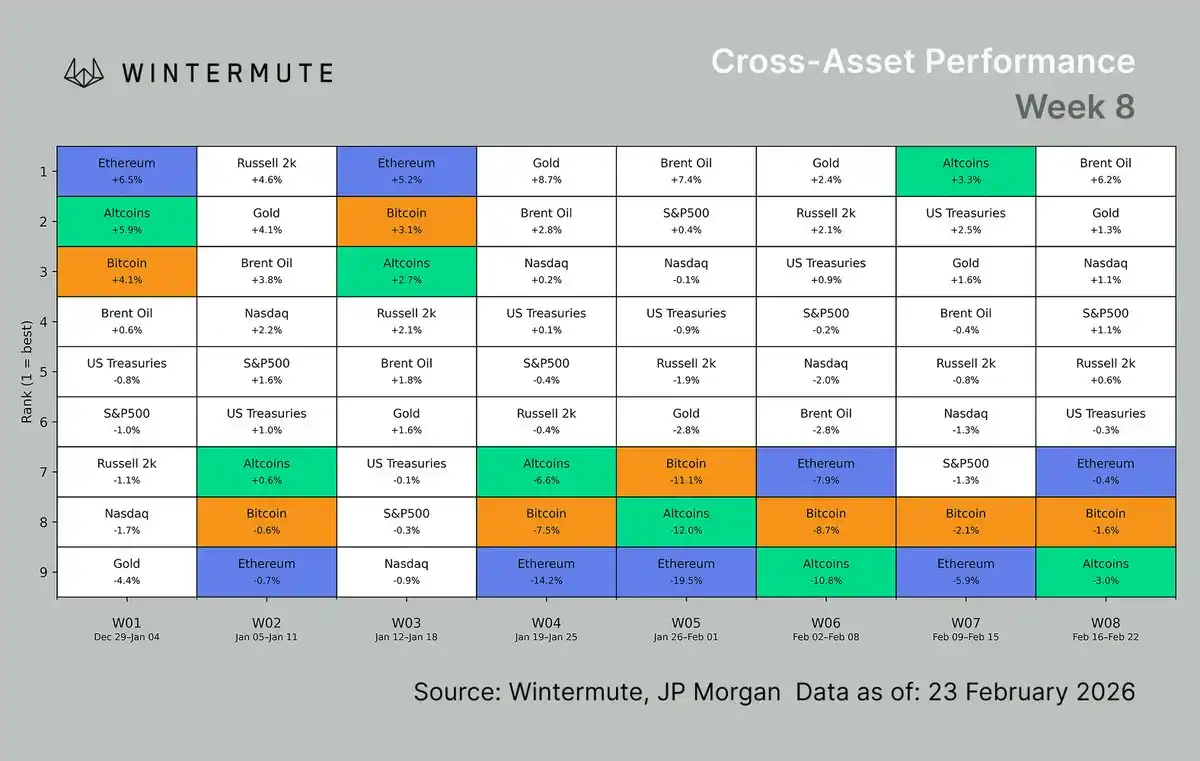
Both drivers attack the same thing: the valuation premium embedded in globally integrated, software-leveraged growth companies. The rotation is already well advanced. Gold, commodities, industrials, metals & mining, defense, and energy are outperforming. Value works, growth is being sold. There is no clarity on rates, no signal that would reverse this trend. The Fed can neither cut with sticky inflation nor hike with slowing growth—this stalemate is the entire trade.
Digital Assets

BTC has failed multiple attempts to break $70k since the liquidation cascade two weeks ago. The absence of bounce buying is more telling than the range itself. Price action is messy, liquidity is thin, the range is tightening and lacks direction. ETH broke below $1,900 this week, a level more psychologically significant than technical; the real support level to watch for ETH is around $1,600.

Institutional demand has not returned after prices stabilized—this contrasts with the situation in the previous $85-95k range, where institutional buying was quite evident. The derivatives market also confirms the lack of directional conviction and trading appetite: basis is at multi-month lows, put skew is rising and still climbing, and open interest has been declining since October.

Trading desk flow is skewed to the sell side, but a noteworthy signal emerged mid-week: high-net-worth individuals briefly showed selective willingness to buy altcoins. In an overall defensive environment, this was a small but notable spark of confidence, though it faded very quickly.

The latter part of the week became messy again; any buying willingness quickly dissipated, indicating the market isn't ready to reward early positioning. The marginal activity remains protective, not offensive.

Our Take

First slowly, then suddenly. The market feels like it's consolidating various narratives into a picture of a paradigm shift.

Right now, crypto assets are being sold as the highest-beta growth assets—falling alongside tech stocks and momentum strategies—in a world where growth asset risk premia are rising and the Fed is powerless to act. The continued net outflows from ETFs confirm this; it's the short-term reality.

But zooming out, the more interesting question is: how sticky is this paradigm? The narratives around stagflation, deglobalization, and Fed gridlock are starting to feel less like a short-term catalyst and more like a genuine repricing of the macro backdrop—a setup favoring hard assets, commodities, and value, not growth. Crypto is currently on the wrong side of this trade.

That said, we've seen this before. Over the past decade, multiple growth scare-induced shifts ultimately reversed as risk appetite returned and the market found its momentum direction again. The difference this time is the structural nature of AI repricing and deglobalization. But it's too early to call it a paradigm shift. How sticky this narrative proves to be is the most important question for crypto in 2026—and we don't have the answer yet.


Domande pertinenti

QAccording to the Wintermute trader, what is the current trading range for Bitcoin and what does its price action resemble?

ABitcoin is trading sideways in the $64-67k range, and its price action is increasingly resembling that of some blue-chip altcoins, trading as a high beta asset.

QWhat two major structural forces does the article identify as driving the current market paradigm shift?

AThe two major structural forces are AI repricing, which is forcing a real-time reassessment of industry risks and valuations, and slow de-globalization, characterized by structural tariffs and fragmenting supply chains.

QHow has institutional demand for Bitcoin behaved since the price stabilized, and what does the derivatives market indicate?

AInstitutional demand has not returned since the price stabilized, in contrast to the significant buying seen in the $85-95k range. The derivatives market confirms a lack of directional conviction, with basis at multi-month lows, rising put skew, and declining open interest since October.

QIn the context of the new macro paradigm, what type of assets are currently outperforming, and where do crypto assets fit into this?

AAssets like gold, commodities, industrials, metals and mining, defense, and energy are outperforming. Value is working, while growth is being sold. Crypto assets are currently on the wrong side of this trade, being sold as the highest beta growth assets.

QWhat does the author state is the most important question for the crypto market in 2026?

AThe most important question for the crypto market in 2026 is determining the stickiness of the new macro paradigm—whether the narratives of stagflation, de-globalization, and Fed impotence represent a true re-pricing of the macro backdrop or just a temporary rotation.

Letture associate

The Tao (τ) Law Makes EDA Go Viral

In May 2026, Huawei's semiconductor division introduced the "Tao (τ) Law" at IEEE ISCAS, shifting the industry focus from Moore's Law's geometric scaling to "time scaling." Unlike traditional approaches relying on transistor miniaturization, τ Law optimizes the time constant (τ) across device, circuit, chip, and system levels to improve information processing speed and efficiency. Huawei has already applied this principle, mass-producing 381 chips across various applications, with a target to achieve performance equivalent to 1.4nm technology by 2031. The implementation of τ Law, involving techniques like Chiplet, 3DIC, and Logic Folding, places new demands on EDA tools, highlighting gaps in current offerings. Traditional 2D or pseudo-3D EDA flows lack native support for true 3D design, cross-layer co-optimization (STCO), and coupled multi-physics analysis (thermal, power, stress), which are crucial for advanced integration. Chinese EDA companies, such as Empyrean Software, Primarius Technologies, and Xpeedic, are evolving from point-tool specialists to providing full-flow, system-level solutions. For instance, Peking University has developed a prototype "true 3D" EDA tool showing significant improvements in wirelength and timing. Empyrean Software has also launched a comprehensive 3DIC design and verification platform. The τ Law framework presents an opportunity for the domestic EDA industry to transition from achieving basic functionality to developing robust, integrated toolsets essential for next-generation chip design.

marsbit23 min fa

The Tao (τ) Law Makes EDA Go Viral

marsbit23 min fa

It's Not Jensen Huang Who Wants to Change the PC, But the PC That's Revolting Against Itself

The 40-year-old PC industry is undergoing a fundamental transformation, driven by the rise of AI PCs. At the GTC Taipei 2026 event, NVIDIA, backed by Microsoft and major PC OEMs, announced the RTX Spark super chip for Windows PCs, marking its official entry into the PC core processor market. This move aims to redefine the AI PC by shifting its core from the CPU to an AI-focused SoC (System on Chip). NVIDIA envisions the PC evolving from a personal computer to a "personal AI"—a platform where local AI Agents can autonomously perform tasks. While Intel pioneered the AI PC concept earlier in 2026, NVIDIA's aggressive push, leveraging its vast CUDA developer ecosystem of 6 million, positions it to potentially reshape the industry's long-standing Wintel (Windows-Intel) power structure. NVIDIA's strategy extends beyond hardware; it's about embedding its CUDA, RTX, and AI software stack into the PC platform itself. The article identifies key shifts: 1) The move from a CPU-centric to an AI SoC-centric architecture, similar to Apple's approach with its M-series chips. 2) The PC's evolution from a human-operated tool to a platform for human-Agent collaboration. 3) The extension of NVIDIA's data center-centric CUDA ecosystem to personal devices via RTX Spark. Ultimately, the change is driven by the broader trend of AI moving to personal devices. Companies like Intel, AMD, Qualcomm, and Apple are all participating in this shift. NVIDIA's entry accelerates the competition, but the core driver is the technology itself finding its optimal expression in the PC. The industry is reinventing itself, with the outcome hinging on execution, ecosystem development, and the creation of compelling local AI applications.

marsbit2 h fa

It's Not Jensen Huang Who Wants to Change the PC, But the PC That's Revolting Against Itself

marsbit2 h fa

Trading

Spot
Futures
活动图片




