Winklevoss‑Backed Gemini Cuts Up To 25% Of Staff, Exits UK, EU, And Australia

bitcoinistPubblicato 2026-02-06Pubblicato ultima volta 2026-02-06

Introduzione

Gemini, the cryptocurrency exchange founded by the Winklevoss twins, announced significant layoffs and a withdrawal from key international markets. The company is cutting up to 25% of its workforce, affecting around 200 employees, and will wind down operations in the UK, EU, and Australia. This decision is part of a strategic shift to focus resources on its new prediction markets platform, Gemini Predictions, which the founders believe represent a major future growth opportunity. They cited regulatory complexity and operational challenges as reasons for scaling back global expansion. Since its mid-December launch, the prediction platform has seen over 10,000 users and $24 million in trading volume. The company's stock (GEMI) has fallen over 85% from its all-time high.

Gemini (GEMI), the cryptocurrency exchange founded and run by billionaire twins Tyler and Cameron Winklevoss, announced significant changes to its business on Thursday, including deep job cuts and a withdrawal from several major international markets.

Gemini Scales Back Global Operations

Gemini plans to reduce its workforce by up to 25%. This decision could affect approximately 200 employees worldwide, as the exchange disclosed its increased focus on artificial intelligence (AI)-related operations.

The cuts will span multiple regions, including the United States and Singapore. At the same time, it will wind down operations in the United Kingdom, the European Union, and Australia, signaling a sharp pullback from markets it once viewed as central to its global expansion strategy.

In a blog post published Thursday, the Winklevoss twins acknowledged the challenges the company has faced overseas. They said operating in foreign jurisdictions has proven difficult due to a combination of regulatory hurdles and operational complexity.

As a result, the founders said Gemini had become overstretched and needed to simplify its structure to remain competitive. The twins described the layoffs as a necessary step to realign the company with its long‐term goals.

“Today, we are reducing our size again by roughly 25%,” they wrote, adding that they believe the resulting organization will be better positioned to carry out the crypto exchange’s mission.

Winklevoss Twins’ Bet On Prediction Markets

The restructuring comes as Gemini narrows its focus toward what the founders see as the next major growth opportunity: prediction markets.

The Winklevoss twins said they believe prediction markets have the potential to become as large as, or even larger than, today’s capital markets. In their view, these platforms can harness collective intelligence and market dynamics to generate insights about future events in ways traditional systems cannot.

As part of this strategy, Gemini has invested in securing the necessary license to launch its own prediction marketplace, positioning the company as an early entrant in what it describes as a new and promising frontier.

The exchange launched Gemini Predictions in mid‐December and says early adoption has been encouraging. According to the company, more than 10,000 users have already participated, trading over $24 million on the platform since its debut.

The founders framed this shift as an evolution of Gemini’s vision. While the company’s first decade focused on building infrastructure for the future of money, they now envision a broader “super app” that bridges both money and markets.

They added that to successfully pursue this direction, Gemini must concentrate its resources and reduce distractions. By scaling back its global operations and workforce, the company aims to free up the bandwidth needed to develop and expand its prediction market offerings.

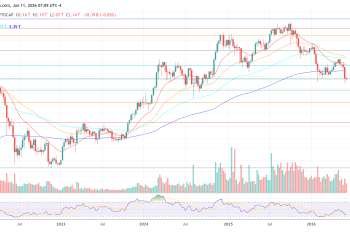
The 1-D chart shows GEMI’s 85% crash since its September public debut. Source: GEMI on TradingView.com

At the time of writing, the exchange’s stock, trading under the ticker symbol GEMI, was trading at $6.69. This represents a 7% drop in the past 24 hours and is over 85% below the stock’s all-time high of $45.90.

Featured image from OpenArt, chart from TradingView.com

Domande pertinenti

QWhat percentage of its workforce is Gemini cutting, and which major international markets is it exiting?

AGemini is cutting up to 25% of its workforce and is exiting the United Kingdom, the European Union, and Australia.

QWhat new area of focus did the Winklevoss twins cite as the reason for the company's restructuring?

AThe Winklevoss twins cited a new focus on prediction markets and AI-related operations as the reason for the restructuring.

QAccording to the founders, what were the main challenges that led to the decision to pull back from international markets?

AThe main challenges were a combination of regulatory hurdles and operational complexity in foreign jurisdictions.

QWhat is the name of Gemini's new prediction market platform, and what early adoption metrics were shared?

AThe platform is called Gemini Predictions. Early adoption metrics show over 10,000 users have participated, trading over $24 million since its mid-December debut.

QHow much has Gemini's stock (GEMI) fallen from its all-time high, and what was its price at the time of writing?

AAt the time of writing, the stock was trading at $6.69, which is over 85% below its all-time high of $45.90.

Letture associate

Can Generative Models Finally Be Trained End-to-End? The Core Is a For Loop

This article introduces a novel training paradigm for generative models called Explorative Modeling (XM), which enables true end-to-end training. Traditionally, powerful generative models like autoregressive and diffusion models are not trained end-to-end. They are trained to predict a single small step but require iterative multi-step sampling for inference. This "exposure bias" leads to error accumulation and limits performance. The core challenge XM addresses is "mode blurring." In generative tasks, a single input (e.g., "generate a dog") corresponds to many valid outputs (multiple modes). Standard training objectives like reconstruction loss force the model to average these modes, producing unrealistic, blurry outputs. To avoid this, existing models break generation into many small, almost deterministic steps, sacrificing end-to-end training. XM tackles this by restructuring the training loop itself. Its key insight is to amplify "generative expressivity." For each training input, instead of generating one sample, the model generates K candidate outputs. Only the candidate closest to the real data is used for computing the loss and updating the model via backpropagation. This simple "best-of-K" mechanism is implemented as a short for-loop. By exploring multiple possibilities, the model learns to distribute its guesses across different modes rather than collapsing to their uninformative average. The paper demonstrates that "exploration" acts as a new, powerful scaling axis. Gains from XM increase with model size, data scale, and compute. Experiments show improvements in FID scores for image generation and significant efficiency gains, sometimes outperforming larger models without exploration. When pushed to the limit, XM enables fully single-step, end-to-end generative models. In robotics tasks, an "Explorative Policy" matched the performance of a 100-step Diffusion Policy with a single forward pass, drastically improving inference speed. While the best-of-K concept is not entirely new, the authors' contribution lies in formally understanding it as a direct method to boost generative expressivity without fragmenting the generation process. This work suggests that as models scale, enhancing exploration during training may become crucial for overcoming fundamental performance bottlenecks.

marsbit49 min fa

Can Generative Models Finally Be Trained End-to-End? The Core Is a For Loop

marsbit49 min fa

Annual Salary of Millions Competing for Electricians, Meta Rushes to Open Its Own Technical School

The AI boom is facing an unexpected bottleneck: a severe shortage of skilled construction workers and electricians. As tech giants like Meta, OpenAI, and Alphabet race to build massive data centers—such as OpenAI's $16 billion "Stargate" project—they are hitting a critical labor wall. The U.S. needs an estimated 130,000 more electricians, 240,000 construction workers, and 150,000 supervisors by 2030 for AI infrastructure alone, but tens of thousands of electrician jobs go unfilled each year. While AI companies offer high premiums, with electricians earning up to $280,000 annually, worker scarcity still causes massive losses—delays on a single project can cost $14.2 million per month. The complexity of building AI data centers, which require immense power (equivalent to powering hundreds of thousands of homes), sophisticated electrical systems, and advanced liquid cooling solutions, demands highly skilled technicians who are in short supply. To combat this, companies are investing heavily in training. Meta has committed $115 million to a free training school offering tuition, housing, and stipends, targeting 5,000 new workers. OpenAI is partnering with unions to secure skilled labor. These efforts are paying off, with a significant rise in Gen Z interest in trade schools over college. However, the power demands are staggering. AI data centers are driving a rapid surge in electricity consumption, projected to account for up to 12% of U.S. power use by 2028 and raising costs for consumers. Furthermore, the construction boom is project-based, leading to a potential future glut of trained workers once building peaks, which could depress wages industry-wide. The race for AI supremacy now depends as much on skilled hands as on advanced chips.

marsbit2 h fa

Annual Salary of Millions Competing for Electricians, Meta Rushes to Open Its Own Technical School

marsbit2 h fa

Trading

Spot
活动图片