Winklevoss-Backed Zcash Treasury Company Suffers Huge Loss of $37.8 Million, Now Shifts to Making Anti-Cancer Drugs?

marsbitPubblicato 2026-08-14Pubblicato ultima volta 2026-08-14

Introduzione

The Nasdaq-traded crypto treasury company Cypherpunk Technologies, backed by the Winklevoss twins, reported a net loss of $37.8 million for the first half of 2026. Despite holding roughly $157 million worth of Zcash (ZEC), the company's market valuation is only about $74 million, trading at a significant discount to its holdings. Cypherpunk announced a strategic pivot to focus on its anti-cancer drug candidate, sirexatamab, which recently received FDA Fast Track designation but requires expensive Phase 3 trials. The company admits it will need to raise substantial capital to fund this development, as its remaining cash is limited. While the company's ZEC was acquired at an average price well below the current market rate, the token's flat price performance has not helped its financial situation. The stock has fallen 40% this year and 96% over five years. CEO Onsi indicated the company is exploring options to advance the drug candidate, potentially through a spin-off or partnership, highlighting the urgent need for new funding.

Author:Protos

Compiled by: Deep Tide TechFlow

Deep Tide Introduction: The Winklevoss-backed Zcash (ZEC) treasury company has a market value less than half its holdings and now relies on anti-cancer drugs to tell a new story. This exposes the common discount dilemma faced by listed crypto companies and also reminds ZEC investors to pay attention to corporate financing risks.

The Winklevoss-backed Zcash (ZEC) treasury company Cypherpunk Technologies announced plans to shift its focus to its anti-cancer drug candidate. The company reported a net loss of $37.8 million for the first six months of 2026.

The company admitted that unless ZEC prices rebound soon, it will need to raise significant funds to cover upcoming FDA trials.

The company projected today: "We expect to continue generating operating losses for the foreseeable future."

Cypherpunk holds ZEC worth approximately $157 million, but Nasdaq traders value the entire company at only $74 million.

This equates to a 0.47x multiple of its basic asset net value (mNAV). It's not surprising that crypto treasury stocks continue to trade below their holding value.

If pre-funded warrants and other sweeteners are included in the company's self-proclaimed enterprise value mNAV, the multiple on the front page rises to 0.96x—still below the value of its ZEC holdings.
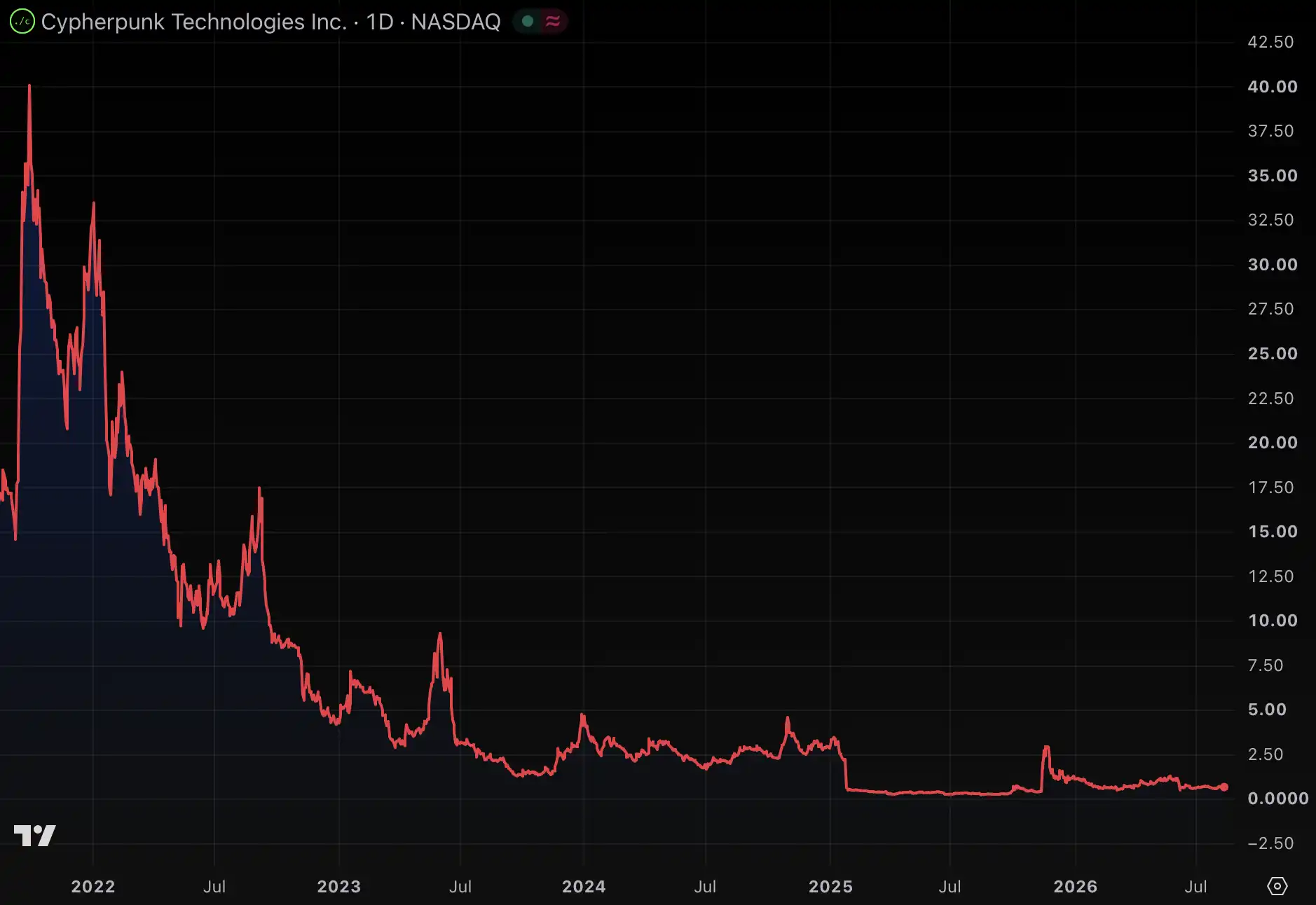
Chart: Cypherpunk Technologies five-year stock price chart. Source: TradingView

Backed by Cameron and Tyler Winklevoss

Cameron and Tyler Winklevoss are the billionaires who helped build the company's ZEC brand.

Initially, the company was successful, acquiring ZEC at an average purchase price of $341.84—well below the current market price of $486 for ZEC.

The company's stock reached $3.70 last November but has now fallen back below $0.69 per share.

Cypherpunk has lost tens of millions this year yet continues to plan an expensive FDA trial path for its anti-cancer drug. The stock is down 40% this year and 96% over the past five years.

The Winklevoss twins' controlled exchange Gemini is the custodian for the company's ZEC.

Anti-Cancer Trials Are More Costly, ZEC Can't Help

Cypherpunk's anti-cancer drug candidate is the anti-DKK1 antibody Sirexatamab. In a randomized Phase 2 study, it failed to outperform the control group in progression-free survival across all patients.

The company attributed this to insufficient power in the final analysis.

On the digital asset treasury side, ZEC prices have been flat year-to-date, so that hasn't helped either.

The FDA still granted the drug candidate Fast Track designation in May, a status that expedites regulatory review. Regulators also agreed to a Phase 3 trial protocol for colorectal cancer involving approximately 270 patients.

Onsi stated that the company is "conducting a strategic process to decide the best path forward for sirexatamab: either as a spun-out company with separate financing or moving forward with a partner equally committed to cancer patients."

In simple terms, this candidate needs more money.

Tyler Winklevoss wrote at launch: "We plan to continue accumulating ZEC rapidly, aiming for Cypherpunk to hold at least 5% of the total ZEC supply."

Nine months later, the company now holds 323,394 ZEC, representing 1.92% of the circulating supply.

As of June 30, the company had only $7.6 million in cash and cash equivalents, $500 million in accumulated deficit, ongoing loss-making operations, and an expensive path to FDA approval for an idealistic drug.

Domande pertinenti

QWhat significant strategic shift did Cypherpunk Technologies announce?

ACypherpunk Technologies announced a strategic shift to focus on its anti-cancer candidate drug, Sirexatamab, moving away from its core business as a Zcash (ZEC) treasury.

QHow much was Cypherpunk's net loss for the first half of 2026, and what is the primary challenge linked to this loss?

ACypherpunk reported a net loss of $37.8 million for the first six months of 2026. The primary challenge is that unless the price of ZEC rebounds soon, the company will need to raise significant capital to fund upcoming FDA trials for its cancer drug.

QWhat discrepancy exists between Cypherpunk's ZEC holdings value and its market valuation on Nasdaq?

ACypherpunk's ZEC holdings are valued at approximately $157 million, but the company's total market valuation on Nasdaq is only $74 million, representing a market net asset value (mNAV) multiple of just 0.47 times its underlying assets.

QWhat role did Cameron and Tyler Winklevoss play in relation to Cypherpunk Technologies?

ACameron and Tyler Winklevoss are billionaire investors who helped establish the company's ZEC brand. Their exchange, Gemini, serves as the custodian for Cypherpunk's ZEC holdings.

QWhat is the status and challenge regarding Cypherpunk's anticancer drug candidate, Sirexatamab?

ASirexatamab failed to outperform the control group in a randomized Phase 2 study for progression-free survival, though the company attributed this to insufficient statistical power. The FDA has granted it Fast Track designation and agreed to a Phase 3 trial plan. The major challenge is that advancing this drug through FDA approval requires substantial additional funding.

Letture associate

Report: Bank of Japan Could Raise Interest Rates as Early as September, with Subsequent Pace Possibly Accelerating

According to Reuters, the Bank of Japan (BOJ) faces mounting pressure to raise interest rates, with a potential hike as early as September. Sources familiar with the internal discussions indicate the central bank is considering accelerating its tightening pace beyond the current schedule of roughly two increases per year. The September 17-18 policy meeting is now viewed as a critical juncture, with market pricing suggesting an approximately 80% probability of a rate hike. This would mark a third increase for 2024, potentially shifting expectations toward a quarterly tightening cycle. Key drivers behind this hawkish shift are multifaceted inflation risks. A persistently weak yen, near a 40-year low, continues to push up import costs. High wholesale prices at a three-year peak signal pending cost pass-through to consumers. Furthermore, inflation expectations among households, businesses, and economists are nearing or exceeding the BOJ's 2% target, raising concerns about de-anchoring. External factors, including energy price volatility from Middle East conflicts and strong global AI-related demand, add further upward pressure. Internal BOJ communications reveal a growing urgency. The July policy meeting summary showed some board members advocating for faster action to avoid "falling behind the curve." Governor Kazuo Ueda acknowledged the need to consider these heightened inflation risks, suggesting the pace of hikes could be increased if financial conditions are deemed too loose. This sentiment underscores a decisive shift within the BOJ toward preemptive monetary tightening.

marsbit31 min fa

Report: Bank of Japan Could Raise Interest Rates as Early as September, with Subsequent Pace Possibly Accelerating

marsbit31 min fa

To Counter Quantum Threat, Ethereum Abandons Poseidon and Switches to Traditional Hashes

On August 13th, Ethereum researcher Justin Drake announced a strategic pivot in the face of the quantum computing threat: the Ethereum Foundation will abandon the SNARK-friendly hash function Poseidon at the L1 level in favor of traditional hash functions like SHA2 or BLAKE2. This decision, informed by eight years of research, represents a major shift in Ethereum's post-quantum cryptography roadmap. Poseidon, introduced in 2019, has been favored for zkRollups and zkVMs due to its efficiency within SNARK circuits. However, its shorter cryptographic history and analysis timeline became liabilities when post-quantum security became a critical requirement. The change is enabled by breakthroughs in SNARK design, particularly the adoption of "binary field" arithmetic. This allows traditional hash functions (which rely heavily on bitwise operations) to be verified efficiently in SNARKs, with recent benchmarks achieving millions of hashes per second on a laptop. Another key driver is the accelerating timeline of the quantum threat. Reports warn that "Cryptographically Relevant Quantum Computers" (CRQCs) could break current public-key cryptography (like ECDSA) as early as the 2030s, risking trillions in on-chain assets. The enhanced cryptanalysis capabilities of AI have also weakened some post-quantum candidates, pushing Ethereum towards hash-based schemes, deemed more quantum-resistant. Ethereum's post-quantum deployment plan aims for a production-ready leanVM by 2027, followed by full deployment across the consensus, execution, and data availability layers by 2028. This leanVM will aggregate numerous large post-quantum signatures into a single compact proof per block. Other major blockchains are also preparing. Solana's core developers have independently chosen the NIST-standardized Falcon signature scheme for their post-quantum roadmap. Starknet has outlined a multi-phase plan, starting with replacing its Pedersen hash with BLAKE2. By moving from the specialized Poseidon to the battle-tested SHA2/BLAKE2, Ethereum is opting for mature, widely analyzed cryptographic primitives, prioritizing long-term security assurance in the quantum era.

marsbit58 min fa

To Counter Quantum Threat, Ethereum Abandons Poseidon and Switches to Traditional Hashes

marsbit58 min fa

Trading

Spot
活动图片