Will Trump Announce the New Fed Chair on the Night of the Fed Decision?

比推Pubblicato 2026-01-28Pubblicato ultima volta 2026-01-28

Introduzione

On January 29, 2026, the Federal Reserve is expected to announce its decision to keep interest rates unchanged, with market consensus nearly 100%. While this outcome is widely anticipated, the focus will be on Chair Jerome Powell’s post-announcement press conference for signals on future monetary policy. Investors are divided over whether the Fed will continue its rate-cutting cycle later in the year or adopt a more hawkish stance due to persistent inflation, which remains at 2.8%, above the 2% target. A key uncertainty is the potential announcement of a new Fed Chair nominee by former President Donald Trump, who has hinted at a January reveal. The shortlist includes Rick Rieder (currently the most probable candidate at 47%), Kevin Warsh, Christopher Waller, and Kevin Hassett. Trump may use the FOMC meeting timing to divert market attention from any hawkish signals from Powell, instead promoting a dovish nominee to reassure markets. The new composition of the voting members on the Fed’s rate-setting committee also leans more hawkish this year, which could influence future decisions regardless of the new Chair’s stance. The outcome of Powell’s remarks and a possible Trump announcement could significantly impact market sentiment.

Author: Golem

Original Title: On the Eve of the Storm: Powell Holds Rates, Trump Announces New Fed Chair?


At 3:00 AM Beijing time on January 29 (this Thursday), the Federal Reserve is set to announce its first interest rate decision of 2026; half an hour later, current Fed Chair Jerome Powell will hold a monetary policy press conference. However, there is little suspense around this Fed rate decision, as the market widely expects the Fed to keep rates unchanged. Polymarket data shows the probability of holding rates steady is close to 100%.
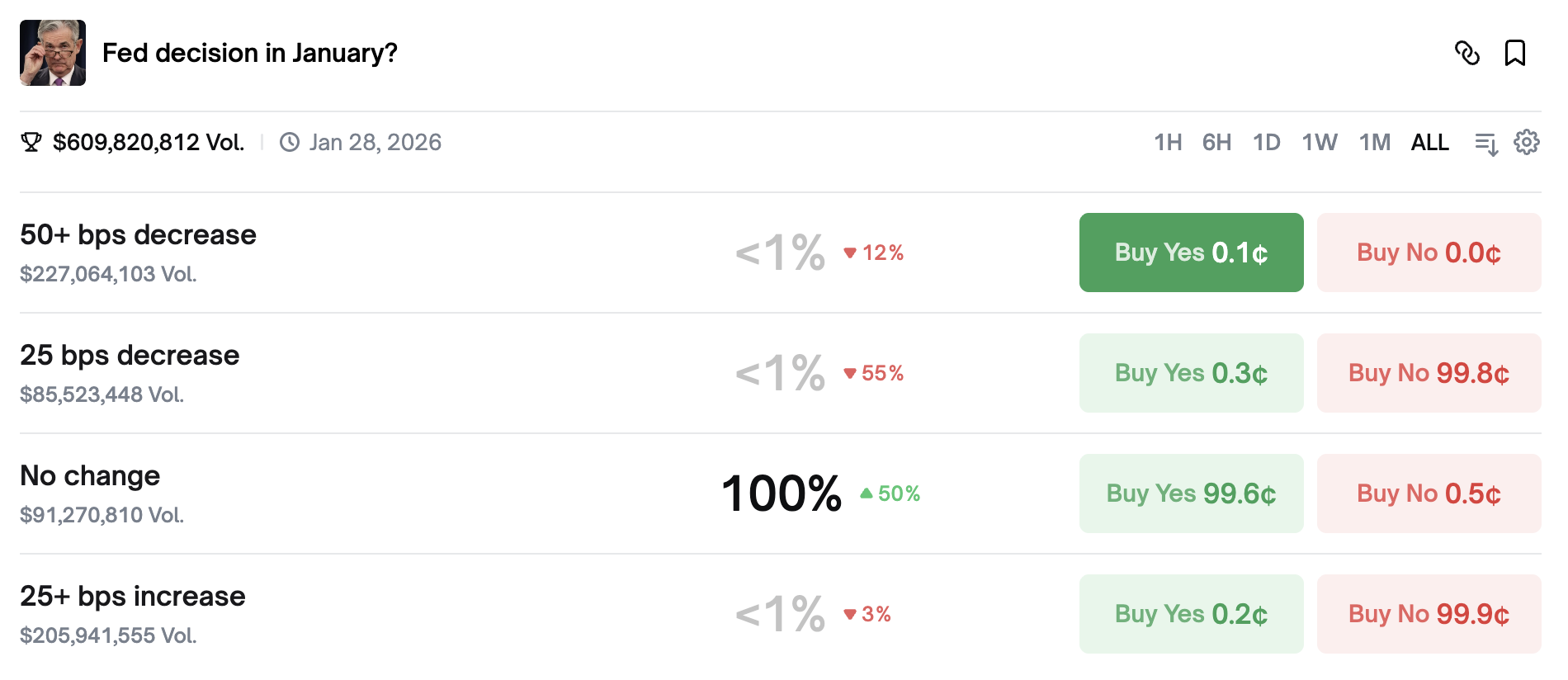
Such a high probability has allowed the market to提前消化 (price in) the negative impact of the Fed's "no rate cut" announcement this time. OKX data shows that BTC has fallen only 0.39% in the past 7 days, basically hovering sideways, but this period of market "silence" might be broken tonight.

On one hand, although the market almost unanimously believes the Fed will hold rates this week, there is significant divergence regarding the fiscal path for the remainder of 2026, making this still an important meeting to watch. The Fed's future key policy tendencies—whether it will continue cutting rates in 2026, the frequency of cuts, etc.—will affect the market. If Powell makes hawkish remarks during his speech, such as "need to continue observing," the market might "fall in response."

On the other hand, the announcement of the successor to the Fed Chair will also have a long-term impact on the market. The shortlist has been narrowed down to four people. Trump previously stated he has a preferred candidate but is waiting for the right time to announce, and this suitable time could very well be tonight.

2026 Rate Cut Direction Still Uncertain

Since last September, the Fed initiated a new rate-cutting cycle, conducting three consecutive rate cuts. If rates are held unchanged this week, it would be the first pause since the cycle began. At this point, the market is concerned not with the reason for holding rates, but whether this is a brief pause to observe or the start of a prolonged pause in rate cuts, or even the beginning of a rate hike cycle?

Previously, the prevailing market view was that 2026 would be a year of further quantitative easing by the Fed.

Reason one, from a data perspective, the US labor market indeed shows signs of weakness. Non-farm payrolls increased by only 50,000 in December 2025, with an unemployment rate of 4.4%. While there hasn't been "massive layoffs," it remains in a state of "low hiring, cooling demand." Reason two, the Fed might still believe Trump's tariff policies won't have a long-term impact on inflation (Odaily: Powell cited this factor for a rate cut in September 2025). Reason three, Trump has publicly stated he will choose a "dovish" figure as the next Fed Chair.

However, some in the market believe there is uncertainty about the Fed continuing rate cuts in 2026. Some analysts think that unless the job market deteriorates significantly, it will be difficult to see rate cuts before mid-year, as the pace of inflation decline is not sufficient to convince hawkish members.

The Fed's mandate, simply put, is to curb inflation and promote employment. However, in 2025, the US experienced a phenomenon of a weak labor market coexisting with high inflation. The Fed ultimately chose to prioritize the employment issue, hence initiating the rate-cutting cycle. Yet, the reality is that the US inflation rate remains stuck at 2.8%, far above the Fed's 2% target, forcing the Fed to reconsider the impact of tariffs on inflation. Holding rates this week would also indicate the Fed is starting to "observe."

Furthermore, although the next Fed Chair chosen by Trump is destined to be "dovish," the new rotating chairs of the Fed's interest rate-setting committee are predominantly "hawkish." At the beginning of each year, four of the 12 regional Fed presidents rotate onto the interest rate-setting committee and gain voting rights for the next eight policy meetings. This year's rotating list includes Dallas Fed President Lorie Logan, Cleveland Fed President Loretta Mester (referred to as Hamack in the text, likely a transliteration for Mester), Philadelphia Fed President Patrick Harker (referred to as Paulson in the text, likely a transliteration for Harker), and Minneapolis Fed President Neel Kashkari.

Among them, Logan and Mester are seen as "hawkish" figures, both having previously publicly stated the Fed should focus on inflation. Harker is seen as "dovish," having expressed "cautious optimism" about inflation. Kashkari's stance is relatively neutral. The addition of new "hawkish" members might disrupt the previous balance of policy倾向 within the Fed. Even if Trump chooses a "dovish" Chair, they cannot single-handedly sway the entire interest rate-setting committee.

Moreover, the Fed Chair might not completely follow Trump's wishes in主导降息 (leading rate cuts). Years ago, Trump personally appointed Powell as Fed Chair, but last year, even though Trump promoted Powell, Powell did not "repay" Trump with sustained, significant rate cuts. Under US law, the Fed is independent and can make interest rate decisions based on the economic situation, not government wishes. Therefore, even if the new Fed Chair verbally promises Trump to cut rates, they might "go their own way" after taking office.

This kind of meaningless "political promise" is also a concern for Trump. Last week, Trump said in a speech at the World Economic Forum in Davos, Switzerland, "It's amazing how people change once they get that job," meaning candidates "say nice things during the interview" but emphasize their independence once confirmed.

Considering these factors, Powell's speech after tonight's FOMC meeting will also be closely watched by investors for hints on how long the Fed might pause rate cuts.

This Week's FOMC Meeting Could Be One of the Best Times for Trump to Announce the Fed Chair Successor

Besides this week's FOMC meeting, the Fed Chair successor is another macro event that can influence the market. The candidates have been narrowed down to Kevin Hassett, Kevin Warsh, Rick Rieder, and Christopher Waller. According to Polymarket data, Rick Rieder currently has the highest probability of being nominated by Trump at 47%; Kevin Hassett has the lowest probability at 6%.
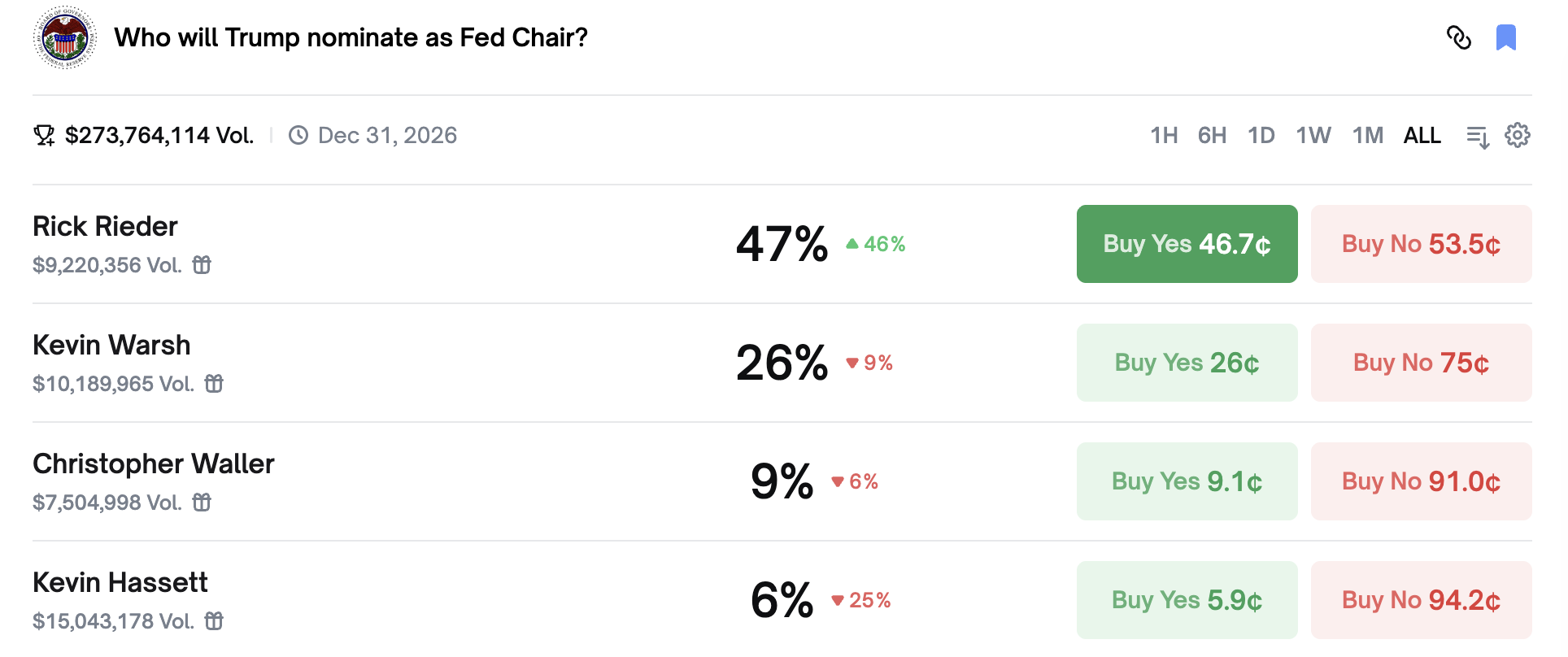
Rick Rieder is BlackRock's Chief Investment Officer of Global Fixed Income. Although he doesn't have much government experience, he has consistently advocated for supporting low interest rates based on his understanding of the market rather than politics. This resume might attract Trump, who is worried about the new Fed Chair becoming "disobedient" upon taking office. Economists at Evercore ISI, including Krishna Guha, even believe "if Rick Rieder becomes the new Fed Chair, he might advocate for three rate cuts this year." (Odaily Note: For more information on Rick Rieder, read 《The Last Seat on the Fed Chair Candidate List, What is Rick Rieder's Attitude Towards Crypto?》)

Hassett was once considered the most likely candidate for the new Fed Chair, with probability一度 (once) exceeding 80%. But Hassett is Trump's economic advisor. Previously,外界质疑 (outside doubts emerged) that if Trump nominated Hassett, it would damage the Fed's independence. Additionally, Trump publicly stated he didn't want to lose Hassett within his administration. Therefore, Hassett's probability of selection declined, though some still believe his nomination probability is higher than 6%.

Trump has repeatedly publicly stated he would announce his nominee in January. In late December 2025, Trump told reporters in Florida he would announce the next Fed Chair人选 (candidate) sometime in January; On January 14, 2026, Trump said in an interview with Reuters he would announce the candidate within the next few weeks; Two weeks later, on January 27, Trump said in Iowa he would announce the new Fed Chair candidate soon, but has not done so yet.

Although Trump's answers are vague each time, it's certain that the probability of an announcement in January is very high. It's even highly possible that the best time to announce is during this week's FOMC meeting.

As mentioned earlier, Powell's speech tonight will be a key focus for investors. If Powell does not make dovish-leaning remarks, financial markets might suffer a blow, a scenario Trump显然不愿见到 (obviously does not want to see). Therefore, if Trump wants to shift market attention away from the uncertain Powell, he might announce his nominee for the next Fed Chair during tonight's FOMC meeting. This would release the positive news of a "dovish chair" to the market, reducing attention on Powell's speech or mitigating potential negative market impacts.

Tonight, let's wait and see!


Twitter:https://twitter.com/BitpushNewsCN

BitPush TG Discussion Group:https://t.me/BitPushCommunity

BitPush TG Subscription: https://t.me/bitpush

Original article link:https://www.bitpush.news/articles/7606677

Crypto di tendenza

Domande pertinenti

QWhat is the market's expectation for the Federal Reserve's interest rate decision on January 29, 2026?

AThe market widely expects the Federal Reserve to maintain the current interest rate, with the probability of no change being close to 100% according to Polymarket data.

QWhy might the Federal Reserve's decision to pause rate cuts in January 2026 be significant despite the high expectation of no change?

AIt is significant because there is considerable divergence in the market's expectations for the Fed's monetary policy path for the rest of 2026, including the frequency of potential future rate cuts. This makes it an important meeting for gauging future policy direction.

QWho are the four candidates reportedly shortlisted by Trump for the next Federal Reserve Chair, and who is the current favorite according to prediction markets?

AThe four candidates are Kevin Hassett, Kevin Warsh, Rick Rieder, and Christopher Waller. According to Polymarket data, Rick Rieder currently has the highest probability of being nominated at 47%.

QWhat reason does the article suggest for why Trump might announce his Fed Chair nominee during the FOMC meeting?

AThe article suggests Trump might announce the nominee during the FOMC meeting to shift market attention away from potentially hawkish comments by Chair Powell. This could help mitigate any negative market reaction by instead highlighting the promise of a future dovish Chair.

QWhat are the two main factors cited that create uncertainty about the Fed's ability to continue its rate-cutting cycle in 2026?

AThe two main factors are: 1) Stubbornly high inflation, which remains at 2.8%, well above the Fed's 2% target, causing the Fed to reassess the impact of tariffs. 2) The annual rotation of voting members on the rate-setting committee, which has introduced new hawkish members who may disrupt the previous policy balance.

Letture associate

Must-Watch Events Next Week|CLARITY Act Could Face Senate Vote; SpaceX, Circle to Report Earnings (8.3-8.9)

**Summary: Key Events and Developments to Watch (August 3-9)** The upcoming week is marked by significant financial disclosures, key legislative deadlines, and notable product updates. **Major Financial Events:** Several companies are scheduled to release their Q2 2026 earnings. American Bitcoin (ABTC) will report on August 3, followed by SpaceX and Hut 8 Mining Corp. on August 4, and Circle on August 5. Notably, a significant portion of SpaceX shares (up to 12% of total shares) will be unlocked on August 6 following their earnings release. **Key Legislative Deadline:** The U.S. Senate faces an August 7 deadline to secure 60 votes for the CLARITY Act, a bipartisan bill aiming to establish a federal regulatory framework for cryptocurrencies. The Senate may hold a full vote on the bill during the week. **Economic Data:** The U.S. July Non-Farm Payrolls report will be released on August 7, providing crucial labor market data. **Technology & Product Updates:** * **Shutdowns:** DeFi portfolio tracker Zapper and wallet app Ctrl Wallet will cease operations on August 3. * **Upgrades:** LayerZero will deprecate its v1 relayers on August 3. XRP Ledger's new version 3.3.0, featuring five new functions, is expected next week. * **AI:** Elon Musk announced that the advanced Grok 4.6 AI model is set for release around August 7. * **Bitcoin:** The BIP-110 forced signaling for a potential Bitcoin network change is scheduled to begin around August 8. **Other Notable Events:** Chinese robotics firm Unitree Tech has set its preliminary price inquiry for its IPO for August 5. South Korean exchange Upbit will delist AQT and AERGO tokens on August 3.

marsbit1 h fa

Must-Watch Events Next Week|CLARITY Act Could Face Senate Vote; SpaceX, Circle to Report Earnings (8.3-8.9)

marsbit1 h fa

Stocks Are Plummeting More Sharply Than Cryptocurrencies. Where Has the Money Gone?

Stock Markets Plunge Deeper Than Cryptocurrencies: Where Did the Money Go? In late July, Seoul's Kospi index triggered circuit breakers for two consecutive days, plummeting over 40% from its June high. The collapse was led by heavyweight stocks like SK Hynix, whose record profits still disappointed investors, and devastating leveraged ETFs, with one major product losing over 83% of its value. This signaled a global, forced deleveraging targeting the most crowded trades. Interestingly, while stocks exhibited extreme volatility akin to crypto markets, Bitcoin rose nearly 15% in July after a prior steep drop. Analysis shows the money fleeing equities did not flow into Bitcoin. Instead, Bitcoin had already absorbed its sell-off in May-June, when U.S. spot Bitcoin ETFs saw historic outflows. The true safe-haven beneficiary was gold, whose price rose over 20% year-on-year, highlighting a decoupling between Bitcoin and gold as "digital gold." The sell-off was a targeted unwinding of leveraged positions in tech and semiconductors, accelerated by broker-dealer risk management and shifts in the AI narrative, including new competition from Chinese memory chipmakers. The retreat path was clear: from high-valuation tech stocks to cash and U.S. Treasuries, then to gold. For Bitcoin to attract sustained institutional inflows, conditions like eased global liquidity pressure, a "soft-landing" Fed rate cut, and U.S. regulatory clarity via legislation like the stalled CLARITY Act are needed. Currently, Bitcoin is not a safe haven but an already-cleared asset. Its low correlation with tech stocks, however, makes it a potential diversification play for institutional portfolios once the storm passes. The money isn't here yet, but the positioning is underway.

marsbit1 h fa

Stocks Are Plummeting More Sharply Than Cryptocurrencies. Where Has the Money Gone?

marsbit1 h fa

In Conversation with Ray Dalio: We Are Currently in an AI Bubble, with 1% of My Portfolio in Bitcoin

Ray Dalio, founder of Bridgewater Associates, warns in an interview that the current AI boom shows classic bubble characteristics, which could lead to significant economic downturns as seen in past cycles like 1929 or 2000. He explains that speculative enthusiasm, fueled by debt and overvaluation, often precedes a crash when rising rates or taxation force asset sales, causing widespread losses and recession. Dalio also outlines his "Big Cycle" theory, describing an approximate 80-year pattern where widening wealth gaps, massive government deficits, and shifting geopolitical power (like China's rise) create internal conflict and global instability. He emphasizes that we are in a late-cycle, transitional phase where traditional powers like the US and UK face decline. For personal wealth protection, Dalio advises diversification beyond cash into assets like stocks, bonds, real estate, and particularly gold, which he prefers over Bitcoin. While he holds about 1% of his portfolio in Bitcoin as a non-printable hard asset, he views gold as more secure from technological or governmental threats. Regarding AI's impact, Dalio believes it will disproportionately benefit capital owners, worsening inequality by replacing both physical and cognitive labor. He suggests that human intuition and emotional intelligence, combined with AI, will be key for future workers. On taxation, Dalio argues that wealth taxes are impractical and risk triggering asset sell-offs, reducing productive investment. He points to the UK as a cautionary example of debt, low productivity, and political strife. Geopolitically, Dalio foresees a more regionalized world, with the US showing weakness in prolonged conflicts like with Iran, akin to past imperial declines. The ideal outcome, he suggests, is coexisting powerful blocs (e.g., Americas, China-Asia Pacific) without major war.

marsbit5 h fa

In Conversation with Ray Dalio: We Are Currently in an AI Bubble, with 1% of My Portfolio in Bitcoin

marsbit5 h fa

Trading

Spot

Articoli Popolari

Come comprare NIGHT

Benvenuto in HTX.com! Abbiamo reso l'acquisto di Midnight (NIGHT) semplice e conveniente. Segui la nostra guida passo passo per intraprendere il tuo viaggio nel mondo delle criptovalute.Step 1: Crea il tuo Account HTXUsa la tua email o numero di telefono per registrarti il tuo account gratuito su HTX. Vivi un'esperienza facile e sblocca tutte le funzionalità,Crea il mio accountStep 2: Vai in Acquista crypto e seleziona il tuo metodo di pagamentoCarta di credito/debito: utilizza la tua Visa o Mastercard per acquistare immediatamente MidnightNIGHT.Bilancio: Usa i fondi dal bilancio del tuo account HTX per fare trading senza problemi.Terze parti: abbiamo aggiunto metodi di pagamento molto utilizzati come Google Pay e Apple Pay per maggiore comodità.P2P: Fai trading direttamente con altri utenti HTX.Over-the-Counter (OTC): Offriamo servizi su misura e tassi di cambio competitivi per i trader.Step 3: Conserva Midnight (NIGHT)Dopo aver acquistato Midnight (NIGHT), conserva nel tuo account HTX. In alternativa, puoi inviare tramite trasferimento blockchain o scambiare per altre criptovalute.Step 4: Scambia Midnight (NIGHT)Scambia facilmente Midnight (NIGHT) nel mercato spot di HTX. Accedi al tuo account, seleziona la tua coppia di trading, esegui le tue operazioni e monitora in tempo reale. Offriamo un'esperienza user-friendly sia per chi ha appena iniziato che per i trader più esperti.

369 Totale visualizzazioniPubblicato il 2025.12.08Aggiornato il 2026.06.02

Come comprare NIGHT

Discussioni

Benvenuto nella Community HTX. Qui puoi rimanere informato sugli ultimi sviluppi della piattaforma e accedere ad approfondimenti esperti sul mercato. Le opinioni degli utenti sul prezzo di NIGHT NIGHT sono presentate come di seguito.

活动图片













