Will Bitcoin Return to $10,000? The Harsh Hypothesis from a Bloomberg Strategist Amid a Deflationary Cycle

marsbitPubblicato 2025-12-16Pubblicato ultima volta 2025-12-16

Introduzione

Bitcoin faces mounting pressure, breaking below $90,000 and testing lows around $86,000, with most major cryptocurrencies also declining. Bloomberg Intelligence senior commodity strategist Mike McGlone presents a bearish outlook, suggesting Bitcoin could fall to $10,000 by 2026. He attributes this potential decline to a macro shift from inflation to deflation, where risk assets like Bitcoin may undergo significant repricing. McGlone emphasizes that Bitcoin is highly correlated with risk appetite and speculative cycles. He points to three key factors: mean reversion after extreme wealth creation, the Bitcoin/Gold ratio (which has already declined from over 30x to around 21x), and systemic oversupply of speculative crypto assets competing for limited risk capital. Not all analysts agree. Standard Chartered has revised its Bitcoin forecast downward but still expects prices around $100,000 in 2025. Glassnode notes current market stress resembles early 2022 conditions, while 10x Research warns that Bitcoin may be in the early stages of a bear market. The broader macro environment remains critical. Upcoming central bank decisions and economic data from the U.S., Europe, and Japan may determine whether deflationary pressures intensify, influencing risk assets globally. The Fed's recent rate cut and internal dissent highlight deepening policy uncertainty, making macro trends a decisive factor for Bitcoin's trajectory.

Over the past weekend, the crypto market did not see a sentiment recovery. After several days of narrow-range fluctuations, Bitcoin came under significant pressure from Sunday evening into Monday's U.S. trading session, falling below the $90,000 mark, with its price briefly touching around $86,000 at the lowest point. ETH dropped 3.4% to $2,980; BNB fell 2.1%; XRP declined 4%; SOL decreased 1.5%, retreating to around $126. Among the top ten cryptocurrencies by market cap, only TRX recorded a slight increase of less than 1%, while the rest were in a correction phase.
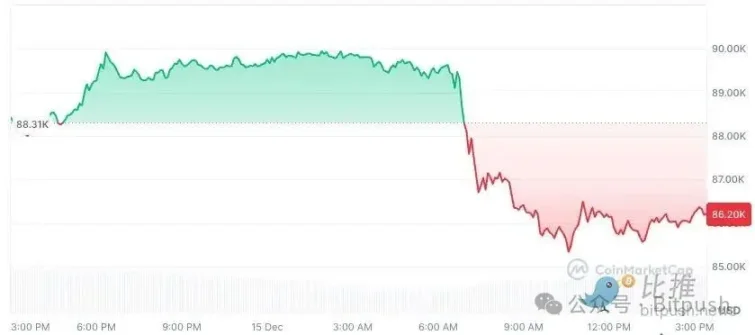
From a time perspective, this is not an isolated adjustment. Since hitting a new all-time high in mid-October, Bitcoin has accumulated a pullback of over 30%, with each rebound appearing brief and hesitant. Although ETF funds have not seen systematic outflows, marginal inflows have significantly slowed, making it difficult to provide the "sentiment foundation" for the market as before. The crypto market is transitioning from one-sided optimism to a more complex and patience-testing phase.

Against this backdrop, Mike McGlone, Senior Commodity Strategist at Bloomberg Intelligence, released a latest report, placing Bitcoin's current trend within a broader macro and cyclical framework and presenting a highly unsettling judgment: Bitcoin is highly likely to return to $10,000 by 2026. This is not alarmist but one of the potential outcomes under a special "deflationary" cycle.

The reason this view has sparked significant controversy is not just because the figure itself is "too low," but because McGlone does not treat Bitcoin as an independent crypto asset. Instead, he reexamines it within the long-term coordinate system of "global risk assets—liquidity—wealth regression."
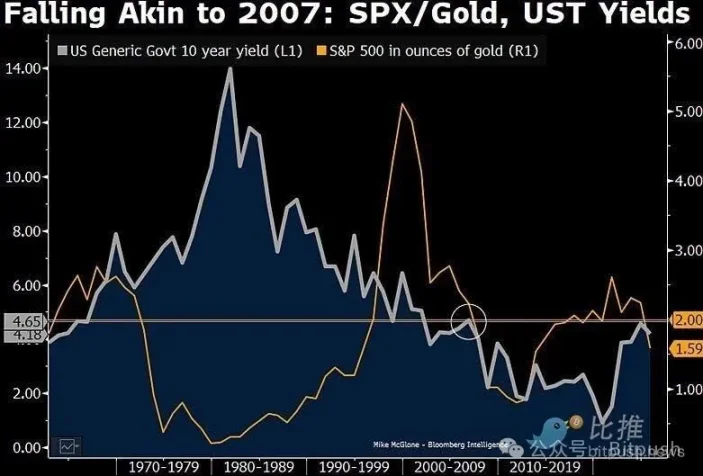
"Deflation After Inflation"? McGlone Focuses Not on Crypto but on the Cycle Inflection Point

To understand McGlone's judgment, the key does not lie in how he views the crypto industry but in how he interprets the next phase of the macro environment.

In his latest perspective, McGlone repeatedly emphasizes a concept: Inflation / Deflation Inflection (the turning point from inflation to deflation). In his view, global markets are near such a critical juncture. As inflation peaks in major economies and growth momentum slows, asset pricing logic is shifting from "fighting inflation" to coping with "deflation after inflation"—the phase of comprehensive price declines following the end of the inflation cycle. He writes: "Bitcoin's decline may resemble the stock market's response to Fed policy in 2007."

This is not the first time he has issued a bearish warning. As early as last November, he predicted Bitcoin would fall to the $50,000 mark.
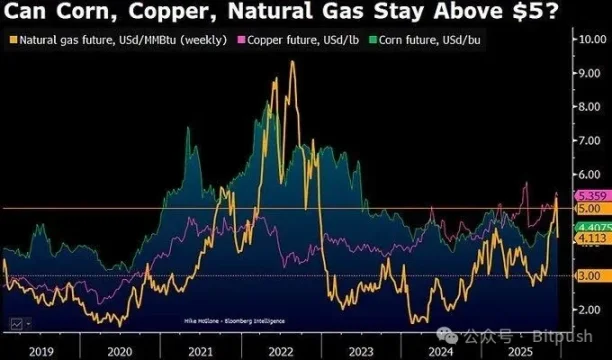
He points out that by around 2026, commodity prices may fluctuate around a key pivot—the "inflation-deflation demarcation line" for core commodities like natural gas, corn, and copper might settle near $5. Among these, only copper, with its genuine industrial demand support, might still stand above this pivot by the end of 2025.

McGlone notes: When liquidity recedes, the market will重新区分 (redistinguish) "real demand" from "financialization premium." In his framework, Bitcoin is not "digital gold" but an asset highly correlated with risk appetite and speculative cycles. When the inflation narrative recedes and macro liquidity tightens, Bitcoin tends to reflect this change earlier and more sharply.

In McGlone's view, his logic is not based on a single technical level but the叠加 (superposition) of three long-term paths.

First, mean reversion after extreme wealth creation. McGlone has long emphasized that Bitcoin is one of the most extreme wealth amplifiers under the global宽松货币环境 (loose monetary environment) of the past decade. When asset price growth long outstrips实体经济增长 (real economic growth) and cash flow growth, the regression is not温和 (gentle) but剧烈 (violent). Historically, whether it was U.S. stocks in 1929 or the tech bubble in 2000, the commonality of the top phase was: the market repeatedly sought a "new paradigm" at highs, and the eventual adjustment幅度 (magnitude) often far exceeded the most pessimistic expectations at the time.

Second, the relative pricing relationship between Bitcoin and gold. McGlone特别强调 (particularly emphasizes) the Bitcoin/Gold ratio. This ratio was about 10x at the end of 2022, then expanded rapidly driven by the bull market, reaching over 30x in 2025. But this year, the ratio has fallen about 40%, dropping to around 21x. In his view, if deflationary pressures persist and gold remains firm due to safe-haven demand, a further return of the ratio to its historical range is not an激进假设 (aggressive assumption).
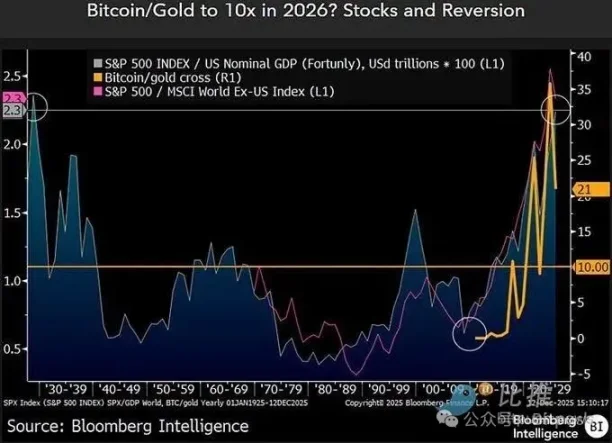
Third, systemic issues in the supply environment of speculative assets. Although Bitcoin itself has a clear supply cap, McGlone has多次指出 (repeatedly pointed out) that what the market is truly trading is not Bitcoin's "uniqueness" but the risk premium of the entire crypto ecosystem. When millions of tokens, projects, and narratives compete for the same risk budget, the entire sector tends to be uniformly discounted in a deflationary cycle, and Bitcoin can hardly完全脱离 (completely detach from) this revaluation process.

It should be noted that Mike McGlone is not a bull/bear spokesperson for the crypto market. As a senior commodity strategist at Bloomberg, he has studied the cyclical relationships between crude oil, precious metals, agricultural products, interest rates, and risk assets for a long time. His predictions are not always precisely timed, but their value lies in: he often raises structural contrarian questions when market sentiment is most consensus-driven.

In his latest remarks, he also主动复盘 (actively reviewed) his "errors," including underestimating the timing of gold breaking through $2,000 and misjudging the节奏 (rhythm) of U.S. Treasury yields and U.S. stocks. But in his view, these deviations反而反复印证 (instead repeatedly confirm) one point: the market is most prone to illusions about trends before cyclical inflection points.

Other Voices: Divergence Is Widening

Of course, McGlone's judgment is not market consensus. In fact, mainstream institutions' attitudes show clear分化 (divergence).

Traditional financial institutions like Standard Chartered have recently significantly lowered their medium-to-long-term target price for Bitcoin, reducing the 2025 expectation from $200,000 to about $100,000, and also adjusting the 2026 imagination space from $300,000 to about $150,000. In other words, institutions no longer assume that ETFs and corporate allocations will持续提供边际买盘 (continuously provide marginal buying) at any price range.

Research from Glassnode points out that Bitcoin's current fluctuation range between $80,000 and $90,000 has already put pressure on the market, with intensity comparable to the trend at the end of January 2022. The current market's relative unrealized loss has approached 10% of the market cap. Analysts further explain that such market dynamics reflect a state of "liquidity constraints, sensitivity to macro shocks," but it has not yet reached the level of typical bear market彻底抛售 (panic selling).
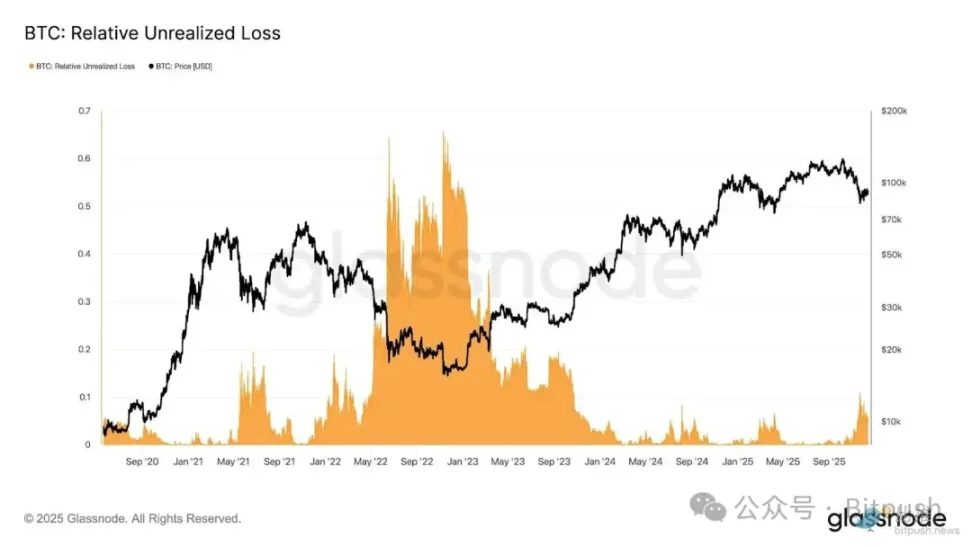
More quantitative and structure-focused 10x Research offers a more direct conclusion: they believe Bitcoin has entered the early stages of a bear market, with on-chain indicators, fund flows, and market structure all indicating that the downward cycle has not yet reached its end.

From a broader time dimension, the current uncertainty surrounding Bitcoin is no longer an issue of the crypto market itself but is firmly embedded in the global macro cycle. The upcoming week is被视为 (seen as) the most critical macro window period of the year-end by multiple strategists—the European Central Bank, the Bank of England, and the Bank of Japan will announce interest rate decisions successively, while the U.S. will迎来 (welcome) a series of delayed employment and inflation data. These data will provide a belated "reality check" for the market.

The Fed's FOMC meeting on December 10 had already released an unusual signal: not only did it cut rates by 25 basis points, but there were also three dissenting votes, and Powell直言 (stated bluntly) that job growth in previous months might have been overestimated. The密集出炉 (intensive release) of macro data this week will重塑 (reshape) the market's core expectations for 2026—whether the Fed can continue to cut rates or will have to press the pause button for a longer period. For risk assets, this answer might be more important than any bull-bear debate on a single asset.


Crypto di tendenza

Domande pertinenti

QWhat is the main argument made by Bloomberg Intelligence senior commodity strategist Mike McGlone regarding Bitcoin's price?

AMike McGlone argues that Bitcoin could potentially fall back to $10,000 by 2026, citing a potential global deflationary cycle following the inflation period as the primary reason. He views Bitcoin not as 'digital gold' but as a risk-on asset highly correlated with speculative cycles and liquidity conditions.

QAccording to the article, what key macroeconomic concept does McGlone emphasize to support his bearish view on Bitcoin?

AMcGlone emphasizes the concept of 'Inflation / Deflation Inflection,' suggesting that global markets are near a turning point where the pricing logic for assets is shifting from fighting inflation to dealing with deflationary pressures after inflation has peaked.

QWhat specific ratio does McGlone use to analyze Bitcoin's relative valuation, and what is its current trend?

AMcGlone uses the Bitcoin/Gold ratio for analysis. The ratio expanded to over 30 times during the bull market but has since declined by approximately 40% and is currently around 21 times. He suggests it could revert further towards its historical range if deflationary pressures persist.

QHow have other major financial institutions, like Standard Chartered, adjusted their Bitcoin price forecasts according to the article?

AStandard Chartered has significantly lowered its Bitcoin price targets, reducing its 2025 forecast from $200,000 to around $100,000 and its 2026 projection from $300,000 to approximately $150,000, reflecting reduced expectations for sustained ETF and corporate buying.

QWhat broader macroeconomic events does the article highlight as critical for risk assets like Bitcoin in the near term?

AThe article highlights upcoming interest rate decisions from the European Central Bank, Bank of England, and Bank of Japan, along with delayed U.S. employment and inflation data, as critical events that will reshape market expectations for 2026 and determine the Federal Reserve's ability to continue cutting rates.

Letture associate

Podcast Notes | Conversation with GSR Asset Management Head: To Determine if This Crypto Rally is Real, Just Watch the Lending Rates on Aave

Podcast Summary: Dialogue with GSR's Head of Asset Management: To Determine if This Crypto Rally is Real, Just Check Lending Rates on Aave Andy Baehr, Managing Director of Asset Management at GSR, discusses the current crypto market, characterizing it as stuck in a state of "ambivalence" with short-lived, unsustainable rallies. He outlines a simple framework: the market moves between "ambivalence" and "conviction" (sustained upward momentum). Currently, every rally resembles a single-stage rocket booster that quickly fizzles out. Baehr identifies three key signals to watch: 1) DeFi lending rates, 2) the potential passage of the CLARITY Act, and 3) the market forming a consensus on the "Fed hawkish peak." He emphasizes that the most immediate indicator for the sustainability of the recent CPI-triggered rally is the USDC borrowing rate on Aave, currently around 3.75%—close to U.S. Treasury yields. The absence of a credit spread indicates low leverage demand and a lack of market energy. He explains that a healthy, sustained rally requires layered buying pressure. Last year's rally progressed from an ETH short squeeze to crypto-native trader influx and finally to ETF inflows. Currently, this structure is missing. Other potential structural buyers like Digital Asset Treasury (DAT) companies are absent, and ETF flows have proven transient. Baehr notes that while small-cap crypto tokens outperformed large caps in Q2—a potential sign of capitation in major assets—capital is also flowing to more exciting opportunities like AI stocks and tech IPOs, leaving crypto sidelined. Regarding DeFi, he highlights that platforms like Aave provide a clear, real-time signal of leverage demand through their supply/demand-driven interest rates. A significant, sustained rate increase would signal genuine market conviction. He also observes the quiet emergence of fixed-income-like products and vaults in DeFi. On regulation, the probability of the CLARITY Act passing before the August 7th deadline has dropped linearly from 75% to below 40% on Polymarket. Baehr suggests its passage would be treated as a bullish surprise, a potent driver for price movement. However, political hurdles, including ethical clause debates and disclosures about the First Family's crypto profits, remain significant obstacles. Ultimately, the market awaits clarity on the Fed's terminal rate under Chair Warsh. Until the "Fed Solstice"—the point where the market collectively understands the peak of hawkish policy—sustained conviction will be difficult to achieve.

marsbit31 min fa

Podcast Notes | Conversation with GSR Asset Management Head: To Determine if This Crypto Rally is Real, Just Watch the Lending Rates on Aave

marsbit31 min fa

7 Months After the Collapse of Huiwang, Southeast Asia's Escrow Platforms Undergo a Major Reshuffle

Following the collapse of Huione Pay—dubbed the "Alipay of Southeast Asia"—seven months ago, the region's underground financial guarantee platform sector is undergoing a significant reshuffle. This power vacuum has been swiftly filled by emerging platforms such as XinBi, Tiger/Navigator, JinBei (renamed JinBo), Dali/Tiancheng, and FullyLight. These platforms, operating largely via Telegram and offering services like escrow for illicit transactions, have absorbed the vast user base and markets left behind by Huione. While positioning themselves as "trust intermediaries," their primary clientele consists of networks involved in online scams, money laundering, illegal gambling, and even human trafficking. For instance, the Tiger/Navigator platform explicitly provides "escrow" services for kidnapping-for-ransom operations ("强押车交易"). Data underscores the immense scale: Huione alone processed over $103 billion in cryptocurrency payments and facilitated over $31 billion through its escrow market before its downfall, linking it to Cambodia's notorious Prince Group. Since its collapse, competitors have seen explosive growth. For example, the XinBi platform has accumulated over $1.6 billion in total USDT revenue, while platforms like NewPay, OkPay (under Dali), and FullyLight Wallet collectively processed over $4.8 billion in USDT in a single year. This ecosystem thrives in regions like Cambodia and Myanmar, where regulatory gaps allow these platforms to act as critical financial infrastructure for sprawling cybercrime industries, from scam compounds to online casinos. The article concludes that the moniker "Southeast Asian Alipay" is a misnomer, obscuring the platforms' fundamental role in enabling serious criminal enterprises rather than representing legitimate financial innovation.

Odaily星球日报1 h fa

7 Months After the Collapse of Huiwang, Southeast Asia's Escrow Platforms Undergo a Major Reshuffle

Odaily星球日报1 h fa

Trading

Spot

Articoli Popolari

Come comprare O

Benvenuto in HTX.com! Abbiamo reso l'acquisto di O1 exchange (O) semplice e conveniente. Segui la nostra guida passo passo per intraprendere il tuo viaggio nel mondo delle criptovalute.Step 1: Crea il tuo Account HTXUsa la tua email o numero di telefono per registrarti il tuo account gratuito su HTX. Vivi un'esperienza facile e sblocca tutte le funzionalità,Crea il mio accountStep 2: Vai in Acquista crypto e seleziona il tuo metodo di pagamentoCarta di credito/debito: utilizza la tua Visa o Mastercard per acquistare immediatamente O1 exchangeO.Bilancio: Usa i fondi dal bilancio del tuo account HTX per fare trading senza problemi.Terze parti: abbiamo aggiunto metodi di pagamento molto utilizzati come Google Pay e Apple Pay per maggiore comodità.P2P: Fai trading direttamente con altri utenti HTX.Over-the-Counter (OTC): Offriamo servizi su misura e tassi di cambio competitivi per i trader.Step 3: Conserva O1 exchange (O)Dopo aver acquistato O1 exchange (O), conserva nel tuo account HTX. In alternativa, puoi inviare tramite trasferimento blockchain o scambiare per altre criptovalute.Step 4: Scambia O1 exchange (O)Scambia facilmente O1 exchange (O) nel mercato spot di HTX. Accedi al tuo account, seleziona la tua coppia di trading, esegui le tue operazioni e monitora in tempo reale. Offriamo un'esperienza user-friendly sia per chi ha appena iniziato che per i trader più esperti.

151 Totale visualizzazioniPubblicato il 2026.06.19Aggiornato il 2026.06.29

Come comprare O

Come comprare PROS

Benvenuto in HTX.com! Abbiamo reso l'acquisto di Pharos (PROS) semplice e conveniente. Segui la nostra guida passo passo per intraprendere il tuo viaggio nel mondo delle criptovalute.Step 1: Crea il tuo Account HTXUsa la tua email o numero di telefono per registrarti il tuo account gratuito su HTX. Vivi un'esperienza facile e sblocca tutte le funzionalità,Crea il mio accountStep 2: Vai in Acquista crypto e seleziona il tuo metodo di pagamentoCarta di credito/debito: utilizza la tua Visa o Mastercard per acquistare immediatamente PharosPROS.Bilancio: Usa i fondi dal bilancio del tuo account HTX per fare trading senza problemi.Terze parti: abbiamo aggiunto metodi di pagamento molto utilizzati come Google Pay e Apple Pay per maggiore comodità.P2P: Fai trading direttamente con altri utenti HTX.Over-the-Counter (OTC): Offriamo servizi su misura e tassi di cambio competitivi per i trader.Step 3: Conserva Pharos (PROS)Dopo aver acquistato Pharos (PROS), conserva nel tuo account HTX. In alternativa, puoi inviare tramite trasferimento blockchain o scambiare per altre criptovalute.Step 4: Scambia Pharos (PROS)Scambia facilmente Pharos (PROS) nel mercato spot di HTX. Accedi al tuo account, seleziona la tua coppia di trading, esegui le tue operazioni e monitora in tempo reale. Offriamo un'esperienza user-friendly sia per chi ha appena iniziato che per i trader più esperti.

145 Totale visualizzazioniPubblicato il 2026.06.22Aggiornato il 2026.06.29

Come comprare PROS

Cosa è VERONA

I. Introduzione al Progetto VERONA è una blockchain costruita per tutti, ovunque attraverso l'astrazione della catena. Utilizzando il suo livello di astrazione generalizzato, VERONA si distingue integrando funzionalità blockchain complesse, come conti, firme e interoperabilità, direttamente a livello di protocollo. Questo approccio consente di interagire con le applicazioni blockchain senza la necessità di comprendere le tecnologie sottostanti.1) Informazioni di Base Nome:VERONA(VERONA)III. Link Correlati Link al sito ufficiale:https://xion.burnt.com/ Whitepaper:https://xion.burnt.com/whitepaper.pdf Esploratori:https://explorer.burnt.com/ Social Media: https://x.com/burnt_xion Nota: L'introduzione al progetto proviene dai materiali pubblicati o forniti dal team ufficiale del progetto, che è solo a scopo di riferimento e non costituisce consulenza per investimenti. HTX non si assume responsabilità per eventuali perdite dirette o indirette risultanti.

163 Totale visualizzazioniPubblicato il 2026.06.22Aggiornato il 2026.06.22

Cosa è VERONA

Discussioni

Benvenuto nella Community HTX. Qui puoi rimanere informato sugli ultimi sviluppi della piattaforma e accedere ad approfondimenti esperti sul mercato. Le opinioni degli utenti sul prezzo di A A sono presentate come di seguito.

活动图片













