Why Truly Mature Traders Are Starting to Monitor Bitcoin Volatility

marsbitPubblicato 2026-03-20Pubblicato ultima volta 2026-03-20

Introduzione

The article explains why sophisticated traders are increasingly focusing on Bitcoin volatility rather than just price direction. It argues that while price indicates where the market is, volatility reveals the density of risk and the path ahead. Many traders lose not because they misjudge direction, but because they misjudge volatility—entering or exiting at inopportune times due to unexpected swings. The text distinguishes between historical volatility (past price movements), implied volatility (market expectations derived from options pricing), and volatility indices like BVIX, EVIX, and Cboe’s BITVX, which make future volatility expectations visible and tradable. These instruments signal a maturation in crypto markets, shifting from purely trading price to also trading risk, uncertainty, and market expectations. A key insight is that low volatility does not mean low risk; it often masks growing fragility, as complacency leads to increased leverage and crowded strategies. When volatility is compressed, the risk of a sudden, extreme move (a "fat tail" event) rises. Conversely, high implied volatility may indicate overpriced fear, creating opportunities to sell volatility for seasoned traders. The article concludes that understanding volatility is essential for advanced trading—it helps with risk management, identifies mispriced expectations, and reveals market sentiment before price moves. As crypto develops better volatility infrastructure, traders who monitor indicators...

Author: Michel Athayde

Many traders have experienced the same kind of frustration: they correctly predicted the direction, but still ended up not making money.

You predicted Bitcoin would rise, and it did, but you chased the breakout and were quickly stopped out by a sharp pullback. You predicted the market reversal was coming, and it did, but before the big move truly unleashed, those whipsawing minor fluctuations had already exhausted your position, patience, and stop-loss space. Superficially, you lost to the rhythm; on a deeper level, you lost to a misjudgment of volatility.

This is precisely why many people, having long focused only on price, still struggle with trading. Price answers "where is the market now," while volatility answers "how restless might the market be next." The former describes the outcome, the latter describes the path; the former tells you the direction, the latter tells you the density of risk.

Therefore, truly mature market participants are no longer just looking at whether BTC will rise or fall, but at how the market is pricing "future volatility."

This is particularly noteworthy recently. More and more platforms and institutions are turning "crypto volatility" from a professional variable隐含 in options into more explicit indices and trading objects. Gate has already listed BVIX and EVIX perpetual contracts, and BitMart has also listed the corresponding BVIXUSDT and EVIXUSDT; meanwhile, Cboe announced in March 2026 the launch of BITVX based on IBIT options. According to its announcement, this index uses a VIX-like methodology to measure Bitcoin's 30-day forward-looking volatility.

This indicates that the crypto market is moving from "only trading price" to "simultaneously trading price, expectations, and risk."

What exactly is volatility?

To explain it in as straightforward a sentence as possible, volatility is the measure of the magnitude of price changes. It doesn't answer the direction, only "how much will it move."

This means that even if a market does not show obvious gains or losses, as long as the intraday and interday swings are large enough, volatility can be high. Conversely, even if a market is rising, as long as the process is smooth enough, volatility may not necessarily be high.

To understand Bitcoin volatility, it is most important to distinguish three levels.

The first level is historical volatility. It is calculated based on past price data, measuring how much BTC has actually fluctuated over a certain period. It's like a rearview mirror, telling you how bumpy the market has been in the past, but it cannot directly represent the future. Historical volatility is suitable for review, horizontal comparison, and risk control baselines, but not for direct prediction of the future.

The second level is implied volatility. It is not directly calculated from past prices, but is derived from option prices, reflecting the market's expectation of future volatility. Mainstream definitions generally emphasize that implied volatility reflects the market's expectation of the magnitude of future fluctuations, not the realized volatility itself. In other words, options are expensive not only because the market is bullish or bearish, but also because the market is putting a price on future uncertainty.

The third level is the volatility index. You can think of it as compressing the market's expectation of volatility over a future period into a more intuitive, observable, and comparable number. In traditional finance, the VIX is the most typical representative. Now, Bitcoin is also acquiring a similar "fear thermometer." Cboe's description of BITVX is that it is based on IBIT options, using its VIX methodology, to measure Bitcoin's 30-day forward-looking volatility.

From this perspective, the truly important thing about indicators like BVIX and EVIX is not whether the name is new, but that they have turned a core variable that originally only existed in complex derivative pricing into something more traders can directly understand and observe.

Why does price not moving not mean risk is low?

Many people are accustomed to interpreting "sideways movement" as "safe" and "low volatility" as "nothing's happening." But in the real market, the opposite is often true.

Calm prices only indicate that volatility has not been released for the time being; it does not mean that the risk has disappeared, nor does it mean the system is more stable. Often, long-suppressed low volatility is accompanied by a rise in something more hidden: fragility.

Because once the market gets used to calm, participant behavior changes accordingly. Leverage will slowly increase, stop-losses will gradually loosen, risk budgets will become more aggressive, and strategies like selling volatility, earning premium, and collecting time value will become increasingly crowded. On the surface, volatility disappears; but more accurately, risk is squeezed into a position that is harder to see.

This is also why the truly dangerous moments are often not when violent fluctuations are already happening, but when volatility has been compressed for a long time and everyone starts to believe that "nothing should go wrong."

Once an unexpected shock occurs at this time, the market faces not ordinary volatility, but the sudden realization of tail risk. Originally seemingly linear price changes can quickly turn into non-linear stampedes, chain liquidations, and liquidity evaporation. What many people earn during low volatility periods is just some small, very stable "calm returns"; but a fat tail extreme event is enough to swallow these returns principal and interest included.

So, low volatility does not naturally equal low risk. Often, it just transfers risk from "visible volatility" to "invisible fragility."

This is also why volatility is worth studying separately. It not only tells you whether the market has been moving a lot lately, but also reminds you: is the market's pricing of future uncertainty beginning to deviate from this surface calm?

For traders, there is a very important sentence here: When volatility is extremely compressed, do not take on extremely asymmetric risks for small profits. What you see in front of you may just be quiet; but what is accumulating deep in the market may be a violent release that has not yet been realized.

Why does volatility often reflect sentiment earlier than price?

Price is explicit; volatility is often leading.

A period where the chart may seem unchanged, the candlesticks even look boring, but as long as the market starts paying a higher premium for future uncertainty, volatility will move first. That is, the行情 hasn't truly developed yet, but capital is already paying for "the big move that might happen."

This is where volatility is more valuable than price. Price reflects the result of already concluded transactions, while volatility is closer to the提前 pricing of collective market psychology. It reflects not simply the bullish or bearish direction, but the degree of divergence, the density of anxiety, the intensity of expectations.

The reverse is also true. A decline in volatility does not automatically equal bullishness, nor does it automatically equal bearishness. A more common implication is that the market's divergence over the future path is narrowing, or short-term risks are considered less urgent. But another situation is equally important:持续 compression of volatility is sometimes not the disappearance of risk, but risk that has not yet materialized. Truly experienced traders will not just ask "will it rise," but will first ask: next, will volatility expand or continue to contract?

This is the core认知 of the entire article: Volatility is not an accessory to price, but the price of market expectations itself.

From BVIX, EVIX to BITVX: Volatility is becoming new infrastructure for the crypto market

If we broaden the perspective a bit, what products like BVIX, EVIX, and BITVX truly illustrate is not that another platform has listed two new products, but a clearer industry trend: the crypto market is gradually补全 the infrastructure layer of "volatility pricing."

Gate's announcement shows that BVIX and EVIX perpetual contracts were listed on January 28, 2026, supporting 1 to 50x leverage; BitMart also issued an announcement listing BVIXUSDT and EVIXUSDT perpetual contracts on the same day. Cboe announced in March 2026 that it plans to launch BITVX on March 23, introducing its VIX-style volatility methodology to the Bitcoin market.
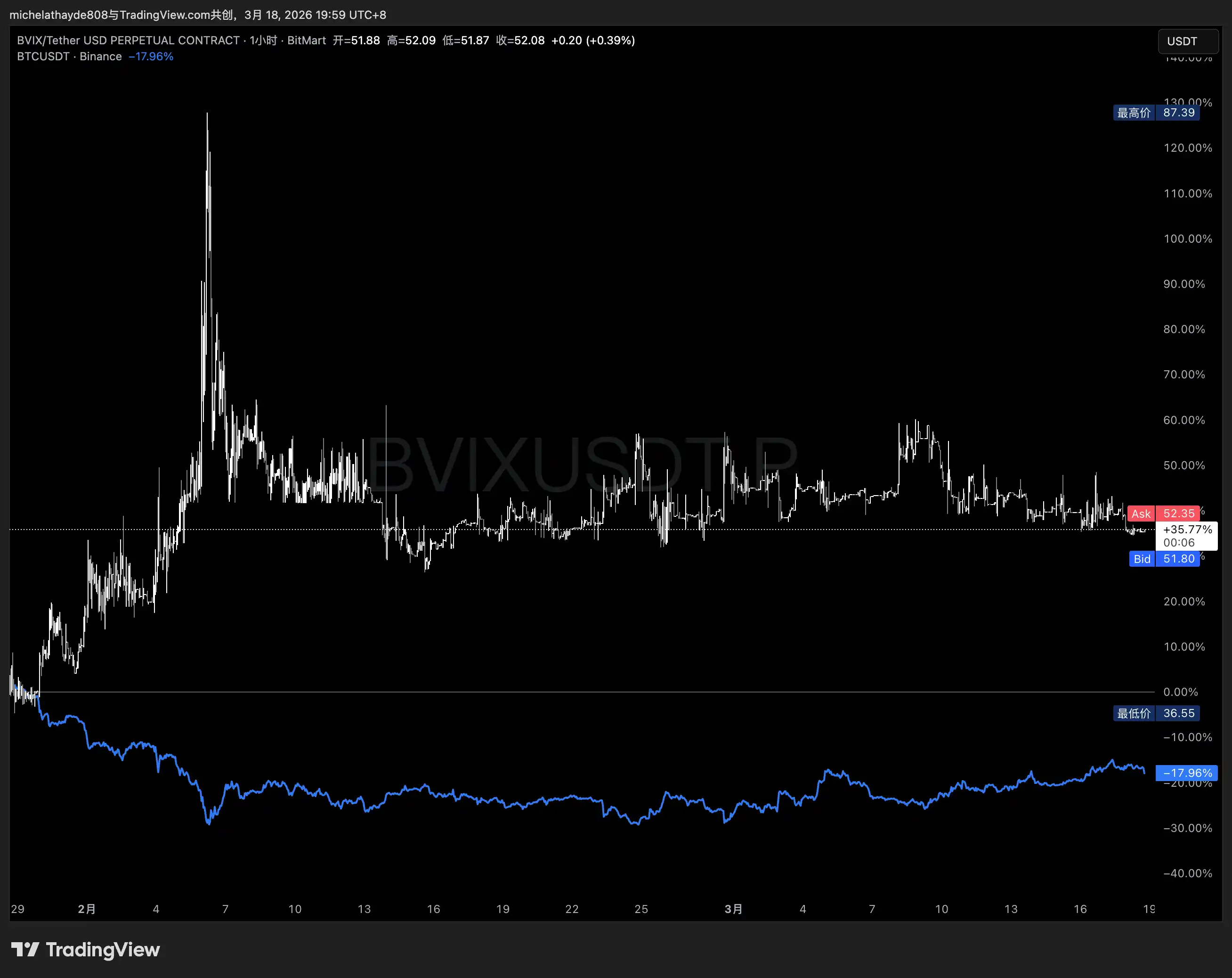
Figure: BVIX vs. BTC trend, gray-white candlesticks are BVIX, blue line is BTC

Looking at these events together, the meaning is clear: The expression of volatility around crypto assets is gradually changing from scattered, professional information hidden in the option surface to a more standardized, explicit index system.

The more mature a market is, the less it will only trade direction. It will also trade risk, trade divergence, trade the uncertainty of future paths. Whoever can more accurately understand what risk the market is actually putting a price on is closer to the true core of this market.

Therefore, the most noteworthy aspect of products like BVIX and EVIX is not whether they are new hot topics, but that they represent a change in the crypto market structure: this market is beginning to more seriously quote prices for "future uncertainty."

How to use volatility in实战?

Many people's first reaction when mentioning volatility is risk control. Actually, this is only half right. Volatility can certainly help you defend, but more importantly, it can also help you understand when the market is selling panic at a high price and when it is selling calm at a low price.

1. Defensive perspective: Don't chase in when sentiment is most expensive

When the price has just broken out, market sentiment quickly ignites, and BVIX or EVIX surges simultaneously, many people will instinctively feel "this is the real breakout." But from a volatility perspective, this often means the market is paying a high premium for future uncertainty.

This is not necessarily a time when you cannot go long, but you need to understand: what you are buying may not only be the direction, but also an already expensive emotional price.

When volatility is high, the margin for error in chasing rallies and selling dips usually decreases significantly. You might be right on direction, but because you entered at the point where sentiment was most euphoric and expectations were most expensive, you still end up not getting ideal returns. Being right on direction does not equal a correct trade; often, what eats away profits is not being wrong on direction, but buying too expensively.

2. Risk identification perspective: Surface calm does not necessarily mean真正的安全

Another more hidden and dangerous scenario is when prices narrow, the market is dull, and many people start to think "there's no risk now." But if you observe that the volatility structure begins to move abnormally, or the market's pricing for future events quietly rises, it indicates that the calm may only be a surface phenomenon.

The most important thing to do at this stage is not to immediately bet on a direction, but to first acknowledge one thing: the market内部 may be accumulating fragility that you cannot see with the naked eye.

For high-leverage traders, this stage is particularly dangerous. Because what truly destroys accounts is often not the big volatility you can see, but the fact that you increased your risk exposure when things "looked fine."

3. Offensive perspective: When panic is being sold at a high price, selling volatility may be more attractive

The真正 interesting thing about volatility is that it can not only signal danger but also provide offensive windows at the strategy level.

When BVIX, EVIX soar, or more broadly, when implied volatility is significantly higher than historical realized volatility, it indicates that the market is paying a very high premium for future uncertainty. For directional traders, this is often one of the most uncomfortable zones because what you are buying is not just the direction, but expensive panic itself.

But for more mature traders, this may instead imply another type of opportunity: selling overestimated volatility.

In the traditional derivatives framework, this type of thinking is typically manifested as selling high implied volatility options, collecting higher premiums, or executing systematic rolling short option strategies to earn sentiment premiums and time decay. Its core logic is not "I must be bearish," but "I think the market's pricing of future volatility is too high."

Of course, this is not a direction suitable for novices to imitate rashly. Selling volatility is essentially a business of making small money while carrying large risks, most afraid of tail events suddenly landing. It has very high requirements for margin management, position constraints, liquidity judgment, and tail hedging. Precisely for this reason, the真正 important thing is not to have everyone become a seller, but to understand a higher-dimensional trading logic: when others are trading direction, mature traders may be trading "whether expectations are overestimated."

4. Relative value perspective: Observing the volatility difference between BTC and ETH

In addition to looking at single volatility levels, the volatility difference between BTC and ETH is also worth observing.

If EVIX remains significantly higher than BVIX, it usually means the market believes ETH faces higher uncertainty, or is willing to pay a higher risk premium for ETH's future path. This does not necessarily give a simple bullish or bearish conclusion directly, but it can help you understand which asset capital is betting risk on, and also assist in judging whether the market currently prefers core hedging or high-elasticity speculation.

Often, the truly valuable information is not in one absolute number, but in the relative changes between different assets and different time periods. The volatility spread is, to some extent, the temperature difference of risk appetite.

The real upgrade is not knowing how to predict rise/fall, but knowing how to read "expectations"

Many traders, upon growing to a certain stage, slowly discover a fact: the hardest thing about the market is never guessing a single rise or fall, but understanding what the market is pricing.

Sometimes, the market prices direction; sometimes, the market prices liquidity; but at many critical moments, what the market is truly trading expensively is uncertainty itself.

This is also why volatility should not be understood as an accessory indicator to price. It is not a footnote next to the行情, nor is it an advanced term only option players need to care about. It is itself a kind of price, a price for future paths, risk distribution, and expectation divergence.

Price reflects the present; volatility prices the future.

And what is most expensive about the future is often not the trend itself, but people's fear of the unknown, or their mistaken belief in calm.

When more and more traders start paying attention to volatility indicators like BVIX, EVIX, and BITVX, what they are truly concerned about is no longer just whether Bitcoin will rise or fall, but:

Could this market be more violent than imagined?

Is this expectation already priced too high, or too low?

Am I trading direction, or overestimated emotion itself?

The crypto market is moving from "only trading price" to "trading expectations, trading risk, trading volatility." Whoever accepts this earlier will have a better chance of breaking free from the trading method of simply guessing direction and entering the next stage of truly understanding market structure.


Domande pertinenti

QWhat is the core reason why mature traders are paying attention to Bitcoin volatility?

AMature traders focus on Bitcoin volatility because it provides insight into the market's pricing of future uncertainty and risk density, rather than just the direction of price movement. It helps them understand the path and potential turbulence of the market, not just the destination.

QWhat are the three key layers of understanding Bitcoin volatility mentioned in the article?

AThe three layers are: 1) Historical Volatility, which measures past price movements; 2) Implied Volatility, which is derived from option prices and reflects the market's expectation of future volatility; and 3) Volatility Indices (like BVIX, EVIX, BITVX), which compress these expectations into a single, observable number.

QWhy can a period of low price volatility (calm market) actually be dangerous?

AA calm market with low volatility can be dangerous because it often masks rising fragility. It leads to increased leverage, relaxed stop-losses, and crowded 'sell volatility' strategies. This creates a situation where a single unexpected shock can trigger a non-linear cascade of liquidations and a rapid evaporation of liquidity, wiping out gains made during the calm period.

QHow can volatility be used from an offensive trading perspective?

AFrom an offensive perspective, when volatility indices like BVIX or EVIX are high, it indicates the market is paying a high premium for uncertainty (panic). This can present an opportunity for sophisticated traders to 'sell volatility' by writing options to collect the inflated premium, betting that the actual future volatility will be lower than what is currently priced in.

QWhat major shift does the emergence of products like BVIX, EVIX, and BITVX signal for the crypto market?

AThe emergence of these volatility indices signals that the crypto market is maturing beyond just 'trading price.' It is building the infrastructure to 'trade expectation, trade risk, and trade volatility' itself. The market is beginning to more formally and transparently price future uncertainty, moving towards the sophistication seen in traditional finance.

Letture associate

Trading

Spot
Futures

Articoli Popolari

Cosa è BITCOIN

Comprendere HarryPotterObamaSonic10Inu (ERC-20) e la sua posizione nel mondo delle criptovalute Negli ultimi anni, il mercato delle criptovalute ha assistito a un aumento della popolarità delle meme coin, catturando l'interesse non solo dei trader, ma anche di coloro che cercano coinvolgimento comunitario e valore di intrattenimento. Tra questi token unici c'è HarryPotterObamaSonic10Inu (ERC-20), un progetto intrigante che mescola riferimenti culturali nel tessuto delle criptovalute. Questo articolo esplora gli aspetti chiave di HarryPotterObamaSonic10Inu, analizzando i suoi meccanismi, l'etica guidata dalla comunità e il suo coinvolgimento con il panorama crittografico più ampio. Che cos'è HarryPotterObamaSonic10Inu (ERC-20)? Come suggerisce il suo nome, HarryPotterObamaSonic10Inu è una meme coin costruita sulla blockchain di Ethereum, classificata secondo lo standard ERC-20. A differenza delle criptovalute tradizionali che possono enfatizzare l'utilità pratica o il potenziale investimento, questo token prospera grazie al valore di intrattenimento e alla forza della sua comunità. Il progetto mira a creare un ambiente in cui gli utenti coinvolti possono riunirsi, condividere idee e partecipare ad attività ispirate a diversi fenomeni culturali. Una caratteristica notevole di HarryPotterObamaSonic10Inu è la zero tassa sulle transazioni. Questo elemento allettante tende a incoraggiare il trading e il coinvolgimento della comunità, privo di costi aggiuntivi che possono scoraggiare i trader di piccole dimensioni. L'offerta totale della moneta è fissata a un miliardo di token, un numero che segna la sua intenzione di mantenere una circolazione sostanziale all'interno della comunità. Creatore di HarryPotterObamaSonic10Inu (ERC-20) Le origini di HarryPotterObamaSonic10Inu sono avvolte in un certo mistero; i dettagli sul creatore rimangono sconosciuti. Lo sviluppo di questo token non presenta un team identificabile o un piano esplicito, cosa non rara nel settore delle meme coin. Invece, il progetto è emerso organicamente, con il suo progresso fortemente dipendente dall'entusiasmo e dalla partecipazione della sua comunità. Investitori di HarryPotterObamaSonic10Inu (ERC-20) Per quanto riguarda investimenti esterni e finanziamenti, HarryPotterObamaSonic10Inu rimane ambiguo. Il token non elenca alcuna fondazione di investimento conosciuta o un sostegno organizzativo significativo. Invece, la linfa vitale del progetto è la sua comunità di base, che informa la sua crescita e sostenibilità attraverso azioni collettive e coinvolgimento nello spazio crittografico. Come funziona HarryPotterObamaSonic10Inu (ERC-20)? In quanto meme coin, HarryPotterObamaSonic10Inu opera principalmente al di fuori delle strutture tradizionali che governano spesso il valore degli asset. Ci sono diversi aspetti distintivi che definiscono il funzionamento del progetto: Transazioni senza tasse: Senza costi fiscali sulle transazioni, gli utenti possono comprare e vendere liberamente il token senza preoccuparsi di costi nascosti. Coinvolgimento della comunità: Il progetto prospera sull'interazione della comunità, sfruttando le piattaforme social per creare entusiasmo e facilitare il coinvolgimento. Discussioni, condivisione di contenuti e coinvolgimento sono elementi cruciali che aiutano ad espandere la sua portata e a favorire la lealtà tra i sostenitori. Nessuna utilità pratica: Va notato che HarryPotterObamaSonic10Inu non offre un'utilità concreta all'interno dell'ecosistema finanziario. Piuttosto, è classificato come un token principalmente per attività di intrattenimento e comunitarie. Riferimento culturale: Il token incorpora astutamente elementi della cultura pop per attirare interesse, collegandosi a appassionati di meme e seguaci delle criptovalute. HarryPotterObamaSonic10Inu esemplifica come le meme coin operino in modo diverso rispetto ai progetti di criptovalute più tradizionali, entrando nel mercato come costrutti sociali innovativi piuttosto che come asset utilitari. Cronologia di HarryPotterObamaSonic10Inu (ERC-20) La storia di HarryPotterObamaSonic10Inu è segnata da diversi traguardi notevoli: Creazione: Il token è emerso da un meme virale, catturando l'immaginazione di molti appassionati di criptovalute. Le date di creazione specifiche non sono disponibili, sottolineando la sua crescita organica. Inserimento negli scambi: HarryPotterObamaSonic10Inu ha fatto il suo ingresso in vari scambi, consentendo un accesso e un trading più facili da parte della comunità. Iniziative di coinvolgimento della comunità: Attività in corso volte a migliorare l'interazione della comunità, comprese gare, campagne sui social media e generazione di contenuti da parte di fan e sostenitori. Piani di espansione futura: La tabella di marcia del progetto include il lancio di una collezione NFT, merchandising e un sito di eCommerce relativo ai suoi temi culturali, coinvolgendo ulteriormente la comunità e cercando di aggiungere più dimensioni al suo ecosistema. Punti chiave su HarryPotterObamaSonic10Inu (ERC-20) Natura guidata dalla comunità: Il progetto dà priorità al contributo collettivo e alla creatività, garantendo che il coinvolgimento degli utenti sia al centro del suo sviluppo. Classificazione come meme coin: Rappresenta l'epitome delle criptovalute basate sull'intrattenimento, distinguendosi dai veicoli d'investimento tradizionali. Nessuna affiliazione diretta con Bitcoin: Nonostante la somiglianza nel nome del ticker, HarryPotterObamaSonic10Inu è distintivo e non ha alcuna relazione con Bitcoin o altre criptovalute consolidate. Focus sulla collaborazione: HarryPotterObamaSonic10Inu è progettato per creare uno spazio per la collaborazione e la condivisione di storie tra i suoi detentori, fornendo un canale per la creatività e il legame comunitario. Prospettive future: L'ambizione di espandersi oltre il suo presupposto iniziale verso NFT e merchandising delinea un percorso per il progetto per potenzialmente entrare in strade più mainstream all'interno della cultura digitale. Poiché le meme coin continuano a catturare l'immaginazione della comunità crittografica, HarryPotterObamaSonic10Inu (ERC-20) si distingue per i suoi legami culturali e il suo approccio centrato sulla comunità. Anche se potrebbe non adattarsi al modello tipico di un token orientato all'utilità, la sua essenza risiede nella gioia e nella camaraderia coltivate tra i suoi sostenitori, evidenziando la natura in evoluzione delle criptovalute in un'epoca sempre più digitale. Con la continuazione dello sviluppo del progetto, sarà importante osservare come le dinamiche della comunità influenzano la sua traiettoria nel panorama in continuo cambiamento della tecnologia blockchain.

1.3k Totale visualizzazioniPubblicato il 2024.04.01Aggiornato il 2024.12.03

Cosa è BITCOIN

Come comprare BTC

Benvenuto in HTX.com! Abbiamo reso l'acquisto di Bitcoin (BTC) semplice e conveniente. Segui la nostra guida passo passo per intraprendere il tuo viaggio nel mondo delle criptovalute.Step 1: Crea il tuo Account HTXUsa la tua email o numero di telefono per registrarti il tuo account gratuito su HTX. Vivi un'esperienza facile e sblocca tutte le funzionalità,Crea il mio accountStep 2: Vai in Acquista crypto e seleziona il tuo metodo di pagamentoCarta di credito/debito: utilizza la tua Visa o Mastercard per acquistare immediatamente BitcoinBTC.Bilancio: Usa i fondi dal bilancio del tuo account HTX per fare trading senza problemi.Terze parti: abbiamo aggiunto metodi di pagamento molto utilizzati come Google Pay e Apple Pay per maggiore comodità.P2P: Fai trading direttamente con altri utenti HTX.Over-the-Counter (OTC): Offriamo servizi su misura e tassi di cambio competitivi per i trader.Step 3: Conserva Bitcoin (BTC)Dopo aver acquistato Bitcoin (BTC), conserva nel tuo account HTX. In alternativa, puoi inviare tramite trasferimento blockchain o scambiare per altre criptovalute.Step 4: Scambia Bitcoin (BTC)Scambia facilmente Bitcoin (BTC) nel mercato spot di HTX. Accedi al tuo account, seleziona la tua coppia di trading, esegui le tue operazioni e monitora in tempo reale. Offriamo un'esperienza user-friendly sia per chi ha appena iniziato che per i trader più esperti.

3.7k Totale visualizzazioniPubblicato il 2024.12.12Aggiornato il 2025.03.21

Come comprare BTC

Cosa è $BITCOIN

ORO DIGITALE ($BITCOIN): Un'Analisi Completa Introduzione all'ORO DIGITALE ($BITCOIN) L'ORO DIGITALE ($BITCOIN) è un progetto basato su blockchain che opera sulla rete Solana, con l'obiettivo di combinare le caratteristiche dei metalli preziosi tradizionali con l'innovazione delle tecnologie decentralizzate. Sebbene condivida un nome con Bitcoin, spesso definito “oro digitale” a causa della sua percezione come riserva di valore, l'ORO DIGITALE è un token separato progettato per creare un ecosistema unico all'interno del panorama Web3. Il suo obiettivo è posizionarsi come un asset digitale alternativo valido, anche se i dettagli riguardanti le sue applicazioni e funzionalità sono ancora in fase di sviluppo. Cos'è l'ORO DIGITALE ($BITCOIN)? L'ORO DIGITALE ($BITCOIN) è un token di criptovaluta esplicitamente progettato per l'uso sulla blockchain di Solana. A differenza di Bitcoin, che fornisce un ruolo di stoccaggio di valore ampiamente riconosciuto, questo token sembra concentrarsi su applicazioni e caratteristiche più ampie. Aspetti notevoli includono: Infrastruttura Blockchain: Il token è costruito sulla blockchain di Solana, nota per la sua capacità di gestire transazioni ad alta velocità e a basso costo. Dinamiche di Offerta: L'ORO DIGITALE ha un'offerta massima fissata a 100 quadrilioni di token (100P $BITCOIN), sebbene i dettagli riguardanti la sua offerta circolante siano attualmente non divulgati. Utilità: Sebbene le funzionalità precise non siano esplicitamente delineate, ci sono indicazioni che il token potrebbe essere utilizzato per varie applicazioni, potenzialmente coinvolgendo applicazioni decentralizzate (dApp) o strategie di tokenizzazione degli asset. Chi è il Creatore dell'ORO DIGITALE ($BITCOIN)? Attualmente, l'identità dei creatori e del team di sviluppo dietro l'ORO DIGITALE ($BITCOIN) rimane sconosciuta. Questa situazione è tipica tra molti progetti innovativi nel settore blockchain, in particolare quelli allineati con la finanza decentralizzata e i fenomeni delle meme coin. Sebbene tale anonimato possa favorire una cultura guidata dalla comunità, intensifica le preoccupazioni riguardo alla governance e alla responsabilità. Chi sono gli Investitori dell'ORO DIGITALE ($BITCOIN)? Le informazioni disponibili indicano che l'ORO DIGITALE ($BITCOIN) non ha alcun sostenitore istituzionale noto o investimenti di venture capital prominenti. Il progetto sembra operare su un modello peer-to-peer incentrato sul supporto e sull'adozione della comunità piuttosto che su percorsi di finanziamento tradizionali. La sua attività e liquidità si trovano principalmente su exchange decentralizzati (DEX), come PumpSwap, piuttosto che su piattaforme di trading centralizzate consolidate, evidenziando ulteriormente il suo approccio di base. Come Funziona l'ORO DIGITALE ($BITCOIN) Le meccaniche operative dell'ORO DIGITALE ($BITCOIN) possono essere elaborate in base al suo design blockchain e alle caratteristiche della rete: Meccanismo di Consenso: Sfruttando il proof-of-history (PoH) unico di Solana combinato con un modello di proof-of-stake (PoS), il progetto garantisce una validazione efficiente delle transazioni contribuendo all'alta performance della rete. Tokenomics: Sebbene meccanismi deflazionistici specifici non siano stati dettagliati ampiamente, l'ampia offerta massima di token implica che potrebbe soddisfare microtransazioni o casi d'uso di nicchia che devono ancora essere definiti. Interoperabilità: Esiste il potenziale per l'integrazione con l'ecosistema più ampio di Solana, inclusi vari piattaforme di finanza decentralizzata (DeFi). Tuttavia, i dettagli riguardanti integrazioni specifiche rimangono non specificati. Cronologia degli Eventi Chiave Ecco una cronologia che evidenzia traguardi significativi riguardanti l'ORO DIGITALE ($BITCOIN): 2023: Il dispiegamento iniziale del token avviene sulla blockchain di Solana, contrassegnato dal suo indirizzo di contratto. 2024: L'ORO DIGITALE guadagna visibilità poiché diventa disponibile per il trading su exchange decentralizzati come PumpSwap, consentendo agli utenti di scambiarlo contro SOL. 2025: Il progetto assiste a un'attività di trading sporadica e a un potenziale interesse per impegni guidati dalla comunità, sebbene non siano state documentate partnership significative o avanzamenti tecnici fino ad ora. Analisi Critica Punti di Forza Scalabilità: L'infrastruttura sottostante di Solana supporta alti volumi di transazioni, il che potrebbe migliorare l'utilità di $BITCOIN in vari scenari di transazione. Accessibilità: Il potenziale basso prezzo di trading per token potrebbe attrarre investitori al dettaglio, facilitando una partecipazione più ampia grazie a opportunità di proprietà frazionata. Rischi Mancanza di Trasparenza: L'assenza di sostenitori, sviluppatori o di un processo di audit pubblicamente noti potrebbe generare scetticismo riguardo alla sostenibilità e all'affidabilità del progetto. Volatilità del Mercato: L'attività di trading è fortemente dipendente dal comportamento speculativo, il che può comportare una significativa volatilità dei prezzi e incertezze per gli investitori. Conclusione L'ORO DIGITALE ($BITCOIN) emerge come un progetto intrigante ma ambiguo all'interno dell'evolvente ecosistema di Solana. Sebbene tenti di sfruttare la narrativa dell'“oro digitale”, la sua partenza dal ruolo consolidato di Bitcoin come riserva di valore sottolinea la necessità di una chiara differenziazione della sua utilità e struttura di governance. L'accettazione e l'adozione future dipenderanno probabilmente dall'affrontare l'attuale opacità e dalla definizione più esplicita delle sue strategie operative ed economiche. Nota: Questo rapporto comprende informazioni sintetizzate disponibili a ottobre 2023, e potrebbero essersi verificati sviluppi oltre il periodo di ricerca.

99 Totale visualizzazioniPubblicato il 2025.05.13Aggiornato il 2025.05.13

Cosa è $BITCOIN

Discussioni

Benvenuto nella Community HTX. Qui puoi rimanere informato sugli ultimi sviluppi della piattaforma e accedere ad approfondimenti esperti sul mercato. Le opinioni degli utenti sul prezzo di BTC BTC sono presentate come di seguito.

活动图片













