Why Must Banks Ban Stablecoin Yields?

marsbitPubblicato 2026-01-19Pubblicato ultima volta 2026-01-19

Introduzione

The article "Why Banks Are Determined to Ban Yield-Bearing Stablecoins?" explores the ongoing debate around the U.S. cryptocurrency market structure bill (CLARITY), particularly the fierce opposition from large banks against interest-bearing stablecoins. Banks argue that such stablecoins could cause deposit outflows, but the author refutes this, explaining that funds used to purchase stablecoins like USDC ultimately flow back into the banking system as reserves held by issuers like Circle. The real concern for banks is not the total volume of deposits but a shift in deposit structure. U.S. major banks (e.g., Bank of America, JPMorgan Chase) rely heavily on "low-interest banking," where transaction deposits (used for payments, transfers) pay near-zero interest, creating a significant spread between deposit rates and the Fed’s benchmark rate. This model generates massive profits—over $360 billion annually from interest differentials and transaction fees. Stablecoins directly compete with transaction deposits by offering similar utility (payments, settlements). If stablecoins can generate yield, users may shift funds from bank transaction accounts to stablecoins to earn higher returns. While the money remains in the banking system (as stablecoin reserves), it moves from low-cost transaction deposits to higher-yield instruments, squeezing bank profit margins and reducing fee income. Thus, banks oppose yield-bearing stablecoins to protect their lucrative low-cost depos...

Original | Odaily Planet Daily (@OdailyChina)

Author | Azuma (@azuma_eth)

With Coinbase's temporary "betrayal" and the Senate Banking Committee's delayed review, the cryptocurrency market structure bill (CLARITY) has once again fallen into a phase of stagnation.

  • Odaily Note: For background, see "The Biggest Variable in the Post-Crypto Market: Can the CLARITY Bill Pass the Senate?" and "CLARITY Review Suddenly Delayed: Why Is the Industry So Divided?".

Based on current market debates, the biggest point of contention surrounding CLARITY has focused on "yield-bearing stablecoins." Specifically, the GENIUS bill passed last year, in order to gain banking industry support, explicitly prohibited yield-bearing stablecoins. However, the bill only stipulated that stablecoin issuers cannot pay holders "any form of interest or yield," but did not restrict third parties from providing yields or rewards. The banking industry is very dissatisfied with this "workaround" and is trying to overturn it in CLARITY, banning all types of yield-bearing paths. This has drawn strong opposition from some cryptocurrency groups, represented by Coinbase.

Why are banks so opposed to yield-bearing stablecoins, insisting on blocking all yield paths? The goal of this article is to answer this question in detail by dissecting the profit model of large U.S. commercial banks.

Bank Deposit Outflows? Pure Nonsense

In statements opposing yield-bearing stablecoins, the most common reason used by banking representatives is "concern that stablecoins will cause bank deposit outflows" — Bank of America CEO Brian Moynihan said in a call last Wednesday: "Up to $6 trillion in deposits (about 30% to 35% of all U.S. commercial bank deposits) could migrate to stablecoins, thereby restricting banks' ability to lend to the overall U.S. economy... and yield-bearing stablecoins could accelerate deposit outflows."

However, anyone with a basic understanding of how stablecoins operate can see that this statement is highly misleading. When $1 flows into a stablecoin system like USDC, that $1 does not disappear into thin air. Instead, it is placed in the reserve treasury of stablecoin issuers like Circle and eventually flows back into the banking system in the form of cash deposits or other short-term liquid assets (such as Treasury bonds).
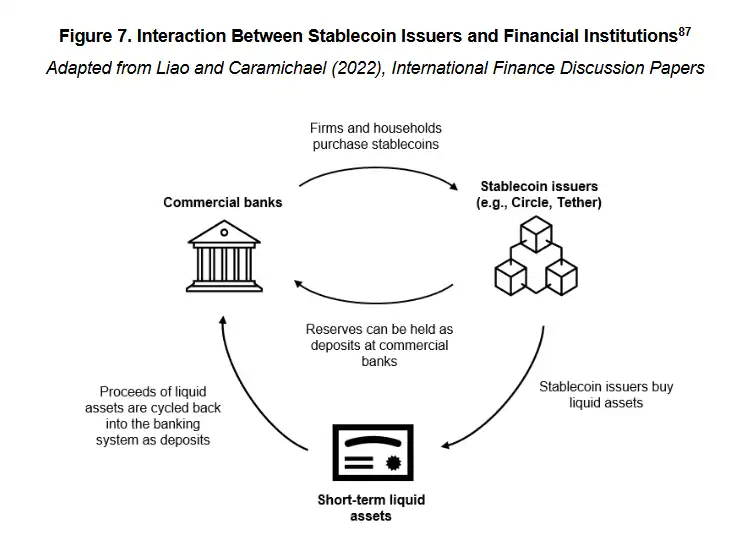
  • Odaily Note: Stablecoins backed by crypto assets, futures hedging, algorithms, or other mechanisms are not considered here. First, because such stablecoins account for a small proportion; second, because these stablecoins do not fall under the discussion scenario for compliant stablecoins under the U.S. regulatory system — last year's GENIUS bill clearly defined reserve requirements for compliant stablecoins, limiting reserve assets to cash, short-term Treasury bonds, or central bank deposits, which must be segregated from operational funds.

So the reality is clear: Stablecoins do not cause bank deposit outflows because the funds always eventually flow back to banks and can be used for credit intermediation. This is determined by the business model of stablecoins and has little to do with whether they yield interest or not.

The real key issue lies in the change in deposit structure after the funds flow back.

The Cash Cow of American Big Banks

Before analyzing this change, we need to briefly introduce the interest-earning practices of large U.S. banks.

Van Buren Capital General Partner Scott Johnsson cited a paper from the University of California, Los Angeles, stating that since the 2008 financial crisis damaged the banking industry's credibility, commercial banks in the U.S. have diverged into two distinct forms in the deposit-taking business — high-interest banks and low-interest banks.
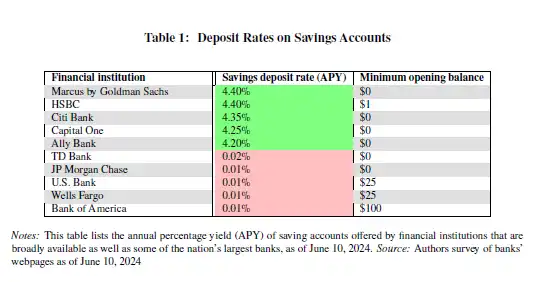
High-interest banks and low-interest banks are not formal classifications in a regulatory sense but are commonly used terms in market context — manifested in the fact that the deposit interest spread between high-interest banks and low-interest banks has reached more than 350 basis points (3.5%).

Why is there such a significant interest spread for the same deposit? The reason is that high-interest banks are mostly digital banks or banks with business structures focused on wealth management and capital market businesses (such as Capital One). They rely on high interest rates to attract deposits to support their credit or investment businesses. Conversely, low-interest banks are mainly national large commercial banks that actually hold the power in the banking industry, such as Bank of America, Chase Bank, and Wells Fargo. They have a vast retail customer base and payment networks, allowing them to maintain extremely low deposit costs through customer stickiness, brand effect, and branch convenience, without needing to compete for deposits with high interest rates.

From the perspective of deposit structure, high-interest banks generally focus on non-transaction deposits, i.e., deposits主要用于储蓄或获取利息回报 — such funds are more sensitive to interest rates and are more costly for banks; low-interest banks generally focus on transaction deposits, i.e., deposits主要用于支付、转账、结算 — the characteristics of such funds are high stickiness, frequent流动性, and extremely low interest rates, making them the most valuable liabilities for banks.
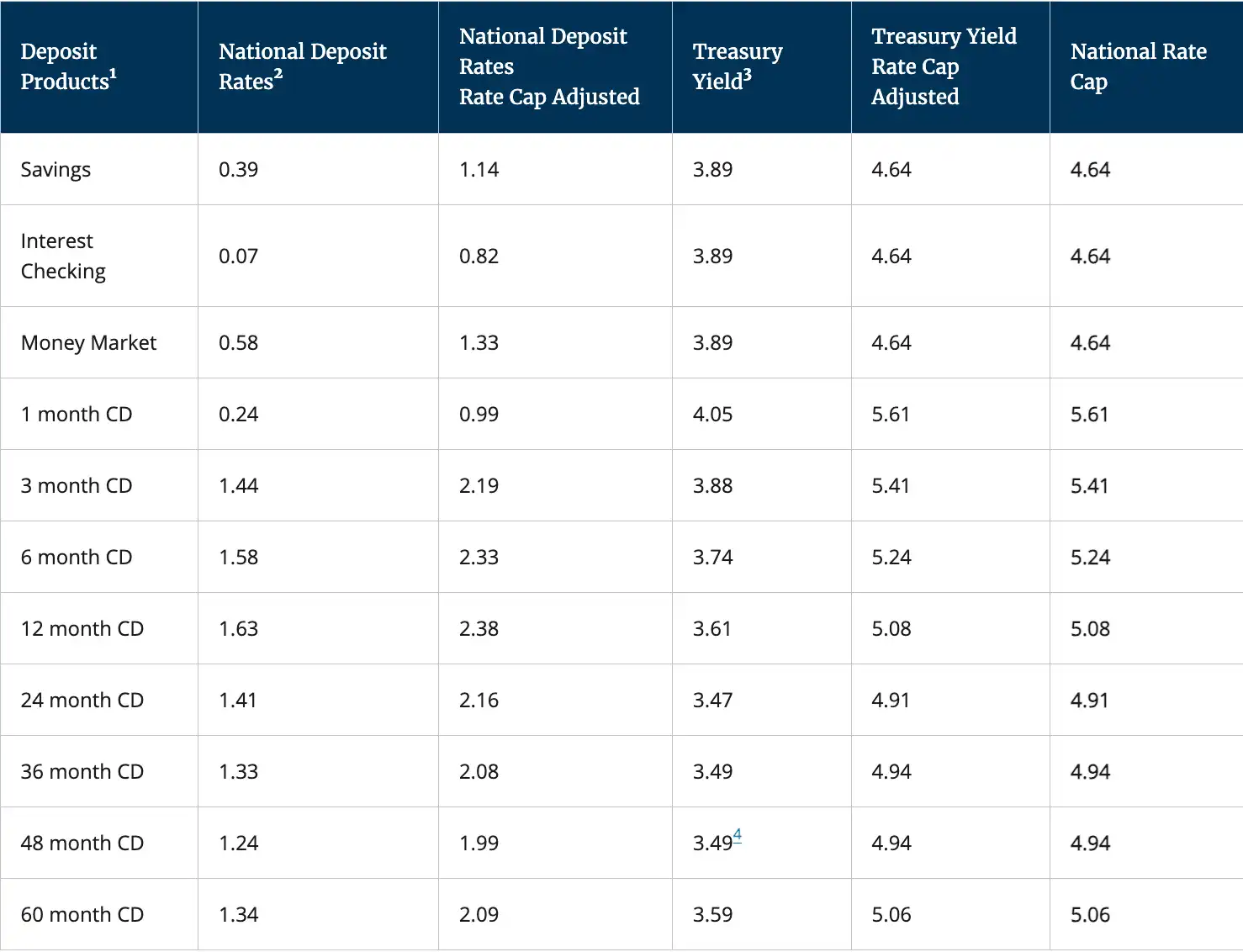
Latest data from the Federal Deposit Insurance Corporation (FDIC) shows that as of mid-December 2025, the average annual interest rate for U.S. savings accounts was only 0.39%.

Note, this is data that already includes the impact of high-interest banks. Since mainstream U.S. banks mostly follow the low-interest model, the actual interest they pay to depositors is far lower than this level — Galaxy founder and CEO Mike Novogratz直言 stated in an interview with CNBC that large banks pay almost zero interest to depositors (about 1 - 11 basis points), while the同期 Federal Reserve benchmark rate was between 3.50% and 3.75%. This spread brings huge profits to banks.
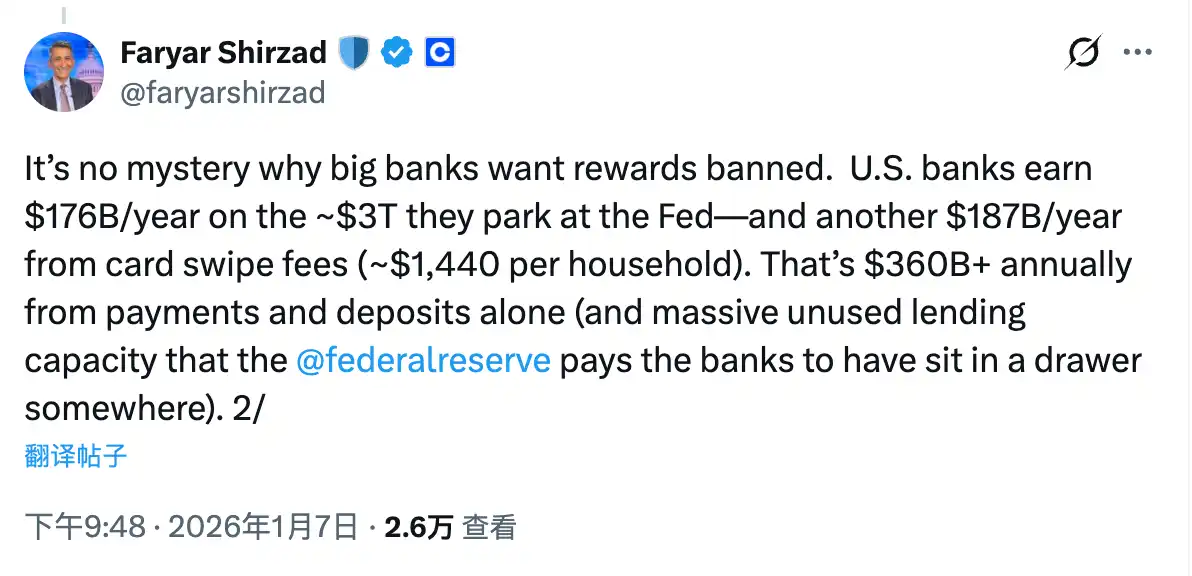
Coinbase Chief Compliance Officer Faryar Shirzad calculated a clearer account — U.S. banks can profit $176 billion annually from approximately $3 trillion in funds deposited at the Federal Reserve, and additionally profit $187 billion annually from transaction fees charged to depositors. Just from deposit spreads and payment transaction环节, this brings in over $360 billion in revenue annually.

The Real Change: Deposit Structure and Profit Distribution

Back to the topic, what changes will the stablecoin system bring to the bank deposit structure? How will yield-bearing stablecoins further助推 this trend? The logic is actually quite simple. What are the use cases for stablecoins? The answers are无非 payment, transfer, settlement... etc. Doesn't this sound familiar!

As mentioned earlier, these functions are the core utilities of transaction deposits, which are both the main type of deposits for large banks and the most valuable liabilities for banks. Therefore, the banking industry's real concern about stablecoins is — stablecoins, as a new transaction medium, can directly compete with transaction deposits in terms of use cases.

If stablecoins did not have yield-bearing functionality, it might be acceptable. Considering the usage barriers and the slight interest advantage of bank deposits (a mosquito's leg is still meat), the actual threat stablecoins pose to this core territory of large banks is not significant. But once stablecoins are given the feasibility of yielding interest, driven by the interest spread, more and more funds may shift from transaction deposits to stablecoins. Although these funds will eventually flow back into the banking system, stablecoin issuers, out of profit consideration, will inevitably invest most of the reserve funds into non-transaction deposits, only needing to retain a certain proportion of cash reserves to handle daily redemptions. This is the so-called change in deposit structure — the money remains in the banking system, but bank costs will increase significantly (the interest spread is compressed), and revenue from transaction fees will also decrease significantly.

At this point, the essence of the problem is very clear. The reason why the banking industry is fiercely opposed to yield-bearing stablecoins has never been about "whether the total amount of deposits within the banking system will decrease," but rather about the possible change in deposit structure and the resulting profit redistribution issue.

In the era without stablecoins, especially without yield-bearing stablecoins, large U.S. commercial banks firmly controlled this source of "zero-cost or even negative-cost" funds known as transaction deposits. They could earn risk-free profits through the spread between deposit rates and benchmark rates, and also continuously charge fees for basic financial services such as payment, settlement, and clearing, thus building an extremely solid closed loop that几乎不需要与储户分享收益.

The emergence of stablecoins essentially dismantles this closed loop. On the one hand, stablecoins highly compete with transaction deposits in terms of functionality, covering core scenarios such as payment, transfer, and settlement; on the other hand, yield-bearing stablecoins further introduce the variable of yield, making transaction funds that were originally not sensitive to interest rates begin to have the possibility of repricing.

In this process, funds do not leave the banking system, but banks may lose control over the profits from these funds — liabilities that were almost zero-cost are forced to transform into liabilities that require paying market-based yields; payment fees that were exclusively enjoyed by banks are also开始被分流 to stablecoin issuers, wallets, and protocol layers.

This is the change that the banking industry truly cannot accept. Understanding this, it is not difficult to understand why yield-bearing stablecoins have become the most intense and最难妥协的争议焦点 in the CLARITY legislative process.


Domande pertinenti

QWhat is the main reason banks are strongly opposed to interest-bearing stablecoins according to the article?

ABanks oppose interest-bearing stablecoins because they fear a shift in deposit structures, where low-cost transactional deposits (their most valuable liabilities) might move to stablecoins, increasing bank funding costs and reducing their profit margins from interest spreads and transaction fees.

QHow do interest-bearing stablecoins potentially impact the profitability of large U.S. commercial banks?

AInterest-bearing stablecoins could compress banks' interest spread profits by forcing them to pay market-based returns on deposits that were previously near-zero cost, and also reduce transaction fee income as stablecoins divert payment and settlement activities away from traditional banking channels.

QWhat is the difference between 'high-interest banks' and 'low-interest banks' in the U.S. banking system as described in the article?

AHigh-interest banks (e.g., digital banks) rely on offering competitive interest rates to attract deposits for lending or investment, while low-interest banks (e.g., large national banks like Bank of America) leverage customer loyalty, brand power, and network convenience to maintain extremely low-cost transactional deposits with minimal interest payments.

QWhy does the article argue that stablecoins do not cause an outflow of bank deposits in the broader sense?

AStablecoins do not cause a deposit outflow because funds used to purchase stablecoins like USDC are held in reserve (e.g., cash or short-term Treasuries) by issuers like Circle, which ultimately flow back into the banking system, remaining available for credit intermediation.

QWhat key legislative bill is currently facing delays and disputes over the issue of interest-bearing stablecoins?

AThe cryptocurrency market structure bill, known as the CLARITY Act, is currently stalled progress in the Senate Banking Committee due to intense debates, particularly around prohibiting all forms of interest-bearing stablecoins.

Letture associate

Near Returns to the AI Stage: Transformation into a Public Chain Due to 'Payroll Difficulties,' Agent and Privacy Emerge as New Growth Narratives

NEAR Returns to AI Origins: From Payroll Struggles to Blockchain, Now Focusing on AI Agents and Privacy NEAR Protocol's journey began not with grand blockchain ambitions, but from a practical hurdle: its AI startup founders, including Transformer paper co-author Illia Polosukhin, couldn't efficiently pay international developers in 2017. This led them to pivot and build a high-performance, scalable blockchain. After years navigating various crypto narratives like sharding and cross-chain interoperability, NEAR is now leveraging its AI roots to re-enter the AI arena. A key driver is its "NEAR Intents" layer, which abstracts complex cross-chain transactions. Users simply state their goal (e.g., swap BTC for ETH), and a solver network finds the optimal route. This system has processed over $20B in cross-chain volume, generating significant fee revenue. A major growth area is private transactions via "Confidential Intents/Swaps," which hide trade details until settlement to protect against MEV and front-running. Remarkably, private swaps recently accounted for over 40% of NEAR's transaction volume, highlighting strong demand but also potential regulatory scrutiny. With its AI-founder pedigree, NEAR is positioning itself at the intersection of blockchain, AI agents, and privacy, aiming to become infrastructure for the emerging agent economy while navigating the challenges of its rapid adoption.

marsbit2 h fa

Near Returns to the AI Stage: Transformation into a Public Chain Due to 'Payroll Difficulties,' Agent and Privacy Emerge as New Growth Narratives

marsbit2 h fa

From Ethereum to AI's 'CROPS': What Exactly is This Set of 'Slow Variables' That Vitalik Repeatedly Emphasizes?

In recent discussions, Vitalik Buterin has frequently emphasized the concept of "CROPS," a framework defining core values for Ethereum's development. CROPS stands for Censorship Resistance, Capture Resistance, Open Source, Privacy, and Security. Initially outlined in the Ethereum Foundation's "EF Mandate," it represents a commitment to user sovereignty, ensuring that the network resists external control, remains open, protects privacy, and prioritizes security. The relevance of CROPS extends beyond Ethereum's foundational principles, becoming crucial in the context of AI integration. As AI agents begin handling wallet operations and automated transactions, the risk increases that users may cede control over their digital assets, privacy, and intentions to centralized AI service providers. A "CROPS AI" would therefore emphasize local execution where possible, privacy-preserving remote model calls (e.g., using zero-knowledge proofs), and transparent, verifiable processes to maintain user agency. Vitalik highlights a significant convergence between "CROPS Ethereum access layer" and "CROPS AI." Both address the same fundamental challenge: how users can access powerful services—be it blockchain data via RPCs or AI models—without exposing sensitive information or relinquishing ultimate control. This intersection points toward a future digital entry point that is more private, secure, and user-controlled. Ultimately, CROPS is not merely an abstract ideal but a practical guidepost. It steers development—from protocol resilience and wallet design to AI agent safety—towards a future where users retain self-sovereignty even as digital systems grow more complex and powerful. In an era of accelerating AI adoption, these "slow variables" of censorship resistance, openness, privacy, and security may define Ethereum's enduring value.

marsbit2 h fa

From Ethereum to AI's 'CROPS': What Exactly is This Set of 'Slow Variables' That Vitalik Repeatedly Emphasizes?

marsbit2 h fa

Silicon Valley 'Startup Guru' Steve Hoffman: Web3 + AI Could Be a Trap

Silicon Valley investor and "Godfather of Startups" Steve Hoffman warns that combining Web3 with AI is likely a trap, not a promising venture. In an interview, Hoffman argues that while AI is a foundational technology touching all industries, Web3 adds complexity, friction, and regulatory risk without solving mainstream consumer or business needs. He advises founders to focus on deep, specialized applications where startups can out-iterate giants, rather than on generic features easily replicated by large tech companies. Hoffman observes that Silicon Valley will lead foundational AI research, while China excels at rapid, large-scale application and commercialization, particularly in robotics. He stresses that AI-driven autonomous agents capable of collaborative, multi-step tasks are 2-4 years away, which will cause significant job displacement. The solution is not to slow AI but to redesign business models around human-AI collaboration and reform social systems like education and retraining. For startups, Hoffman recommends focusing on vertical, expertise-heavy domains to build defensibility. He sees major opportunities in AI fraud detection and cybersecurity. Key founder mindsets include systemic thinking over feature-focus, relentless customer centricity, building adaptive teams, and deeply understanding AI's capabilities and limits. Hoffman is also leading a non-profit initiative to establish university centers aimed at training future leaders in responsible, human-value-aligned AI innovation.

marsbit3 h fa

Silicon Valley 'Startup Guru' Steve Hoffman: Web3 + AI Could Be a Trap

marsbit3 h fa

Token Inefficient, Economy Tokenless

The article "Tokens Aren't Economical, Economics Aren't Tokenized" analyzes a pivotal shift in the AI industry from a technology-driven narrative to one dominated by capital efficiency. It highlights two concurrent trends: a severe capital shortage due to the exorbitant and recurring costs of compute (e.g., OpenAI's high burn rate) and a wave of corporate spin-offs where major tech companies are separating their AI units (like Kuaishou's Kling and Baidu's Kunlunxin). The core argument is that AI's "anti-internet" business model, where user growth increases costs rather than profits, has created a disconnect between high valuations and actual cash flow. Spin-offs address this by allowing AI assets to be valued independently. Within a parent company, they are seen as cost centers, but as standalone entities, they are priced based on their growth potential and scarcity in the primary market, leading to massive valuation premiums (e.g., Kling's estimated value tripling post-spin-off). The industry is at an inflection point, moving from "model worship" to "value realization." The competition is evolving from a pure compute (GPU) race to a broader focus on systemic efficiency and full-stack engineering (involving CPUs and orchestration) to achieve viable commercialization. The year 2026 is framed as a critical moment where the industry must definitively answer how to economically translate AI capability into tangible business value, reshaping the sector's future power structure.

marsbit3 h fa

Token Inefficient, Economy Tokenless

marsbit3 h fa

Trading

Spot
Futures
活动图片