Why is HYPE Still Surging? Has it Peaked?

Odaily星球日报Pubblicato 2026-05-20Pubblicato ultima volta 2026-05-20

Introduzione

The article analyzes the reasons behind the recent sharp rise of the HYPE token. It attributes the price surge to several key developments that are causing the market to re-evaluate Hyperliquid, transitioning its perception from just a high-performance perpetual DEX to a broader on-chain trading system. Major catalysts include the launch of HYPE ETFs by 21Shares (THYP) and Bitwise (BHYP), which are opening new compliant capital channels. Bitwise's plan to allocate 10% of BHYP's management fee revenue to buy and stake HYPE is seen as a potential source of sustained buying pressure. The return of USDC to the platform, facilitated by Coinbase and Circle, is projected to generate a new, stable revenue stream for Hyperliquid from reserve yields, estimated to potentially fund daily HYPE buybacks worth over $400,000. Furthermore, Hyperliquid is expanding into new areas like prediction markets with HIP-4 (which requires significant HYPE staking) and Real-World Assets (RWA), where its Open Interest has hit a record $2.6 billion. A potential U.S. SEC exemption for tokenized stock trading could further boost its RWA business. While these fundamentals strengthen HYPE's long-term value proposition, the article notes that short-term price action is currently influenced by a large-scale showdown between whale long and short positions exceeding $60 million, making near-term direction uncertain.

Original | Odaily Planet Daily(@OdailyChina)

Author | Asher(@Asher_ 0210)

In the current crypto market landscape, if there's one altcoin that can still excite the market, it's probably HYPE.

Market data shows that the HYPE/BTC and HYPE/BNB exchange rates have continued to hit new all-time highs, with HYPE/BTC currently at 0.0006249 and HYPE/BNB at 0.075. This indicates that HYPE's strength is not merely following the market rebound but consistently outperforming mainstream crypto assets like BTC and BNB.
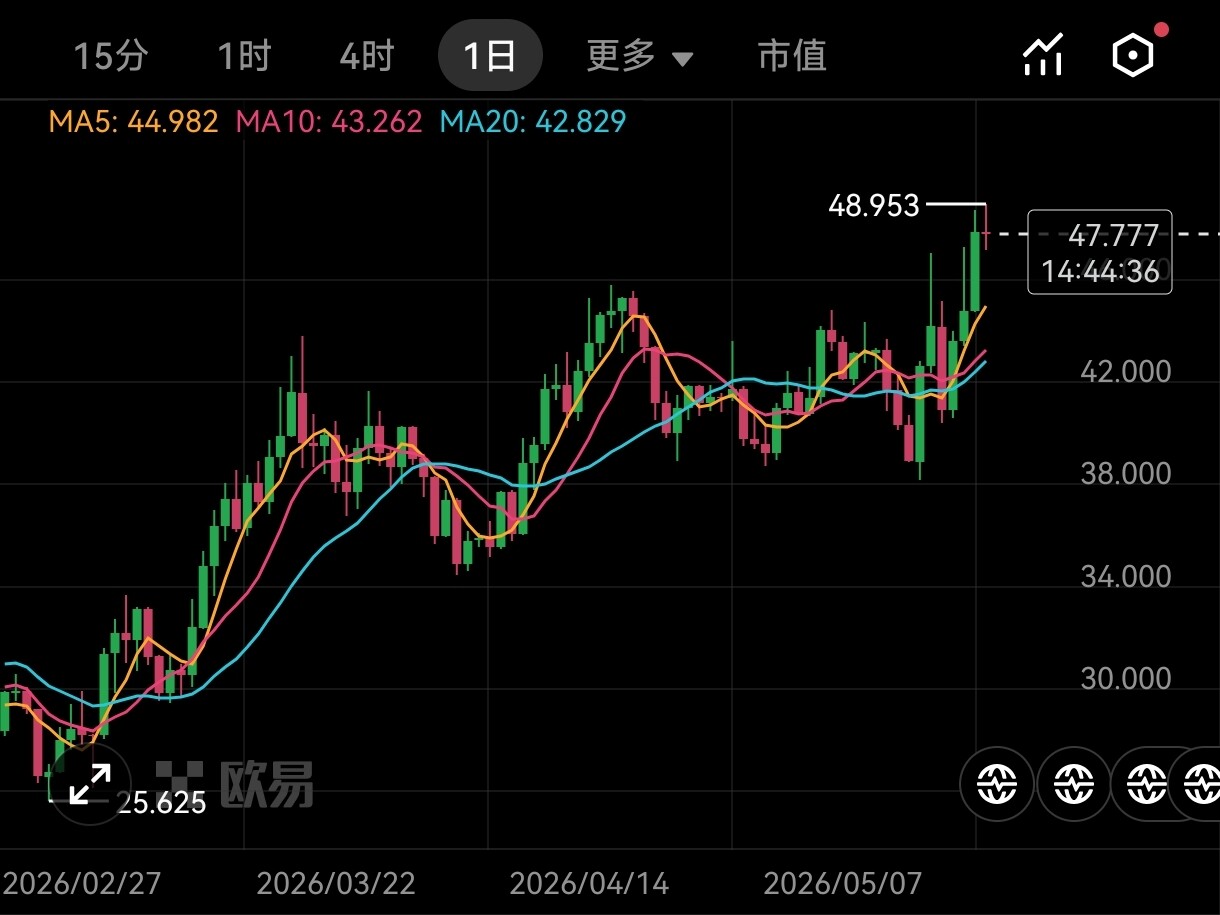
Previously, the public understanding of Hyperliquid was more limited to being a high-performance Perp DEX. However, capital is clearly no longer just buying a decentralized exchange platform token; it's betting that Hyperliquid can integrate more asset types, more liquidity, and more trading scenarios into the same on-chain trading system.

HYPE's price performance reflects the market reevaluating Hyperliquid's value.

In this article, Odaily Planet Daily will dissect the logic behind its rise through several key changes.

From THYP to BHYP: Compliant Buying Channels for HYPE Are Opening Up

The first external catalyst for HYPE's recent surge is the opening of ETF channels.

Currently, two asset management institutions have begun launching ETF products centered around Hyperliquid. On May 12, 21Shares listed the Hyperliquid ETF under the ticker THYP; on May 15, Bitwise listed the Hyperliquid ETF under the ticker BHYP. Data shows that as of May 18 EST, the total historical net inflow for 21Shares Hyperliquid ETF THYP reached $12.901 million; the total historical net inflow for Bitwise Hyperliquid ETF BHYP reached $2.0446 million.

More crucially, Bitwise did not stop at just issuing the ETF. Yesterday, Bitwise announced that it would use 10% of the management fee income from its BHYP Hyperliquid ETF to hold HYPE on its corporate balance sheet, and the related HYPE holdings will also be staked.

This transforms the ETF narrative from a mere product launch into a potential source of sustained buying pressure. The larger the ETF's scale and the higher its management fee income, the greater the theoretical amount Bitwise would allocate for acquiring HYPE. In the short term, this capital may not immediately dictate the price; but in the long run, it links ETF growth, the asset manager's income, and HYPE holdings together.

In other words, ETFs don't just bring HYPE one-time hype; they open a new funding channel. HYPE is starting to transition from a crypto-native asset into an on-chain trading platform token that traditional capital can also price.

USDC Returns to Hyperliquid: HYPE Gains Potential Daily Buying Pressure Exceeding $400k

The second reason for HYPE's recent rise is that with the return of USDC to Hyperliquid, the market has begun to recalculate the protocol's future stable revenue and whether this revenue can continue to flow towards HYPE buybacks.

According to an official Hyperliquid announcement, Coinbase will act as the fund deployer, Circle will be responsible for CCTP and native cross-chain infrastructure deployment, and both have committed to staking HYPE to activate AQAv2. This means the USDC return is not just a simple stablecoin integration, but a new mechanism established by Coinbase, Circle, and Hyperliquid around native USDC, cross-chain liquidity, and reserve yield distribution.

The key is that Coinbase will subsequently share the majority of USDC reserve yields with the Hyperliquid protocol. While the exact revenue split has not been officially disclosed, if referencing the previous USDH yield distribution mechanism, Hyperliquid could potentially receive about 90% of the reserve yields. Therefore, the market also interprets AQAv2 as a protocol revenue-sharing mechanism Hyperliquid established for USDC reserve yields.

Based on community calculations, assuming a $4.7 billion scale with a 3.8% annualized yield, USDC reserve yields correspond to approximately $160 million in annualized revenue, translating to potential daily HYPE buyback pressure of about $440,000. Once the AQAv2 interface is perfected and officially operational, Hyperliquid will no longer rely solely on trading fees for HYPE buybacks but may gain an additional, relatively stable source of cash flow.

This is where the USDC return truly impacts HYPE's pricing. Previously, the intensity of HYPE buybacks depended primarily on trading volume; the more active the trading, the higher the protocol revenue and buyback capacity. However, with the addition of USDC reserve yield buybacks, the source of buying pressure for HYPE is no longer solely dependent on trading fees but also on the amount of stablecoin liquidity Hyperliquid can attract and retain. In other words, trading fee buybacks represent platform trading activity, while USDC reserve yield buybacks represent the platform's ability to attract and retain capital. The market's repricing of HYPE may be precisely because it observes that HYPE's buyback story no longer relies solely on trading heat.

Hyperliquid Integrates HIP-4, Entering the Prediction Market Arena

Beyond RWA, Hyperliquid is also reaching into this year's hottest crypto sector—prediction markets.

On May 2, Hyperliquid launched HIP-4 Outcome Markets on its mainnet, initially offering intraday binary outcome contracts for BTC. Simply put, users can trade on whether the BTC price will be above a specified price at a certain point in time. Contract prices fluctuate between 0.001 and 0.999, reflecting the market's pricing of the event's probability; upon settlement, the contract pays out 1 if the event occurs and 0 if it does not.

Predictefy data shows that on the first day of HIP-4's launch, the trading volume for BTC price-related event contracts reached $6.15 million, placing Hyperliquid's volume in this specific market far ahead of competitors like Kalshi, Polymarket, and other prediction markets offering similar instruments.

For HYPE, the significance of HIP-4 is not just adding another product feature but connecting prediction markets to HYPE's staking, fee, and buyback mechanisms. According to the design, in the future, when deploying prediction events permissionlessly, market creators will need to stake 1 million HYPE, which is higher than the 500,000 HYPE required for deploying perpetual markets under HIP-3. Each staking slot can support rolling and periodic markets and can be reused after settlement. If issues like oracle manipulation, abnormal market states, or prolonged downtime occur, staked assets may be slashed.

Therefore, HIP-4 brings HYPE not just a simple prediction market concept boost but a more direct value-capture path. More permissionless deployment of prediction events means greater demand for HYPE staking, and more trading volume means more fee revenue, which ultimately feeds back into Hyperliquid's existing buyback logic.

RWA Open Interest Hits New Highs: Hyperliquid's Ceiling Isn't Just a Perp DEX

Beyond ETFs and USDC yield flows, RWA is pushing Hyperliquid's trading boundaries even further.

Data shows that the open interest size for RWA trading on the Hyperliquid platform has risen to $2.6 billion, setting a new all-time high and doubling compared to two months ago. This data indicates that Hyperliquid is no longer merely catering to trading demand for crypto assets like BTC, ETH, and SOL; real-world assets are also gaining scale within its on-chain trading system.

This is crucial for HYPE's valuation. If Hyperliquid were just a Perp DEX, its valuation anchors would primarily be the crypto cycle, trading volume, and fee revenue. But RWA opens up a different dimension: stocks, commodities, precious metals, Pre-IPO assets, etc., could all become subjects of 24/7 on-chain trading.

The significance of RWA for Hyperliquid isn't adding a few more trading pairs; it's pulling the platform out of the internal competition within the crypto market. Perp DEXs compete over who can capture more crypto trading volume, but RWA competition is about who can bring off-chain asset trading demand on-chain. If Hyperliquid can continue growing this market segment, HYPE's pricing will no longer just follow the crypto trading cycle but will begin to be tied to the much larger demand for real-world asset trading.

US SEC Plans to Propose Tokenized Stock Exemption, Adding Fuel to RWA Narrative

Potential US SEC regulatory easing for tokenized stocks is further raising Hyperliquid's long-term ceiling. According to reports, the US SEC is preparing to propose an innovation exemption for tokenized stock trading, allowing tokens tied to publicly traded company stocks to be traded on crypto platforms. Under certain circumstances, relevant platforms might not need full broker-dealer or exchange registration, and third-party-issued tokenized stocks might not even require consent from the listed company.

For Hyperliquid, this isn't about starting tokenized stock trading from scratch, but it adds a regulatory angle to the RWA direction it's already pursuing. On the Hyperliquid platform, trading for real-world assets like stocks and Pre-IPO assets is already gaining scale, and RWA open interest has also hit new highs. If US regulation genuinely opens an experimental window for tokenized stocks, this type of on-chain trading demand could be further amplified.

For Hyperliquid, the clearer the regulatory boundaries, the lower the resistance for real-world asset on-chain trading might become. Those best positioned to capture this incremental demand often aren't individual asset issuers but platforms capable of hosting order books, liquidity, and settlement. If tokenized stocks transition from a grey-area experiment to a compliant growth area, Hyperliquid's already-operating RWA business wouldn't just be an early attempt but could become the main battlefield in the next round of on-chain trading competition.

Fundamentals Continue to Strengthen, But Short-Term Enters a Bull-Bear Confrontation Zone

The logic behind HYPE's rise is becoming clearer. ETFs open channels for compliant capital, the USDC return brings potential incremental buyback pressure, and RWA, prediction markets, and tokenized stocks continue to expand Hyperliquid's trading boundaries. These changes all point in the same direction—Hyperliquid is no longer just a Perp DEX but is expanding into a larger on-chain trading system.

However, the validity of long-term logic doesn't guarantee a one-way short-term price rally. According to on-chain data, HYPE is currently witnessing a large-scale standoff between major whale long and short positions, with the TOP1 and TOP2 whales positioned as direct counterparties, with a total size exceeding $60 million. Bulls are betting on Hyperliquid's future growth potential, while bears are wagering on the pullback pressure after rapid short-term gains. As whale position sizes increase, HYPE's short-term price may no longer be determined solely by fundamentals but will also be influenced by factors like leverage liquidations, funding rates, and market sentiment.

Therefore, HYPE's short-term price movement is not easy to predict and will likely depend on which side of the whale confrontation is forced to exit first. However, when viewed over a longer horizon, HYPE's fundamentals remain compelling. Hyperliquid continues to expand tradable assets, capital entry points, and revenue streams, with HYPE playing an increasingly central role as a value carrier within the buyback, staking, and fee capture mechanisms.

Related Content

First-Day Trading Volume Crushes Polymarket: Hyperliquid Enters Prediction Markets with BTC Binary Options

Behind Coinbase's Acquisition of USDH: Hyperliquid's Strategic Choice

Domande pertinenti

QWhat are the two main external catalysts mentioned for HYPE's recent price increase?

AThe two main external catalysts are: 1) The opening of ETF channels with the launch of the THYP ETF by 21Shares and the BHYP ETF by Bitwise. 2) The return of USDC to Hyperliquid, establishing a new revenue-sharing mechanism with Coinbase and Circle.

QHow does the Bitwise Hyperliquid ETF (BHYP) potentially create a sustained buying pressure for HYPE?

ABitwise announced it will use 10% of the BHYP ETF's management fee income to purchase and stake HYPE on its corporate balance sheet. This means as the ETF grows and generates more fees, Bitwise will theoretically have more funds to buy HYPE, creating a potential continuous buy-side channel.

QAccording to the article, what is the estimated daily buy pressure for HYPE from the USDC reserve earnings (AQAv2) mechanism?

ABased on community estimates, the potential annual revenue from USDC reserves is around $160 million, which translates to an estimated daily buy pressure of approximately $440,000 for HYPE through protocol buybacks.

QWhat new market did Hyperliquid enter with HIP-4, and what is the HYPE staking requirement for creators on that platform?

AHyperliquid entered the prediction market with HIP-4 Outcome Markets. Creators wishing to deploy prediction events permissionlessly will need to stake 1 million HYPE, which is double the 500,000 HYPE required for deploying perpetual markets under HIP-3.

QWhat does the article suggest is the primary reason for the short-term price uncertainty of HYPE despite its strong fundamentals?

AThe short-term price uncertainty is attributed to large-scale whale positioning, where the top long and top short whale positions are acting as direct counterparties with a total size exceeding $60 million. This introduces volatility based on leverage, funding rates, and market sentiment, independent of the long-term fundamentals.

Letture associate

Why Haven't Forex Stablecoins Taken Off?

Why FX Stablecoins Never Took Off: A Path Forward via Synthetic FX Despite the explosive growth of stablecoin-powered digital banking, which has seen ~$6B in VC investment and a 24x surge in crypto card spending in under a year, a major limitation persists: these banks are essentially dollar-only accounts. This leaves 95-99% of global accounts, which are denominated in non-USD currencies, underserved. Attempts to create native foreign currency (FX) stablecoins (like EURC) have largely failed, with total FX stablecoin TVL at ~$600M compared to $400B for USD stablecoins—a 700x gap. These FX tokens face critical challenges: fragile pegs due to low liquidity, limited exchange/FinTech acceptance, poor on/off-ramps, complex regional compliance, and a chicken-and-egg adoption problem. The article argues that the solution lies not in competing with entrenched USD stablecoin networks (USDT/USDC), but in adopting a synthetic FX model inspired by traditional finance. Specifically, it advocates for Mark-to-Market Non-Deliverable Forwards (NDFs)—cash-settled FX derivatives that allow users to maintain underlying USD stablecoin holdings while having their account balance and P&L denominated in a foreign currency. This approach offers key advantages: strong oracle-based pegs, retention of deep USD stablecoin liquidity and yield, superior on/off-ramps, scalability to any currency with a reliable feed, and capital efficiency. It mirrors how modern institutional FX markets operate. Primary use cases for on-chain NDFs include: 1. **Digital Banks/Wallets:** Enabling multi-currency accounts for international users without leaving the USD stablecoin ecosystem, boosting deposits and retention. 2. **FX Carry Trade Vaults:** Offering access to sovereign interest rate differentials (e.g., earning yield on BRL) in a more stable and scalable format than crypto-native products like Ethena. 3. **Global Enterprise Payments:** Allowing merchants to receive payments in local currency equivalents while settling in USD stablecoins, similar to services offered by Stripe for fiat. The conclusion is that synthetic FX, not native FX stablecoins, is the viable path to integrating foreign exchange into the growing stablecoin digital banking landscape, potentially unlocking the next phase of institutional DeFi and multi-trillion-dollar global adoption.

链捕手32 min fa

Why Haven't Forex Stablecoins Taken Off?

链捕手32 min fa

IOSG Founder: Web3 Is 'Losing Blood,' How Can Practitioners Survive Better?

IOSG Founder: Web3 Is "Bleeding Out" – How Can Practitioners Survive Better? In a candid reflection, the founder of IOSG Ventures voices deep concerns about the current state of Web3, describing an ecosystem experiencing severe "blood loss." Despite the recent MuShanghai event showcasing a successful pivot towards a more diverse, global community, a somber reality persists: many crypto-native attendees were there exploring exits or new labels in biotech, AI, and robotics. The core issue is identified as a breakdown in the ecosystem's positive feedback loop. Alarmingly, underestimated "low-probability bad events" are occurring simultaneously: a significant brain drain of Chinese developers to AI, a lack of breakout applications despite massive funding, and a widening credibility gap for practitioners globally, often stigmatized as scam artists. This has created a dire接班人 (successor) problem, with the next generation seeing little professional prestige or financial upside in crypto compared to fields like AI. A significant portion of the critique focuses on Ethereum and Vitalik Buterin. While not pessimistic about Ethereum's technology, the founder worries that critical development windows were missed by focusing on niche technical narratives like ZK and L2 instead of mass-market applications. A more urgent concern is that Vitalik may be isolated in an "information bubble," shielded from the grassroots community's hardships by layers of intermediaries, preventing crucial feedback from reaching him. The call is for Vitalik to return to a founder's mindset, re-engage directly with the community, and rally efforts for the next decade. The divergence between U.S. and Chinese OG (Original Gangster) ecosystems is stark. While many U.S. builders reinvest their wealth into the ecosystem, the Chinese scene suffers from a severe lack of "造血能力" (blood-making ability), with most market-driven funds struggling and many early success stories cashing out entirely. This threatens the entire Asian Web3 ecosystem's survival. For individual practitioners, survival advice is pragmatic: find your core "why," maintain life balance beyond token prices, continuously learn new skills (like AI), form small, trusted alliances for mutual support, and practice self-compassion. The industry's greatest need is not money or tech, but lighthouses—individuals at all levels who offer mentorship, grants, referrals, and honest reflection to guide others. The piece concludes with a direct appeal: OGs must pay forward the opportunities the industry gave them; founders must not struggle alone; and builders must continue their work, ensuring it remains a viable profession. The survival of Web3's "cathedral" depends not on any single leader but on the collective responsibility of everyone who remains.

marsbit1 h fa

IOSG Founder: Web3 Is 'Losing Blood,' How Can Practitioners Survive Better?

marsbit1 h fa

Deficits, Inflation, and the New Fed: The Deep Logic Behind US Bond Yields Breaking 5% and the Market Reset

In the week of May 15-19, 2026, U.S. long-term Treasury yields surged to multi-year highs, with the 30-year yield hitting 5.2%, a level unseen since 2007, and the 10-year yield climbing to 4.687%. Equity markets declined in response. Four primary factors are driving the rise in yields. First, stubborn inflation persists, with April wholesale prices rising 6% year-over-year, fueling expectations of potential future Fed rate hikes instead of cuts. Second, newly confirmed Fed Chair Kevin Warsh inherits a complex inflation battle, with markets closely awaiting his first FOMC meeting. Third, deteriorating U.S. fiscal health, marked by large deficits and rising debt servicing costs, is eroding the traditional "safe-haven" premium for Treasuries. Fourth, the "One Big Beautiful Bill" tax cuts are projected to add trillions to the national debt, contributing to Moody's recent credit rating downgrade. Rising yields pressure stocks through several channels: a higher discount rate reduces the present value of future earnings (especially for growth stocks); rising risk-free rates compress equity risk premiums, making bonds relatively more attractive; higher borrowing costs impact consumers and corporations; and a stronger dollar affects multinational earnings. For investors, the environment favors value and financial stocks over long-duration growth stocks. Bond investors find attractive yields in short to intermediate maturities, while income investors see the best fixed-income opportunities in over a decade. Key developments to watch include Chair Warsh's first FOMC meeting, upcoming inflation data, Treasury auction demand, and whether the 30-year yield approaches 6%, a level that could trigger a more sustained equity valuation reset. The bond market's message is clear: the era of cheap government borrowing is over, posing a central challenge for markets in late 2026.

marsbit1 h fa

Deficits, Inflation, and the New Fed: The Deep Logic Behind US Bond Yields Breaking 5% and the Market Reset

marsbit1 h fa

Is MicroStrategy Selling Bitcoin Not a Bearish Signal? Deconstructing the 5 Financial Logics Behind Corporate Bitcoin Divestment

The article "Is Strategy Selling Bitcoin Not a Bearish Signal? Decoding 5 Financial Logics Behind Corporate Bitcoin Divestment" analyzes why companies might sell their bitcoin holdings, arguing it's not necessarily negative. It begins by noting the market's surprise at Strategy's potential sale, contrasting its previous "never sell" stance. The core argument is that corporate decisions prioritize shareholder value, and selling bitcoin can be a rational strategic choice. The article outlines five key financial reasons for such sales: 1. **Increase Bitcoin Holdings Per Share:** Companies can use proceeds from bitcoin sales to repurchase shares when the stock price is undervalued relative to its bitcoin assets. This reduces the outstanding share count, potentially increasing the bitcoin amount backing each remaining share. 2. **Optimize Capital Structure & Reduce Financing Costs:** Building cash reserves through bitcoin sales can improve credit ratings (as favored by agencies like S&P), leading to lower future borrowing costs. Repaying debt with sale proceeds also reduces financial leverage. 3. **Legitimate Tax Planning:** In the absence of wash-sale rules for bitcoin in the US, companies can sell to realize capital losses, then repurchase, lowering the tax basis of their holdings and creating tax offsets. 4. **Counter Negative Market Narratives:** A controlled, non-disruptive sale could demonstrate market resilience and disprove fears that corporate selling would crash the market, thereby normalizing bitcoin as a corporate treasury asset. 5. **Repurchase Preferred Stock at a Discount:** If a company's preferred stock trades significantly below its face value, using bitcoin sale proceeds to repurchase it can retire expensive liabilities at a profit, saving on future dividend payments. The conclusion emphasizes that bitcoin's monetary properties offer flexibility. Strategic sales can protect corporate and shareholder interests, making asset utilization more important than rigid "hold" mandates.

marsbit1 h fa

Is MicroStrategy Selling Bitcoin Not a Bearish Signal? Deconstructing the 5 Financial Logics Behind Corporate Bitcoin Divestment

marsbit1 h fa

Trading

Spot
Futures

Articoli Popolari

Come comprare HYPE

Benvenuto in HTX.com! Abbiamo reso l'acquisto di Hyperliquid (HYPE) semplice e conveniente. Segui la nostra guida passo passo per intraprendere il tuo viaggio nel mondo delle criptovalute.Step 1: Crea il tuo Account HTXUsa la tua email o numero di telefono per registrarti il tuo account gratuito su HTX. Vivi un'esperienza facile e sblocca tutte le funzionalità,Crea il mio accountStep 2: Vai in Acquista crypto e seleziona il tuo metodo di pagamentoCarta di credito/debito: utilizza la tua Visa o Mastercard per acquistare immediatamente HyperliquidHYPE.Bilancio: Usa i fondi dal bilancio del tuo account HTX per fare trading senza problemi.Terze parti: abbiamo aggiunto metodi di pagamento molto utilizzati come Google Pay e Apple Pay per maggiore comodità.P2P: Fai trading direttamente con altri utenti HTX.Over-the-Counter (OTC): Offriamo servizi su misura e tassi di cambio competitivi per i trader.Step 3: Conserva Hyperliquid (HYPE)Dopo aver acquistato Hyperliquid (HYPE), conserva nel tuo account HTX. In alternativa, puoi inviare tramite trasferimento blockchain o scambiare per altre criptovalute.Step 4: Scambia Hyperliquid (HYPE)Scambia facilmente Hyperliquid (HYPE) nel mercato spot di HTX. Accedi al tuo account, seleziona la tua coppia di trading, esegui le tue operazioni e monitora in tempo reale. Offriamo un'esperienza user-friendly sia per chi ha appena iniziato che per i trader più esperti.

252 Totale visualizzazioniPubblicato il 2024.12.11Aggiornato il 2026.04.28

Come comprare HYPE

Discussioni

Benvenuto nella Community HTX. Qui puoi rimanere informato sugli ultimi sviluppi della piattaforma e accedere ad approfondimenti esperti sul mercato. Le opinioni degli utenti sul prezzo di HYPE HYPE sono presentate come di seguito.

活动图片













