Why is Ethereum Urgently Needing ZK-ification?

marsbitPubblicato 2026-01-13Pubblicato ultima volta 2026-01-13

Introduzione

The article discusses the urgent need for Ethereum to adopt zero-knowledge (ZK) technology as a core narrative for its future development. While Ethereum previously focused on ICOs, DeFi, and being a global financial settlement layer, it now lacks a compelling new narrative. ZK technology is highlighted as a critical solution, with Ethereum being the blockchain most invested in its development. ZK-EVM has reached the Alpha stage, a milestone celebrated by Vitalik Buterin. The primary motivation for ZK integration is to maintain Ethereum’s decentralization while improving scalability. Currently, increasing the Gas limit boosts TPS but raises node operation costs, potentially centralizing the network. ZK proofs allow nodes to verify transactions efficiently without expensive hardware upgrades, similar to automated exam grading versus manual checking. ZK itself doesn’t directly increase TPS but enables future Gas limit hikes with minimal node cost increases. The recent Fusaka upgrade, including PeerDAS, advances this goal. A ZK-powered Ethereum could achieve over 1000 TPS, strengthening its narrative. The article also addresses the role of third-party ZK teams (e.g., Polygon, Scroll, ZKsync, Taiko), which remain crucial for innovation and testing different ZK-EVM types (Type 1 to 4). ZK-VMs, like Brevis, are noted for higher performance and diversity, as they aren’t constrained by EVM compatibility. While ZK L1 may attract some L2 users, it also benefits L2s by reducing costs...

One of the most frequently asked questions recently is, how to view Ethereum's narrative?

Admittedly, Ethereum focused on ICOs and the world computer in 2017, and on DeFi and the financial settlement layer in 2021. However, for the 2025 cycle, there seems to be few new narratives that can match the height of the old ones.

Perhaps ETF and Staking ETF count as half, but this is not within the control of Ethereum developers. If there is another half, it can only be ZK.

Ethereum is undoubtedly the public chain that has bet the most on ZK in the entire Crypto world.

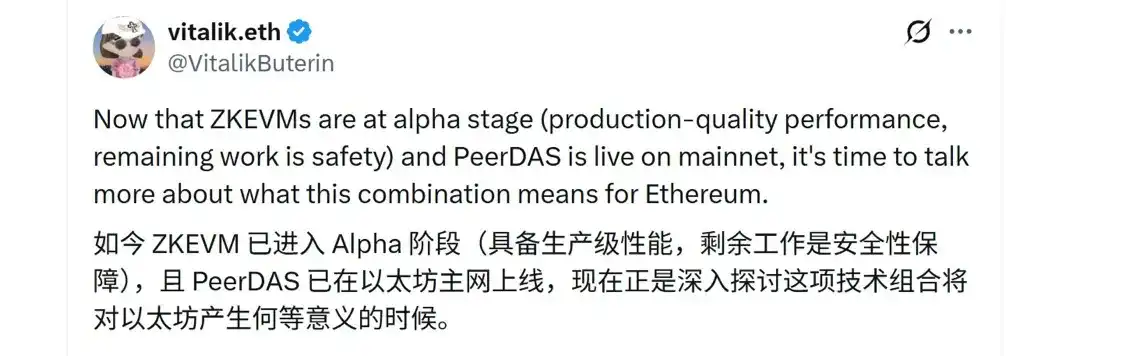
A few days ago, Vitalik was quite excited. He officially announced on Twitter that ZKEVM has now entered the Alpha stage.
Why is Ethereum so persistent about ZK?

Actually, Ethereum's TPS is not low anymore, with the theoretical peak already increased to over 200 TPS. The main reason is that Ethereum has repeatedly raised the Gas limit.
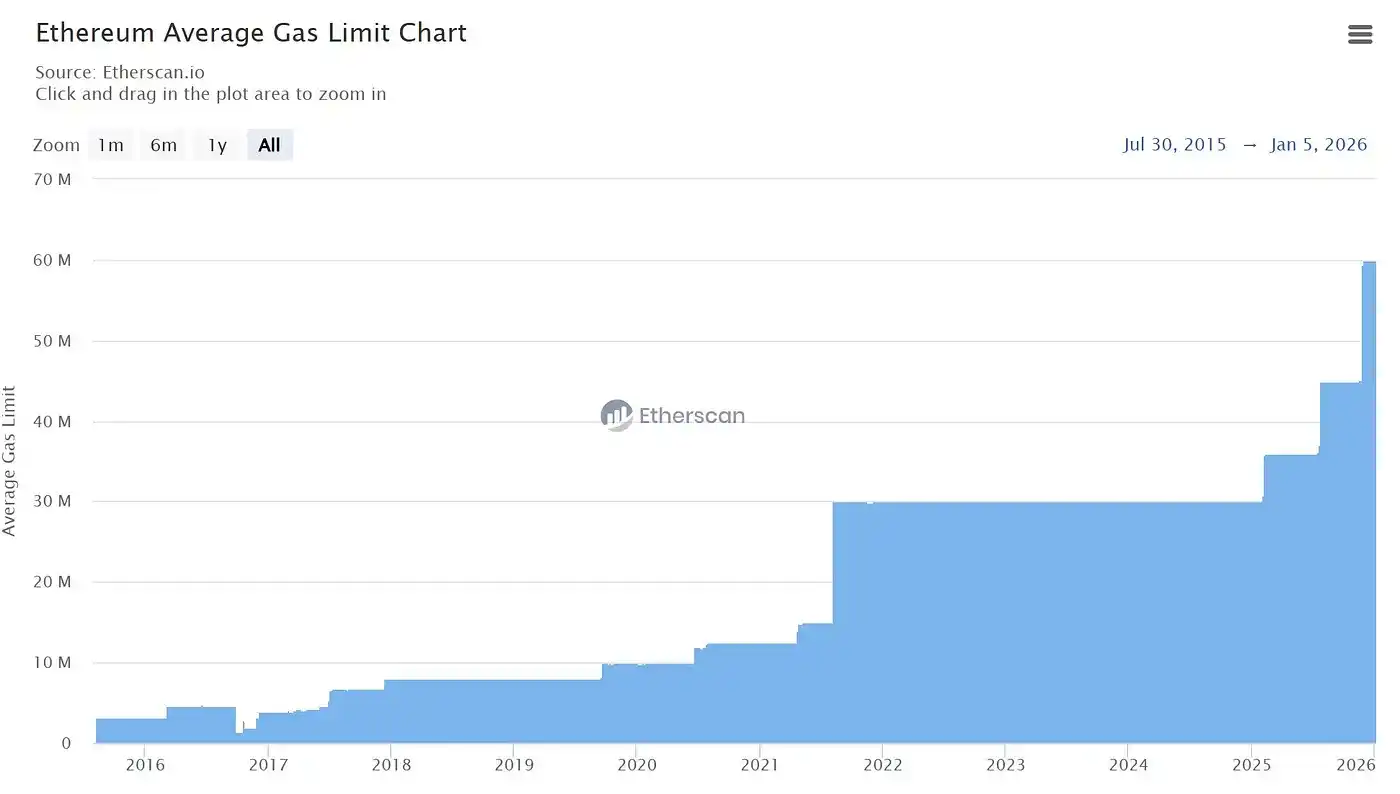
However, raising the Gas limit comes at a cost and cannot be done indefinitely. Its cost is that nodes need more expensive servers to run.

But Ethereum also wants to maintain its proud high degree of decentralization, so it cannot push node server performance too high (refer to Solana, where a single server is about 5–10 times more expensive than an ETH server).

Therefore, the mainnet must be ZK-ified. Note, this is not about creating a few ZK L2s; this is a full ZK-ification of the L1 mainnet.

So what are the benefits after ZK-ification?

Those ETH nodes can simply verify these ZK proofs, without needing to tediously verify transactions one by one as in the past.
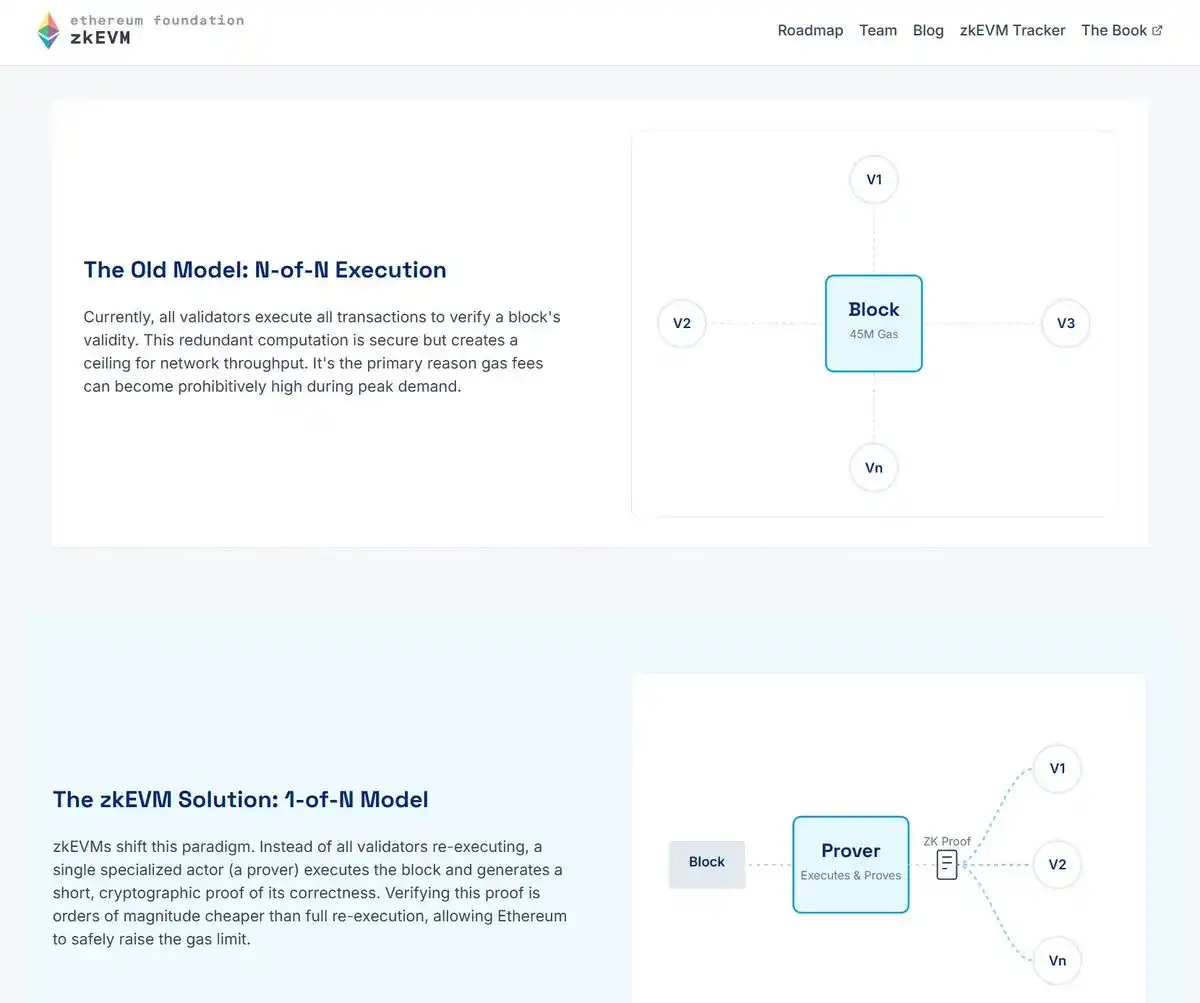
For example, if you are a grading teacher (node), the transactions are the students' exam papers.

In the past, manually grading papers was slow. But since the invention of the answer sheet (ZK-ification)神器, the machine calculates the total score in a second, so as a teacher, aren't you much more relaxed?

You are relaxed; in the past, one person could only grade 50 papers, but now they can grade 1000. The person is the same, but efficiency skyrockets.

Therefore, Ethereum must first ZK-ify the mainnet, and then it can significantly raise the Gas limit again.

ZK-ification itself does not directly increase TPS; it is a prerequisite. Improving performance still relies on raising the Gas limit, but after ZK-ification, nodes do not need to increase server costs much, making the代价很小.

After the recent Fusaka upgrade (especially the PeerDAS upgrade) performed well, Ethereum has taken another step closer to mainnet ZK-ification, which is why Vitalik is so excited.

Imagine a mainnet with TPS breaking thousands; for Ethereum, that indeed counts as a decent narrative.

Someone raised a question:

If Ethereum itself builds a ZK-EVM for the mainnet, are other ZK teams still meaningful?

First, the conclusion is, they are still meaningful.

Why?

First, ZK engineering is one of the most difficult developments in the entire network, sitting at the same table as FHE. It requires a large number of cryptography talents.

It is believed that the ETH Foundation has some reserves in this area, but as an open-source community, Ethereum adheres to the philosophy that many hands make light work. It needs a large number of third-party ZK teams for trial, error, and innovation. In return, Ethereum will give substantial support.

Second, there are four types of ZK-EVM, from type 1 to type 4. Several groups, including Polygon, Scroll, ZKsync, and Taiko, are like each认领任务,分别实现其中一个类型.

Additionally, there is ZK-VM, such as Brevis.

In fact, ZK-VM's position is even more stable compared to ZK-EVM.

The reason is that among the four major ZK-EVM types, it is highly likely that one with the best cost-performance ratio will eventually be chosen to become part of the designated solution for Ethereum's mainnet ZK-EVM, which may affect the other three.

However, for ZK-VM, it is not EVM-compatible by nature, so it will definitely be part of Ethereum's diversity.

Moreover, since VM is not constrained by EVM limitations, its performance can run very high. Ethereum's ZK-EVM poses no threat to it; instead, the Ethereum official will continue to encourage it.

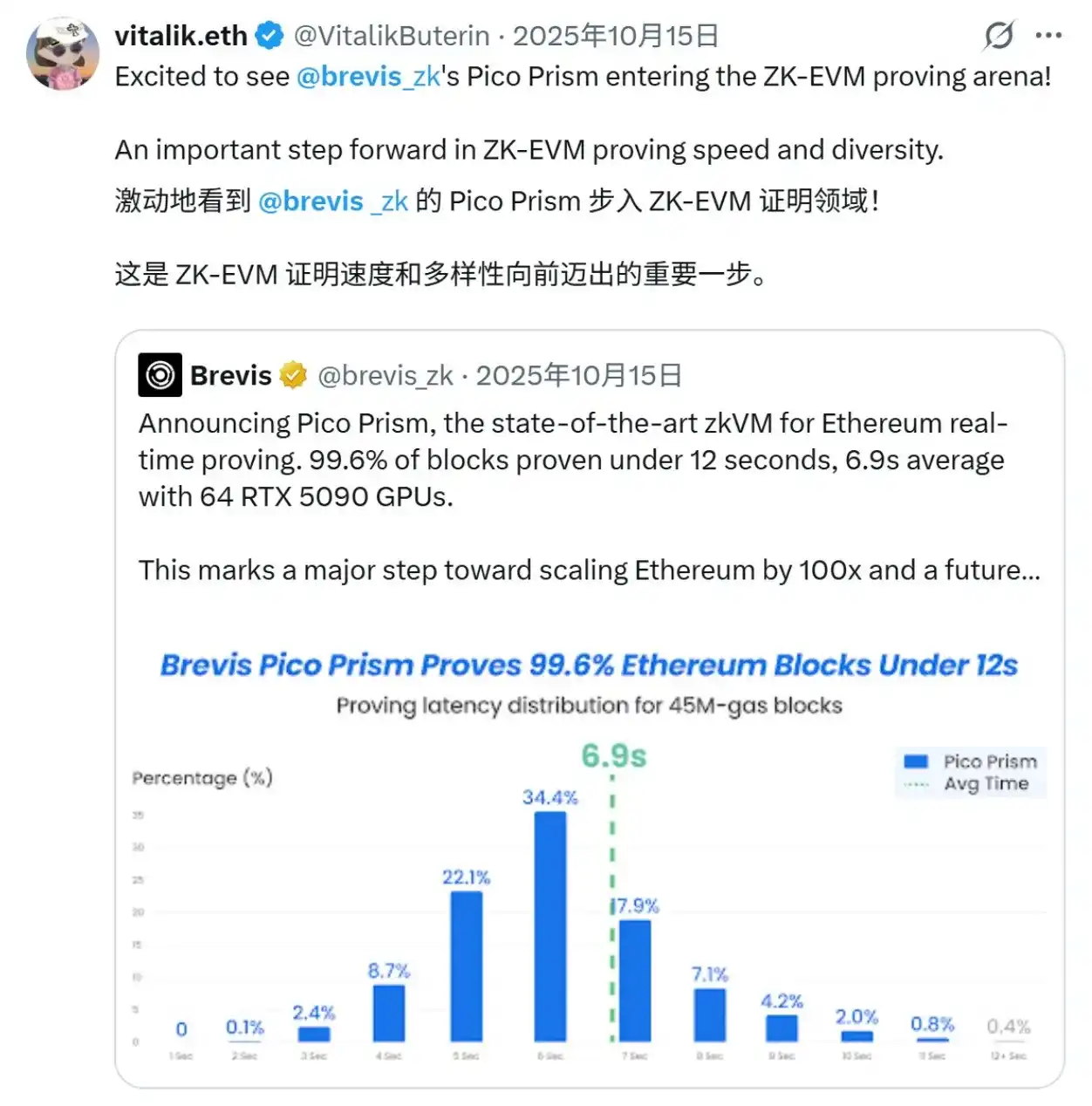
For example, Vitalik previously specifically mentioned the performance of Brevis's ZK-VM and expressed期待它们进入 ZK-EVM 领域.
What about L2?There might be some impact, but it's still not significant.

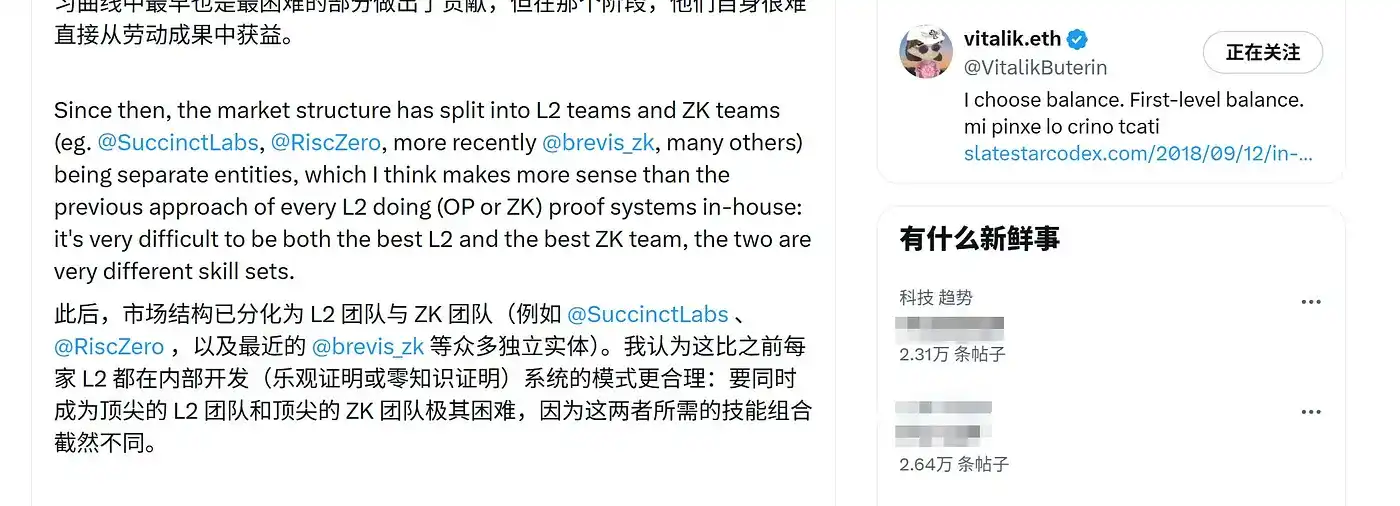
Vitalik once said when discussing Polygon that ZK and L2 should be separated比较好.

The ZK-ified L1 will certainly attract back some users from ZK L2s. After all, if L1 is cheap enough, the number of users on L2 may decrease.

But think about it the other way: if L1 is the foundation and L2 is the skyscraper, the foundation must be as solid as possible. So, if the L1 mainnet is ZK-ified, L2 fees will also decrease, which is beneficial.

Moreover, in that tweet, Vitalik also specifically mentioned Brevis, which works on ZK-VM. The reason is that much of Brevis's ZK work is not limited to L2, meaning "ZK research and L2 research are separated."

For example, they have a ZK computing power market, helping with ZK-ified reward distribution for Uniswap's hooks, which is application-driven.
In summary, Ethereum has been online for 10 years now, and the slogan of ZK-ification has been proposed for five or six years. After continuous cultivation, ZK-ification has finally entered the Alpha stage. This is thanks to the continuous investment from Ethereum and numerous third-party ZK teams including Brevis and Polygon.


Domande pertinenti

QWhy does Ethereum urgently need to become ZK-based according to the article?

AEthereum needs to become ZK-based to significantly increase its TPS by raising the Gas limit without forcing node operators to use prohibitively expensive servers, thereby preserving its high degree of decentralization while scaling.

QWhat is the role of ZK technology in improving Ethereum's node efficiency?

AZK technology allows nodes to simply verify cryptographic proofs of transaction batches instead of manually verifying each transaction individually, dramatically increasing the number of transactions a node can process without a proportional increase in computational cost.

QHow does the article differentiate between ZK-EVM and ZK-VM, and which one is considered more stable?

AThe article states that ZK-VM is considered more stable because it is not EVM-compatible and exists as part of Ethereum's diversity. It is not threatened by Ethereum's own ZK-EVM development and is performance-optimized without EVM constraints.

QWhat impact might a ZK-based Ethereum L1 have on existing ZK L2s?

AA cheaper and more scalable ZK-based L1 might attract some users back from L2s. However, it also benefits L2s by providing a more robust foundational layer (L1), which can lead to lower fees on L2s as well.

QWhat is the significance of the 'Alpha stage' announcement for ZKEVM mentioned in the article?

AThe announcement that ZKEVM has entered its Alpha stage signifies a major milestone after years of development, indicating that the core technology for Ethereum's full ZK integration is becoming operational and bringing the vision of a high-TPS, decentralized mainnet closer to reality.

Letture associate

Anthropic's IPO Launch: Commercial Miracle or Valuation Bubble?

Anthropic has confidentially filed for an IPO, led by Morgan Stanley and Goldman Sachs, potentially going public by October. Following its latest $650 billion funding round, its pre-IPO valuation stands at $965 billion, with projections reaching up to $2 trillion at listing, which would make it the highest-valued private company ever. The article, written by Fu Sheng, addresses skepticism that this represents an AI bubble akin to the 2000 dot-com crash. It argues the current situation differs fundamentally. Unlike the internet bubble era, which relied on speculative narratives with little revenue, Anthropic's valuation is backed by unprecedented, measurable financial performance. Key data points include: * **Revenue Growth:** ARR skyrocketed from $10 billion in early 2025 to $470 billion by May 2026, targeting $100 billion by year-end—a growth curve unmatched in business history. * **Profitability:** It achieved operating profitability in Q2 2026 with an estimated $5.6 billion profit. * **Efficiency:** With ~3,000 employees and ~$470 billion ARR, its revenue per employee exceeds $10 million. Products like Claude Code, launched less than a year ago, already generate $25 billion in annualized revenue. * **Enterprise Adoption:** It boasts a strong enterprise client base, with 8 of the Fortune 10 and over 1,000 large firms spending over $1 million annually on Claude. The valuation is framed using a traditional SaaS model (e.g., a 10x Price-to-Sales multiple on $100 billion revenue). The author contends the core question for analysts has shifted from "How big could this be?" to "How much is it earning and will earn next quarter?" The discussion extends beyond Anthropic to a broader paradigm shift: the transition from a "carbon-based" to a "silicon-based" economy. Companies are increasingly prioritizing investment in compute and AI capabilities over human resources, as these directly scale productivity and competitive advantage. Anthropic's IPO is thus positioned not just as a corporate milestone, but as a price anchor for this new economic era.

链捕手1 h fa

Anthropic's IPO Launch: Commercial Miracle or Valuation Bubble?

链捕手1 h fa

Near Returns to the AI Stage: Transformation into a Public Chain Due to 'Payroll Difficulties,' Agent and Privacy Emerge as New Growth Narratives

NEAR Returns to AI Origins: From Payroll Struggles to Blockchain, Now Focusing on AI Agents and Privacy NEAR Protocol's journey began not with grand blockchain ambitions, but from a practical hurdle: its AI startup founders, including Transformer paper co-author Illia Polosukhin, couldn't efficiently pay international developers in 2017. This led them to pivot and build a high-performance, scalable blockchain. After years navigating various crypto narratives like sharding and cross-chain interoperability, NEAR is now leveraging its AI roots to re-enter the AI arena. A key driver is its "NEAR Intents" layer, which abstracts complex cross-chain transactions. Users simply state their goal (e.g., swap BTC for ETH), and a solver network finds the optimal route. This system has processed over $20B in cross-chain volume, generating significant fee revenue. A major growth area is private transactions via "Confidential Intents/Swaps," which hide trade details until settlement to protect against MEV and front-running. Remarkably, private swaps recently accounted for over 40% of NEAR's transaction volume, highlighting strong demand but also potential regulatory scrutiny. With its AI-founder pedigree, NEAR is positioning itself at the intersection of blockchain, AI agents, and privacy, aiming to become infrastructure for the emerging agent economy while navigating the challenges of its rapid adoption.

marsbit4 h fa

Near Returns to the AI Stage: Transformation into a Public Chain Due to 'Payroll Difficulties,' Agent and Privacy Emerge as New Growth Narratives

marsbit4 h fa

From Ethereum to AI's 'CROPS': What Exactly is This Set of 'Slow Variables' That Vitalik Repeatedly Emphasizes?

In recent discussions, Vitalik Buterin has frequently emphasized the concept of "CROPS," a framework defining core values for Ethereum's development. CROPS stands for Censorship Resistance, Capture Resistance, Open Source, Privacy, and Security. Initially outlined in the Ethereum Foundation's "EF Mandate," it represents a commitment to user sovereignty, ensuring that the network resists external control, remains open, protects privacy, and prioritizes security. The relevance of CROPS extends beyond Ethereum's foundational principles, becoming crucial in the context of AI integration. As AI agents begin handling wallet operations and automated transactions, the risk increases that users may cede control over their digital assets, privacy, and intentions to centralized AI service providers. A "CROPS AI" would therefore emphasize local execution where possible, privacy-preserving remote model calls (e.g., using zero-knowledge proofs), and transparent, verifiable processes to maintain user agency. Vitalik highlights a significant convergence between "CROPS Ethereum access layer" and "CROPS AI." Both address the same fundamental challenge: how users can access powerful services—be it blockchain data via RPCs or AI models—without exposing sensitive information or relinquishing ultimate control. This intersection points toward a future digital entry point that is more private, secure, and user-controlled. Ultimately, CROPS is not merely an abstract ideal but a practical guidepost. It steers development—from protocol resilience and wallet design to AI agent safety—towards a future where users retain self-sovereignty even as digital systems grow more complex and powerful. In an era of accelerating AI adoption, these "slow variables" of censorship resistance, openness, privacy, and security may define Ethereum's enduring value.

marsbit4 h fa

From Ethereum to AI's 'CROPS': What Exactly is This Set of 'Slow Variables' That Vitalik Repeatedly Emphasizes?

marsbit4 h fa

Trading

Spot
Futures

Articoli Popolari

Come comprare ZK

Benvenuto in HTX.com! Abbiamo reso l'acquisto di ZKsync (ZK) semplice e conveniente. Segui la nostra guida passo passo per intraprendere il tuo viaggio nel mondo delle criptovalute.Step 1: Crea il tuo Account HTXUsa la tua email o numero di telefono per registrarti il tuo account gratuito su HTX. Vivi un'esperienza facile e sblocca tutte le funzionalità,Crea il mio accountStep 2: Vai in Acquista crypto e seleziona il tuo metodo di pagamentoCarta di credito/debito: utilizza la tua Visa o Mastercard per acquistare immediatamente ZKsyncZK.Bilancio: Usa i fondi dal bilancio del tuo account HTX per fare trading senza problemi.Terze parti: abbiamo aggiunto metodi di pagamento molto utilizzati come Google Pay e Apple Pay per maggiore comodità.P2P: Fai trading direttamente con altri utenti HTX.Over-the-Counter (OTC): Offriamo servizi su misura e tassi di cambio competitivi per i trader.Step 3: Conserva ZKsync (ZK)Dopo aver acquistato ZKsync (ZK), conserva nel tuo account HTX. In alternativa, puoi inviare tramite trasferimento blockchain o scambiare per altre criptovalute.Step 4: Scambia ZKsync (ZK)Scambia facilmente ZKsync (ZK) nel mercato spot di HTX. Accedi al tuo account, seleziona la tua coppia di trading, esegui le tue operazioni e monitora in tempo reale. Offriamo un'esperienza user-friendly sia per chi ha appena iniziato che per i trader più esperti.

190 Totale visualizzazioniPubblicato il 2024.12.13Aggiornato il 2026.06.02

Come comprare ZK

Discussioni

Benvenuto nella Community HTX. Qui puoi rimanere informato sugli ultimi sviluppi della piattaforma e accedere ad approfondimenti esperti sul mercato. Le opinioni degli utenti sul prezzo di ZK ZK sono presentate come di seguito.

活动图片








