Why Hyperliquid’s $48B oil-driven volume could signal a crypto reset

ambcryptoPubblicato 2026-03-20Pubblicato ultima volta 2026-03-20

Introduzione

Middle East tensions are causing a significant oil supply shock, driving traders to seek 24/7 exposure through perpetual contracts on Hyperliquid. This has positioned Hyperliquid as the leading perp DEX by volume, with weekly trades nearing $48 billion. The platform's native token, HYPE, has surged 30% monthly, diverging from most altcoins. However, this rally is fueled by leveraged long positions and geopolitical FOMO. Analysts suggest that an unwind of these crowded oil trades on Hyperliquid could signal easing tensions and potentially trigger a broader crypto market reset towards risk-on sentiment.

A supply shock is a strong catalyst, especially for traders chasing short-term upside.

Currently, the West Asian crisis is driving a real supply-side squeeze in the oil market. As a result, investor sentiment is shifting, with oil flows picking up and traders increasingly positioning for further upside. In short, long positions are becoming more aggressive as the narrative gains momentum.

Against this backdrop, Hyperliquid [HYPE] is starting to stand out as a key beneficiary. According to DeFiLlama data, it’s now leading perp DEX volume, with weekly volume nearing $48 billion, roughly 2x larger than the next platform in line.
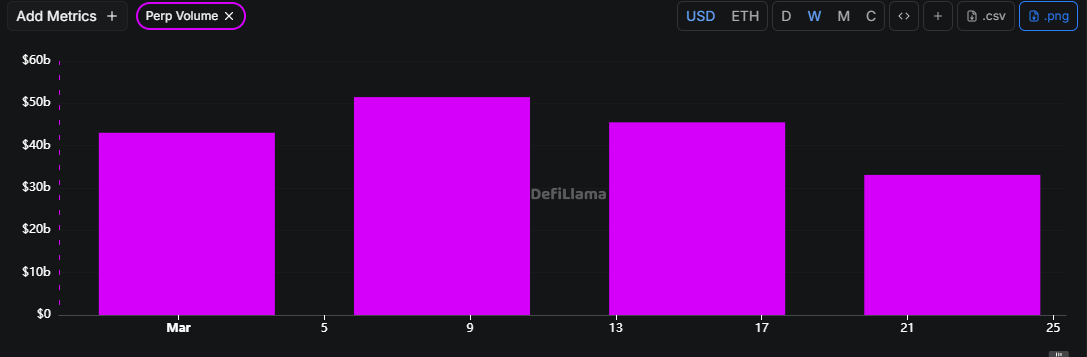
Source: DeFiLlama

Importantly, this shift is also catching the attention of major TradFi players.

JPMorgan analysts, for instance, point to traders chasing 24/7 oil exposure as the main driver behind the spike in Hyperliquid’s perp DEX volume, a gap TradFi markets still don’t cover. As a result, Hyperliquid is gaining an edge in capturing incremental flow and liquidity.

Notably, this on-chain activity is showing up in HYPE’s price action as well. On the monthly chart, HYPE is up roughly 30%, clearly diverging from other high-cap altcoins that are mostly printing single-digit gains. In short, the market is starting to price in this edge.

However, with HYPE now running into resistance around the $2.3k level, a strong case remains that macro FUD and crowded positioning are driving this move rather than a sustained trend. Consequently, if flows cool or positioning gets too crowded, it increases the risk of an unwind.

So the key question is: If we start to see large long squeezes and exits on Hyperliquid, could that flush act as a signal for a market reset and indicate when the broader crypto market flips back to risk-on?

Traders piling into oil on Hyperliquid raise the question of a reset

The conflict in the Middle East has thrown the global oil market into disarray.

According to the Kobeissi Letter, oil prices have jumped sharply since December, and Saudi Arabia’s prediction markets are calling for the war to last through April, with $180 tagged as the “base case” for oil. In short, the market is bracing for continued volatility and supply-driven moves.

In this setup, Lookonchain flagged a trader depositing 4.105 million USDC on Hyperliquid to open a 5x long on $20.19 Brent oil, showing how traders are chasing FOMO and using leverage to capture outsized returns in the oil market. The bigger picture, though? Moves like this underline Hyperliquid’s central role in enabling perp trades and explain why its DEX volume keeps hitting new highs.
Source: TradingView (BRENT OIL/USD)

From a technical angle, these perp bets on Hyperliquid make total sense.

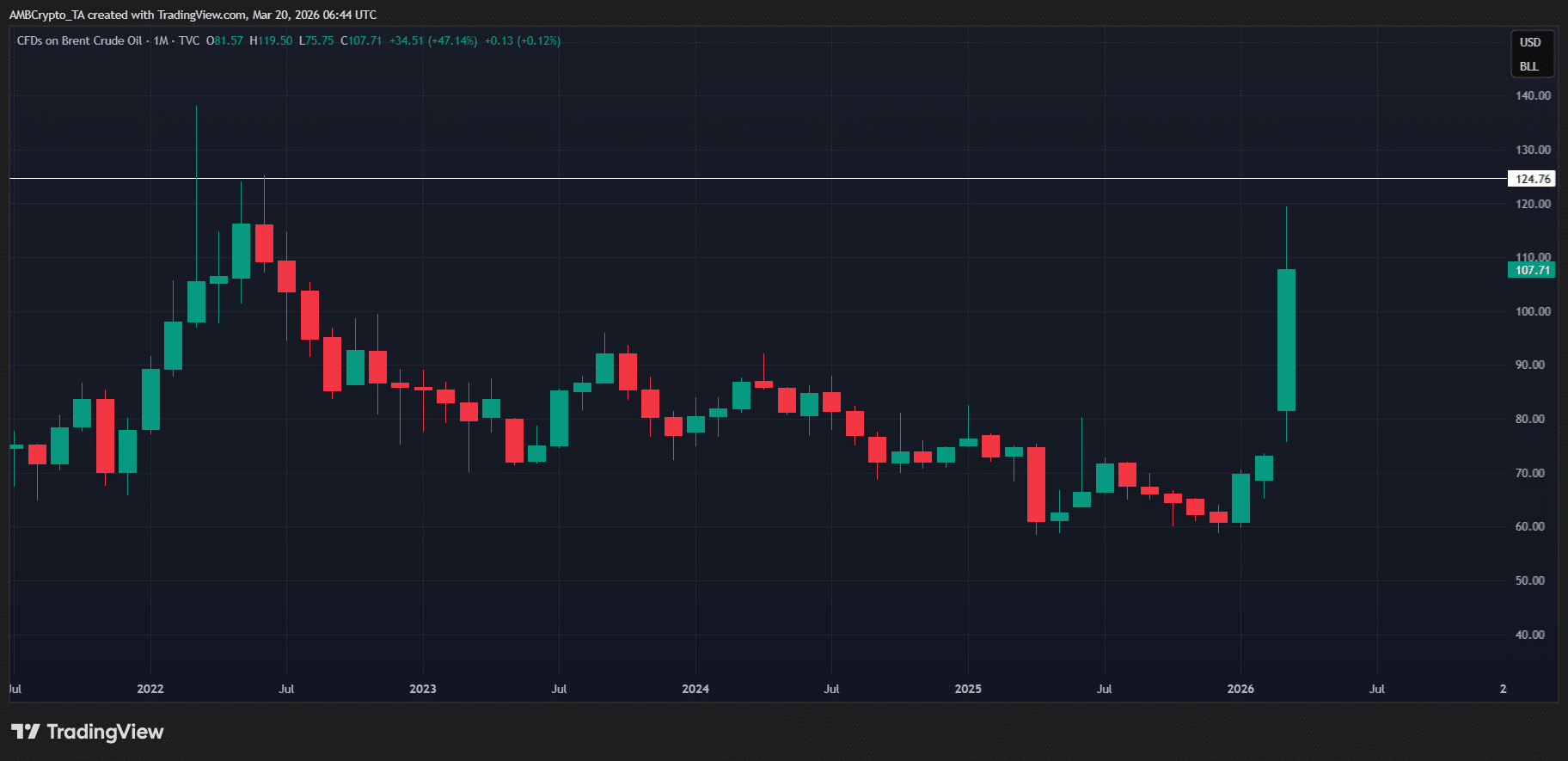
As the chart above shows, Brent Oil is up a massive 47% so far in March, marking its first 40%+ monthly rally since the COVID-19 crisis. Prices have already bounced back to 2022 levels around $110, with this trade’s liquidation set at $87.87, leaving the trader comfortably sitting on significant unrealized gains.

Meanwhile, the broader crypto market is still stuck around a $2.4 trillion market cap. Capital rotation into risk assets looks capped as traders chase oil momentum, with Hyperliquid standing out as the only altcoin posting double-digit gains.

According to AMBCrypto, this is a key trend to watch. The crypto market’s next risk-on move seems tied to long crowding on Hyperliquid. Once those positions start to unwind, it could signal geopolitical tensions easing and open the door for a broader risk-on rotation.


Final Summary

  • Middle East tensions are driving a supply shock in oil, fueling FOMO-driven longs on Hyperliquid and pushing HYPE up 30%, highlighting its central role in perp trading.
  • Brent oil rallies 47% in March while crypto remains stuck, showing that broader risk-on moves may hinge on potential unwind on Hyperliquid.


Domande pertinenti

QWhat is the main driver behind the spike in Hyperliquid's perp DEX volume according to JPMorgan analysts?

AJPMorgan analysts point to traders chasing 24/7 oil exposure as the main driver behind the spike in Hyperliquid's perp DEX volume, a gap that TradFi markets still don't cover.

QHow much has the price of HYPE increased on the monthly chart, and how does this compare to other altcoins?

AOn the monthly chart, HYPE is up roughly 30%, clearly diverging from other high-cap altcoins that are mostly printing single-digit gains.

QWhat is the 'base case' price target for oil according to Saudi Arabia's prediction markets mentioned in the article?

ASaudi Arabia's prediction markets are calling for the war to last through April, with $180 tagged as the 'base case' for oil.

QWhat specific example does Lookonchain provide to show how traders are chasing oil FOMO on Hyperliquid?

ALookonchain flagged a trader depositing 4.105 million USDC on Hyperliquid to open a 5x long on $20.19 Brent oil.

QAccording to the article, what could a potential unwind of long positions on Hyperliquid signal for the broader crypto market?

AA potential unwind of long positions on Hyperliquid could signal that geopolitical tensions are easing and open the door for a broader risk-on rotation in the crypto market.

Letture associate

Within Strategy's Framework, STRC's Dividend Yield Remains at 12% as Share Price Stays Below Par Value

Michael Saylor, Executive Chairman of Strategy (MSTR), confirmed that the dividend rate for its STRC perpetual preferred shares will remain at 12.00% through August 2026. The rate has increased from 9% at its July 2025 launch to the current high via a "ratchet" mechanism, which permanently raises the rate by 0.5% whenever the share price falls below $95. This mechanism is intended to push the price back toward its $100 par value and support Strategy's "at-the-market" (ATM) program for issuing new shares to fund Bitcoin purchases. However, the mechanism has not worked as intended. STRC shares closed at $89.46 on July 31, remaining about 10-11% below par value despite the record-high dividend. Competition from rival Strive's higher-yielding SATA securities has pressured demand. The persistent discount has forced Strategy to suspend new STRC issuances via its ATM program, limiting this funding channel for Bitcoin acquisitions. STRC's struggles reflect Bitcoin's own volatility, as the preferred shares historically move in tandem. Analysts have warned the ratchet structure carries long-term, one-way risk. A law firm is investigating Strategy's ability to maintain dividend payments if Bitcoin's price stays low. Retail investors own roughly 83% of outstanding STRC shares, a group seen as prone to panic selling during downturns. In response, Strategy has established financial reserves, including a liquidity cushion covering about 26 months of dividend/interest obligations, and a $2 billion share buyback program alongside a Bitcoin monetization framework, though the company emphasized it is not obligated to sell any Bitcoin.

cryptonews.ru6 min fa

Within Strategy's Framework, STRC's Dividend Yield Remains at 12% as Share Price Stays Below Par Value

cryptonews.ru6 min fa

Analyst: Bitcoin's Price Will Drop to $60k in August, Then Rebound to $70k

Financial analyst Andrey Poroshin has provided a new forecast for Bitcoin's price dynamics in August. Poroshin, an analyst at the Bitbanker exchange, expects the cryptocurrency market to experience a downturn this month, with prices retesting the $60,000 level due to a lack of supportive macroeconomic catalysts. He noted that the recent US Federal Reserve decision to hold interest rates did not significantly impact the market, while inflation remains above the 2% target. Poroshin stated that Bitcoin is ending July under pressure from moderate volatility and a lack of new macroeconomic stimuli, leading to continued market caution. According to his base scenario, Bitcoin will drop to a range of $60,000 to $62,000 before recovering to $70,000. He pointed out that even $70,000 remains below the cost of mining in the US, which has prompted some miners to shift towards AI data center operations. Poroshin cited the winding down of BitMEX's operations as a potential catalyst for a price rebound, suggesting the exit of weaker players often coincides with market reversals and reduced short-term selling pressure. He believes Bitcoin is currently less susceptible to geopolitical shocks, such as the Iran-US conflict, and does not expect significant market changes in August related to the pending CLARITY Act. Looking ahead, Poroshin forecasts that September will bring more active price fluctuations driven by potential Fed rate decisions and possible discussions or approval of the CLARITY Act.

cryptonews.ru6 min fa

Analyst: Bitcoin's Price Will Drop to $60k in August, Then Rebound to $70k

cryptonews.ru6 min fa

Trading

Spot
活动图片




