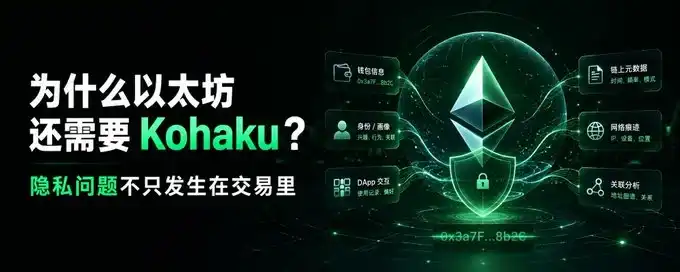
Why Does Ethereum Still Need Kohaku? Privacy Concerns Aren't Just in Transactions

marsbitPubblicato 2026-06-09Pubblicato ultima volta 2026-06-09

Introduzione

The article "Why Ethereum Still Needs Kohaku: Privacy Issues Extend Beyond Transactions" explains the Kohaku initiative as a suite of privacy-first tools designed to improve user privacy on the Ethereum network. It addresses the problem that while Ethereum's transparency enables innovation, it also exposes users' financial activities, asset holdings, and social connections when they reuse a single address. Kohaku aims to bridge the gap between existing privacy protocols (like Railgun, Privacy Pools) and practical user experience by integrating privacy features into wallets, developer tools, and daily interactions. Key focuses include: enabling wallets to manage multiple accounts for different purposes ("many accounts, many you"), facilitating controlled visibility for transactions instead of full transparency, protecting user data during RPC queries and network activity, and providing developers with easier ways to integrate privacy. The article clarifies that Kohaku is not a single product but an ongoing effort to make privacy a default, usable component of the ecosystem, moving beyond complex protocols to practical application. It counters common misconceptions, arguing that privacy is a fundamental user right for normal activities, not just for anonymity, and that it can coexist with compliance through selective disclosure. Ultimately, Kohaku represents an essential step for Ethereum's maturation, ensuring users can participate in the open network while maintaining contro...

Author: Luna

This article is an original contribution from the author. The views expressed are solely those of the author's personal understanding. ETHPanda has edited and organized the content.

Recently, the relevant team within the Ethereum Foundation has become more active in explaining the direction of this privacy-related work around Kohaku to the outside world. The community has shown considerable interest in this name, but some confusion also exists: Is it a wallet, a protocol, or a set of more underlying developer tools? This article will clarify the problems Kohaku aims to solve in a more understandable way.

Kohaku points not to a single feature, but to a theme that is increasingly difficult to avoid in Ethereum's long-term user experience: privacy. It connects privacy protocols, wallet experiences, developer tools, and daily user activities, attempting to bring these capabilities beyond just research papers or tools for a few advanced users.

If summarized in one sentence: What Kohaku wants to achieve is to allow Ethereum users to maintain basic information boundaries while using the open network.

I. First, Understand the Problem: Why Does Ethereum Have Privacy Anxiety?

The power of Ethereum largely comes from its "openness." Transactions, contracts, asset flows, and address interactions can all be verified and audited by anyone. This transparency enables open finance, on-chain governance, and composable applications.

However, the same mechanism also brings side effects: the on-chain behavior of ordinary users is almost by default exposed. An address can reveal which assets a user holds, which protocols they have participated in, when payments or receipts occurred, which addresses they have interacted with, and can even be used to infer certain social relationships or economic status.

In real life, we do not post our bank statements, shopping records, social relationships, and salary income on public bulletin boards. But in the on-chain world, if users consistently reuse the same address, similar information exposure is very likely to occur.

Therefore, Ethereum's privacy issue is not as simple as "whether someone wants to hide bad deeds." It is more like a fundamental user rights issue: As on-chain applications increasingly resemble real-life activities, can users still decide which information should be public and which should only be disclosed in necessary scenarios?

II. What is the Kohaku Initiative?

Kohaku is a set of privacy-first tooling in the Ethereum ecosystem. It revolves around wallets, privacy protocols, developer integrations, and user experience. It is not a standalone consumer App, nor is it just a single protocol.

The Kohaku documentation lists tooling directions for privacy pool protocols such as Railgun, Privacy Pools, Tornado, some of which are still WIP or in alpha stages; the GitHub repository also continued merging related implementations and version updates at the end of May. Therefore, Kohaku is more like a set of evolving privacy infrastructure tools rather than a fully finalized product.

The question it aims to answer is also very concrete: Ethereum already has some privacy protocols and cryptographic capabilities; how can wallets and applications more easily, securely, and naturally integrate them into real-world usage scenarios?

💡 The key word for Kohaku is not "mystery," but "usability": turning privacy capabilities into basic components that wallets and applications can call, users can understand, and the ecosystem can iterate upon.

III. Why is Kohaku Considered "Infrastructure Catch-up"?

Over the past few years, the Ethereum ecosystem has spent a great deal of effort solving issues like scaling, L2, account abstraction, modularity, and data availability. This work has made transactions cheaper, throughput higher, and application deployment more flexible. But for ordinary users, another issue is equally important: Will what I do on-chain be permanently, completely, and without context exposed to everyone?

Privacy technology is not new today. The problem lies in the fact that many privacy solutions have long remained at the protocol layer, research layer, or advanced user layer. Users need to understand complex concepts, wallets require additional adaptation, and developers also lack sufficiently convenient integration methods. As a result, while privacy capabilities exist, they have not become part of the default experience.

Kohaku is precisely about bridging that "from protocol to experience" middle layer. Privacy should not just be a selling point for an independent tool; it can gradually enter more routine areas such as wallet design, account management, RPC access, fund flows, and developer interfaces.

IV. What Specific Problems Might Kohaku Be Addressing?

1. Wallet Layer Privacy: Privacy Must Enter the Entry Point

The wallet is the first entry point for the vast majority of users into Ethereum. If privacy capabilities cannot enter wallets, they will be difficult for ordinary users to truly adopt.

When users connect to a dApp today, they often directly expose a long-term address. This address might be used simultaneously for DeFi, NFTs, social interactions, receiving payments, and voting. Once these activities are linked together, the address is no longer just a technical identifier but becomes a publicly analyzable dossier.

The concept of "many accounts, many you" mentioned in the Kohaku documentation provides an intuitive idea: in reality, a person uses different identities in different scenarios. Correspondingly, in the on-chain experience, wallets could also make it easier for users to create and manage different accounts for different dApps and purposes, and complete funding and usage in more privacy-friendly ways.

2. Transaction Privacy: From "Fully Public" to "Controllable Visibility"

Ethereum transactions are transparent by default; the sender, receiver, amount, and transaction data may all be visible. But not all transactions need to disclose their complete context permanently to the entire network.

This does not mean turning Ethereum into a completely black-box system. A more reasonable direction is "controllable visibility": users can prove, disclose, and audit when necessary, but do not need to expose all information indiscriminately to all observers.

Privacy pool protocols like Railgun and Privacy Pools attempt to provide such capabilities. Kohaku's role, then, is more akin to helping wallets and applications integrate these protocol capabilities into usable experiences.

3. RPC & Network Privacy: Queries Themselves Can Leak Information

When many people discuss on-chain privacy, they only focus on whether transactions are public, overlooking another issue: when wallets query on-chain data, they might also leak what the user is looking at, checking, or which addresses they are concerned about.

Wallets typically need to obtain on-chain information via RPC. If all requests pass through centralized RPC services, users' querying behavior itself could form a profile. Therefore, the Kohaku documentation mentions directions like private RPC, user-defined RPC, light clients, and verifying untrusted RPC results through light clients like Helios.

This type of work may sound less eye-catching than "private transactions," but it is crucial for the real user experience. Because privacy doesn't only happen at the moment a transaction is sent; it also occurs in every step where a wallet loads balances, browses history, connects to applications, and requests data.

4. Developer Usability: Privacy Cannot Stay Only in Papers

For privacy technology to enter mainstream applications, developers must be able to understand and integrate it at low cost. Otherwise, even the strongest cryptographic capabilities can only serve a few teams familiar with the underlying mechanisms.

Through toolkits, documentation, and wallet implementations, Kohaku breaks down these problems into modules more accessible to developers: Which privacy protocols can be integrated? How do wallets handle accounts? How do users complete shield/unshield? How to retain necessary proving capabilities while protecting privacy?

This work requires not just code, but also ecosystem understanding. Wallet teams, protocol teams, application developers, and ordinary users all need to understand more clearly: What problems is Kohaku actually solving, and how will these capabilities enter daily use?

V. Common Misconceptions: Privacy Is Not a Thin Slogan

Misconception 1: Privacy Equals Anonymous Crime Tools

This is the most common and easily misleading misconception. In reality, privacy is a basic need for ordinary people: you would not want all your payment records, asset status, and social relationships to be queried by strangers at any time. On-chain privacy follows the same logic.

Of course, privacy tools need to address risks of abuse and explore mechanisms for proof, disclosure, and risk control. However, the existence of risks should not lead to negating all reasonable privacy needs of users.

Misconception 2: Ethereum Already Has Privacy Protocols, So the Problem Is Solved

There is a big gap between "having tools" and "users being able to use them naturally." Ordinary users will not research complex protocols for every daily interaction, nor will they voluntarily take on the security risks that come with high-threshold operations.

Therefore, the real key is to build privacy capabilities into wallets, default processes, and developer interfaces. Only when users can make safer choices without becoming cryptography experts can privacy be considered to have entered the product layer.

Misconception 3: Kohaku Is a Standalone Product

Kohaku is not a single product but a set of work revolving around privacy protocol toolkits, wallet implementations, best practices, RPC privacy, and developer integrations.

Thus, evaluating Kohaku is not just about whether it has launched a standalone App, but also about whether these tools can be absorbed by more wallets and applications to become part of the default experience.

Misconception 4: Privacy and Compliance Are Inevitably in Conflict

There is indeed tension between privacy and compliance, but it is not necessarily a binary choice. More important future directions may include minimizing information exposure, selective disclosure, verifiable claims, risk isolation, and user authorization.

In other words, good privacy design is not about making all information disappear, but about allowing information to be disclosed only in appropriate scenarios, with appropriate granularity, and to appropriate parties.

VI. What Would Users Experience After These Capabilities Enter Wallets?

If work like Kohaku is adopted by more wallets, ordinary users might first notice not complex cryptographic concepts, but several changes closer to daily use.

  • Wallets might encourage users to manage accounts by scenario more, rather than tying all activities to one long-term address.
  • The barrier to using privacy protocols might decrease, but this depends on wallet integration, protocol maturity, and security audit progress.
  • Wallets might pay more attention to RPC, query, and network layer leakage issues; users would be protected not just in transactions themselves, but also in their querying behavior.
  • Users might have more choices: when to be public, to whom, and to what extent.

These changes will not happen overnight, nor do they mean all wallets will immediately incorporate complex privacy features. But they point in the same direction: the maturation of Ethereum's user experience should not only be reflected in being cheaper and faster, but also in being safer and having more defined boundaries.

VII. What Should Developers Focus On?

For developers, the focus of Kohaku is not to require all applications to immediately shift to being privacy-first, but to make privacy capabilities easier to understand, test, and integrate.

In the past, many applications by default required users to connect with the same address and built all interactions on the premise of address traceability. As privacy tools gradually mature, product teams can rethink: Should they support more granular identities? Should they reduce unnecessary data exposure? Should they make privacy protection a more natural default process, rather than hiding it in advanced settings?

This is especially true for wallet teams. Wallets are not just signing tools; they are also the management layer for user identity, assets, permissions, and information boundaries. The value of Kohaku ultimately depends on whether these complex technologies can be translated into simple, trustworthy, low-friction interactions.

Conclusion: Privacy Is a Piece of the Puzzle for Ethereum's Journey Towards Everyday Use

If Ethereum were merely an open ledger used by a few developers and traders, the privacy pressure brought by transparency might not be so apparent. But if Ethereum is to carry broader activities like payments, identity, social interactions, organizational collaboration, and finance, then privacy is no longer a peripheral issue.

The importance of the Kohaku Initiative lies precisely here: it not only states "Ethereum needs privacy," but also places privacy back into the positions that truly affect user experience—wallets, protocols, and developer tools.

Kohaku is still under construction and iteration, but it addresses a very real problem: In a default-public on-chain world, how can users regain the right to choose?

This might also be a question that Ethereum's next phase of user experience must answer. Truly mature public infrastructure should not only allow everyone to participate but also enable everyone to maintain reasonable boundaries while participating.


Domande pertinenti

QWhat is the primary purpose of the Kohaku Initiative within the Ethereum ecosystem, as described in the article?

AThe primary purpose of the Kohaku Initiative is to bridge the gap between existing privacy protocols/capabilities and real-world user experience. It is a set of privacy-first tooling focused on making privacy features easier to integrate into wallets, more understandable for users, and more accessible for developers, moving them from research papers into default user experiences.

QAccording to the article, what is one of the key misconceptions about privacy on Ethereum that the author addresses?

AA key misconception addressed is that 'privacy equals anonymous crime tools.' The author argues that privacy is a fundamental need for ordinary users, akin to not wanting all payment records, asset status, and social relationships to be publicly queryable. While acknowledging risks of abuse, the article asserts that reasonable user privacy demands should not be dismissed.

QBesides transaction privacy, what other aspect of user activity does Kohaku aim to protect, as mentioned in the section about RPC and network privacy?

AKohaku aims to protect the privacy of user queries and data-fetching behavior. When wallets query blockchain data via RPC services, these requests can reveal what information a user is looking at, which addresses they are checking, or what they are interested in, potentially creating a user profile. Kohaku explores solutions like private RPC and light clients to address this.

QWhat specific user experience change might wallets adopting Kohaku's principles encourage, according to the article?

AWallets might encourage users to manage different accounts for different scenarios or purposes, rather than binding all activities to a single, long-term address. This aligns with the concept of 'many accounts, many you,' helping users maintain better information boundaries across various dApps and use cases.

QHow does the article define the relationship between privacy and compliance, arguing against a common misunderstanding?

AThe article argues that privacy and compliance are not necessarily in conflict. The future direction should focus on minimizing information exposure, enabling selective disclosure, using verifiable claims, isolating risks, and implementing user authorization. Good privacy design allows information to be disclosed only in appropriate scenarios, to appropriate parties, and with appropriate granularity, rather than hiding everything.

Letture associate

Wang Chuan: After Investing in Storage Stocks and Seeing a Thirty-Fold Return, How to Remain Unanxious (Part 7) - A Quarter-Century Cycle

Wang Chuan: Reflections on Investment Anxiety and Market Cycles After Observing a 30x Gain in a Storage Stock (Part 7) – A Quarter-Century Cycle This article examines the cyclical nature and inherent risks in technology hardware investments, using the storage and semiconductor sectors as examples. It criticizes the misleading practice of "annualized" Net Dollar Retention (NDR) rates, where short-term growth is extrapolated unrealistically. A key concept explored is "reflexivity" – demand driven by panic, exploration, and liquidity during market booms, which can vanish just as quickly when conditions reverse. This reflexivity exists both in product demand and among speculative stock buyers, creating powerful feedback loops that inflate prices during upturns and exacerbate crashes during downturns. The author highlights a major risk for hardware sectors: unlike assets with defined cycles (e.g., Bitcoin's halving), there's no guarantee of a swift recovery post-crash. Companies like Micron, Intel, and Cisco took roughly a quarter-century to surpass their 2000 highs, enduring drawdowns exceeding 80%. This is attributed to the "bullwhip effect" in supply chains, where demand collapses instantly but过剩产能 persists, and a migration of narrative-driven capital. High-valuation stories吸引 speculative funds during growth phases, but these funds quickly depart for the next hot narrative once growth slows, leaving behind stronger companies with much lower valuations. The piece warns of dangerous mental models formed during bull markets: 1) equating current strong demand with perpetual high growth, and 2) believing that making fast, large profits is easy. Citing巴菲特, the author notes that easy money undermines rationality, likening speculators to Cinderella at a ball with a clock that has no hands. The current phase presents an asymmetric risk-reward scenario: potential for further gains exists, but the downside risk is an 80%+ drawdown and a multi-decade wait for breakeven, which reflexive speculators cannot tolerate. The hypothetical investor "老王" (Lao Wang), who achieved a 30x return, is used to illustrate potential pitfalls. Leverage could lead to a wipeout during a sharp correction. Even without leverage, ingrained beliefs in easy money would likely lead him to double down after losses, expecting a quick rebound. Instead, he might face a protracted decline, depleting his resources through frantic trading as the high-growth narrative fades. The conclusion references Schopenhauer, comparing those who have seen multiple market cycles to an audience seeing the same magic trick repeatedly—once the illusion is understood, its power is gone.

marsbit6 min fa

Wang Chuan: After Investing in Storage Stocks and Seeing a Thirty-Fold Return, How to Remain Unanxious (Part 7) - A Quarter-Century Cycle

marsbit6 min fa

US Stocks Too Expensive? This Top CIO Scoured the Globe and Found 5 Stocks More Attractive Than NVIDIA

Summary: Main Street Research CIO James Demmert maintains his bullish 8,100 target for the S&P 500 but argues that greater opportunities now lie overseas. He identifies five international stocks with superior valuations poised to benefit from the AI revolution, suggesting international markets will outperform the US for years. Key Recommendations: 1. **ASML (Netherlands):** A foundational chip manufacturing technology provider, offering crucial AI exposure and geographic diversification. Demmert's top long-term pick. 2. **HSBC (UK/Asia):** A global bank with a 9x P/E ratio, better growth prospects than US peers like JPMorgan, and strong Asian presence. 3. **Siemens Energy (Germany):** A direct play on global power grid expansion driven by AI, crypto, and EV electricity demand. 4. **BHP Group (Australia):** A "hidden AI play" and "second derivative" of the trend due to massive copper demand for data centers. Trades at a 16x P/E. 5. **AstraZeneca (UK):** An undervalued healthcare stock with a strong pipeline (18x P/E, >20% growth), expected to benefit from AI's impact on medicine. Core Thesis: International outperformance is driven by both attractive valuations and a major policy shift. While the US tightens fiscal policy, Europe and Japan are launching unprecedented stimulus, reigniting growth. Demmert recommends allocating 45% of a portfolio internationally, citing excessive US investor conservatism as a key mistake.

marsbit11 min fa

US Stocks Too Expensive? This Top CIO Scoured the Globe and Found 5 Stocks More Attractive Than NVIDIA

marsbit11 min fa

a16z Partner: Three Paths for Crypto Projects to Find PMF

Author: Jason Rosenthal. Compiler: Shenchao TechFlow. Finding Product-Market Fit (PMF) is the most critical variable for a company's survival. In the crypto space, misaligned growth hacking and airdrops often mask the absence of true PMF. However, leading teams are now finding PMF faster. Here are three proven paths for crypto projects to achieve PMF: 1. **Co-build with Anchor Clients:** Partner with the most sophisticated potential clients in your field and develop the product based on their specific needs. Their adoption serves as the strongest validation, more valuable than media coverage or TVL metrics. This approach is shaping current product roadmaps, as seen in collaborations between crypto startups and traditional finance. 2. **Position Ahead of an Exponential Curve:** Identify and position yourself ahead of a major emerging trend before the market fully realizes it. The most evident current curve is the rise of AI Agents as autonomous economic actors. Projects like AgentCash by Merit Systems, which enables AI Agents to pay for API access with crypto, are building foundational payment rails for the impending Agent economy. 3. **Be Your Own First and Best Customer:** The most enduring infrastructure companies don't wait for external validation. They first build and prove their technology by using it to power their own applications at scale before offering it to others. Matter Labs exemplifies this by anchoring its ZKsync technology in a concrete application, Cari Network, which enables U.S. regional banks to conduct real-time, on-chain interbank transfers of tokenized deposits. The underlying logic is consistent: the fastest path to PMF involves choosing the right battlefield and executing with conviction—by co-building with clients whose validation compounds, positioning ahead of the curve before consensus forms, or becoming your own best case study.

marsbit11 min fa

a16z Partner: Three Paths for Crypto Projects to Find PMF

marsbit11 min fa

Wang Chuan: How to Avoid Anxiety When the Neighbor, Lao Wang, Made Thirty Times His Investment in Storage Stocks (7) - A Quarter-Century Cycle

Wang Chuan: Reflections on a Quarter-Century Cycle – How to Stay Calm After a 30x Gain on Storage Stocks (Part 7) This article continues the discussion on investment pitfalls. It highlights the deceptive use of metrics like the "Annualized Net Dollar Retention Rate" by some companies to inflate growth projections. The core analysis focuses on the "reflexivity" present in both product demand and financial markets during boom periods. In a bubble, speculative and fear-driven demand in the real economy interacts with speculative, leveraged buying in financial markets, creating a powerful upward feedback loop. This dynamic reverses sharply when faced with physical or liquidity constraints, leading to a cascading downturn. The hardware and semiconductor sectors face unique risks. Unlike assets with defined cycles, there's no guarantee of a swift recovery post-crash. Historical examples like Micron, Intel, and Cisco show it can take decades to surpass previous peaks after severe drawdowns (80-95%). This is due to the "bullwhip effect" in supply chains—demand vanishes quickly while过剩产能 persists—and the migration of speculative capital and growth narratives to new sectors once momentum slows. Companies may have stronger fundamentals years later, but the speculative "soul" of extreme valuations is long gone. The author warns of psychological traps for new investors: mistaking temporary, intense demand for permanent growth, and believing that making quick, large profits is easy. Citing Buffett, the piece cautions that easy money erodes rationality. The current phase presents an asymmetric risk-reward scenario: potential for further gains versus the risk of an 80%+ drawdown and a multi-decade recovery wait—an outcome reflexive speculators cannot endure. The hypothetical "Lao Wang" who made 30x may be wiped out by leverage or, driven by the "get-rich-quick" mindset, may repeatedly try to recover losses until exhausted, failing to recognize that the high-growth narrative has ended. The piece concludes with Schopenhauer's analogy: those who've seen multiple cycles are like an audience watching the same magic trick repeatedly—the illusion no longer works.

链捕手20 min fa

Wang Chuan: How to Avoid Anxiety When the Neighbor, Lao Wang, Made Thirty Times His Investment in Storage Stocks (7) - A Quarter-Century Cycle

链捕手20 min fa

Trading

Spot
Futures

Articoli Popolari

Cosa è ETH 3.0

ETH3.0 e $eth 3.0: Un'Analisi Approfondita del Futuro di Ethereum Introduzione Nel panorama in rapida evoluzione delle criptovalute e della tecnologia blockchain, ETH3.0, spesso indicato come $eth 3.0, è emerso come un argomento di considerevole interesse e speculazione. Il termine comprende due concetti principali che warrantono chiarimenti: Ethereum 3.0: Questo rappresenta un potenziale futuro aggiornamento volto ad aumentare le capacità dell'attuale blockchain di Ethereum, concentrandosi principalmente sul miglioramento della scalabilità e delle prestazioni. ETH3.0 Meme Token: Questo progetto di criptovaluta distinto cerca di sfruttare la blockchain di Ethereum per creare un ecosistema incentrato sui meme, promuovendo il coinvolgimento all'interno della comunità delle criptovalute. Comprendere questi aspetti di ETH3.0 è essenziale non solo per gli appassionati di criptovalute, ma anche per coloro che osservano tendenze tecnologiche più ampie nello spazio digitale. Che cos'è ETH3.0? Ethereum 3.0 Ethereum 3.0 è pubblicizzato come un aggiornamento proposto per la rete Ethereum già stabilita, che è stata la spina dorsale di molte applicazioni decentralizzate (dApps) e contratti smart sin dalla sua nascita. I miglioramenti previsti si concentrano principalmente sulla scalabilità, integrando tecnologie avanzate come lo sharding e le prove a conoscenza zero (zk-proofs). Queste innovazioni tecnologiche mirano a facilitare un numero senza precedenti di transazioni al secondo (TPS), potenzialmente raggiungendo milioni, affrontando così una delle limitazioni più significative della tecnologia blockchain attuale. Il miglioramento non è meramente tecnico, ma anche strategico; è volto a preparare la rete Ethereum per un'adozione e un'utilità diffuse in un futuro contrassegnato da un aumento della domanda di soluzioni decentralizzate. ETH3.0 Meme Token Al contrario di Ethereum 3.0, l'ETH3.0 Meme Token si avventura in un dominio più leggero e giocoso, combinando la cultura dei meme di internet con la dinamica delle criptovalute. Questo progetto consente agli utenti di acquistare, vendere e scambiare meme sulla blockchain di Ethereum, fornendo una piattaforma che promuove il coinvolgimento della comunità attraverso la creatività e interessi condivisi. L'ETH3.0 Meme Token mira a dimostrare come la tecnologia blockchain possa intersecarsi con la cultura digitale, creando casi d'uso che siano sia divertenti che finanziariamente praticabili. Chi è il Creatore di ETH3.0? Ethereum 3.0 L'iniziativa verso Ethereum 3.0 è principalmente propulsa da un consorzio di sviluppatori e ricercatori all'interno della comunità di Ethereum, tra cui Justin Drake. Conosciuto per le sue intuizioni e contributi all'evoluzione di Ethereum, Drake è stato una figura di spicco nelle discussioni riguardanti la transizione di Ethereum verso un nuovo livello di consenso, chiamato “Beam Chain.” Questo approccio collaborativo allo sviluppo significa che Ethereum 3.0 non è il prodotto di un creatore singolo, ma piuttosto una manifestazione di ingegno collettivo focalizzato sul progresso della tecnologia blockchain. ETH3.0 Meme Token I dettagli riguardanti il creatore dell'ETH3.0 Meme Token sono attualmente non rintracciabili. La natura dei token meme conduce spesso a una struttura più decentralizzata e guidata dalla comunità, il che potrebbe spiegare la mancanza di attribuzione specifica. Questo si allinea con l'etica della comunità crypto più ampia, dove l'innovazione spesso nasce da sforzi collaborativi piuttosto che individuali. Chi sono gli Investitori di ETH3.0? Ethereum 3.0 Il supporto per Ethereum 3.0 proviene principalmente dalla Ethereum Foundation insieme a una comunità entusiasta di sviluppatori e investitori. Questa associazione fondamentale fornisce un considerevole grado di legittimità e migliora le prospettive di implementazione di successo poiché sfrutta la fiducia e la credibilità costruite nel corso degli anni di operazioni della rete. Nel clima in rapida evoluzione delle criptovalute, il supporto della comunità gioca un ruolo cruciale nello sviluppo e nell'adozione, posizionando Ethereum 3.0 come un serio contenditore per i futuri progressi della blockchain. ETH3.0 Meme Token Sebbene le fonti attualmente disponibili non forniscano informazioni esplicite riguardo ai fondamenti o alle organizzazioni di investimento che sostengono l'ETH3.0 Meme Token, ciò è indicativo del modello di finanziamento tipico per i token meme, che spesso si basa sul supporto di base e sul coinvolgimento della comunità. Gli investitori in tali progetti sono tipicamente individui motivati dal potenziale per innovazioni guidate dalla comunità e dallo spirito di cooperazione trovato all'interno della comunità crypto. Come Funziona ETH3.0? Ethereum 3.0 Le caratteristiche distintive dell'Ethereum 3.0 risiedono nella sua proposta di implementazione della tecnologia di sharding e zk-proof. Lo sharding è un metodo di partizionamento della blockchain in pezzi più piccoli e gestibili o “shard,” che possono elaborare transazioni in modo concorrente piuttosto che sequenziale. Questa decentralizzazione dell'elaborazione aiuta a prevenire la congestione e garantisce che la rete rimanga reattiva anche sotto un carico pesante. La tecnologia delle prove a conoscenza zero (zk-proof) contribuisce con un ulteriore livello di sofisticazione consentendo la validazione delle transazioni senza rivelare i dati sottostanti coinvolti. Questo aspetto non solo migliora la privacy, ma aumenta anche l'efficienza complessiva della rete. Si parla anche di incorporare una macchina virtuale Ethereum a conoscenza zero (zkEVM) in questo aggiornamento, amplificando ulteriormente le capacità e l'utilità della rete. ETH3.0 Meme Token L'ETH3.0 Meme Token si distingue capitalizzando sulla popolarità della cultura dei meme. Stabilisce un mercato per gli utenti che desiderano partecipare al trading di meme, non solo per divertimento, ma anche per potenziale guadagno economico. Integrando funzioni come lo staking, la fornitura di liquidità e meccanismi di governance, il progetto promuove un ambiente che incentiva l'interazione e la partecipazione della comunità. Offrendo una miscela unica di intrattenimento e opportunità economica, l'ETH3.0 Meme Token mira ad attrarre un pubblico variegato, che va dagli appassionati di crypto ai semplici intenditori di meme. Timeline di ETH3.0 Ethereum 3.0 11 Novembre 2024: Justin Drake accenna al prossimo aggiornamento ETH 3.0, incentrato sui miglioramenti della scalabilità. Questo annuncio segna l'inizio delle discussioni formali riguardo l'architettura futura di Ethereum. 12 Novembre 2024: La proposta attesa per Ethereum 3.0 dovrebbe essere svelata a Devcon a Bangkok, preparando il terreno per un feedback più ampio della comunità e potenziali passi successivi nello sviluppo. ETH3.0 Meme Token 21 Marzo 2024: L'ETH3.0 Meme Token viene ufficialmente elencato su CoinMarketCap, segnando il suo ingresso nel dominio pubblico delle criptovalute e aumentando la visibilità per il suo ecosistema basato sui meme. Punti Chiave In conclusione, Ethereum 3.0 rappresenta una significativa evoluzione all'interno della rete Ethereum, concentrandosi sul superamento delle limitazioni riguardanti scalabilità e prestazioni attraverso tecnologie avanzate. I suoi aggiornamenti proposti riflettono un approccio proattivo alle future esigenze e usabilità. D'altra parte, l'ETH3.0 Meme Token incarna l'essenza della cultura guidata dalla comunità nello spazio delle criptovalute, sfruttando la cultura dei meme per creare piattaforme coinvolgenti che incoraggiano la creatività e la partecipazione degli utenti. Comprendere gli scopi e le funzionalità distinte di ETH3.0 e $eth 3.0 è fondamentale per chiunque sia interessato ai continui sviluppi nello spazio crypto. Con entrambe le iniziative che tracciano percorsi unici, esse sottolineano collettivamente la natura dinamica e multifacetica dell'innovazione blockchain.

173 Totale visualizzazioniPubblicato il 2024.04.04Aggiornato il 2024.12.03

Cosa è ETH 3.0

Cosa è ETHEREUM

HarryPotterTrumpHomerSimpson777Inu: Panoramica di un Progetto Crypto Web3 Introduzione Nel mondo in rapida evoluzione delle criptovalute e della finanza decentralizzata, progetti innovativi emergono frequentemente, catturando l'interesse della comunità degli investitori e degli appassionati di crypto. Uno di questi progetti è HarryPotterTrumpHomerSimpson777Inu, una criptovaluta che si trova all'incrocio tra cultura popolare e tecnologia blockchain. Questo token guidato dalla comunità mescola personaggi e figure politiche ben noti, con l'obiettivo di creare una piattaforma coinvolgente e promuovere un'adozione diffusa. Che cos'è HarryPotterTrumpHomerSimpson777Inu? HarryPotterTrumpHomerSimpson777Inu è un token costruito sulla blockchain di Ethereum, progettato per essere accessibile e divertente per un pubblico diversificato. L'unicità di questo progetto deriva dal suo approccio tematico, che intreccia elementi di fantasia, politica e intrattenimento. Sfruttando il fascino nostalgico di personaggi amati, il progetto cerca di creare un'esperienza di criptovaluta coinvolgente, incoraggiando il coinvolgimento e la partecipazione della comunità. L'obiettivo principale di HarryPotterTrumpHomerSimpson777Inu è stabilire un token che risuoni con gli utenti a livello personale, promuovendo sia il divertimento che il coinvolgimento nell'ambito crypto. Questo branding distintivo mira ad attrarre individui che in precedenza potrebbero non essersi interessati alle criptovalute, facilitando un nuovo punto di ingresso per utenti potenziali. Creatore di HarryPotterTrumpHomerSimpson777Inu L'identità del creatore dietro HarryPotterTrumpHomerSimpson777Inu rimane sconosciuta. Questa non è una pratica rara nel dominio delle criptovalute, dove l'anonimato è spesso preferito dai fondatori come mezzo di protezione della privacy e promozione di un ethos decentralizzato. Questa oscurità non diminuisce il valore del progetto; al contrario, riflette una tendenza più ampia all'interno del settore, dove molti progetti di successo sono emersi da origini anonime. Investitori di HarryPotterTrumpHomerSimpson777Inu Le informazioni pubbliche riguardo agli investitori di HarryPotterTrumpHomerSimpson777Inu sono limitate. La natura del progetto, incentrata sul coinvolgimento della comunità, suggerisce una dipendenza da investimenti di piccole dimensioni da parte di singoli appassionati piuttosto che da sostegni sostanziali da fondazioni di investimento consolidate o corporation. Questo livello di trasparenza nel finanziamento è tipico di molti progetti di criptovaluta guidati dalla comunità, dove il supporto spesso proviene da movimenti di base piuttosto che da investitori istituzionali. Come Funziona HarryPotterTrumpHomerSimpson777Inu? Operando sulla blockchain di Ethereum, HarryPotterTrumpHomerSimpson777Inu sfrutta la sua solida infrastruttura per facilitare transazioni e promuovere interazioni tra gli utenti all'interno della comunità. Ciò che distingue questo progetto è il suo posizionamento tematico: canalizzando il carisma di personaggi iconici provenienti da diversi ambiti culturali, crea un'identità di marca distintiva. Questo approccio non solo attrae gli utenti, ma coltiva anche una comunità fedele attorno al token. Le meccaniche operative del progetto si concentrano sul coinvolgimento della comunità. Adotta un modello decentralizzato che incoraggia la partecipazione, consentendo agli utenti di interagire attraverso vari canali mentre promuovono lo scambio di idee e esperienze. Inoltre, il progetto abbraccia i principi del Web3, privilegiando la sovranità degli utenti e la decentralizzazione, che sono i pilastri del futuro di Internet. Timeline di HarryPotterTrumpHomerSimpson777Inu La storia di HarryPotterTrumpHomerSimpson777Inu è segnata da diversi eventi decisivi: 12 agosto 2023: L'inizio di HarryPotterTrumpHomerSimpson777Inu, segnando il suo ingresso nell'ecosistema delle criptovalute. Fase di Sviluppo: Un periodo focalizzato sulla costruzione di una strategia completa per stimolare la crescita guidata dalla comunità e il coinvolgimento degli utenti. Listing sugli Scambi: Sebbene i dettagli specifici di listing non siano stati divulgati, il progetto è stato reso accessibile su vari scambi di criptovalute, migliorando la sua visibilità nel mercato. Coinvolgimento della Comunità: Sforzi continui per coinvolgere attivamente la comunità, stabilendo canali di dialogo e promuovendo la partecipazione attraverso varie attività, tra cui concorsi, discussioni e votazioni comunitarie. Aspetti Chiave di HarryPotterTrumpHomerSimpson777Inu Focus sulla Comunità Un tratto distintivo di HarryPotterTrumpHomerSimpson777Inu è la sua forte enfasi sul coinvolgimento della comunità. Il progetto incoraggia attivamente gli utenti a partecipare a discussioni, condividere idee e contribuire all'evoluzione del progetto. Questa interazione coltiva un senso di appartenenza e di ownership tra i membri della comunità, essenziale per la sostenibilità a lungo termine del token. Utilizzo della Blockchain di Ethereum La scelta di costruire sulla blockchain di Ethereum consente a HarryPotterTrumpHomerSimpson777Inu di sfruttare le sue caratteristiche di sicurezza ben consolidate e architettura decentralizzata. Questa base garantisce affidabilità per le transazioni e fornisce un framework affidabile su cui sviluppare varie funzionalità. Approccio Tematico Unico Fusione di elementi della cultura pop nella sua identità, HarryPotterTrumpHomerSimpson777Inu crea una narrazione coinvolgente che lo differenzia da altre criptovalute. L'amalgama di personaggi e temi genera riconoscimento e intrigo immediati, rendendo il token relazionabile a un'ampia gamma di utenti potenziali. Anonimato nello Sviluppo Il creatore anonimo del progetto rimane una caratteristica ricorrente in molte iniziative di criptovaluta. Questo aspetto evidenzia un ethos di decentralizzazione, introducendo anche un livello di mistero che potrebbe affascinare un segmento della comunità crypto, attirando l'attenzione sul progetto e invitando l'impegno da parte di utenti che supportano l'idea di un'iniziativa decentralizzata e gestita dalla comunità. Conclusione HarryPotterTrumpHomerSimpson777Inu si presenta come un'aggiunta distintiva al panorama delle criptovalute, combinando il fascino della cultura popolare con le meccaniche innovative della tecnologia blockchain. Sebbene i dettagli riguardanti il creatore e gli investitori specifici rimangano non divulgati, il focus del progetto sulla comunità e il suo approccio tematico lo contraddistinguono come un potenziale attore influente nel contesto del Web3 e delle criptovalute. Man mano che l'ecosistema delle criptovalute continua ad espandersi, iniziative come HarryPotterTrumpHomerSimpson777Inu ci ricordano le molteplici modalità in cui la blockchain può connettere le comunità globali attraverso narrazioni e valori condivisi.

911 Totale visualizzazioniPubblicato il 2024.04.06Aggiornato il 2024.12.03

Cosa è ETHEREUM

Come comprare ETH

Benvenuto in HTX.com! Abbiamo reso l'acquisto di Ethereum (ETH) semplice e conveniente. Segui la nostra guida passo passo per intraprendere il tuo viaggio nel mondo delle criptovalute.Step 1: Crea il tuo Account HTXUsa la tua email o numero di telefono per registrarti il tuo account gratuito su HTX. Vivi un'esperienza facile e sblocca tutte le funzionalità,Crea il mio accountStep 2: Vai in Acquista crypto e seleziona il tuo metodo di pagamentoCarta di credito/debito: utilizza la tua Visa o Mastercard per acquistare immediatamente EthereumETH.Bilancio: Usa i fondi dal bilancio del tuo account HTX per fare trading senza problemi.Terze parti: abbiamo aggiunto metodi di pagamento molto utilizzati come Google Pay e Apple Pay per maggiore comodità.P2P: Fai trading direttamente con altri utenti HTX.Over-the-Counter (OTC): Offriamo servizi su misura e tassi di cambio competitivi per i trader.Step 3: Conserva Ethereum (ETH)Dopo aver acquistato Ethereum (ETH), conserva nel tuo account HTX. In alternativa, puoi inviare tramite trasferimento blockchain o scambiare per altre criptovalute.Step 4: Scambia Ethereum (ETH)Scambia facilmente Ethereum (ETH) nel mercato spot di HTX. Accedi al tuo account, seleziona la tua coppia di trading, esegui le tue operazioni e monitora in tempo reale. Offriamo un'esperienza user-friendly sia per chi ha appena iniziato che per i trader più esperti.

2.9k Totale visualizzazioniPubblicato il 2024.12.10Aggiornato il 2026.06.02

Come comprare ETH

Discussioni

Benvenuto nella Community HTX. Qui puoi rimanere informato sugli ultimi sviluppi della piattaforma e accedere ad approfondimenti esperti sul mercato. Le opinioni degli utenti sul prezzo di ETH ETH sono presentate come di seguito.

活动图片














