Why Do You Always Lose Money on Polymarket? Because You're Betting on News, While the Pros Read the Rules

marsbitPubblicato 2026-04-20Pubblicato ultima volta 2026-04-20

Introduzione

Why do you always lose money on Polymarket? Because you bet on news, while the pros study the rules. This article explains how top traders ("che tou") profit by meticulously analyzing market rules, not just predicting events. Polymarket, a prediction market platform, often sees disputes over event outcomes due to ambiguous rule wording. For instance, a market asking "Who will be the leader of Venezuela by the end of 2026?" was misinterpreted by many who bet on Delcy Rodríguez, assuming she held power. However, the rules specified "officially holds" as the formally appointed, sworn-in individual. Since Nicolás Maduro was still recognized as president officially, he won the market—even being in prison. To resolve such disputes, Polymarket uses a decentralized arbitration system via UMA protocol. The process involves: 1. Proposal: Anyone can propose a market outcome by staking 750 USDC, earning 5 USDC if unchallenged. 2. Dispute: A 2-hour window allows challenges with a 750 USDC stake; successful challengers earn 250 USDC. 3. Discussion: A 48-hour period on UMA Discord for evidence and debate. 4. Voting: UMA token holders vote in two 24-hour phases (blind then public). Outcomes require >65% consensus and 5M tokens voted; otherwise, four re-votes occur before Polymarket intervention. 5. Settlement: Results are final and automatic. Unlike traditional courts, Polymarket’s system lacks separation between arbitrators and stakeholders—voters often hold market positions, creating co...

Author: Changan I Biteye Content Team

Do you know why you can't beat the pros on Polymarket? Because they scrutinize the rules, parsing every word like lawyers reviewing a contract.

In April 2026, a controversy over Venezuela's leader erupted in the Polymarket community.

There was a market on Polymarket asking, "Who will be the leader of Venezuela by the end of 2026?" Many traders intuitively thought: Maduro is in a U.S. prison, Delcy is presiding over the cabinet in Caracas, so the de facto ruler is obviously Delcy. They placed their bets on Delcy.

But the rules and supplementary notes were clear: "officially holds" refers to the person formally appointed and sworn in. The UN-recognized Venezuelan government has not formally removed or replaced Maduro; official government information still identifies him as president. The rules specifically added: "Temporarily authorized to exercise presidential powers does not equate to a transfer of the presidential office."

According to these rules, even if Maduro remains in a U.S. prison, he is still the legitimate president of Venezuela.

Similar examples abound:

  • After Polymarket issued a stablecoin, controversy arose over "What is the FDV of the Polymarket token?": Is a stablecoin considered a token? A single word makes all the difference.

  • Iran Uranium: The standard for "agreement"—conditional statements vs. formally signed agreements.

Behind these cases lies the same logic: On Polymarket, the rules are paramount. But when disputes arise over the rules, Polymarket has a complete adjudication process to resolve them. This article will explain how this mechanism operates, and where it resembles and fundamentally differs from traditional courts.

I. Polymarket's Adjudication Mechanism

Ambiguity in the rule text doesn't just cause pricing discrepancies; it becomes a formal dispute at settlement.

Polymarket sees numerous market settlements daily, with markets involving political statements, diplomatic postures, and military actions being particularly prone to controversy.

Disputed events are actually the norm in prediction markets. Ambiguity creates pricing divergence during trading and turns into conflict at settlement—it's the same issue at two different points in time.

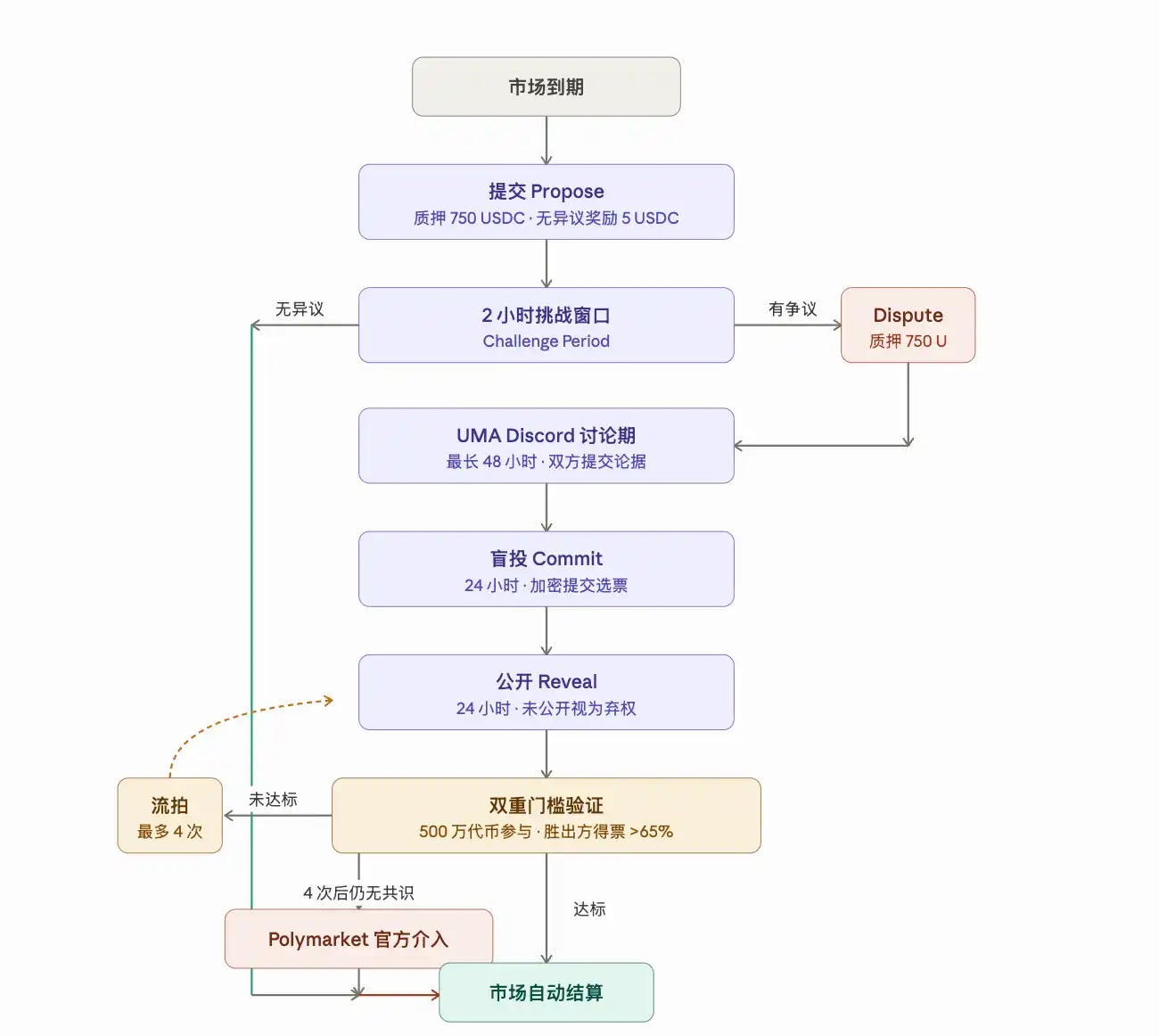
To resolve these disputes, Polymarket has established a complete adjudication process. The settlement process splits into two paths: normal settlement and dispute resolution.

Step 1: Submit a Proposal (Propose)

When a market meets the settlement conditions, anyone can submit a proposed resolution, declaring whether the market should be judged YES or NO. Submitting a proposal requires staking 750 USDC as a bond, which serves as the submitter's endorsement of their judgment. If the market has no objections, the user who submitted the proposal receives a 5 USDC reward.

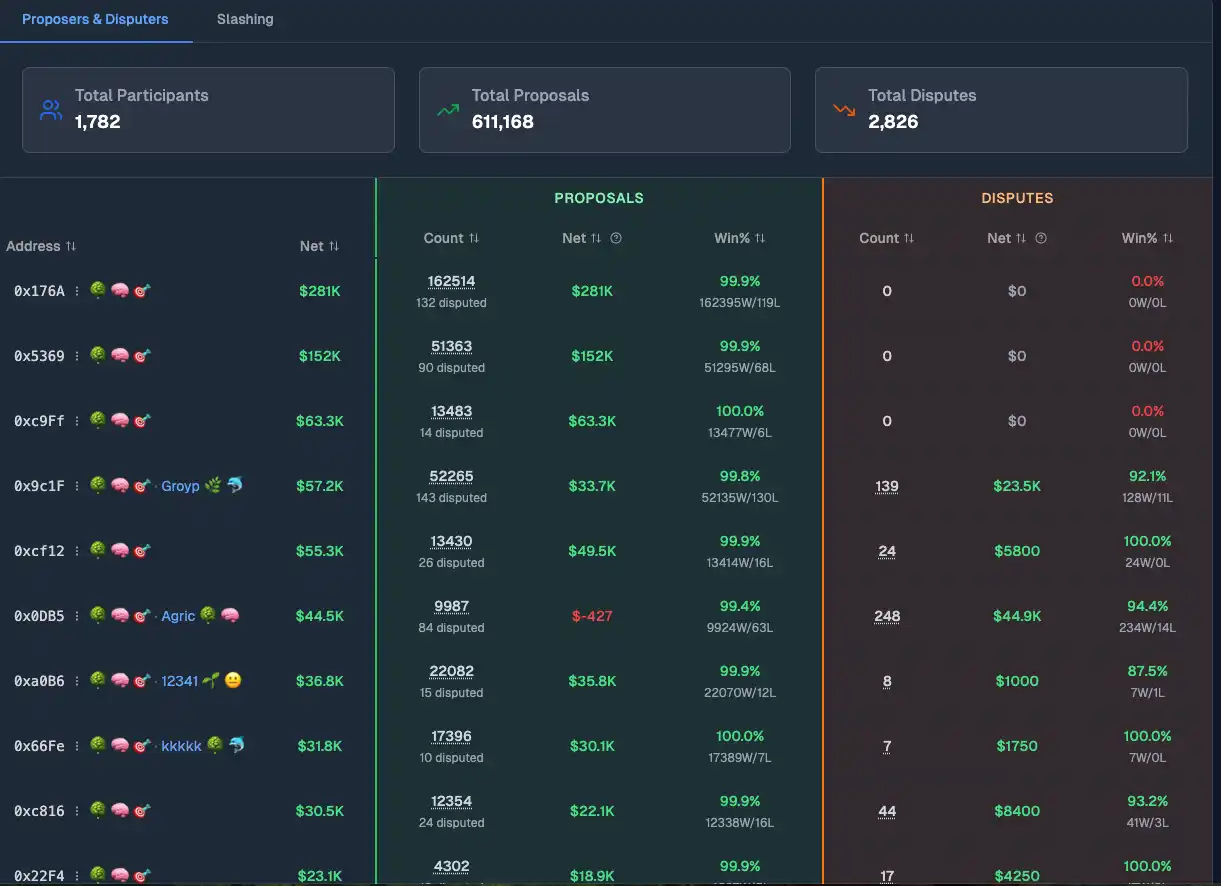
Currently, only 1782 users have submitted Proposals. The top-earning user has accumulated $281K.
Step 2: 2-Hour Challenge Window (Dispute)

After a proposal is submitted, it enters a 2-hour challenge period. This is the first fork in the entire process.

If no objections are raised within 2 hours, the system defaults the proposal as correct, the market settles directly, and the process ends. The vast majority of markets follow this path.

If someone believes the proposal result is incorrect, they can challenge it within this 2-hour window, also requiring a stake of 750 USDC. A successful challenge earns a 250 USDC bonus.

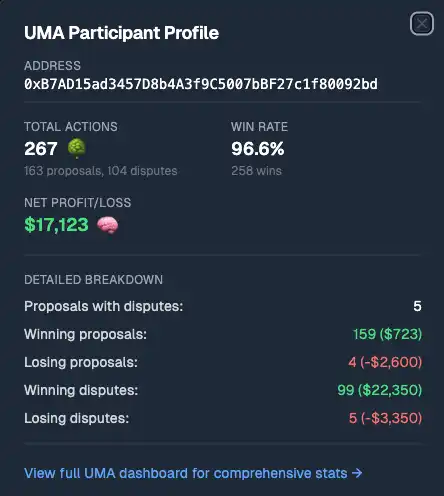
Very few users specialize in Disputes. The user who has earned the most from the Dispute环节 is 0xB7A, with profits of $17,123.
Step 3: Up to 48-Hour Discussion Period

Once entering the dispute track, both parties proceed to the UMA Discord discussion phase. This stage allows各方 to present arguments and evidence: interpretations of the rule text, relevant news reports, historical precedents, official statements—any material supporting their position can be presented at this stage.

The discussion period lasts up to 48 hours and is the only phase where reasons can be fully stated. The quality of this stage很大程度上 determines the direction of the subsequent vote.

Step 4: 48-Hour Voting

After the discussion, it enters the UMA token holder voting phase, divided into two 24-hour stages.

  • The first stage is blind voting. It forces each voter to make an independent judgment based on their understanding of the rules, rather than following big players.

  • The second stage is public. Votes not made public in this stage are considered abstentions and are directly invalidated.

After voting, UMA sets two settlement thresholds that must be met simultaneously for the adjudication to complete:

  • Participation level: At least 5 million tokens must participate in the vote, ensuring the裁决 has sufficient representativeness.

  • Absolute consensus: The winning side must have a vote share exceeding 65%, not a simple 51% majority.

If both thresholds are not met, the vote fails and enters a new round of re-voting, up to a maximum of 4 times. If no consensus is reached after 4 rounds, Polymarket officials have the right to intervene directly in the adjudication.

Step 5: Automatic Settlement

Once the vote result is confirmed, the market settles automatically, and funds are distributed according to the result. There is no appeal, no retrial, no recourse.

The entire dispute process, from challenge submission to final settlement, is typically completed within a week.
II. Polymarket vs. Traditional Courts: The Same Logic, Different Design

On the surface, Polymarket's adjudication process is highly similar to traditional courts: there is a party making a claim, a party challenging the claim, a discussion phase for statements, and finally an adjudicator who gives the result.

But the two systems differ fundamentally in one key design: separation of powers.

  1. Court power is isolated

In traditional courts, the plaintiff and defendant only have the right to state their case, not to adjudicate. The judge only has adjudication power, without a vested interest. Crucially, the judge must remain independent of the case. If the judge has any interest in the case, they must recuse themselves, and another judge takes over.

The adjudicator and the interested party are never the same person.

  1. Polymarket lacks this isolation

UMA token holders are the adjudicators, but they can simultaneously hold positions in the disputed market. Which direction they adjudicate directly affects their own profits and losses. The裁判者 and the interested party being the same person is called a conflict of interest in traditional courts, requiring mandatory recusal, but in Polymarket, it is legal and normal.

This design flaw is the root cause of the following two problems.

1️⃣ Why the discussion环节 fails

In court, the positions of the plaintiff and defendant are fixed from the moment of filing. Lawyers don't switch sides mid-trial, nor do they withdraw their statements because the other side is more assertive. Positions are clear, roles are defined, and the entire debate is built on this stability.

The UMA Discord discussion faces two problems simultaneously.

  • Herd mentality: The discussion is public and real-name. Once influential KOLs state their position, it's easy for others to follow. Many participants just post "P1" or "P2" without giving any理由.

  • Position switching: Participants also hold positions in the disputed market. When their positions change, their stance naturally changes with it. This is why posts in the UMA Discord are often deleted after being made.

Both problems stem from the same root: the adjudicator and the interested party are not separated. Courts use a mandatory recusal system to separate these two roles, ensuring the stability of positions during discussion. Polymarket lacks this isolation.

2️⃣ Why the adjudication results are opaque

In court, the judge hears the full arguments from both sides before making a ruling. The ruling document states which arguments were adopted, the basis for the decision, and the reasoning behind it. The losing party might disagree, but at least they know why they lost and can strengthen their arguments next time.

These rulings form a system of precedents that can be studied. Future judges, lawyers, and parties can cite them, making the adjudication standards searchable, learnable, and predictable.

After UMA voting concludes, there is only a result: YES or NO. The讨论 parties don't know what the voters saw, what they believed, or why they leaned one way. Winners don't know which argument worked; losers don't know where their persuasion fell short. Because the adjudication logic is never made public, the outcomes of disputes are difficult to learn from and accumulate.

Court rulings form a system of precedent; Polymarket's adjudications leave only a result.

III. Final Thoughts

Therefore, Polymarket is never just a market for "guessing events" correctly. It's more like a system that translates real-world events into legal text and then translates that legal text into settlement results.

Understanding the rules is as important as doing research. The pros' advantage often comes from their depth of understanding of the rules, knowing what this system acknowledges and what adjudications will recognize.

Those who realize earlier that a gap exists between "reality" and "the rules" have a better chance of profiting from the price deviations created by misreading, controversy, and emotion.


Domande pertinenti

QWhat is the main reason why many traders lose money on Polymarket according to the article?

ABecause they bet based on news and intuition, while experienced traders focus on meticulously reading and interpreting the rules of each market.

QDescribe the first step (Propose) in Polymarket's dispute resolution process.

AWhen a market meets settlement conditions, anyone can submit a proposal for a YES or NO outcome. This requires staking 750 USDC as a bond. If the proposal is accepted without dispute, the submitter earns a 5 USDC reward.

QWhat is a fundamental design difference between Polymarket's UMA voting system and a traditional court system?

APolymarket's UMA token holders, who act as the arbitrators, are allowed to hold positions in the markets they are voting on, creating a conflict of interest. Traditional courts enforce strict separation, where judges must recuse themselves if they have any interest in a case.

QWhy does the article claim the discussion phase in the UMA Discord often fails?

AIt fails due to herd mentality, where participants follow influential KOLs without providing their own reasoning, and because participants can change their stated positions as their market positions change, since arbitrators are not isolated from having a financial stake.

QWhat key advantage do 'che tou' (car heads, or experienced traders) have over regular users on Polymarket?

ATheir advantage comes from a deeper understanding of the platform's rules—knowing how the system will interpret events and what evidence it will recognize during a dispute resolution—allowing them to profit from pricing discrepancies created by misreadings and emotions.

Letture associate

A Nation Blocks Chips, a Giant Buys a Nuclear Power Plant: Why It's Time to Seriously Consider DeAI

**Title: Great Powers Blockade Chips, Giants Buy Nuclear Plants: Why It's Time to Seriously Consider DeAI** In May 2026, the US closed loopholes for Chinese firms to acquire advanced NVIDIA chips via overseas subsidiaries. That same month, Kenya halted a $1B geothermal data center project involving Microsoft, fearing its immense energy consumption. Meanwhile, Huawei announced mass production of its Ascend AI chip. These disparate events underscore a new reality: the competition for computing power ("compute") has escalated beyond the tech industry, becoming a geopolitical and infrastructural battleground. A new era of oligopoly is forming, with control over the AI stack—from GPU chips (NVIDIA) and cloud platforms (AWS, Azure, Google Cloud) to foundational models (OpenAI, Anthropic)—concentrating in a few Western "AI Octopus" corporations. This centralization creates systemic risks: pricing power and platform lock-in for users, infrastructure fragility, and a widening "compute divide" that threatens to marginalize nations without independent AI capacity. An "AI Iron Curtain" is deepening through export controls. In response, some nations like Saudi Arabia and the UAE are investing heavily to buy compute power, aiming to transition from oil to AI economies. The EU seeks to triple its compute capacity by 2030 to reduce dependency. However, the spending gap is vast, with four US tech giants alone planning ~$750B in AI capex for 2026. The race is increasingly constrained by energy, with AI tasks consuming up to 1000x more power than web searches, pushing firms to even acquire nuclear plants. This landscape is fueling interest in Decentralized AI (DeAI). It proposes a third way: using open protocols to coordinate a global network of idle GPUs, independent developers, and data centers, creating an AI infrastructure without a single controlling entity. Leveraging blockchain and cryptographic verification, DeAI aims to break market concentration, disperse energy demands, reduce geopolitical dependencies, and enhance transparency. While still nascent in performance and stability, DeAI's core promise is not immediate superiority but providing a crucial alternative architecture to resist monopoly, censorship, and centralized power. As specialized AI hardware costs fall and open-source models flourish, the window to build this foundation is open. The very existence of such competition serves as a vital check against the inevitable abuse of concentrated power.

marsbit37 min fa

A Nation Blocks Chips, a Giant Buys a Nuclear Power Plant: Why It's Time to Seriously Consider DeAI

marsbit37 min fa

Outpoll Review: A Prediction Market Platform Built for Active Traders

Outpoll Review: A Prediction Market Platform Built for Active Traders In recent years, prediction markets have grown from a niche sector to a mainstream arena, attracting billions in trading volume and institutional capital. However, the user experience and tools for traders have not kept pace. Outpoll, a new global prediction market platform, aims to fill this gap by providing enhanced trading infrastructure for active and professional traders. Built on standard prediction market principles, Outpoll allows users to trade on the outcome of specific events. It uses fully collateralized contracts with USDC settlement, charges a competitive 0.1% fee per trade, and provides clear settlement rules upfront to minimize disputes. A key focus for Outpoll is its professional-grade trading tools. The platform supports limit and market orders, as well as take-profit and stop-loss orders for open positions—features uncommon in prediction markets. For automated trading, Outpoll offers comprehensive REST and WebSocket APIs, enabling portfolio management, price arbitrage, and integration with existing tools. The platform also features a creator-led market model, where approved experts and community leaders can create and manage markets for niche topics under platform supervision. Its integrated interface combines news feeds directly with trading functions, allowing users to monitor events and manage positions seamlessly. Outpoll launched with a native Android app (available on Google Play) and plans an iOS version later this year. In summary, Outpoll distinguishes itself with trader-focused tools, practical APIs, transparent and collateralized markets, integrated news, and an expanding creator program. For active traders, its advanced order types and API access alone make it a platform worth watching. Outpoll is now globally accessible via outpoll.com and Google Play.

marsbit45 min fa

Outpoll Review: A Prediction Market Platform Built for Active Traders

marsbit45 min fa

Bitwise: Crypto Becomes a Contrarian Investment, Three Logics to Understand the Current Market

**Summary** Matt Hougan, Bitwise's CIO, analyzes the current crypto market through three key lenses, arguing it has shifted from a momentum-driven to a contrarian investment. **1) Crypto Becomes a Contrarian Play:** The market is weak, with major assets like Bitcoin and Ethereum down significantly. Capital has moved to hot sectors like AI, leaving crypto as an "unloved" asset class. This transforms crypto investing from trend-following to a test of patience and fundamental analysis. Investors now favor projects with solid fundamentals (e.g., Hyperliquid) over speculative ones. **2) Regulatory Overhang:** The uncertain fate of the U.S. CLARITY Act, a major crypto regulatory framework, is a key headwind. With its passage in 2024 seen as far from guaranteed (estimates range from 30-55%), institutional capital remains on the sidelines, choosing less risky alternatives like AI stocks. The market needs clarity—whether the bill passes or fails—more than any specific outcome to move decisively. **3) Capital Rotates to New Fundamentals:** This cycle differs from past bear markets where money fled to Bitcoin. Now, capital seeks smaller assets with strong use cases. While major cryptos fell in May 2024, tokens like Hyperliquid (+72%), Zcash (+50%), and XLM (+44%) rallied on their specific fundamentals. This rotation confirms the new contrarian, fundamentals-driven logic and signals the bear market may be in its later stages. **Conclusion:** Short-term pressure persists due to regulatory uncertainty and competition from AI narratives. Investing in crypto now requires a contrarian mindset—acting against the crowd and focusing on fundamental value. Patience and targeting high-quality projects based on their merits are essential for capturing long-term gains.

marsbit1 h fa

Bitwise: Crypto Becomes a Contrarian Investment, Three Logics to Understand the Current Market

marsbit1 h fa

ChatGPT Might Be Disappearing Soon

OpenAI announced at its "Intelligence at Work" event that its coding assistant, Codex, will be fully integrated into the ChatGPT app within weeks. This move marks a strategic shift from a conversational AI (Chat) towards a unified "agentic" platform capable of execution. Codex, originally launched to compete with Anthropic's Claude Code, has grown rapidly to 5 million weekly active users, with 20% being non-developers like analysts and designers. Its enterprise revenue now constitutes 40% of OpenAI's total. The integration is the first step in creating a super-app combining ChatGPT (interface), Codex (execution engine), and the Atlas browser (web access). OpenAI also unveiled new Codex features: specialized Agent plugins for six professional roles, an "Annotations" tool for direct document editing, and a "Sites" function to turn work into shareable web apps. Internally, this reflects a power shift; the Codex team now leads core product strategy. While the ChatGPT brand remains for its vast user base, the platform's future is focused on autonomous agents that perform tasks, not just chat. The article notes that competition with Claude Code pushed OpenAI's development, with Codex competing on cost-effectiveness and accessibility rather than raw coding quality. It concludes that the essence of "ChatGPT" is evolving from a chatbot into an AI agent platform, with the name potentially becoming a legacy symbol of its original function.

marsbit1 h fa

ChatGPT Might Be Disappearing Soon

marsbit1 h fa

Trading

Spot
Futures
活动图片




