Why Do Gold Farming Studios Sustain World of Warcraft but 'Kill' All Web3 Games?

marsbitPubblicato 2026-01-30Pubblicato ultima volta 2026-01-30

Introduzione

The article explores why gold farming studios, which thrived in games like World of Warcraft (WoW), have negatively impacted Web3 games. In WoW, gold farming did not destroy the game because in-game currency was not the ultimate value—prestige, achievements, and top-tier gear were untradeable and bound to player effort. Blizzard also managed the issue by incorporating gold buying into official systems, adding time-based constraints, and emphasizing social and cooperative elements that gold couldn’t bypass. Roblox, another successful game, avoids gold farming issues by focusing on creativity—monetizing through map creation and community engagement rather than repetitive tasks—and maintaining a closed economic system with limited cash-out options. In contrast, Web3 games often fail because they inherently link play and earn, allowing repeatable actions and free asset withdrawal. This design attracts capital and bots rather than genuine players, making it impossible to balance fun, profit, and scalability. The author argues that not everything should be financialized; some values, like memory and experience, are meant to be lived, not traded.

Written by: Lao Bai

A while ago, I tweeted about my son frantically recharging Robux in Roblox to steal other people's items, marveling at how this game is even more powerful than Genshin Impact's gacha system or Pop Mart's blind boxes—a true god of spending, which resonated with many folks. That post also had the highest traffic recently.

The next day, it suddenly occurred to me—why are there seemingly no "gold farming studios" in Roblox, despite it being such a cash-heavy game? Or even if there are, why do they have almost no impact on the game's lifecycle? Coincidentally, @j0hnwang also dug up his previous article on Roblox, mentioning this very point. I had bookmarked it before and went back to read it again.
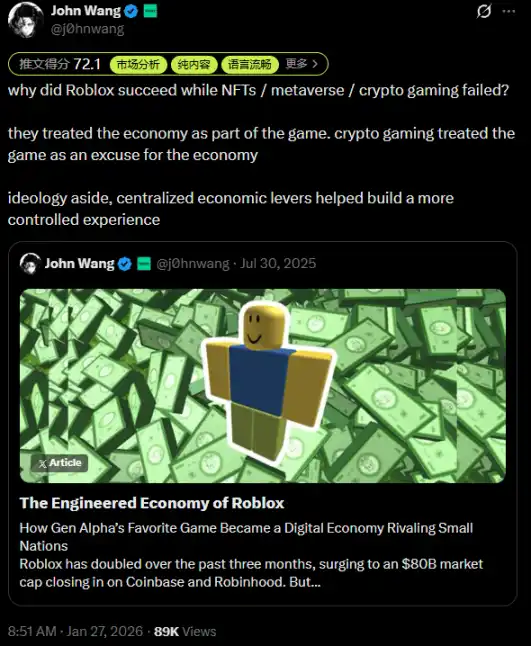
John's view is that Roblox treats the economic system as part of the game, while crypto games treat the game as a facade for the economic system. He believes that centralized economic mechanisms help build a more controllable gaming experience.

This makes sense. The lack of fun in Web3 games has been a common criticism, but the current generation of Web3 games has significantly improved in playability, and their economic mechanisms are also very centrally regulated. Yet, the outcome remains unchanged. There must be other reasons.

Then I thought about World of Warcraft and Kaito. On the day X blocked Kaito's API, I made the following comment.

Once Behavior Can Be Scaled, It Will Be Industrialized

From the "Chinese Farmers" in the Web2 era of World of Warcraft, to the scripts and gold farming studios in Web3's X2Earn, and now the inevitable "AI批量起号,多人矩阵嘴撸" (AI mass account creation, multi-account matrix farming) brought by嘴撸 (a term for farming).

So,嘴撸 wasn't ruined by clever retail players or KOLs; it was ruined by the property of "replicability." This isn't just a problem with the Kaito project; it's essentially the ultimate fate of all incentive systems.

So, what is the secret behind World of Warcraft and Roblox? Why can't studios kill them? Why did players complain about inflation and Chinese Farmers when they first appeared on the US servers, but eventually accept it as a fixed part of the game's ecosystem?

There must be something that Web3 games lack, and it's not just centralized economic mechanisms.

First, Let's Talk About World of Warcraft
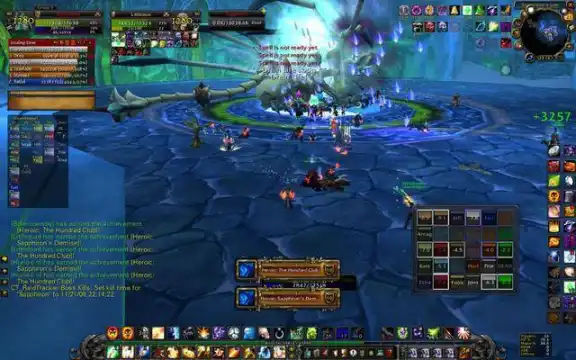
1. Gold Is Not the "Endgame Value"

Those who have deeply played WOW should know this: in the game, gold has little to do with your status or identity. Your achievements, rankings, reputation, etc.—none of these can be directly bought with gold. When a top-tier item drops in a dungeon, you either roll for it or bid with DKP (Dragon Kill Points) based on contribution. The player who loots it also binds it immediately, so it can't be sold for cash.

So, gold can at most save you some time, but it can't turn you into a core player. Many domestic web games back then were the complete opposite—big spenders could dominate everything with RMB, similar to the current style of Web3 games.

Essentially, in World of Warcraft, all "meaningful things"—top equipment, achievements, titles, dungeon contribution, etc.—cannot be directly purchased with gold. So, although gold farming can be scaled, leading to the industrialization of the first Chinese Farmers, it始终无法主导游戏的核心体验 (could never dominate the core experience of the game). In other words, this "industrialization" was confined to the "peripheral layer" of the game.

2. The Official Approach: "Absorption, Not Confrontation"

After the emergence of gold farming studios, Blizzard made a series of moves that, in hindsight, were very clever:

  • First, official control—allowing you to buy gold with real money, but the price is regulated by the system, and there's no free financial exit, turning the underground black market into official currency exchange;
  • Second, adding various barriers—such as daily and weekly quests, various cooldown locks... No matter how many accounts or high levels you have, you still have to wait patiently, diluting the advantage of industrialization;
  • Third, adding more "meaningful things" that cannot be bought with gold, like guilds, raids, social reputation... This led to the later emergence of gold runs and GKP (Gold Kill Points), but various dungeon first kills were always achieved by top guilds, never by gold runs. So, gold farming in World of Warcraft always remained a "second-class citizen."

As for Roblox, the Logic Is Slightly Different
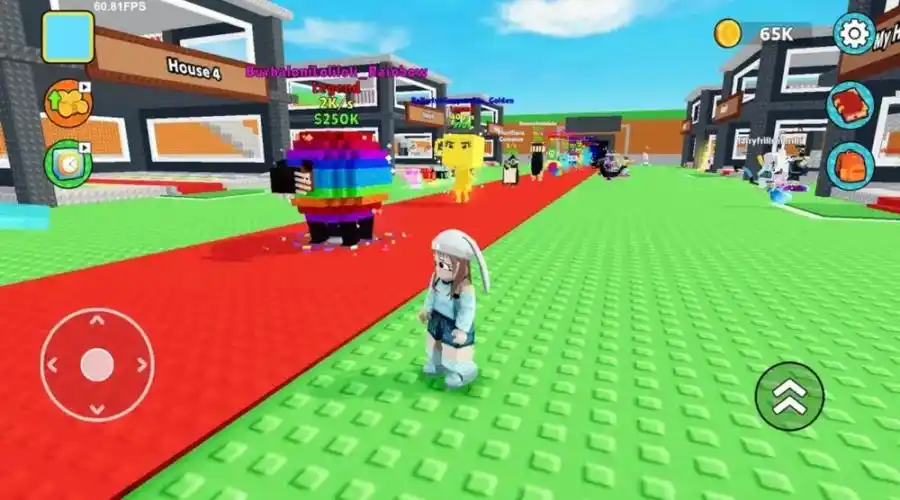
1. Encouraging Creativity Over Repetitive Labor

If you read the article I referenced in my previous post about Roblox, you'll know that the most profitable activities in Roblox are not repetitive tasks like farming resources, which offer little profit.

The real money is in creating maps, designing gameplay, and operating communities.

These are difficult for studios to scale and replicate. No matter how many resources you farm, you can't farm a gameplay that appeals to kids (though with AI now, this might also become "mass-producible").

2. Closed-Loop Internal Economic System, Restricted Asset Exchange

This is somewhat similar to John's idea. It's quick to buy Robux with a credit card, but converting Robux back to cash isn't as smooth—there are barriers, delays, and exchange rate losses, so arbitrage and搬砖 (a term for grinding/farming for profit) tactics don't work well here.

Moreover, most of the money in Roblox flows to platform fees, the top creators mentioned above, and in-game consumption, forming a closed-loop economic system with little overflow.

Of course, whether it's World of Warcraft or Roblox, being fun and having a large player base are the most important foundations, which is undeniable.

So, What Is the Real Reason Behind the Collective Demise of Web3 Games?

Thinking back, aside from the fun factor, perhaps the initial design intention of链游 (chain games/Web3 games) destined today's outcome.

Almost all链游 allow for "repeatable behavior" + "freely withdrawable assets."

In an era where Web2 gaming systems are already mature, this inevitably turns the final players of链游 into capital + scripts, not humans.

In other words, as long as Play and Earn are linked, this will always be the result.

Whether it's Play 2 Earn, the later improved Move 2 Earn, or Play & Earn, they are all different in name but not in essence.

This is somewhat like an impossible triangle for games. Among being fun, allowing speculators to make money, and enabling studios to scale, you can achieve at most two.
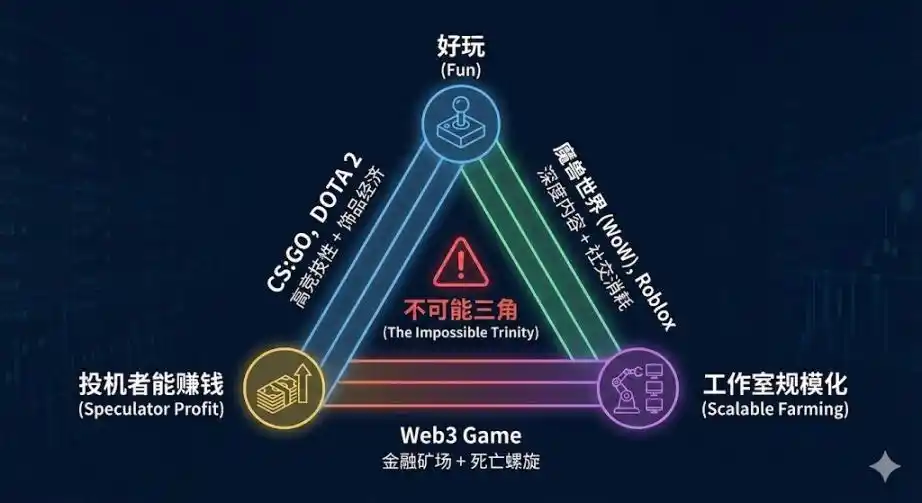
From this perspective, the problem with Web3 games isn't team quality or funding scale; it's that, at the most fundamental genetic level, they cannot be "fun."

Would Putting World of Warcraft on-Chain Work? Would It Be Meaningful?

I remember during the peak of链游 hype, we often fantasized about a scenario: what if World of Warcraft went on-chain?

Not the entire game, but putting WOW's economic system on-chain, including gold, items, mounts, etc., making them freely tradable, freely withdrawable, and financializable.

Now, thinking back, we were very naive. Doing this would注定会被系统毁掉 (destined to be destroyed by the system).

The underlying axioms of World of Warcraft's success:

  • Meaning cannot be traded—The most valuable things, top equipment, achievements, titles... are almost all bound, untradeable, non-transferable. These things signify what you have done, not what you own;
  • Progress does not equal wealth—Your time investment, operational skills, and team collaboration are your foundation. Gold can at most make you more comfortable; it cannot allow you to跨越阶级 (transcend classes);
  • Players are not asset owners but role-players—This equipment was obtained by me through effort / exchanged with DKP, this Boss was a world first kill by our guild, this character is my心血 (labor of love) trained over 10 years... Once this becomes "something I bought, an investment," this character emotionally bound to you downgrades into a skin for an asset account.

If we must talk about going on-chain, the things in World of Warcraft truly worth putting on-chain are these—for example, proof of a Boss's first kill, guild history, timestamps of your achievements, records of witnessing world events... What goes on-chain is not assets and value, but memories and traces.

The greatness of World of Warcraft lies precisely in the fact that its most important things can never be sold.

From this perspective, "链游必须死" (Chain games must die).

And it's not just链游. We once treated blockchain as a hammer, seeing everything as a nail to be struck. Little did we know that too many things in this world根本不需要被「金融化」 (simply do not need to be "financialized"). Their reason for existence is to be experienced, remembered, and told.


Domande pertinenti

QWhy did gold farming studios not destroy World of Warcraft (WoW) like they did with Web3 games?

AIn WoW, gold is not the ultimate value; meaningful elements like top-tier equipment, achievements, and reputation cannot be directly bought with gold. The official response involved absorbing and regulating the economy rather than outright对抗, implementing systems like official currency exchange, time-gated content, and non-tradable prestigious items. This kept gold farming activity on the periphery without dominating the core game experience.

QHow does Roblox prevent gold farming studios from harming its ecosystem?

ARoblox encourages creative activities like map design and community management, which are hard to scale industrially, rather than repetitive resource grinding. Its economy is a closed loop with friction and delays for cashing out Robux, making arbitrage difficult. The platform's focus on creativity and internal consumption, combined with financial barriers to withdrawal, limits the impact of farming.

QWhat is the fundamental reason Web3 games fail according to the article?

AWeb3 games inherently link play and earn, allowing repeatable actions and freely withdrawable assets. This design inevitably attracts capital and bots rather than genuine players, making it impossible for the games to be truly fun. The 'impossible triangle' suggests that a game cannot simultaneously achieve being fun, allowing speculators to profit, and enabling studio scalability—Web3 games prioritize the latter two at the expense of enjoyment.

QWhat would happen if World of Warcraft's economy were fully put on-chain?

AFully on-chaining WoW's economy would destroy it because the game's success relies on non-tradable elements like bound items, achievements, and player identity rooted in effort and memory, not financial ownership. On-chaining would reduce characters to asset accounts, stripping away the emotional attachment and meaning that comes from earned progress and shared experiences.

QWhat does the article suggest is worth putting on-chain from games like WoW?

AThe article suggests that instead of assets and value, meaningful elements like proof of first kills, guild history, achievement timestamps, and records of world events should be put on-chain. These represent memories and traces of player experiences, which align with the emotional and narrative value of the game, rather than promoting financialization.

Letture associate

What Happens to Ethereum Developer Tools After the Grants Run Out?

On February 27th, the Ethereum Foundation (EF) announced Project Odin, a structured sustainability support program designed for a select group of strategic, previously grant-funded teams. Unlike a standard grant, Odin offers a long-term advisory mechanism focused on helping these teams establish credible, sustainable paths within a two-year framework, thereby reducing long-term dependence on single funding sources. The program addresses a critical post-grant challenge: how essential public goods, especially major developer tools, can achieve financial sustainability beyond initial funding. While grants from EF and programs like Gitcoin or RetroPGF remain vital for startups and research, they often fall short for mature, widely-used infrastructure. Tools like compilers, languages, and network stacks are deeply embedded but struggle with monetization, trapped between being too foundational to lose and too public to generate natural revenue. Project Odin provides teams with a dedicated Strategic Advisor to guide them through a three-phase process: 1) analyzing current funding and realistic options, 2) validating potential paths with stakeholders, and 3) executing plans, which may include crafting support contracts, service agreements, or other recurring revenue models. The first pilot participant is Vyper, a critical smart contract language for the EVM, highlighting the need for sustainable models for core infrastructure. The initiative reframes the public goods conversation from "who should be funded" to "how do already-proven teams avoid perpetual funding crises?" It encourages ecosystem participants—protocols and projects that depend on these tools—to view sustainable support not just as charity, but as essential risk management for their own operational supply chains.

marsbit15 min fa

What Happens to Ethereum Developer Tools After the Grants Run Out?

marsbit15 min fa

MARA Reports Q1 Revenue Below Expectations, Net Loss of $1.3 Billion, Stock Plunges After Hours

Bitcoin mining firm MARA Holdings reported disappointing Q1 2024 results, causing its stock to erase all daily gains and fall 3.44% in after-hours trading. Revenue dropped 18% year-over-year to $174.6 million, missing Wall Street estimates of $192.7 million. The company posted a net loss of $1.3 billion, a significant increase from a $533.4 million loss a year ago, primarily driven by unrealized losses on its holdings of 38,689 Bitcoin, which depreciated in value during the quarter. MARA also sold over 15,100 BTC in late March to repurchase debt at a discount. The broader mining environment remains challenging due to a 35% decline in Bitcoin's price from its all-time high and a nearly 30% increase in mining difficulty over the past year. MARA's market cap ranking among U.S. miners has slipped to seventh. Critically, the company announced a strategic pivot away from Bitcoin mining expansion. It stated it has no plans to purchase new mining equipment and is fully transitioning toward AI data centers. Its strategy involves retrofitting existing mining sites for AI and high-performance computing (HPC) and leveraging its recent $1.5 billion acquisition of Long Ridge Energy & Power, a gas-fired power plant and data center. This infrastructure could eventually support 600 MW of AI compute capacity, allowing MARA to redeploy up to 90% of its non-custodial mining power for AI and IT workloads.

marsbit15 min fa

MARA Reports Q1 Revenue Below Expectations, Net Loss of $1.3 Billion, Stock Plunges After Hours

marsbit15 min fa

The AI Investment Landscape Is Being Reshaped: Beyond the 'Magnificent Seven', What Opportunities Lie in the Semiconductor Supply Chain?

AI Investment Map is Reshaping: Opportunities Beyond the 'Magnificent Seven' Since ChatGPT ignited the AI wave, investment initially focused on the "Magnificent Seven" tech giants dominating cloud infrastructure. However, the rise of DeepSeek and debates on AI capital expenditure effectiveness are shifting this dynamic. Investors now recognize opportunities deeper in the supply chain—the companies providing the essential "picks and shovels." Early concerns about an AI investment "arms race" and potential low returns were partly alleviated by strong Q1 earnings from cloud providers, validating robust compute demand. This has highlighted a more certain investment thesis: regardless of which AI applications ultimately win, massive capital expenditure will first fuel demand for semiconductors and related components. This "pick-and-shovel" logic has driven semiconductor ETFs to record highs. Key beneficiaries include: * **Memory Chipmakers (e.g., SK Hynix, Samsung, Micron)**: High Bandwidth Memory (HBM) is a critical bottleneck for AI training. * **Photonics Companies**: Crucial for high-speed data transfer within AI data centers. * **The Broader "AI-11" Semiconductor Ecosystem**: This encompasses foundries & lithography (TSMC, ASML), logic & custom chips (AMD, Broadcom, Intel, Marvell), and enterprise storage (SanDisk, Western Digital). Every dollar of AI infrastructure spending flows through this chain. While the "Magnificent Seven" remain dominant in market size, their earnings growth premium over the rest of the S&P 500 ("S&P 493") is narrowing. Market attention and marginal investment are shifting towards the expanding semiconductor supply chain. The investment narrative is evolving from "betting on the ultimate AI winner" to "investing in the certainty of the infrastructure build-out." Understanding this shift from the demand side to the supply side is key to identifying future AI investment opportunities.

marsbit44 min fa

The AI Investment Landscape Is Being Reshaped: Beyond the 'Magnificent Seven', What Opportunities Lie in the Semiconductor Supply Chain?

marsbit44 min fa

Trading

Spot
Futures
活动图片