Why Do Chinese Memes Lack Staying Power?

Odaily星球日报Pubblicato 2026-01-13Pubblicato ultima volta 2026-01-13

Introduzione

Chinese meme coins on BSC experienced a brief surge in early January 2026, led by tokens like “我踏马来了” (I’m F*cking Coming) and “老子” (Laozi), but quickly lost momentum within days. The rally, initially sparked by a tweet from He Yi (Binance co-founder), reflected a recurring pattern within the BSC ecosystem—dubbed “Shandongology”—where meme tokens gain traction through perceived endorsements from CZ or He Yi, even without direct involvement. This culture has led to growing community fatigue and internal division. Many participants expressed resistance to what they see as excessive sycophancy, undermining cohesion and diverting attention from organic meme culture. Unlike the October 2025 wave, which attracted global interest and cross-chain engagement, this surge failed to gain significant traction outside Chinese-speaking communities, limiting liquidity and buyer diversity. Moreover, Chinese meme coins are no longer novel. While they’ve become a recurring category within crypto, their reliance on “Shandongology” and lack of independent cultural identity make them highly susceptible to short-lived hype cycles. Tokens that fail to evolve beyond influencer-driven narratives tend to fade quickly, reinforcing a “pump-and-dump” pattern that shortens each meme cycle.

Original | Odaily Planet Daily (@OdailyChina)

Author | Golem (@web 3_golem)
"The two-day on-chain bull run is over"—this is the prevailing sentiment in the Meme community today.

Following the surge in October last year, Chinese Meme coins once again sparked a frenzy on BSC in January this year, giving rise to many community-favored tokens (related reading:From "Life K-Line" to "Laozi", a rundown of the top 5 hottest BSC "Chinese Memes"). However, according to GMGN data today, popular Chinese Memes have generally seen pullbacks. Within 24 hours, "I'm F*cking Coming" dropped by 30%, "Laozi" fell by 25%, "Life K-Line" declined over 20%, and "Manager Xiao Ni" plunged over 40%.

Every feast eventually ends, and Memes cool down particularly quickly. Last October, the Chinese Meme hype started during the National Day holiday and lasted a full month before fading. But this time, it ended so abruptly. What exactly went wrong?

Rejection of "Shandong-ology" Undermines Community Unity

This round of Chinese Meme hype was cold-started from a tweet by He Yi. On January 1st, He Yi posted on X with the caption "2026, I'm f*cking coming" to celebrate the New Year. A week later, the同名 Meme coin began to gain traction, eventually listing on Binance Alpha and igniting the Chinese Meme community.

However, along with this came widespread discussion in the community about "Crypto Shandong-ology: which way does the fish head face?"—pointing directly to a整套 Meme launch model on BSC revolving around CZ and He Yi. CZ and He Yi don’t need to personally direct or even know about these tokens; from developers to the community to the Binance alpha team, everyone automatically "gets enlightened." The fate of a Meme is decided by a single tweet.

In February 2025, CZ首次 interacted with a worthless on-chain test token TST on BSC, marking the雏形 of this Meme launch model on BSC. After subsequent small-cycle iterations like the dispute over CZ’s dog and the Dubai narrative, the community figured out the "social nuances" necessary for a BSC Meme hype cycle from cold start to peak.

To make money in such an ecosystem, put politely, one must learn from the top and the excellent; put bluntly, one "absolutely cannot stand upright."

"Is it really different this time?" As this Chinese Meme wave peaked again, countless bloggers asked on social media. This wasn’t just mere meme-ing; it genuinely reflected the psychological shadow left by this "Crypto Shandong-ology" since 2025.

When enough shadows accumulate, they form rejection. Some criticized the BSC ecosystem for going to any lengths to "suck up," blindly截取 content from CZ and He Yi’s tweets, even giving birth to tokens like "Mom," "Dad," and "Laozi," making Chinese Memes increasingly tacky.

Previously, Odaily Planet Daily also analyzed the community debate sparked by "I'm F*cking Coming" listing on Binance Alpha, calling it "a serious blow to genuine Chinese Meme culture" (related reading: How to evaluate the listing of "I'm F*cking Coming" on Binance?).

When rejection of "Crypto Shandong-ology" becomes widespread, searching for community Meme coins without the CZ/He Yi angle itself became a community force. Crypto blogger Honest Mai总 (X:@Michael_Liu93)直言, "Everyone is really tired of sucking up." (The blogger holds 1% of "Life K-Line" tokens)
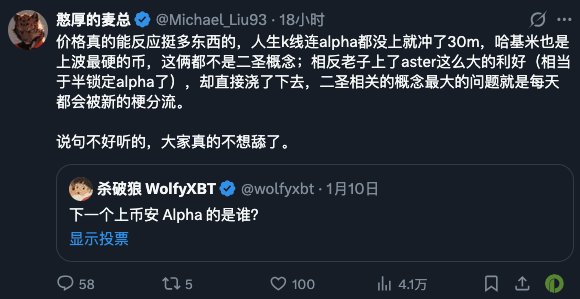
Regardless, such division ultimately harms the unity of the BSC Meme community. Capital cannot form a合力. When a community-consensus leader fails to emerge quickly, Meme sentiment rapidly dissipates.

Lack of External Liquidity

To sustain a small Meme cycle, there must be price increases, and to sustain increases, there must be new buying pressure exceeding selling pressure. A possible reason for the lack of staying power in this Chinese Meme wave is the absence of external liquidity injection. The market cap was primarily driven up by the Chinese community on BSC, without attracting buying from overseas communities or the Solana Meme community.

The Chinese Meme hype last October had an unprecedented reach. Many overseas Meme influencers sought help on X to join Chinese Meme communities; "Dagou WeChat groups" suddenly saw an influx of English-speaking degens. This wave also prompted other chains to court the Chinese Meme community: Base chain lead Jesse invited the community to build on Base, while Solana founder Toly and Solana Foundation president Lily Liu fueled the hype for the Solana Chinese Meme "Suolala."

This influence溢出 from the wealth effect of Chinese Meme coins translated into tangible on-chain buying power, prolonging the duration of the October hype.

But the January Chinese Meme hype lacked this externality, still revolving around CZ and He Yi’s tweets. The only Chinese Meme with some externality, "Life K-Line" (reportedly covered by CCTV on January 3rd), had its spotlight quickly overshadowed after "I'm F*cking Coming" listed on Alpha.

One piece of this lack of external liquidity: using language filters on X to search for posts and views about recent hot Chinese Memes (e.g., I'm F*cking Coming, Laozi, Small Shareholder) in English-speaking regions shows that, aside from exchange listing announcements with high views, discussion of these Memes in English is scarce.
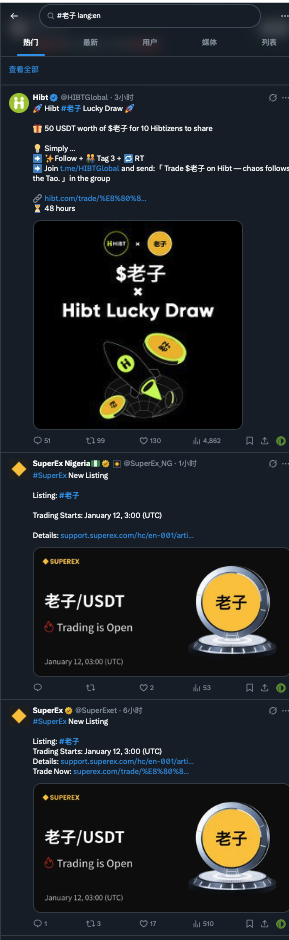
Hot posts about "Laozi" in the X English section are all exchange listing announcements

Chinese Memes Themselves Are No Longer Novel

A乒乓球 dropped from a height always bounces back lower each time.

Chinese Memes themselves are no longer a sufficiently attractive narrative.

Odaily Planet Daily asserted at the end of October last year that although the October Meme hype ended, Chinese Memes themselves would not die out but would become a fixed Meme category, with periodic hype cycles in the future. (Related reading:After Binance Life, Chinese Memes Evolve from Hits to a Sector)

This also means that if a Meme coin merely has a Chinese ticker and some "position-determines-view" logic for rising, it is destined not to last.

Since last October, the only Chinese Meme coins with lasting vitality are Binance Life and Hachimi. Tokens like Customer Service Xiao He, Cultivation, and Nailong have vanished into history. The representative Memes in this wave were all strongly tied to the "Shandong-ology" of CZ and He Yi and failed to develop an independent culture beyond the "Two Saints'" halo. Thus, they are注定 to lack the生命力 to survive beyond small Meme cycles, like any previous similar token (theoretically, Life K-Line doesn't belong here; its popularity was essentially sparked by the CCTV article).

When the Chinese Meme narrative first emerged, a Chinese Meme coin could rise simply due to novelty. Now, Chinese Memes have become an unremarkable, fixed category. As Chinese Memes fully integrate into the BSC Meme cycle assembly line, and as the market becomes increasingly familiar with this playbook, the ecosystem reverts to a "speed run" mode. The entire Meme cycle accelerates: cold start via "imperial decree," baiting continued interaction, listing on Binance Alpha, and finally, dumping...

This round of Chinese Memes is just a microcosm of that.

Domande pertinenti

QWhat are the main reasons mentioned for the lack of staying power of Chinese Meme coins in the recent cycle?

AThe main reasons include community division due to rejection of the 'Shandong School' dynamics (excessive reliance on CZ and He Yi's influence), lack of external liquidity from international or Solana communities, and the diminished novelty of Chinese Meme narratives as a category.

QHow did the 'Shandong School' concept affect the cohesion of the BSC Meme community?

AThe 'Shandong School' concept, which revolves around creating Meme coins based on CZ and He Yi's social media activity, caused community division. Some participants rejected this sycophantic culture, leading to fragmented consensus and reduced collective buying power, which weakened the Meme cycle's sustainability.

QWhy was external liquidity important for previous Chinese Meme booms, and how did it differ in January?

AExternal liquidity, from international or cross-chain communities, provided additional buying pressure that extended the duration of previous booms (e.g., October 2025). In January, the lack of such external engagement, with minimal discussion in English-speaking communities, resulted in quicker exhaustion of the hype.

QWhat role did Binance Alpha play in the recent Chinese Meme cycle?

ABinance Alpha listings, such as for '我踏马来了' (I'm Coming), acted as a catalyst by amplifying visibility and legitimacy. However, it also intensified community debates over the 'Shandong School' and centralized influence, contributing to the cycle's rapid decline.

QHow has the perception of Chinese Meme coins evolved over time?

AInitially, Chinese Meme coins benefited from novelty and freshness, attracting broad interest. Over time, they became a standardized category within BSC's Meme cycles, losing their unique appeal. The market now operates in a 'pump and dump' mode, with accelerated cycles due to familiarity with the playbook.

Letture associate

7 Months After the Collapse of Huiwang, Southeast Asia's Escrow Platforms Undergo a Major Reshuffle

Following the collapse of Huione Pay—dubbed the "Alipay of Southeast Asia"—seven months ago, the region's underground financial guarantee platform sector is undergoing a significant reshuffle. This power vacuum has been swiftly filled by emerging platforms such as XinBi, Tiger/Navigator, JinBei (renamed JinBo), Dali/Tiancheng, and FullyLight. These platforms, operating largely via Telegram and offering services like escrow for illicit transactions, have absorbed the vast user base and markets left behind by Huione. While positioning themselves as "trust intermediaries," their primary clientele consists of networks involved in online scams, money laundering, illegal gambling, and even human trafficking. For instance, the Tiger/Navigator platform explicitly provides "escrow" services for kidnapping-for-ransom operations ("强押车交易"). Data underscores the immense scale: Huione alone processed over $103 billion in cryptocurrency payments and facilitated over $31 billion through its escrow market before its downfall, linking it to Cambodia's notorious Prince Group. Since its collapse, competitors have seen explosive growth. For example, the XinBi platform has accumulated over $1.6 billion in total USDT revenue, while platforms like NewPay, OkPay (under Dali), and FullyLight Wallet collectively processed over $4.8 billion in USDT in a single year. This ecosystem thrives in regions like Cambodia and Myanmar, where regulatory gaps allow these platforms to act as critical financial infrastructure for sprawling cybercrime industries, from scam compounds to online casinos. The article concludes that the moniker "Southeast Asian Alipay" is a misnomer, obscuring the platforms' fundamental role in enabling serious criminal enterprises rather than representing legitimate financial innovation.

Odaily星球日报18 min fa

7 Months After the Collapse of Huiwang, Southeast Asia's Escrow Platforms Undergo a Major Reshuffle

Odaily星球日报18 min fa

The Changing Landscape: What Are Crypto VCs Experiencing?

Title: The Shifting Landscape of Crypto Venture Capital The era of dedicated crypto venture capital funds is undergoing a significant transformation. Once essential for navigating the sector's complexity and high risk, these specialized funds are now facing an identity crisis as the market matures. This shift mirrors historical patterns in other specialized investment classes like cleantech and SPACs, where initial information advantages dissipate as technologies become mainstream and integrated into existing industry frameworks. The article argues that crypto is reaching a critical inflection point, transitioning from a "building phase" to an "integration phase." Major players like Stripe, BlackRock, and Visa now engage with crypto not for its novel mechanics but as a foundational financial infrastructure. Their needs—regulatory compliance, banking partnerships, distribution channels—align with traditional fintech, a domain easily understood by large, generalist funds like Sequoia and Founders Fund. This evolution creates a "barbell effect" within the VC landscape. On one end are massive, diversified platforms that can incorporate crypto as one vertical among many. On the other are small, nimble funds focused on niche, experimental projects. The middle ground—medium-sized dedicated crypto funds—is being squeezed out. Their typical fund size makes it impossible to generate sufficient returns solely from early-stage crypto bets, yet they cannot compete with giants for later-stage deals. Consequently, leading crypto-native firms like Paradigm and Framework Ventures are expanding into AI, robotics, and other sectors, driven partly by LP pressure for better returns amid a broader VC DPI crisis. Others, like Dragonfly and a16z, have narrowed their crypto focus predominantly to financial infrastructure like stablecoins, reframing the sector's core narrative. For crypto entrepreneurs, this consolidation presents challenges. While generalist funds offer larger checks and broader resources, crypto projects now compete fiercely with AI for attention and capital within these firms. Furthermore, the long-term, non-commercial foundational work that built the ecosystem—funded by dedicated crypto VCs—is less likely to attract generalist capital focused on direct returns. The conclusion is that "crypto investor" as a standalone category is becoming obsolete, akin to "internet investor." Crypto is becoming a baseline infrastructure layer. The future will see a barbell structure: large-scale growth financing handled by generalist funds, while pioneering, speculative projects are funded by small, specialized vehicles. The dedicated crypto funds of the 2017-2021 boom, which incubated core infrastructure, are giving way to this new, bifurcated reality.

Foresight News35 min fa

The Changing Landscape: What Are Crypto VCs Experiencing?

Foresight News35 min fa

As Consensus Accelerates, What Are Young Investors Betting On?

Title: As Consensus Forms Faster, What Are Young Investors Betting On? In the rapid evolution of tech investment, a new generation of young investors is navigating a landscape where AI, robotics, commercial aerospace, and quantum computing are advancing simultaneously. Traditional investment logic based on financial models is giving way to a need for deep technical understanding and the ability to act before industry consensus forms. An analysis of trends from the "WAIC FUTURE TECH" list of young investment leaders reveals key shifts in focus. The first major trend is the movement of AI from the digital screen into the physical world. Investment is shifting from large language models and chatbots towards embodied AI, robotics, AI hardware, and edge computing. While demonstrations generate excitement, the real challenge lies in achieving scalable, reliable, and cost-effective delivery in complex real-world environments like factories and logistics. Success depends not just on algorithms but on the integration of sensors, actuators, and control systems. Second, the competitive focus for large models is moving beyond raw capability toward building an "intelligence flywheel." The goal is to create self-reinforcing systems where user interaction generates data, improving the model, which in turn enhances the user experience and attracts more engagement. Companies that successfully embed AI into workflows to create these closed-loop systems can build lasting value that isn't easily erased by the next model upgrade. Third, facing a potential bottleneck in high-quality human-generated data, investors are looking at new underlying technologies. Reinforcement learning and self-play, as demonstrated by AlphaGo Zero, offer paths for AI to generate its own experience. Scientific foundation models, which aim to build general AI capabilities for fields like life sciences and materials discovery, represent a non-consensus direction that could unlock new frontiers of knowledge and data. Finally, in deep-tech areas like quantum computing, commercial aerospace, and space-based infrastructure, patient capital is essential. These fields have long, uncertain development and validation cycles involving complex engineering, supply chains, and regulations. Investment here requires a long-term view, focusing on foundational team capabilities and the eventual emergence of market demand, even if commercial returns are distant. Collectively, these trends illustrate how young investors are adapting to a new era. They are learning to make earlier, technically-informed judgments, balance hype with real-world viability, and provide the patient capital needed to build the deep-tech foundations of the future.

marsbit1 h fa

As Consensus Accelerates, What Are Young Investors Betting On?

marsbit1 h fa

Trading

Spot
活动图片





