Why Do Chinese Memes Lack Staying Power?

Odaily星球日报Pubblicato 2026-01-13Pubblicato ultima volta 2026-01-13

Introduzione

Chinese meme coins on BSC experienced a brief surge in early January 2026, led by tokens like “我踏马来了” (I’m F*cking Coming) and “老子” (Laozi), but quickly lost momentum within days. The rally, initially sparked by a tweet from He Yi (Binance co-founder), reflected a recurring pattern within the BSC ecosystem—dubbed “Shandongology”—where meme tokens gain traction through perceived endorsements from CZ or He Yi, even without direct involvement. This culture has led to growing community fatigue and internal division. Many participants expressed resistance to what they see as excessive sycophancy, undermining cohesion and diverting attention from organic meme culture. Unlike the October 2025 wave, which attracted global interest and cross-chain engagement, this surge failed to gain significant traction outside Chinese-speaking communities, limiting liquidity and buyer diversity. Moreover, Chinese meme coins are no longer novel. While they’ve become a recurring category within crypto, their reliance on “Shandongology” and lack of independent cultural identity make them highly susceptible to short-lived hype cycles. Tokens that fail to evolve beyond influencer-driven narratives tend to fade quickly, reinforcing a “pump-and-dump” pattern that shortens each meme cycle.

Original | Odaily Planet Daily (@OdailyChina)

Author | Golem (@web 3_golem)
"The two-day on-chain bull run is over"—this is the prevailing sentiment in the Meme community today.

Following the surge in October last year, Chinese Meme coins once again sparked a frenzy on BSC in January this year, giving rise to many community-favored tokens (related reading:From "Life K-Line" to "Laozi", a rundown of the top 5 hottest BSC "Chinese Memes"). However, according to GMGN data today, popular Chinese Memes have generally seen pullbacks. Within 24 hours, "I'm F*cking Coming" dropped by 30%, "Laozi" fell by 25%, "Life K-Line" declined over 20%, and "Manager Xiao Ni" plunged over 40%.

Every feast eventually ends, and Memes cool down particularly quickly. Last October, the Chinese Meme hype started during the National Day holiday and lasted a full month before fading. But this time, it ended so abruptly. What exactly went wrong?

Rejection of "Shandong-ology" Undermines Community Unity

This round of Chinese Meme hype was cold-started from a tweet by He Yi. On January 1st, He Yi posted on X with the caption "2026, I'm f*cking coming" to celebrate the New Year. A week later, the同名 Meme coin began to gain traction, eventually listing on Binance Alpha and igniting the Chinese Meme community.

However, along with this came widespread discussion in the community about "Crypto Shandong-ology: which way does the fish head face?"—pointing directly to a整套 Meme launch model on BSC revolving around CZ and He Yi. CZ and He Yi don’t need to personally direct or even know about these tokens; from developers to the community to the Binance alpha team, everyone automatically "gets enlightened." The fate of a Meme is decided by a single tweet.

In February 2025, CZ首次 interacted with a worthless on-chain test token TST on BSC, marking the雏形 of this Meme launch model on BSC. After subsequent small-cycle iterations like the dispute over CZ’s dog and the Dubai narrative, the community figured out the "social nuances" necessary for a BSC Meme hype cycle from cold start to peak.

To make money in such an ecosystem, put politely, one must learn from the top and the excellent; put bluntly, one "absolutely cannot stand upright."

"Is it really different this time?" As this Chinese Meme wave peaked again, countless bloggers asked on social media. This wasn’t just mere meme-ing; it genuinely reflected the psychological shadow left by this "Crypto Shandong-ology" since 2025.

When enough shadows accumulate, they form rejection. Some criticized the BSC ecosystem for going to any lengths to "suck up," blindly截取 content from CZ and He Yi’s tweets, even giving birth to tokens like "Mom," "Dad," and "Laozi," making Chinese Memes increasingly tacky.

Previously, Odaily Planet Daily also analyzed the community debate sparked by "I'm F*cking Coming" listing on Binance Alpha, calling it "a serious blow to genuine Chinese Meme culture" (related reading: How to evaluate the listing of "I'm F*cking Coming" on Binance?).

When rejection of "Crypto Shandong-ology" becomes widespread, searching for community Meme coins without the CZ/He Yi angle itself became a community force. Crypto blogger Honest Mai总 (X:@Michael_Liu93)直言, "Everyone is really tired of sucking up." (The blogger holds 1% of "Life K-Line" tokens)
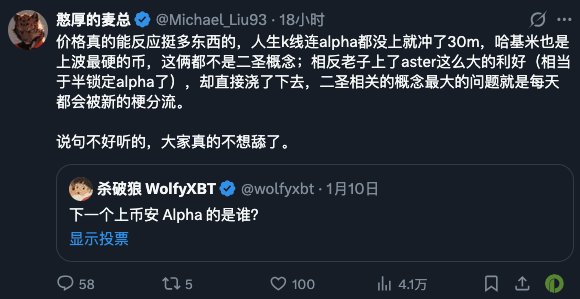
Regardless, such division ultimately harms the unity of the BSC Meme community. Capital cannot form a合力. When a community-consensus leader fails to emerge quickly, Meme sentiment rapidly dissipates.

Lack of External Liquidity

To sustain a small Meme cycle, there must be price increases, and to sustain increases, there must be new buying pressure exceeding selling pressure. A possible reason for the lack of staying power in this Chinese Meme wave is the absence of external liquidity injection. The market cap was primarily driven up by the Chinese community on BSC, without attracting buying from overseas communities or the Solana Meme community.

The Chinese Meme hype last October had an unprecedented reach. Many overseas Meme influencers sought help on X to join Chinese Meme communities; "Dagou WeChat groups" suddenly saw an influx of English-speaking degens. This wave also prompted other chains to court the Chinese Meme community: Base chain lead Jesse invited the community to build on Base, while Solana founder Toly and Solana Foundation president Lily Liu fueled the hype for the Solana Chinese Meme "Suolala."

This influence溢出 from the wealth effect of Chinese Meme coins translated into tangible on-chain buying power, prolonging the duration of the October hype.

But the January Chinese Meme hype lacked this externality, still revolving around CZ and He Yi’s tweets. The only Chinese Meme with some externality, "Life K-Line" (reportedly covered by CCTV on January 3rd), had its spotlight quickly overshadowed after "I'm F*cking Coming" listed on Alpha.

One piece of this lack of external liquidity: using language filters on X to search for posts and views about recent hot Chinese Memes (e.g., I'm F*cking Coming, Laozi, Small Shareholder) in English-speaking regions shows that, aside from exchange listing announcements with high views, discussion of these Memes in English is scarce.
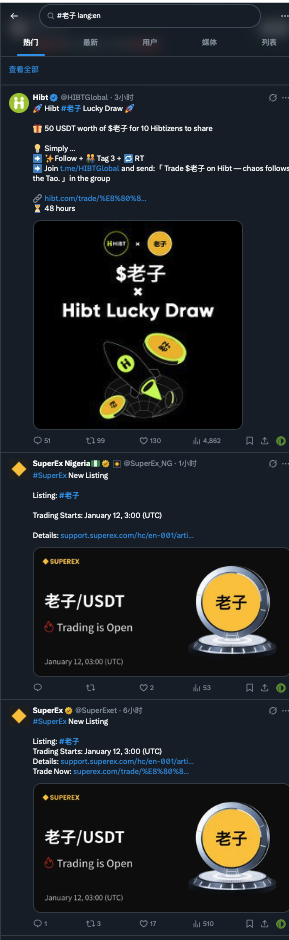
Hot posts about "Laozi" in the X English section are all exchange listing announcements

Chinese Memes Themselves Are No Longer Novel

A乒乓球 dropped from a height always bounces back lower each time.

Chinese Memes themselves are no longer a sufficiently attractive narrative.

Odaily Planet Daily asserted at the end of October last year that although the October Meme hype ended, Chinese Memes themselves would not die out but would become a fixed Meme category, with periodic hype cycles in the future. (Related reading:After Binance Life, Chinese Memes Evolve from Hits to a Sector)

This also means that if a Meme coin merely has a Chinese ticker and some "position-determines-view" logic for rising, it is destined not to last.

Since last October, the only Chinese Meme coins with lasting vitality are Binance Life and Hachimi. Tokens like Customer Service Xiao He, Cultivation, and Nailong have vanished into history. The representative Memes in this wave were all strongly tied to the "Shandong-ology" of CZ and He Yi and failed to develop an independent culture beyond the "Two Saints'" halo. Thus, they are注定 to lack the生命力 to survive beyond small Meme cycles, like any previous similar token (theoretically, Life K-Line doesn't belong here; its popularity was essentially sparked by the CCTV article).

When the Chinese Meme narrative first emerged, a Chinese Meme coin could rise simply due to novelty. Now, Chinese Memes have become an unremarkable, fixed category. As Chinese Memes fully integrate into the BSC Meme cycle assembly line, and as the market becomes increasingly familiar with this playbook, the ecosystem reverts to a "speed run" mode. The entire Meme cycle accelerates: cold start via "imperial decree," baiting continued interaction, listing on Binance Alpha, and finally, dumping...

This round of Chinese Memes is just a microcosm of that.

Domande pertinenti

QWhat are the main reasons mentioned for the lack of staying power of Chinese Meme coins in the recent cycle?

AThe main reasons include community division due to rejection of the 'Shandong School' dynamics (excessive reliance on CZ and He Yi's influence), lack of external liquidity from international or Solana communities, and the diminished novelty of Chinese Meme narratives as a category.

QHow did the 'Shandong School' concept affect the cohesion of the BSC Meme community?

AThe 'Shandong School' concept, which revolves around creating Meme coins based on CZ and He Yi's social media activity, caused community division. Some participants rejected this sycophantic culture, leading to fragmented consensus and reduced collective buying power, which weakened the Meme cycle's sustainability.

QWhy was external liquidity important for previous Chinese Meme booms, and how did it differ in January?

AExternal liquidity, from international or cross-chain communities, provided additional buying pressure that extended the duration of previous booms (e.g., October 2025). In January, the lack of such external engagement, with minimal discussion in English-speaking communities, resulted in quicker exhaustion of the hype.

QWhat role did Binance Alpha play in the recent Chinese Meme cycle?

ABinance Alpha listings, such as for '我踏马来了' (I'm Coming), acted as a catalyst by amplifying visibility and legitimacy. However, it also intensified community debates over the 'Shandong School' and centralized influence, contributing to the cycle's rapid decline.

QHow has the perception of Chinese Meme coins evolved over time?

AInitially, Chinese Meme coins benefited from novelty and freshness, attracting broad interest. Over time, they became a standardized category within BSC's Meme cycles, losing their unique appeal. The market now operates in a 'pump and dump' mode, with accelerated cycles due to familiarity with the playbook.

Letture associate

Gensyn AI: Don't Let AI Repeat the Mistakes of the Internet

In recent months, the rapid growth of the AI industry has attracted significant talent from the crypto sector. A persistent question among researchers intersecting both fields is whether blockchain can become a foundational part of AI infrastructure. While many previous AI and Crypto projects focused on application layers (like AI Agents, on-chain reasoning, data markets, and compute rentals), few achieved viable commercial models. Gensyn differentiates itself by targeting the most critical and expensive layer of AI: model training. Gensyn aims to organize globally distributed GPU resources into an open AI training network. Developers can submit training tasks, nodes provide computational power, and the network verifies results while distributing incentives. The core issue addressed is not decentralization for its own sake, but the increasing centralization of compute power among tech giants. In the era of large models, access to GPUs (like the H100) has become a decisive bottleneck, dictating the pace of AI development. Major AI companies are heavily dependent on large cloud providers for compute resources. Gensyn's approach is significant for several reasons: 1) It operates at the core infrastructure layer (model training), the most resource-intensive and technically demanding part of the AI value chain. 2) It proposes a more open, collaborative model for compute, potentially increasing resource utilization by dynamically pooling idle GPUs, similar to early cloud computing logic. 3) Its technical moat lies in solving complex challenges like verifying training results, ensuring node honesty, and maintaining reliability in a distributed environment—making it more of a deep-tech infrastructure company. 4) It targets a validated, high-growth market with genuine demand, rather than pursuing blockchain integration without purpose. Ultimately, the boundaries between Crypto and AI are blurring. AI requires global resource coordination, incentive mechanisms, and collaborative systems—areas where crypto-native solutions excel. Gensyn represents a step toward making advanced training capabilities more accessible and collaborative, moving beyond a niche controlled by a few giants. If successful, it could evolve into a fundamental piece of AI infrastructure, where the most enduring value in the AI era is often created.

marsbit8 h fa

Gensyn AI: Don't Let AI Repeat the Mistakes of the Internet

marsbit8 h fa

Why is China's AI Developing So Fast? The Answer Lies Inside the Labs

A US researcher's visit to China's top AI labs reveals distinct cultural and organizational factors driving China's rapid AI development. While talent, data, and compute are similar to the West, Chinese labs excel through a pragmatic, execution-focused culture: less emphasis on individual stardom and conceptual debate, and more on teamwork, engineering optimization, and mastering the full tech stack. A key advantage is the integration of young students and researchers who approach model-building with fresh perspectives and low ego, prioritizing collective progress over personal credit. This contrasts with the US culture of self-promotion and "star scientist" narratives. Chinese labs also exhibit a strong "build, don't buy" mentality, preferring to develop core capabilities—like data pipelines and environments—in-house rather than relying on external services. The ecosystem feels more collaborative than tribal, with mutual respect among labs. While government support exists, its scale is unclear, and technical decisions appear driven by labs, not state mandates. Chinese companies across sectors, from platforms to consumer tech, are building their own foundational models to control their tech destiny, reflecting a broader cultural drive for technological sovereignty. Demand for AI is emerging, with spending patterns potentially mirroring cloud infrastructure more than traditional SaaS. Despite challenges like a less mature data industry and GPU shortages, Chinese labs are propelled by vast talent, rapid iteration, and deep integration with the open-source community. The competition is evolving beyond a pure model race into a contest of organizational execution, developer ecosystems, and industrial pragmatism.

marsbit9 h fa

Why is China's AI Developing So Fast? The Answer Lies Inside the Labs

marsbit9 h fa

3 Years, 5 Times: The Rebirth of a Century-Old Glass Factory

Corning, a 175-year-old glass company, is experiencing a dramatic revival as a key player in AI infrastructure, driven by surging demand for high-performance optical fiber in data centers. AI data centers require vastly more fiber than traditional ones—5 to 10 times as much per rack—to handle high-speed data transmission between GPUs. This structural demand shift, coupled with supply constraints from the lengthy expansion cycle for fiber preforms, has created a significant supply-demand gap. Nvidia has invested in Corning, along with Lumentum and Coherent, in a $4.5 billion total commitment to secure the optical supply chain for AI. Corning's competitive edge lies in its expertise in producing ultra-low-loss, high-density, and bend-resistant specialty fiber, which is critical for 800G+ and future 1.6T data rates. Its deep involvement in co-packaged optics (CPO) with partners like Nvidia further solidifies its position. While not the largest fiber manufacturer globally, Corning's revenue from enterprise/data center clients now exceeds 40% of its optical communications sales, and it has secured multi-year supply agreements with major hyperscalers including Meta and Nvidia. Financially, Corning's optical communications revenue has surged, doubling from $1.3 billion in 2023 to over $3 billion in 2025. Its stock price has risen nearly 6-fold since late 2023. Key future catalysts include the rollout of Nvidia's CPO products and the scale of undisclosed customer agreements. However, risks include high current valuations and potential disruption from next-generation technologies like hollow-core fiber. The company's long-term bet on light over electricity, maintained even through the telecom bubble crash, is now being validated by the AI boom.

marsbit10 h fa

3 Years, 5 Times: The Rebirth of a Century-Old Glass Factory

marsbit10 h fa

Trading

Spot
Futures
活动图片