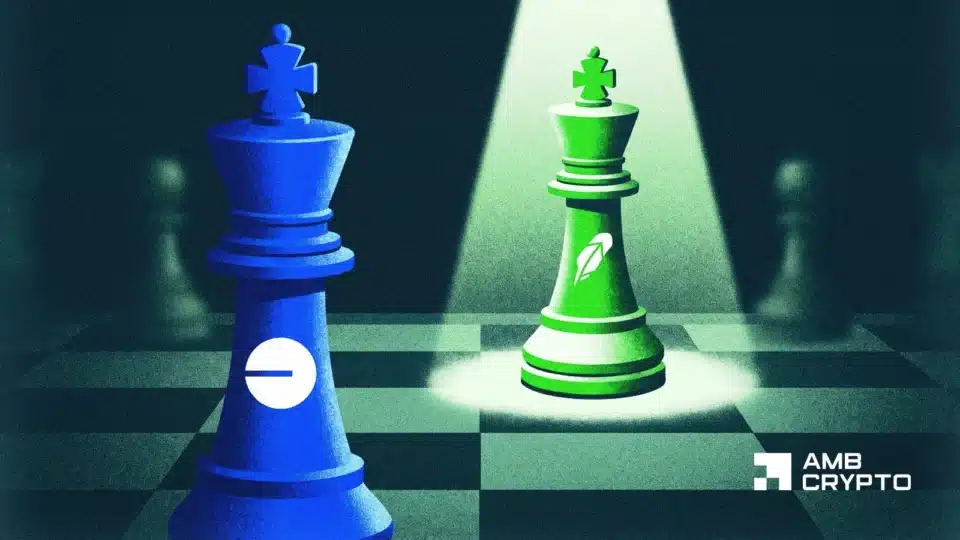
Why Did the Star Web3 Project Across Protocol Choose to Abandon the DAO?

marsbitPubblicato 2026-03-15Pubblicato ultima volta 2026-03-15

Introduzione

Across Protocol, a prominent Web3 project, is proposing to transition from a decentralized autonomous organization (DAO) structure to a private company. Co-founder Hart Lambur explained on the Talking Tokens podcast that the current DAO model has become a bottleneck for growth, particularly as institutional and enterprise demand increases. The protocol, which has facilitated over $35 billion in cross-chain transactions, believes a more traditional corporate structure will allow it to operate more efficiently. The proposal offers two options for ACX token holders: convert their tokens into equity in the new private entity, AcrossCo., or redeem them for USDC at a one-month average market price. Lambur acknowledged limitations due to U.S. securities laws, which restrict the number of shareholders in an S-corporation, necessitating consolidation for larger token holders. This move reflects a broader industry trend of recognizing the operational challenges of DAOs. Lambur cited similar sentiments from Aave's founder and Uniswap's recent proposal to create a legal entity, highlighting the friction and inefficiencies of decentralized governance structures. The proposal will enter a two-week discussion period before a community Snapshot vote.

Original Title: What Across Protocol's going private proposal really means for its token holders and DAO

Original Author: Jacquelyn Melinek

Original Compilation: Ken, ChainCatcher

Today, as many traditional companies delve deeper into the field of tokenization, Across Protocol is proposing a different path to its token holders: to become a private company by buying out their tokens, or to exchange them for equity.

@AcrossProtocol co-founder @hal2001 Lambur stated on the @_TalkingTokens podcast by @TokenRelations: "The protocol is seeking to go private because its DAO structure is hindering its development."

"I have always been a token maximalist," said Lambur. "We launched the Across token very early, with an extremely low market cap and a very broad airdrop, primarily because we wanted to build publicly and accumulate value for our community and users. But I think the macro environment has changed."

Across Protocol connects multiple major networks (including @Ethereum and @Solana), allowing users to bridge or swap tokens across chains. To date, it has processed over $35 billion in transaction volume.

But as institutional and corporate demand grows, its structure has proven to be a bottleneck. Lambur believes the protocol "would develop better with a more traditional structure."

To our knowledge, Across's proposal to privatize itself is a rare move, but it comes as the industry begins to acknowledge that a DAO is a difficult organizational structure to operate.

In August 2025, when @UniswapFND proposed creating the legal entity DUNI, the protocol stated that a formal structure would bring more "capability and greater autonomy."

Earlier this week, @Aave founder @StaniKulechov wrote about the friction involved in operating a DAO. "As we have been operating, DAOs are exceptionally difficult, and this difficulty is different from the difficulty of building complex things. The difficulty lies in the fact that you are fighting against your own organizational structure every day."

For Across, Risk Labs is the foundation and legal entity "currently responsible for signing contracts" and building the protocol, but Lambur said the DAO is separate from it.

The protocol currently operates under a "classic token structure," meaning you have an on-chain protocol and a legal entity that maintains a loose cooperative relationship with the protocol. But Lambur said they are two separate structures. "This is one of the reasons people criticize the DAO model, and in essence, we are trying to unify these two," he added.

Before announcing the proposal on Wednesday, Across had been considering this move for months. "It's this situation: you look at the macro environment, see how undervalued these tokens are, and then look at the various frictions you face when trying to conduct business in a more traditional way."

The proposal offers token holders two options: exchange their ACX tokens for equity in AcrossCo., or exchange them for USDC at a one-month average market price. Users holding a large number of tokens can directly exchange them for shares, while those holding a small number of tokens can do so through a special purpose vehicle with no handling fees.

Lambur acknowledged that one of the biggest negatives of the proposal is the limitation on how many token holders can transfer their holdings into a potential S-corp through equity. "This is based on U.S. securities laws, and we have designed it to be as inclusive as humanly possible."

"A U.S. C-corp cannot have 5,000 entries on its cap table," so some consolidation is necessary, he pointed out. Nevertheless, he remains optimistic that this will work.

Before releasing a Snapshot vote or decision to the community, the proposal will have a two-week discussion period.


Crypto di tendenza

Domande pertinenti

QWhy is Across Protocol proposing to go private and abandon its DAO structure?

AAcross Protocol's co-founder Hart Lambur stated that the DAO structure has become a bottleneck for growth, especially as institutional and enterprise demand increases. He believes the protocol would perform better with a more traditional corporate structure to reduce operational friction and adapt to the changed macro environment.

QWhat are the two options being offered to ACX token holders in the privatization proposal?

AToken holders can either exchange their ACX tokens for equity in AcrossCo. (the new corporate entity) or redeem them for USDC at a one-month average market price. Large holders can directly swap for equity, while smaller holders may use a fee-free special purpose vehicle for consolidation.

QWhat limitation does the privatization proposal face regarding U.S. securities laws?

AU.S. securities laws restrict the number of token holders who can hold equity in the new structure, as a U.S. C-corporation cannot have thousands of individuals on its cap table. The proposal aims to be inclusive as possible but requires consolidation through SPVs for smaller holders.

QHow does Across Protocol's move reflect broader trends in the DAO ecosystem?

AThe move highlights growing recognition that DAOs are challenging to operate efficiently. Similar to Uniswap's proposal for a legal entity (DUNI) and Aave's founder discussing DAO operational friction, Across acknowledges that traditional structures may offer greater autonomy and capability for growth.

QWhat is the current status of the privatization proposal within Across Protocol community?

AThe proposal is in a two-week discussion period before being put to a Snapshot vote for the community to decide. This allows token holders to debate the terms before formal voting occurs.

Letture associate

Global Stock Market's Storm Center: South Korea's Stock Market De-leveraging Is Largely Complete

Storm's Eye: South Korean Market De-leveraging Nears Completion The recent sharp correction in South Korean equities, with the KOSPI index dropping 32% from its June high, has been a key trigger for global tech stock volatility. The core driver was not a fundamental shift but a forced de-leveraging process within the market's unique structure, which is now largely complete. Two main leverage channels amplified the sell-off: 1. **Leveraged ETFs:** Their size, proportionally four times larger than in the U.S., peaked near $50 billion. Their mandatory daily rebalancing mechanism created a vicious cycle of "price drop → forced selling → further drop." Approximately 75% of this excess has been unwound, shrinking to $26 billion, with regulatory curbs now blocking new inflows. 2. **Hedge Fund Leverage:** Using swaps to magnify exposure, hedge funds saw their net long positioning fall by over 50% from peak levels. The most intense phase of this institutional de-leveraging is over. In contrast, **retail margin debt** poses minimal systemic risk. At 0.5% of market cap, it is far lower than in the U.S. or China, lacks automatic triggers, and is concentrated in smaller stocks. The conclusion: the high-leverage structures most prone to "chain-reaction selling" have been substantially cleared. The market is transitioning from a liquidity-driven crash to one priced more on fundamentals. The article argues that the AI trend—centered on Korean memory chips—remains intact. This episode represents a painful but necessary clearing of crowded trades, not the end of the AI revolution. For investors, the key question is conviction in the long-term AI direction; if the trend is real, current volatility is a cost of entry, not a terminal risk.

链捕手1 h fa

Global Stock Market's Storm Center: South Korea's Stock Market De-leveraging Is Largely Complete

链捕手1 h fa

Trading

Spot

Articoli Popolari

Come comprare DAO

Benvenuto in HTX.com! Abbiamo reso l'acquisto di DAO Maker (DAO) semplice e conveniente. Segui la nostra guida passo passo per intraprendere il tuo viaggio nel mondo delle criptovalute.Step 1: Crea il tuo Account HTXUsa la tua email o numero di telefono per registrarti il tuo account gratuito su HTX. Vivi un'esperienza facile e sblocca tutte le funzionalità,Crea il mio accountStep 2: Vai in Acquista crypto e seleziona il tuo metodo di pagamentoCarta di credito/debito: utilizza la tua Visa o Mastercard per acquistare immediatamente DAO MakerDAO.Bilancio: Usa i fondi dal bilancio del tuo account HTX per fare trading senza problemi.Terze parti: abbiamo aggiunto metodi di pagamento molto utilizzati come Google Pay e Apple Pay per maggiore comodità.P2P: Fai trading direttamente con altri utenti HTX.Over-the-Counter (OTC): Offriamo servizi su misura e tassi di cambio competitivi per i trader.Step 3: Conserva DAO Maker (DAO)Dopo aver acquistato DAO Maker (DAO), conserva nel tuo account HTX. In alternativa, puoi inviare tramite trasferimento blockchain o scambiare per altre criptovalute.Step 4: Scambia DAO Maker (DAO)Scambia facilmente DAO Maker (DAO) nel mercato spot di HTX. Accedi al tuo account, seleziona la tua coppia di trading, esegui le tue operazioni e monitora in tempo reale. Offriamo un'esperienza user-friendly sia per chi ha appena iniziato che per i trader più esperti.

180 Totale visualizzazioniPubblicato il 2024.12.11Aggiornato il 2026.06.02

Come comprare DAO

Discussioni

Benvenuto nella Community HTX. Qui puoi rimanere informato sugli ultimi sviluppi della piattaforma e accedere ad approfondimenti esperti sul mercato. Le opinioni degli utenti sul prezzo di DAO DAO sono presentate come di seguito.

活动图片