Why CLARITY Act faces crucial test as approval odds drop to 42%

ambcryptoPubblicato 2026-02-24Pubblicato ultima volta 2026-02-24

Introduzione

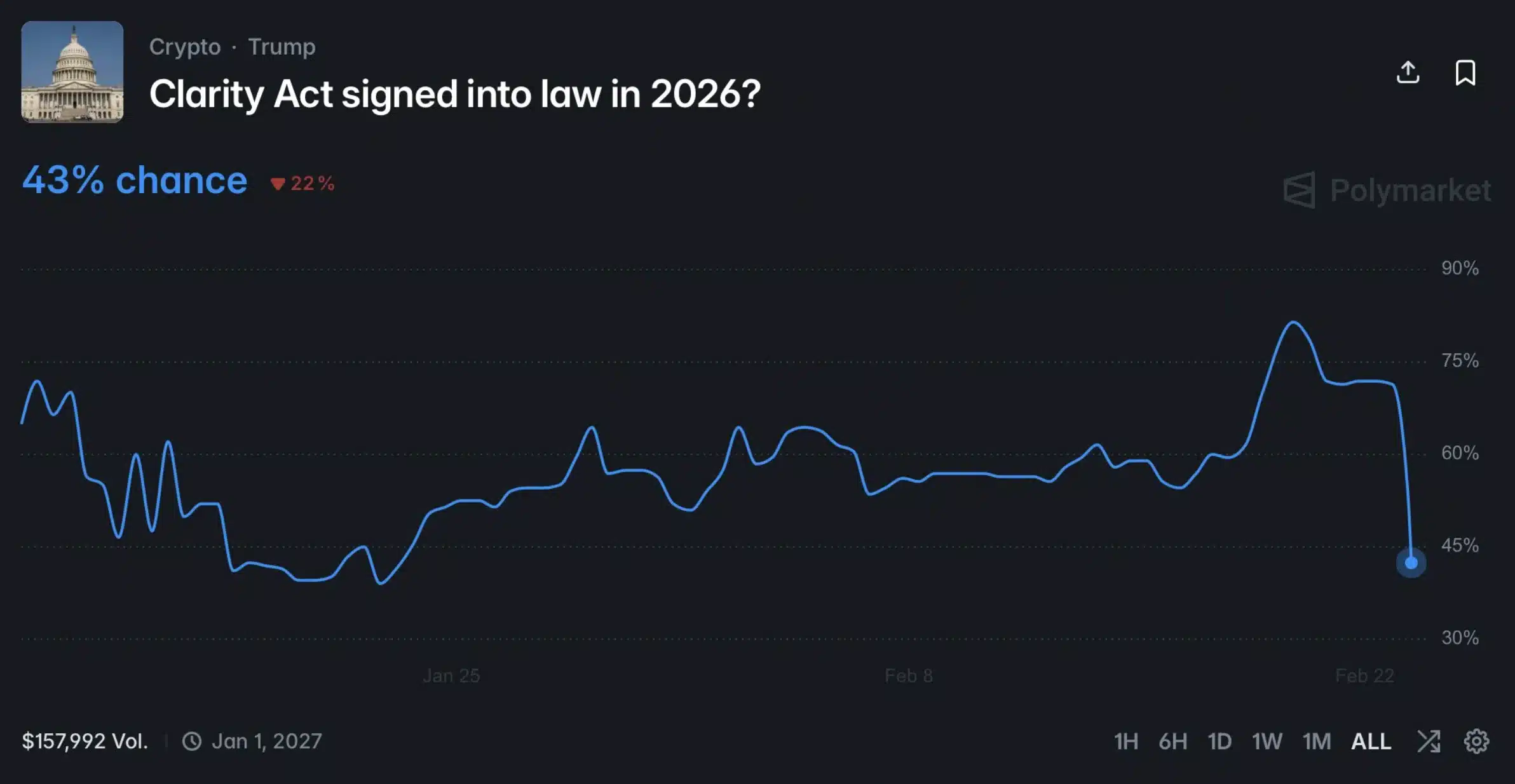
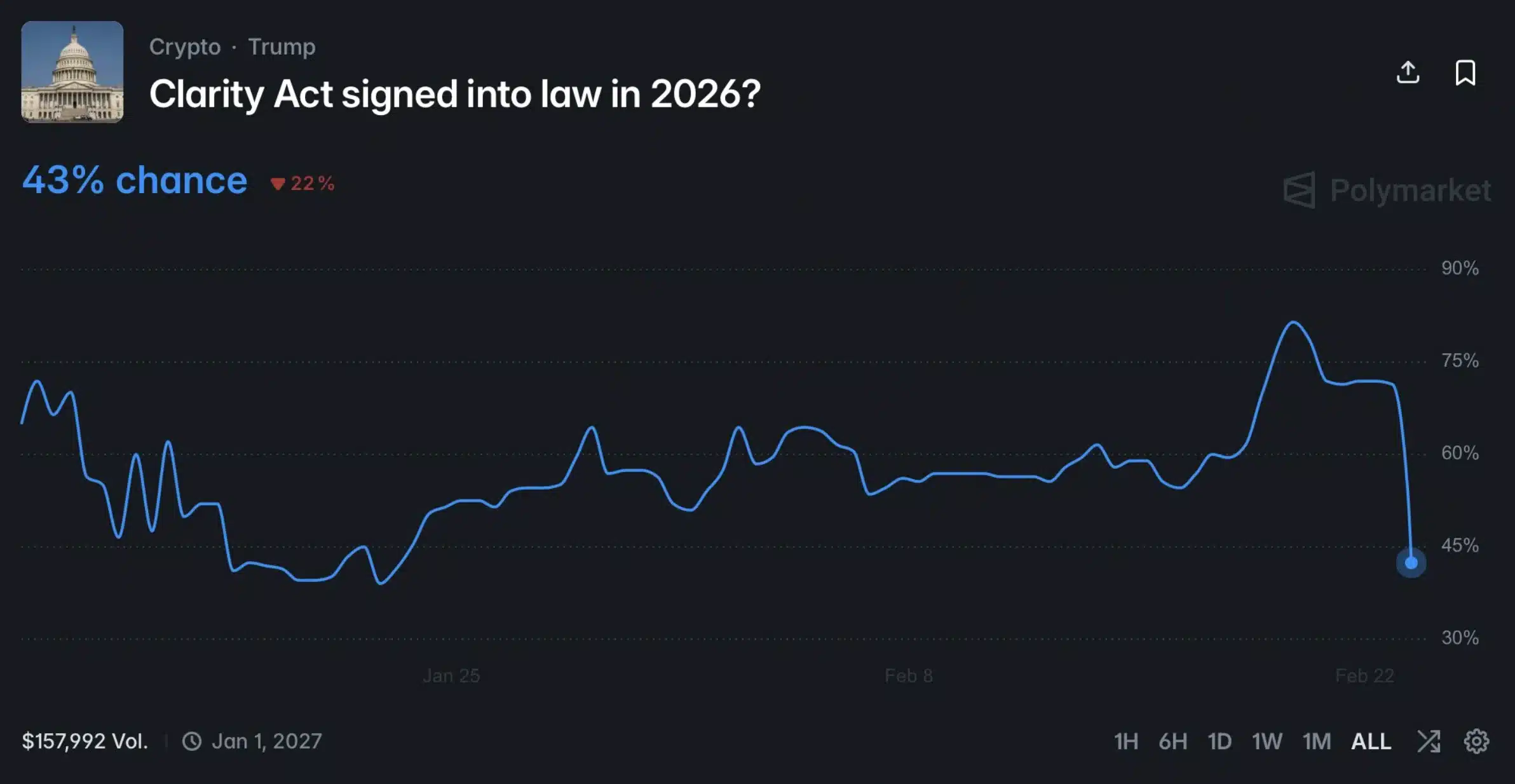
The CLARITY Act faces a critical test as its approval odds on Polymarket dropped sharply from 72% to 42%, reflecting declining market confidence. The White House is mediating between crypto firms (like Coinbase and Ripple) advocating for stablecoin features such as programmability and rewards, and banking groups concerned about deposit outflows and financial stability. A key disagreement revolves around whether crypto companies should be allowed to offer high yields on stablecoins, which banks fear could weaken the traditional financial system. The White House has set a March 1 deadline for a compromise, warning that failure could stall the bill. The latest draft imposes strict rules, with severe penalties for attempts to disguise interest payments. Its future also depends on Senator Tim Scott’s support. While some industry leaders remain optimistic about passage by April, the political deadlock and tight timeline pose significant roadblocks.

As expectations grow around the possible approval of the CLARITY Act, the White House held its third round of talks this week, where a so-called “compromise” began to take shape.

During the event held at ETHDenver, Patrick Witt from the White House Crypto Council said that the gap between both sides has “shrunk considerably” after a long private meeting last week.

On one side were major crypto players, including Coinbase, Ripple, and Andreessen Horowitz, advocating for the preservation of stablecoins’ unique features, such as programmability and rewards.

The other side included major banking groups, such as the American Bankers Association and the Bank Policy Institute, which focused on safeguarding the traditional banking system.

What is the main point of disagreement?

That being said, the main disagreement comes from fear of the unknown. Banks worry that if crypto companies are allowed to offer high rewards on stablecoins, people may pull their money out of banks. This could weaken banks and harm the economy.

However, crypto supporters see this differently. They believe banks are trying to block competition. In their view, banning yield gives banks unfair control over people’s savings and slows down innovation.

Now that the White House is taking direct control of the draft law, the crypto industry knows regulation is coming.

The White House has set a firm March 1 deadline, warning that if negotiators fail to finalize the bill by then, it could stall or collapse.

The latest draft includes strict rules to prevent loopholes. If companies try to disguise interest as “rewards,” they could face action from the SEC, Treasury, and CFTC, with fines of up to $500,000 per day.

This shows the administration is focused on tight control, not a soft compromise, keeping stablecoins close to the traditional banking system.

Roadblocks remain

However, the bill’s future still depends on Senator Tim Scott, who has yet to reschedule a key meeting. If talks succeed, the long delay may finally end. If not, the CLARITY Act could remain stuck in political deadlock.

Remarking on the same, Witt said,

“I believe if we solve this, it’s going to start a domino effect here, and I think things could move pretty fast once it’s resolved.”

Weighing in on the sentiment, Dan Gambardello added,

“Seems like they’re just playing games...”

Source: Dan Gambardello/X
Even though Patrick Witt says talks are improving and both sides are working honestly, many people in the market think the deal may still fail.

CLARITY Act odds are decreasing

In just one day, the odds on Polymarket for the CLARITY Act passing dropped sharply, from 72% to 42%. This shows that traders and investors are losing confidence.

Data from Santiment also suggests that people are starting to expect the bill to stall or collapse.

But some people are still optimistic,

Additionally, many leaders in the crypto industry are still hopeful about the CLARITY Act.

On the 20th of February, Ripple CEO Brad Garlinghouse also said that he believes the bill could pass as early as April.

For now, the crypto community and investors are waiting nervously. They want to see if Washington can finally deliver the clear rules it has been promising for years.


Final Summary

  • The CLARITY Act is entering its most critical phase, with the 1st of March deadline leaving little room for further delays.
  • Talks between crypto firms and banks have narrowed differences, but key disagreements over stablecoin rewards remain unresolved.


Domande pertinenti

QWhat is the main point of disagreement between crypto companies and banks regarding the CLARITY Act?

AThe main disagreement stems from banks' fear that if crypto companies are allowed to offer high rewards on stablecoins, people may withdraw their money from traditional banks, potentially weakening the banking system and harming the economy. Crypto supporters, however, view this as banks trying to block competition and maintain unfair control over people's savings, which slows down innovation.

QWhat is the deadline set by the White House for finalizing the CLARITY Act, and what is the consequence of missing it?

AThe White House has set a firm deadline of March 1st. It has warned that if negotiators fail to finalize the bill by then, the legislation could stall or collapse entirely.

QAccording to the article, what has happened to the market's prediction for the CLARITY Act's approval?

AThe odds for the CLARITY Act passing on Polymarket dropped sharply from 72% to 42% in just one day, indicating that traders and investors are losing confidence and starting to expect the bill to stall or fail.

QWho is a key political figure whose support is critical for the future of the CLARITY Act?

ASenator Tim Scott is a key figure, as the bill's future depends on him rescheduling a crucial meeting. His actions will determine if the long delay ends or if the act remains in political deadlock.

QWhat are the potential penalties for companies that try to disguise interest payments as 'rewards' under the latest draft of the act?

ACompanies that try to disguise interest as 'rewards' could face enforcement action from the SEC, Treasury, and CFTC, with fines of up to $500,000 per day for such violations.

Letture associate

Bitcoin Withdrawals Continue: 8 Years of Storage in a Coldcard Cold Wallet Ended in Zero

Coldcard Hardware Wallet Hacked: Losses Mount Due to Vulnerable Seed Generation A critical vulnerability in Coldcard hardware wallets has led to a continued wave of fund thefts. According to Galaxy Research, the total stolen has reached 1,367.05 BTC (approx. $88.6 million) from 4,585 addresses, a significant increase from the initial 594.5 BTC reported on July 30, 2026. Most of the stolen funds remain on the attackers' addresses. The issue is not with the current firmware, which Coinkite has updated, but with seed phrases generated on vulnerable devices between March 2021 and the release of fixed firmware versions. Due to a programmer error, devices switched from using a hardware random number generator to the software-based Yasmarang generator, which was initialized with publicly accessible data like the chip's serial number. This made the seed phrases predictable through offline brute-force attacks, meaning wallets remain at risk until funds are moved to a new wallet generated with the patched firmware. Affected devices include Mk2/Mk3 with firmware 4.0.1–4.1.9 (and up to 5.0.3), Mk4/Mk5 up to version 5.6.0, and Q models up to 1.5.0Q. The only exceptions are seeds created with a high-entropy method like at least 50 independent dice rolls or a strong unique BIP-39 passphrase. All other owners must generate a new seed on the fixed firmware and transfer their assets. A case highlighting the human impact involves a 39-year-old long-term investor who lost 2 BTC (approx. $130,000) in minutes. He had accumulated the Bitcoin over eight years through physical labor, viewing it as a financial lifeline and a retirement plan in a country suffering from hyperinflation. His story underscores that even conservative "buy and hold in cold storage" strategies can be compromised by such underlying technical flaws. From a technical perspective, this incident echoes historical failures where weak random number generators undermined cryptographic security, challenging the assumption that offline storage is automatically foolproof.

cryptonews.ru3 h fa

Bitcoin Withdrawals Continue: 8 Years of Storage in a Coldcard Cold Wallet Ended in Zero

cryptonews.ru3 h fa

Trading

Spot
活动图片