Why Aave’s $42B risk model faces its first real test after Chaos Labs’ exit

ambcryptoPubblicato 2026-04-07Pubblicato ultima volta 2026-04-07

Introduzione

Risk management is central to DeFi protocol performance, especially during volatile periods. Aave, with $42.34B in TVL and $16.55B in loans, relies on continuous risk model adjustments rather than fixed settings. External teams like Chaos Labs have historically updated liquidation thresholds, borrow limits, and collateral rules in response to market conditions. Chaos Labs’ recent exit signals strain in Aave’s risk framework as the protocol scales. Their departure reflects deeper misalignments in risk management strategy and comes despite their critical role in overseeing Aave’s growth from $5.2B to over $26B in TVL. The exit also highlights operational and financial challenges, as the engagement remained unprofitable even with a proposed $5M budget. Aave now faces its first major test in risk continuity. Responsibility shifts to internal teams and other providers like LlamaRisk, but questions remain about response speed and coordination—especially as Aave introduces greater complexity with V4. While systems are currently stable, any delay in adjustments could allow risks to accumulate. Market confidence may now depend less on past performance and more on how effectively Aave manages this transition.

Risk management in DeFi now plays a central role in how protocols perform, especially during volatile periods. As Q1 2026 ended, Aave [AAVE] managed about $42.34 billion in TVL and $16.55 billion in loans; it relies on continuous adjustments rather than fixed settings.

Source: Stani Kulechov on X

External teams like Chaos Labs update liquidation thresholds, borrow limits, and collateral rules as conditions change.

As these updates happen more often, the system responds faster to market stress. This improves stability and user confidence, although it also means protocols depend more on external risk models as complexity increases.

Chaos Labs exit signals strain in Aave’s risk model

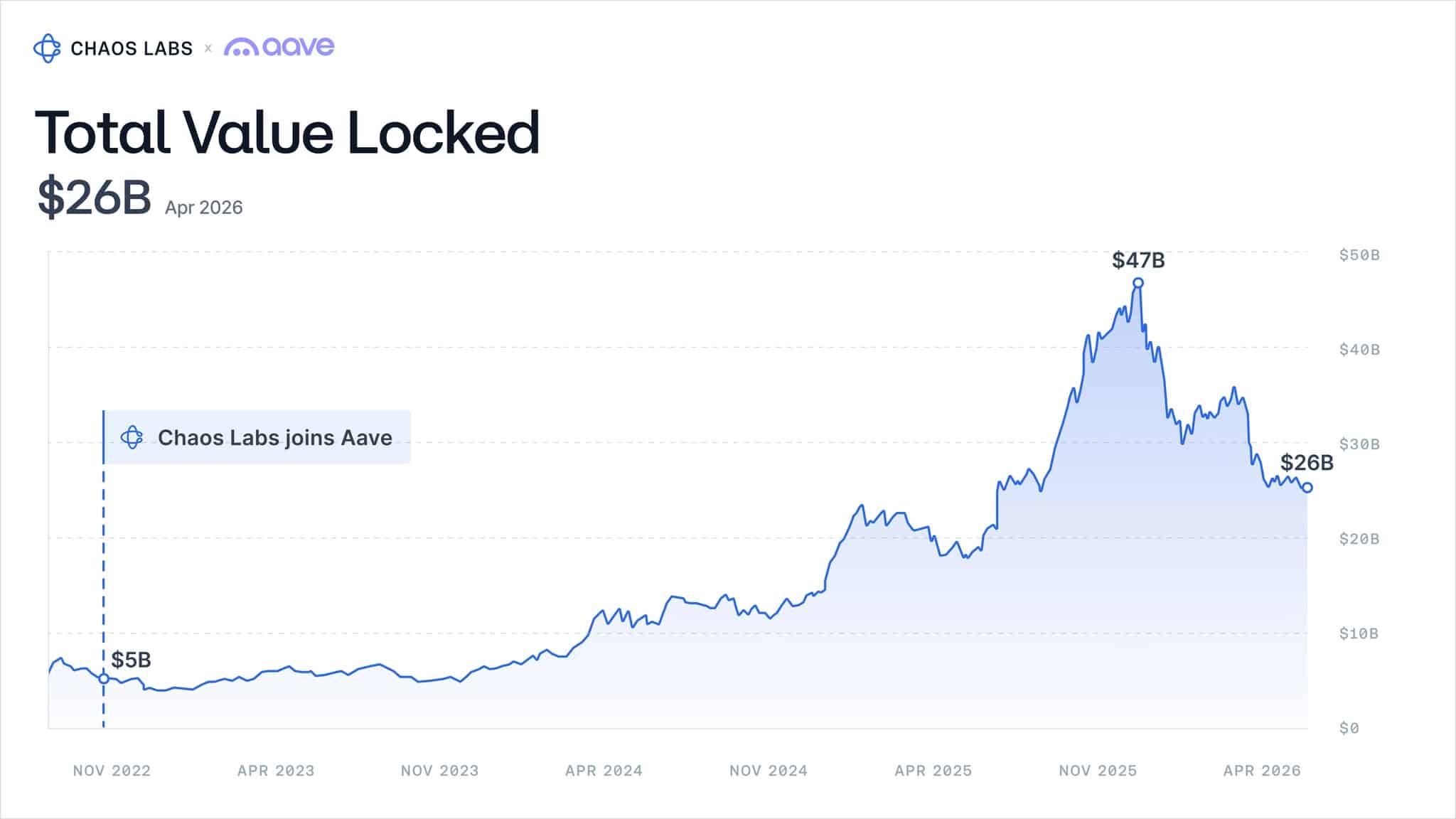
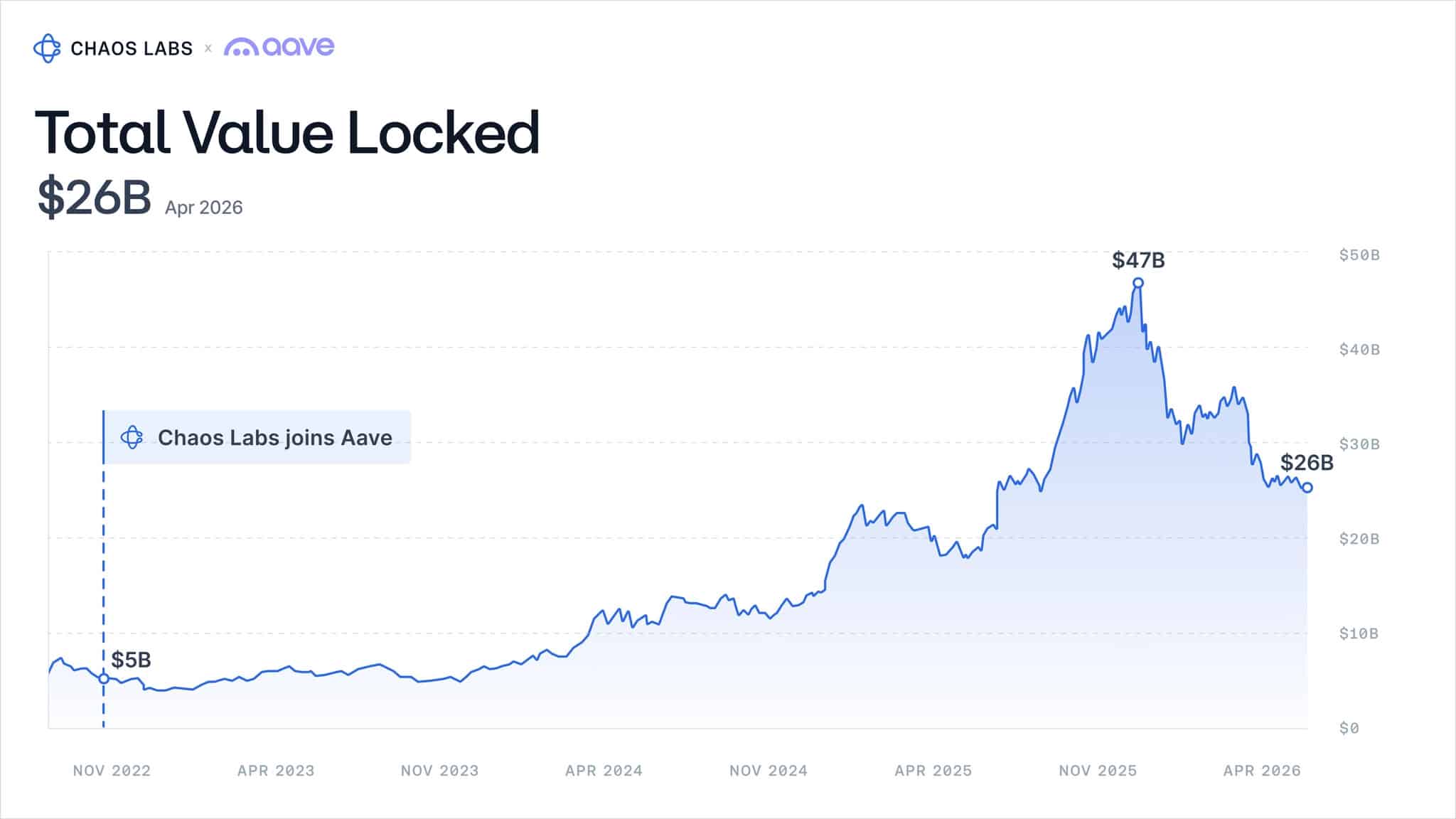
Chaos Labs’ exit signals more than a contributor change; it reflects growing strain in how Aave manages risk as it scales. For three years, Chaos Labs priced every loan while Aave’s TVL expanded from $5.2 billion to over $26 billion, processing $2.5 trillion in deposits and more than $2 billion in liquidations, according to Chaos Labs report.

Source: Governance. Aave.com

Yet, the exit was driven by deeper misalignment on how risk should be handled going forward. As core contributors left, workload and operational risk increased, while Aave V4 introduced greater complexity on an unfamiliar structure.

Stani Kulechov, founder and Aave’s CEO, applauded them in a post stating, “We also want to thank the entire Chaos Labs team for their contributions over the years, as they have helped bring the protocol we built into its current level of maturity.”

Consequently, the engagement remained loss-making despite a proposed $5 million budget. This shift suggests that as protocols grow, maintaining high-quality risk oversight becomes harder, which could affect long-term stability if demand outpaces control.

Aave’s risk continuity now faces its first real test

Aave now enters a critical transition as it absorbs the exit of a key risk contributor, shifting focus from performance to continuity.

With Chaos Labs gone, responsibility shifts to internal teams and providers like LlamaRisk, raising questions about response speed. Stani noted that “LlamaRisk already serves as a risk contributor to the Aave DAO and has deep familiarity with the protocol’s architecture and parameters. We support LlamaRisk increasing their budget to accommodate this additional workload and expanding their team as needed. “

As Aave expands toward V4, risk complexity increases, which places more pressure on coordination.

In the short term, systems remain stable; however, any slowdown in adjustments could allow risks to build gradually. This shift suggests that market confidence may now depend less on past performance and more on how effectively this transition is managed.


Final Summary

  • Aave stability relied on continuous risk updates, but Chaos Labs’ exit raises questions about maintaining the same responsiveness.
  • Aave now enters a transition where slower adjustments could increase risk, shifting focus from past performance to execution.

Domande pertinenti

QWhat was the total value locked (TVL) and loan amount managed by Aave as Q1 2026 ended?

AAave managed about $42.34 billion in TVL and $16.55 billion in loans as Q1 2026 ended.

QWhy did Chaos Labs exit from its role in Aave's risk management?

AChaos Labs' exit was driven by deeper misalignment on how risk should be handled going forward, increased workload and operational risk as core contributors left, and the introduction of greater complexity with Aave V4 on an unfamiliar structure. The engagement also remained loss-making despite a proposed $5 million budget.

QWhat are the potential risks for Aave following Chaos Labs' departure?

AFollowing Chaos Labs' exit, potential risks include slower response speeds in risk adjustments, which could allow risks to build gradually. There is also increased pressure on coordination as Aave expands toward V4, and market confidence may now depend more on how effectively the transition is managed rather than past performance.

QWho is taking over the risk management responsibilities for Aave after Chaos Labs' exit?

AResponsibility shifts to internal teams and providers like LlamaRisk, which already serves as a risk contributor to the Aave DAO and has deep familiarity with the protocol's architecture and parameters.

QHow did Aave's TVL grow during Chaos Labs' three-year contribution?

ADuring Chaos Labs' three-year contribution, Aave's TVL expanded from $5.2 billion to over $26 billion.

Letture associate

Microsoft is Afraid of Being Marginalized by AI Giants

Microsoft, once the defining force of the PC era, now faces a familiar challenge in the AI age: the risk of being relegated to a profitable but invisible infrastructure provider. This anxiety was laid bare at Build 2026, where CEO Satya Nadella unveiled a major strategic pivot. The catalyst was a quiet April agreement that dissolved Microsoft's exclusive licensing and cloud-hosting deal with OpenAI, its once-vital partner. This erased Microsoft's key AI moat. With OpenAI and Anthropic defining AI applications and gaining enterprise traction—even within Microsoft's own ranks—Nadella had to answer: without exclusivity, what is Microsoft's role? The answer was a suite of seven in-house AI models, a developer-focused AI workstation (Surface RTX Spark Dev Box), and, most crucially, the Agent 365 platform for enterprise AI governance. The models, notably targeting Anthropic's strengths in coding and enterprise, signal a defensive move. However, the broader strategy is to make the models themselves less decisive. Financially, Microsoft's AI revenue is strong, driven largely by Azure running others' models. Yet its user-facing products like Copilot show weak penetration and engagement. Microsoft earns infrastructure money but lacks direct user mindshare. Nadella's core fear is being "hollowed out." As OpenAI and Anthropic prepare for IPOs and gain financial independence, they may build their own infrastructure, threatening Azure's lucrative AI revenue stream. Microsoft's window is to entrench itself deeper: not as the model creator, but as the indispensable platform for securely deploying, managing, and governing all AI models within the enterprise through Agent 365. Build 2026 revealed Microsoft's bet: in the AI era, the ultimate power lies not in any single model, but in the enterprise "operating system" that controls them. Nadella is determined to ensure Microsoft is the driver of this new era, not just a passenger.

marsbit10 min fa

Microsoft is Afraid of Being Marginalized by AI Giants

marsbit10 min fa

CPU, Quietly Returning to the Center of the AI Computing Power Stage

Over the past three years, AI computing power narratives have been dominated by GPUs. However, starting in 2026, this story began to shift. While training large models remains GPU-intensive, the rapid growth of inference and AI agent workloads, which require high levels of task orchestration, concurrency, and data flow management, has highlighted a renewed critical role for CPUs. These are tasks GPUs are not designed to handle. Intel's recent launch of the Xeon 6+ processor, built on its Intel 18A process and featuring up to 288 efficiency cores (E-cores), exemplifies this strategic pivot. It is positioned not as a mere companion to GPUs but as the essential "control plane" for AI infrastructure, optimized for high-density, energy-efficient, and high-throughput workloads characteristic of AI agents and inference. This "CPU resurgence" is not about CPUs outperforming GPUs in raw computation. It reflects a systemic bottleneck: as AI scales from training single models to deploying countless intelligent agents, the demand for coordination and data handling surges. Major cloud providers are also developing their own high-density ARM-based server CPUs for similar workloads. However, Intel's success with this strategy faces significant challenges. Competition includes NVIDIA's integrated CPU-GPU solutions, the expanding adoption of cloud vendors' in-house ARM CPUs, and the crucial market test of Intel's 18A manufacturing process against rivals like TSMC's N2. In conclusion, CPUs are indeed reclaiming a central, though redefined, role in AI compute—managing the complex orchestration that enables massive-scale AI deployment. While the trend is clear, which company will ultimately lead this CPU resurgence remains an open question to be decided in the data centers of 2027 and beyond.

marsbit31 min fa

CPU, Quietly Returning to the Center of the AI Computing Power Stage

marsbit31 min fa

Trading

Spot
Futures
活动图片