Why 21Shares believes ‘passive strategies’ for crypto ETFs are outdated

ambcryptoPubblicato 2026-03-26Pubblicato ultima volta 2026-03-26

Introduzione

21Shares President Duncan Moir argues that passive 'HODL' strategies for crypto ETFs are becoming outdated. Instead, the firm advocates for active management to capture yield and diversification opportunities in the growing asset class. Key strategies include yield-generating products like a preferred stock ETP offering an 11.5% dividend, staking rewards in ETFs, and thematic offerings such as a Bitcoin-and-gold ETP. While U.S. investor interest remains focused on large coins, European institutions are exploring newer assets and application layers. Despite a decline in total crypto ETF AUM to $130 billion, active strategies aim to drive future demand.

For most Bitcoin OGs in the space, the main crypto investment strategy has always been ‘HODL,’ which has been enough to outperform most assets in certain periods.

Early asset managers who entered the sector also adopted a similar passive strategy for their respective crypto ETFs (exchange-traded funds). They have been holding the crypto assets in the hope that, in three, six, or 12 months, their value would appreciate.

According to 21Shares president Duncan Moir, however, crypto ETFs are transitioning from passive management to active strategies. Moir noted that the sector was a ‘nascent’ and ‘growing asset class’ that fits perfectly with active management.

At the core of this new strategy is scaling yield streams and extra earning opportunities beyond just holding the crypto assets. From a regional crypto ETF demand, Moir said,

The interest is still concentrated in the larger coins in the US. In Europe, institutional clients are more interested in newer assets and the application layer beyond the Layer-1.
Source: CoinShares

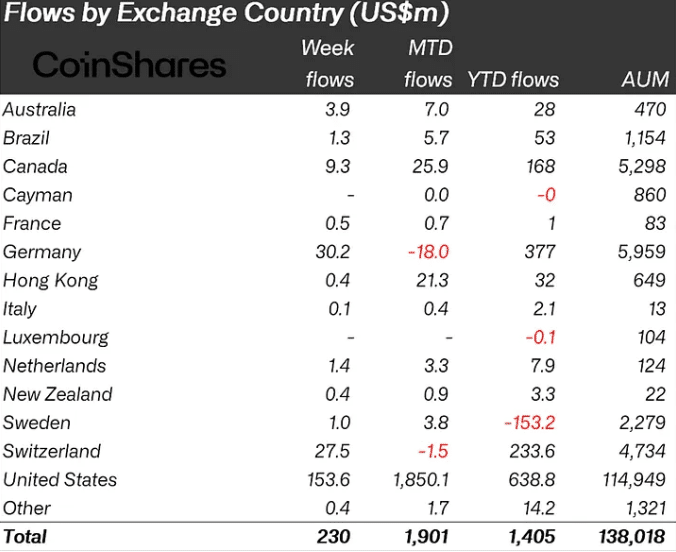
In fact, on a year-to-date (YTD) basis, the U.S. leads with $638 million in crypto inflows, followed closely by Germany at $377 million and Switzerland at $233 million.

Crypto ETFs evolution and diversification

For Moir, the mature investor base in Europe, who already hold Bitcoin and Ethereum, is looking to expand their crypto allocation with better offerings.

This led to 21Shares launching an ETP tied to Strategy’s preferred stock, Stretch (STRC), which offers an annual dividend yield of up to 11.5% payable monthly. This is one of the Strategy’s ways of raising capital for Bitcoin buys.

Moir noted that the product has been an instant success across several regions, underscoring a strong appetite for yield-bearing assets that are feasibly accessible via traditional platforms.

Additionally, crypto ETF staking rewards have become another active strategy to maximize investors’ returns.

Grayscale and BlackRock’s push for staking rewards in their respective Spot ETH ETFs is one example of asset managers seeking more opportunities for investors.

Finally, Moir said they also look for major thematic trends or future shifts that can be maximized. The approach informed the launch of 21Shares’ Bitcoin-and-gold ETP, based on the rising demand for safe havens amid debasement trade and rising U.S. fiscal debt.

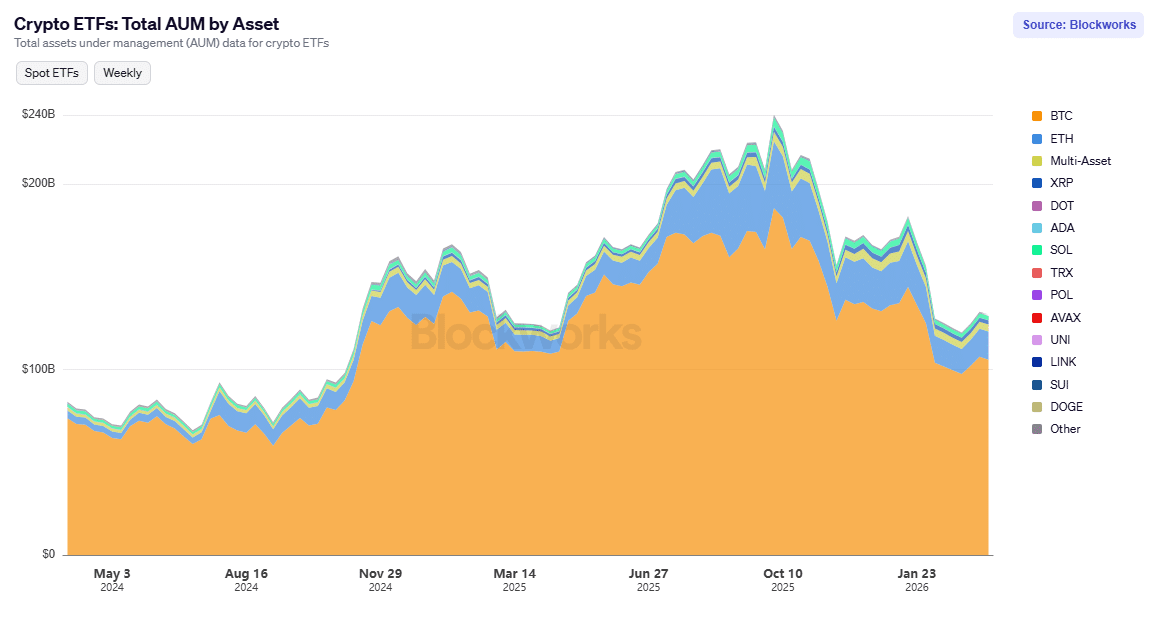
It remains to be seen how the new active strategy will drive demand into crypto ETFs. As of writing, the total crypto ETF assets under management (AUM) were about $130 billion, down from nearly $240 billion at the peak of 2025.
Source: Blockworks

Final Summary

  • 21Shares’ Duncan Moir said that active strategies will be at the center of the next crypto ETF management.
  • Yield-focused wrappers and staking rewards are some active strategies asset managers are deploying for investors.


Domande pertinenti

QAccording to 21Shares president Duncan Moir, why are crypto ETFs transitioning from passive to active strategies?

ABecause crypto sector is a 'nascent' and 'growing asset class' that fits perfectly with active management, focusing on scaling yield streams and extra earning opportunities beyond just holding crypto assets.

QWhat regional differences in crypto ETF demand does Duncan Moir highlight between the US and Europe?

AIn the US, interest is concentrated in larger coins, while in Europe, institutional clients are more interested in newer assets and the application layer beyond Layer-1.

QWhat are two specific active strategies mentioned that asset managers are using to maximize investor returns?

AYield-focused wrappers (like the ETP tied to Stretch offering 11.5% annual dividend) and staking rewards in crypto ETFs.

QWhat was the rationale behind 21Shares launching a Bitcoin-and-gold ETP?

AIt was based on the rising demand for safe havens amid debasement trade and rising U.S. fiscal debt, capitalizing on major thematic trends.

QWhat is the current total assets under management (AUM) for crypto ETFs as mentioned in the article?

AAbout $130 billion, down from nearly $240 billion at the peak of 2025.

Letture associate

Bitcoin Withdrawals Continue: 8 Years of Storage in a Coldcard Cold Wallet Ended in Zero

Coldcard Hardware Wallet Hacked: Losses Mount Due to Vulnerable Seed Generation A critical vulnerability in Coldcard hardware wallets has led to a continued wave of fund thefts. According to Galaxy Research, the total stolen has reached 1,367.05 BTC (approx. $88.6 million) from 4,585 addresses, a significant increase from the initial 594.5 BTC reported on July 30, 2026. Most of the stolen funds remain on the attackers' addresses. The issue is not with the current firmware, which Coinkite has updated, but with seed phrases generated on vulnerable devices between March 2021 and the release of fixed firmware versions. Due to a programmer error, devices switched from using a hardware random number generator to the software-based Yasmarang generator, which was initialized with publicly accessible data like the chip's serial number. This made the seed phrases predictable through offline brute-force attacks, meaning wallets remain at risk until funds are moved to a new wallet generated with the patched firmware. Affected devices include Mk2/Mk3 with firmware 4.0.1–4.1.9 (and up to 5.0.3), Mk4/Mk5 up to version 5.6.0, and Q models up to 1.5.0Q. The only exceptions are seeds created with a high-entropy method like at least 50 independent dice rolls or a strong unique BIP-39 passphrase. All other owners must generate a new seed on the fixed firmware and transfer their assets. A case highlighting the human impact involves a 39-year-old long-term investor who lost 2 BTC (approx. $130,000) in minutes. He had accumulated the Bitcoin over eight years through physical labor, viewing it as a financial lifeline and a retirement plan in a country suffering from hyperinflation. His story underscores that even conservative "buy and hold in cold storage" strategies can be compromised by such underlying technical flaws. From a technical perspective, this incident echoes historical failures where weak random number generators undermined cryptographic security, challenging the assumption that offline storage is automatically foolproof.

cryptonews.ru4 h fa

Bitcoin Withdrawals Continue: 8 Years of Storage in a Coldcard Cold Wallet Ended in Zero

cryptonews.ru4 h fa

Trading

Spot
活动图片




