Who is the Truly Strongest Agent in OpenClaw? Leaderboard of 23 Real-World Task Evaluations Released

marsbitPubblicato 2026-04-08Pubblicato ultima volta 2026-04-08

Introduzione

This report presents a comprehensive benchmark evaluating the performance of AI coding agents on 23 real-world OpenClaw tasks, focusing solely on the core metric of success rate. The transparent and reproducible testing methodology employs three scoring methods: automated checks, an LLM judge (Claude Opus), and a hybrid approach. The diverse task set covers areas like code/file operations, content creation, research, system tools, and memory persistence. The top 10 models by success rate (Best % / Avg %) are: 1. anthropic/claude-opus-4.6 (93.3% / 82.0%) 2. arcee-ai/trinity-large-thinking (91.9% / 91.9%) 3. openai/gpt-5.4 (90.5% / 81.7%) 4. qwen/qwen3.5-27b (90.0% / 78.5%) 5. minimax/minimax-m2.7 (89.8% / 83.2%) Claude Opus 4.6 leads in peak performance, while Arcee's Trinity demonstrates superior average success rate stability. The Qwen series shows strong cost-performance potential with multiple entries in the top ten. All task definitions and scoring logic are publicly available for independent verification.

Want to know which large language model truly performs the strongest in OpenClaw's real-world agent tasks?

MyToken, based on evaluation websites, has compiled a transparent benchmark focused on assessing the practical capabilities of AI coding agents, looking solely at the core dimension of success rate (speed and cost belong to other independent dimensions, to be analyzed separately later). Fully public and reproducible, it only presents rigorous evaluation standards + the latest Top 10 success rate rankings.

I. Evaluation Dimension:Success Rate

Specific standard: The percentage of given tasks that the AI agent completes accurately and fully. Each task adopts a highly standardized process:

  • Precise user prompt

Sent to the agent in full to simulate real user request scenarios

  • Expected Behavior

Clearly states acceptable implementation methods and key decision points

  • Scoring Criteria (checklist)

Lists an atomic success判定 (judgment) checklist for verification item by item

II. Three Scoring Methods

This evaluation primarily employs 3 scoring methods:

  • Automated Checks: Python scripts directly verify objective results like file content, execution records, tool calls, etc.

  • LLM Judge: Claude Opus scores according to a detailed scale (content quality, appropriateness, completeness, etc.)

  • Hybrid Mode: Combines automated objective checks + LLM judge qualitative assessment

All task definitions, Prompts, and scoring logic are fully public for retesting and verification.

III. Tasks Used for Evaluation

This benchmark covers 23 tasks across different categories. It spans multiple dimensions including basic interaction, file/code operations, content creation, research & analysis, system tool calls, memory persistence, etc., highly aligning with developers' daily use scenarios of OpenClaw:

  1. Sanity Check(Automated) —— Process simple instructions and reply to greetings correctly

  2. Calendar Event Creation(Automated) —— Generate a standard ICS calendar file from natural language

  3. Stock Price Research(Automated) —— Query stock prices in real-time and output a formatted report

  4. Blog Post Writing(LLM Judge) —— Write a ~500-word structured Markdown blog post

  5. Weather Script Creation(Automated) —— Write a Python weather API script with error handling

  6. Document Summarization(LLM Judge) —— Provide a refined 3-part summary of the core themes

  7. Tech Conference Research(LLM Judge) —— Research and organize information (name, date, location, link) for 5 real tech conferences

  8. Professional Email Drafting(LLM Judge) —— Politely decline a meeting and propose an alternative

  9. Memory Retrieval from Context(Automated) —— Precisely extract dates, members, tech stack, etc., from project notes

  10. File Structure Creation(Automated) —— Automatically generate standard project directories, README, .gitignore

  11. Multi-step API Workflow(Hybrid) —— Read config → Write calling script → Fully document

  12. Install ClawdHub Skill(Automated) —— Install from the skill repository and verify usability

  13. Search and Install Skill(Automated) —— Search for weather-related skills and install correctly

  14. AI Image Generation(Hybrid) —— Generate and save an image based on description

  15. Humanize AI-Generated Blog(LLM Judge) —— Rewrite machine-like content into natural spoken language

  16. Daily Research Summary(LLM Judge) —— Synthesize multiple documents into a coherent daily summary

  17. Email Inbox Triage(Hybrid) —— Analyze multiple emails and organize a report by urgency

  18. Email Search and Summarization(Hybrid) —— Search archived emails and extract key information

  19. Competitive Market Research(Hybrid) —— Competitive analysis in the enterprise APM field

  20. CSV and Excel Summarization(Hybrid) —— Analyze spreadsheet files and output insights

  21. ELI5 PDF Summarization(LLM Judge) —— Explain a technical PDF in language a 5-year-old can understand

  22. OpenClaw Report Comprehension(Automated) —— Precisely answer specific questions from a research report PDF

  23. Second Brain Knowledge Persistence(Hybrid) —— Store information across sessions and recall it accurately

IV. Core Conclusion: Top 10 Large Model Rankings by Success Rate (Best % / Avg %)

  • Data updated to April 7, 2026

  • Best % is the single highest success rate, Avg % is the average success rate over multiple runs, better reflecting stability

Below are the top ten models by success rate:

  1. anthropic/claude-opus-4.6(Anthropic)——93.3% / 82.0%

  2. arcee-ai/trinity-large-thinking(Arcee AI)——91.9% / 91.9%

  3. openai/gpt-5.4(OpenAI)——90.5% / 81.7%

  4. qwen/qwen3.5-27b(Qwen)——90.0% / 78.5%

  5. minimax/minimax-m2.7(MiniMax)——89.8% / 83.2%

  6. anthropic/claude-haiku-4.5(Anthropic)——89.5% / 78.1%

  7. qwen/qwen3.5-397b-a17b(Qwen)——89.1% / 80.4%

  8. xiaomi/mimo-v2-flash(Xiaomi)——88.8% / 70.2%

  9. qwen/qwen3.6-plus-preview(Qwen)——88.6% / 84.0%

  10. nvidia/nemotron-3-super-120b-a12b(NVIDIA)——88.6% / 75.5%
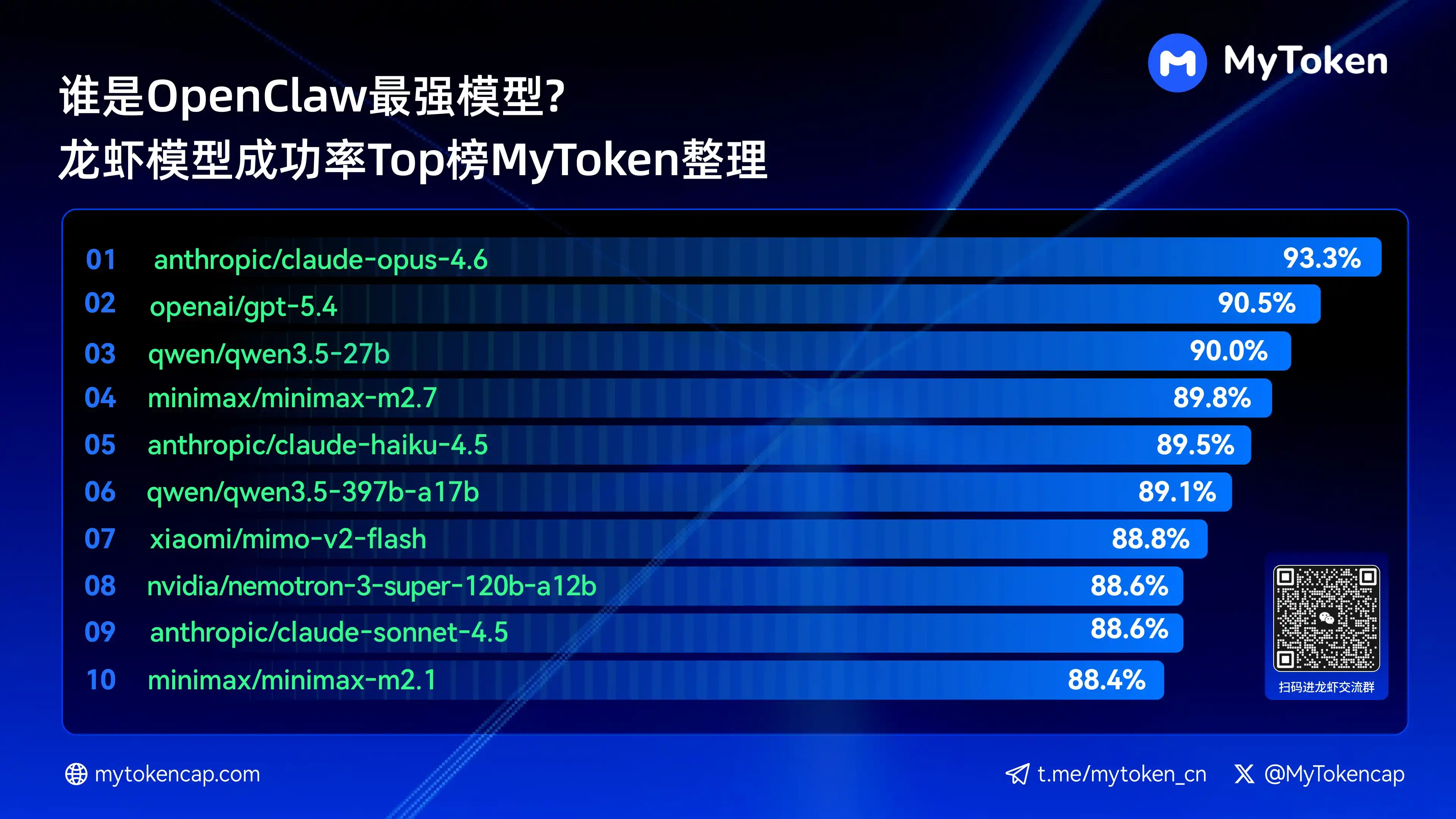
Claude Opus 4.6 currently leads with the highest success rate of 93.3%, but Arcee's Trinity shows impressive performance in average stability. The Qwen series also has multiple entries in the top ten, demonstrating strong cost-performance potential. Success rate is the basic threshold; subsequent dimensions of speed and cost will further impact the actual experience.

This set of 23 task benchmarks is fully transparent. We strongly encourage everyone to conduct practical tests结合 (combining with) their own scenarios. For rankings of more other models, please look forward to the agent leaderboard feature即将 (soon to be) launched by MyToken.

(Data sourced from PinchBench's publicly available OpenClaw agent benchmark tests, continuously updated.)


Domande pertinenti

QWhat is the core evaluation dimension used in the OpenClaw agent benchmark?

AThe core evaluation dimension is success rate, which measures the percentage of tasks that the AI agent completes accurately and completely.

QHow many real-world tasks are included in the OpenClaw benchmark test?

AThe benchmark test covers 23 different real-world tasks.

QWhich model achieved the highest single-run success rate (Best %) in the ranking?

Aanthropic/claude-opus-4.6 from Anthropic achieved the highest single-run success rate of 93.3%.

QWhat are the three scoring methods used to evaluate the agents' performance?

AThe three scoring methods are: 1) Automated checks using Python scripts, 2) LLM judge (Claude Opus) evaluation, and 3) A hybrid mode combining automated checks and LLM evaluation.

QWhich model showed the best performance in average success rate (Avg %), indicating greater stability?

Aarcee-ai/trinity-large-thinking from Arcee AI achieved the highest average success rate of 91.9%, indicating the best stability.

Letture associate

Must-Watch Events Next Week|CLARITY Act Could Face Senate Vote; SpaceX, Circle to Report Earnings (8.3-8.9)

**Summary: Key Events and Developments to Watch (August 3-9)** The upcoming week is marked by significant financial disclosures, key legislative deadlines, and notable product updates. **Major Financial Events:** Several companies are scheduled to release their Q2 2026 earnings. American Bitcoin (ABTC) will report on August 3, followed by SpaceX and Hut 8 Mining Corp. on August 4, and Circle on August 5. Notably, a significant portion of SpaceX shares (up to 12% of total shares) will be unlocked on August 6 following their earnings release. **Key Legislative Deadline:** The U.S. Senate faces an August 7 deadline to secure 60 votes for the CLARITY Act, a bipartisan bill aiming to establish a federal regulatory framework for cryptocurrencies. The Senate may hold a full vote on the bill during the week. **Economic Data:** The U.S. July Non-Farm Payrolls report will be released on August 7, providing crucial labor market data. **Technology & Product Updates:** * **Shutdowns:** DeFi portfolio tracker Zapper and wallet app Ctrl Wallet will cease operations on August 3. * **Upgrades:** LayerZero will deprecate its v1 relayers on August 3. XRP Ledger's new version 3.3.0, featuring five new functions, is expected next week. * **AI:** Elon Musk announced that the advanced Grok 4.6 AI model is set for release around August 7. * **Bitcoin:** The BIP-110 forced signaling for a potential Bitcoin network change is scheduled to begin around August 8. **Other Notable Events:** Chinese robotics firm Unitree Tech has set its preliminary price inquiry for its IPO for August 5. South Korean exchange Upbit will delist AQT and AERGO tokens on August 3.

marsbit1 h fa

Must-Watch Events Next Week|CLARITY Act Could Face Senate Vote; SpaceX, Circle to Report Earnings (8.3-8.9)

marsbit1 h fa

Stocks Are Plummeting More Sharply Than Cryptocurrencies. Where Has the Money Gone?

Stock Markets Plunge Deeper Than Cryptocurrencies: Where Did the Money Go? In late July, Seoul's Kospi index triggered circuit breakers for two consecutive days, plummeting over 40% from its June high. The collapse was led by heavyweight stocks like SK Hynix, whose record profits still disappointed investors, and devastating leveraged ETFs, with one major product losing over 83% of its value. This signaled a global, forced deleveraging targeting the most crowded trades. Interestingly, while stocks exhibited extreme volatility akin to crypto markets, Bitcoin rose nearly 15% in July after a prior steep drop. Analysis shows the money fleeing equities did not flow into Bitcoin. Instead, Bitcoin had already absorbed its sell-off in May-June, when U.S. spot Bitcoin ETFs saw historic outflows. The true safe-haven beneficiary was gold, whose price rose over 20% year-on-year, highlighting a decoupling between Bitcoin and gold as "digital gold." The sell-off was a targeted unwinding of leveraged positions in tech and semiconductors, accelerated by broker-dealer risk management and shifts in the AI narrative, including new competition from Chinese memory chipmakers. The retreat path was clear: from high-valuation tech stocks to cash and U.S. Treasuries, then to gold. For Bitcoin to attract sustained institutional inflows, conditions like eased global liquidity pressure, a "soft-landing" Fed rate cut, and U.S. regulatory clarity via legislation like the stalled CLARITY Act are needed. Currently, Bitcoin is not a safe haven but an already-cleared asset. Its low correlation with tech stocks, however, makes it a potential diversification play for institutional portfolios once the storm passes. The money isn't here yet, but the positioning is underway.

marsbit1 h fa

Stocks Are Plummeting More Sharply Than Cryptocurrencies. Where Has the Money Gone?

marsbit1 h fa

In Conversation with Ray Dalio: We Are Currently in an AI Bubble, with 1% of My Portfolio in Bitcoin

Ray Dalio, founder of Bridgewater Associates, warns in an interview that the current AI boom shows classic bubble characteristics, which could lead to significant economic downturns as seen in past cycles like 1929 or 2000. He explains that speculative enthusiasm, fueled by debt and overvaluation, often precedes a crash when rising rates or taxation force asset sales, causing widespread losses and recession. Dalio also outlines his "Big Cycle" theory, describing an approximate 80-year pattern where widening wealth gaps, massive government deficits, and shifting geopolitical power (like China's rise) create internal conflict and global instability. He emphasizes that we are in a late-cycle, transitional phase where traditional powers like the US and UK face decline. For personal wealth protection, Dalio advises diversification beyond cash into assets like stocks, bonds, real estate, and particularly gold, which he prefers over Bitcoin. While he holds about 1% of his portfolio in Bitcoin as a non-printable hard asset, he views gold as more secure from technological or governmental threats. Regarding AI's impact, Dalio believes it will disproportionately benefit capital owners, worsening inequality by replacing both physical and cognitive labor. He suggests that human intuition and emotional intelligence, combined with AI, will be key for future workers. On taxation, Dalio argues that wealth taxes are impractical and risk triggering asset sell-offs, reducing productive investment. He points to the UK as a cautionary example of debt, low productivity, and political strife. Geopolitically, Dalio foresees a more regionalized world, with the US showing weakness in prolonged conflicts like with Iran, akin to past imperial declines. The ideal outcome, he suggests, is coexisting powerful blocs (e.g., Americas, China-Asia Pacific) without major war.

marsbit5 h fa

In Conversation with Ray Dalio: We Are Currently in an AI Bubble, with 1% of My Portfolio in Bitcoin

marsbit5 h fa

Trading

Spot
活动图片




