Who is the 'Only Alternative' to SpaceX, Valued at Trillions?

marsbitPubblicato 2026-05-08Pubblicato ultima volta 2026-05-08

Introduzione

Rocket Lab (RKLB), considered by many as the "only alternative" to SpaceX, reported strong Q1 2026 results with revenue of $200.3M, beating expectations. Its stock has surged 240% over the past year. The company is seen as replicating SpaceX's proven path. Its small-lift Electron rocket is the world's only frequently and reliably launched vehicle in its class and has demonstrated reusability through ocean recovery. The key to its future growth, however, is the upcoming medium-lift Neutron rocket, designed to compete directly with SpaceX's Falcon 9. Neutron features innovative designs like the fixed, reusable "HungryHippo" payload fairing, aiming for greater efficiency. Like SpaceX with Starlink, Rocket Lab operates a dual business model of "Launch + Space Systems," with satellite components already generating nearly 70% of its revenue. While SpaceX's valuation is estimated at $1.75-$2 trillion, Rocket Lab's market cap is around $45 billion. This gap represents both the reality of SpaceX's dominance and the significant upside potential investors see in Rocket Lab if Neutron succeeds. The major risk is that Neutron's first flight, currently scheduled for late 2026, could face delays or failures—a common challenge in aerospace. Its success is critical for validating Rocket Lab's ambition to become the world's second provider of reusable medium-lift launch capability.

Author|Azuma(@azuma_eth)

After the U.S. stock market closed on May 8th, commercial aerospace company Rocket Lab (RKLB) announced a much better-than-expected Q1 2026 earnings report.

The financial report data showed that Rocket Lab's Q1 revenue reached $200.3 million, a significant year-on-year increase of 63.5%, higher than the expected $189 million; the Q2 revenue guidance was raised to $225-240 million, far exceeding analysts' expectations of $205 million. Although the operating loss of $56 million shows the company is still in a "cash-burning" mode, the adjusted gross margin has climbed to 43% (only 33.4% in the same period last year), indicating that the company's unit economics are significantly improving while scaling up — in simple terms, it's "burning money" more efficiently.

Boosted by the positive earnings report, RKLB rose nearly 7% after hours, and has gained a whopping 240% over the past year.

As SpaceX's century-level IPO approaches, commercial aerospace has become another hot theme in the U.S. stock market, with capital beginning to assign internet-level valuation imagination to the business of "building rockets." In this frenzy, apart from SpaceX, whose valuation is pointing to $1.75-2 trillion with significant pre-market premium, Rocket Lab, positioned as "the pure commercial aerospace stock most similar to SpaceX," has also become an alternative option in the eyes of many investors.

The 'Only Alternative' to SpaceX?

The reason Rocket Lab is seen as the current "only alternative" to SpaceX is that it is perfectly replicating the successful path already proven by SpaceX — first achieving commercial closure and reusable technology with a small rocket, then using a larger rocket to optimize costs and capture the core market.

Electron: The Dominant Player in the Small Rocket Segment

In the business of building rockets, PPT presentations are everywhere, but companies that can reliably launch rockets are few and far between. Currently, Rocket Lab's "Electron" is the world's only small launch vehicle achieving frequent and reliable commercial operation, and it is also the second most frequently launched rocket in the U.S., second only to SpaceX's "Falcon 9."

The "maturity" of Electron is reflected not only in its dozens of launch records and extremely high success rate but also in the implementation of its recovery technology. Rocket Lab has successfully retrieved the first-stage booster from the ocean multiple times and has even reused engines in subsequent launches. This mastery of engineering "reusability" technology is precisely the trump card weapon that allowed SpaceX to dominate the commercial aerospace market.

Neutron: The Falcon 9 Chaser

If the small rocket is Rocket Lab's entry ticket, then the medium-to-large rocket "Neutron" currently under development is the main engine for its charge towards a hundred-billion-dollar market cap.

Neutron is not simply a scaled-up version of Electron; it was designed from the outset with a strong "target" — to chase Falcon 9. Falcon 9 is currently the only commercially reusable medium-to-large rocket on the market, and SpaceX holds an absolute monopoly in this field.
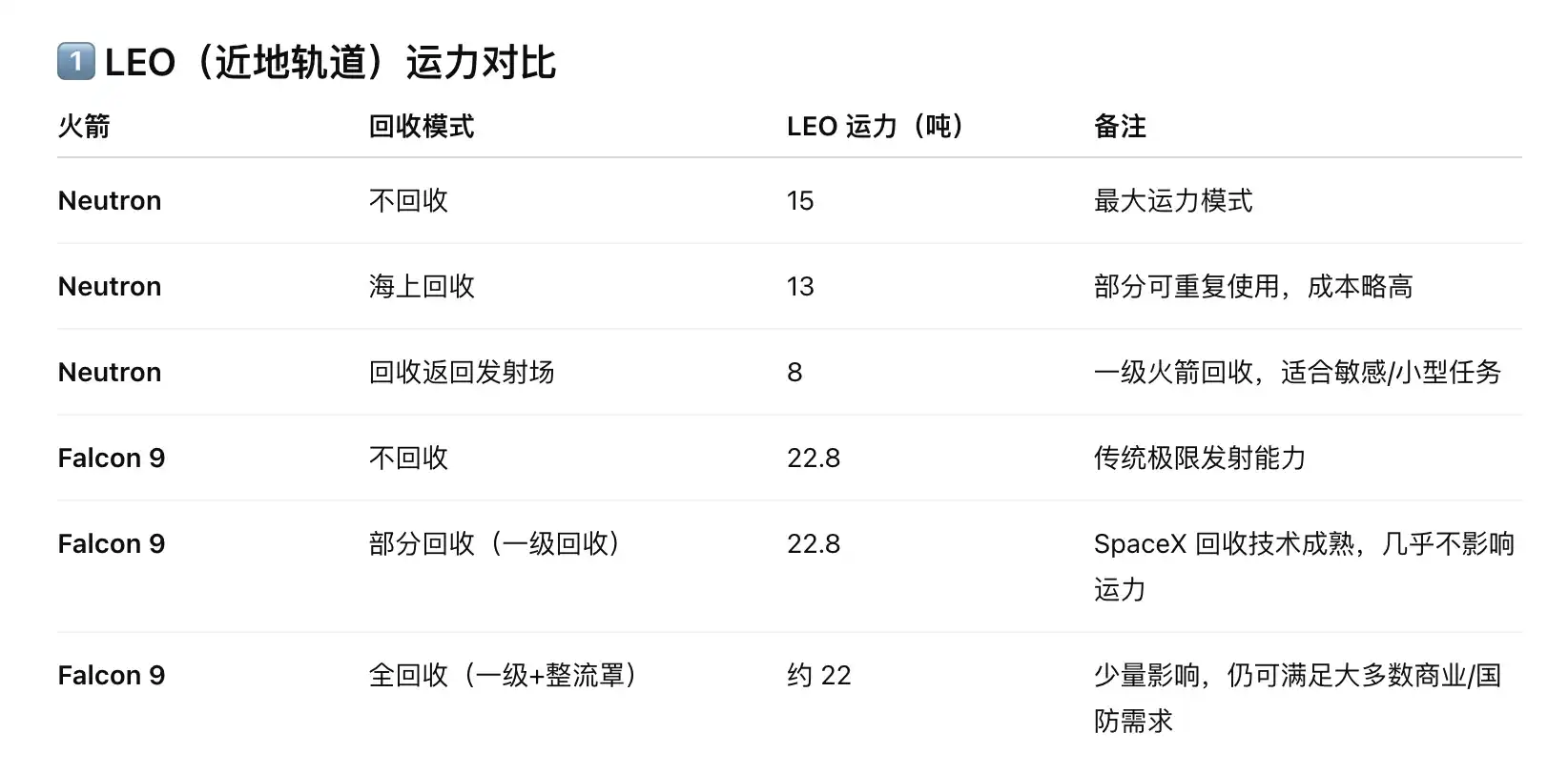
The biggest significance of Neutron's emergence is that it is expected to become the world's only second option that can compete with Falcon 9, although its designed payload capacity (approx. 8-15 tons) is still slightly inferior to Falcon 9. However, in engineering logic, it attempts to achieve a curved overtaking of its predecessor through "late-mover advantages" — with unique designs like the HungryHippo fairing and Archimedes engine, Neutron aims to surpass Falcon 9 in efficiency regarding fairing recovery and engine reusability.
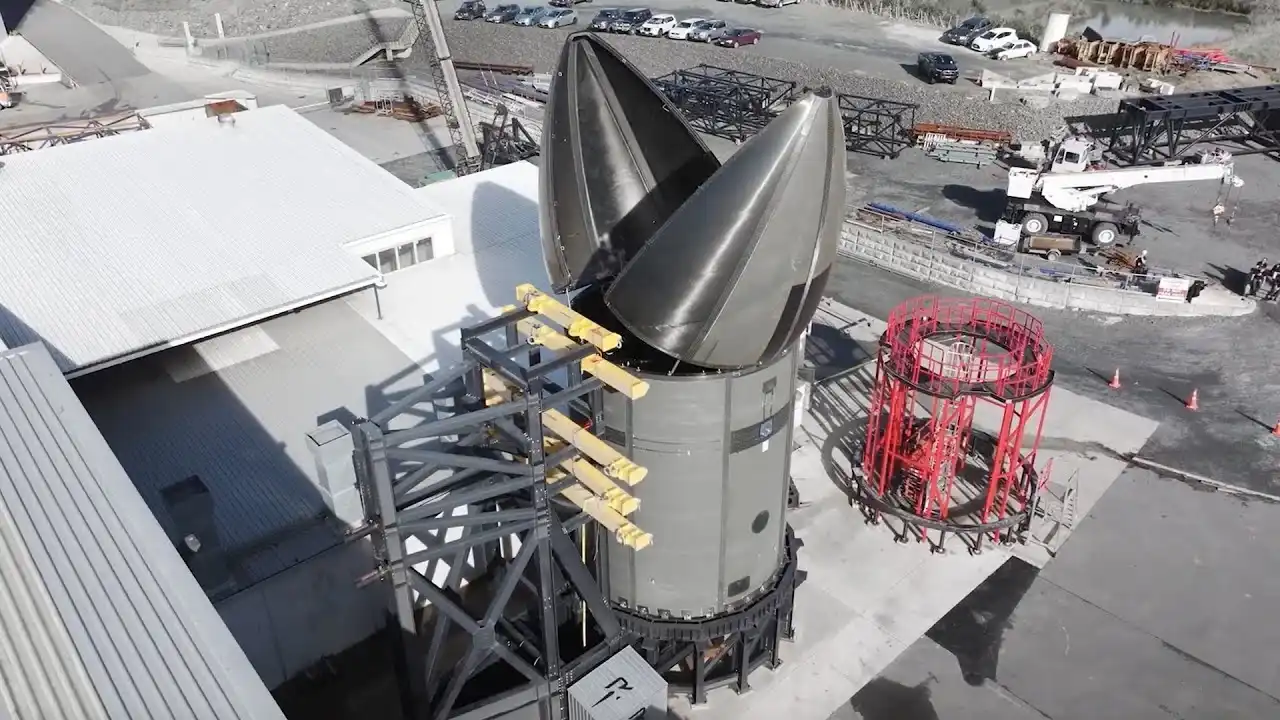
  • Odaily Note: HungryHippo is Neutron's most significant design highlight. Unlike SpaceX, which needs to retrieve millions of dollars worth of fairing debris from the sea after each launch, Neutron's fairing adopts a fixed, non-separating design connected to the first-stage booster. When releasing the second stage, it opens like a "hippopotamus mouth," closes after deployment, and lands with the first stage for recovery. This means the fairing avoids the complex process of at-sea recovery and post-landing reassembly; it's ready for refueling immediately after landing.

Judging from the disclosed testing progress, Rocket Lab is rapidly narrowing the generational gap with SpaceX in medium-to-large launch capabilities.

"Building Rockets" plus "Building Satellites": Replicating SpaceX's Ecological Loop

Just as SpaceX has Starlink, Rocket Lab is also building its own "launch + manufacturing" dual-drive ecosystem. Rocket Lab's "Space Systems" business (covering satellite platforms, laser communication, solar arrays, etc.) currently accounts for nearly 70% of its total revenue. This means that even during Neutron's R&D phase, Rocket Lab can still generate substantial revenue by selling satellite components.

This kind of "full industry chain" business model is almost unique to Rocket Lab in the public market, before SpaceX's own potential listing.

Huge Valuation Gap: A Reflection of Reality and an Investment Opportunity

Currently, SpaceX's private market valuation is as high as $1.75 to $2 trillion, while Rocket Lab's market cap has just surpassed $45 billion. The huge valuation gap objectively reflects the real-world status difference between the two companies, but this is precisely where investors see the most attractive "odds."

In the current global commercial aerospace field, the only company that can stably achieve frequent launches, reusability, high payload capacity, and low costs is SpaceX. Falcon 9's cost advantage has reached a level that makes most competitors despair, and this advantage is gradually forming a terrifying positive spiral — the cheaper, the more launches; the more launches, the more data; the more data, the faster the upgrades; the faster the upgrades, the cheaper it gets... This moat built by scale, data, and pace has left countless latecomers in awe.

But Rocket Lab's opportunity lies in the fact that, currently, Neutron appears to be the most promising reusable medium-to-large rocket to catch up with Falcon 9's pace. "The only choice after SpaceX" — this single label alone is compelling enough. Once Neutron successfully completes its maiden flight, Rocket Lab's valuation logic will completely shift from "a small rocket company" to "the world's second platform company with medium-to-large reusable rocket capability," poised to capture a large number of commercial contracts from SpaceX's hands. Therefore, the current market enthusiasm for Rocket Lab is largely a bet on the success probability of Neutron.

At this point in 2026, with SpaceX having broken through the trillion-dollar valuation ceiling, Rocket Lab, with a market cap of only about 2.5% of SpaceX's, clearly has more room for upside imagination.

Biggest Risk: "Neutron" Hasn't Flown Yet...

But there's still one big suspense — Can Neutron actually fly on schedule?

According to the latest disclosure, Neutron's maiden flight is scheduled for the end of 2026. However, looking back at history, no new rocket launch has ever proceeded without delays. The aerospace industry has a harsh reality — a PPT rocket ≠ a real rocket.

Historically, many rockets never flew; many rockets blew up on their first flight; and many rockets failed in their cost-control designs. Neutron has yet to make its first flight. If Neutron's R&D progress encounters setbacks or its maiden flight is delayed, the current market cap will face severe pressure tests, and even the best story will be hard to continue telling.


Domande pertinenti

QWhy is Rocket Lab considered the 'only alternative' to SpaceX in the commercial space sector?

ARocket Lab is seen as the primary alternative to SpaceX because it is replicating SpaceX's proven path to success. It established a viable commercial business with its small Electron rocket and reusability technology, and is now developing the Neutron medium-lift rocket to compete with SpaceX's Falcon 9. Additionally, Rocket Lab operates a dual business model of 'launch + manufacturing' similar to SpaceX's Starlink ecosystem.

QWhat was the market reaction to Rocket Lab's Q1 2026 earnings report?

AFollowing its Q1 2026 earnings report, Rocket Lab's stock (RKLB) rose nearly 7% in after-hours trading. The report showed revenue of $200.3 million, a 63.5% year-over-year increase, surpassing expectations of $189 million, and provided strong Q2 guidance.

QWhat is the key design feature of Rocket Lab's Neutron rocket that aims to surpass the Falcon 9's efficiency?

AA key efficiency feature of the Neutron rocket is its 'HungryHippo' fairing. Unlike SpaceX's fairings which separate and require sea recovery, Neutron's fairing is fixed and non-separating. It opens to release the second stage and then closes, allowing it to be recovered intact with the first stage, eliminating complex recovery and refurbishment processes.

QWhat is the primary risk currently facing Rocket Lab's growth story?

AThe primary risk for Rocket Lab is the development and first launch of its Neutron rocket. Scheduled for late 2026, any significant delays, technical failures, or cost overruns in Neutron's development could severely impact the company's valuation and growth narrative, as much of its future potential is tied to this vehicle.

QHow does Rocket Lab's current valuation compare to SpaceX's, and what opportunity does this present for investors?

ASpaceX's valuation is estimated at $1.75 to $2 trillion, while Rocket Lab's market capitalization is just over $45 billion. This massive gap reflects their current market positions but presents a significant opportunity for investors. If Rocket Lab's Neutron rocket succeeds, the company's valuation could be re-rated from a small-launch provider to the world's second platform with medium-lift reusable rocket capability, offering substantial upside potential.

Letture associate

Will the Next Crypto Bull Run Start with On-Chain Trading of SpaceX?

This article presents a scenario-based forecast for the crypto industry from 2026 to 2029, arguing that the next major cycle will be driven not by technological narratives but by legal access to real-world assets. The author predicts that by mid-2026, pre-IPO perpetual contracts for top private companies like SpaceX, OpenAI, and Anthropic on platforms like Hyperliquid will become the primary gateway for accessing quality assets, as most crypto-native tokens fail to capture real value. The much-hyped AI x Crypto intersection largely fails except for prediction markets, which thrive on betting on AI model supremacy. By 2027, public blockchain foundations are forced to choose between catering to retail speculation or building compliant infrastructure for institutions, with many opting for the latter. Growth in stablecoins and tokenized private credit/equity hits a "triple ceiling" due to regulatory and political uncertainty rather than market demand. The pivotal shift is forecast for 2028. A major liquidation event in pre-IPO perpetuals exposes the structural flaw of synthetic markets lacking a real underlying asset anchor. In response, regulatory changes finally allow the public solicitation of private securities resales to verified accredited investors. This creates a legitimate secondary market for real company equity, which then becomes the core asset class of the new bull market, relegating synthetic perps to a niche role. By 2029, the industry becomes "boring" but foundational. Tokens without claims on real cash flows or assets cease trading. Stablecoin growth is steady but politically capped. Crypto infrastructure fades from view as it gets absorbed into traditional finance backends. The article's central thesis is that the key bottleneck for crypto's next phase is legal and regulatory channels for real asset ownership, not technology.

marsbit1 h fa

Will the Next Crypto Bull Run Start with On-Chain Trading of SpaceX?

marsbit1 h fa

The Value Distribution of Stablecoins

**Summary: The Value Distribution of Stablecoins** The article argues that stablecoins are evolving from mere trading tools into broader channels for dollar access. It divides the stablecoin ecosystem into four layers to analyze how value is distributed: 1. **Issuance Layer:** Mints stablecoins, holds reserve assets, and captures the spread between reserve yield and user costs (e.g., Tether, Circle). This layer currently earns the largest profit margin. 2. **Infrastructure Layer:** Connects stablecoins to the traditional financial system, handling fiat on/off-ramps, banking integration, compliance (KYC/AML), and asset management (e.g., Bridge, BVNK). This is the "unglamorous" but critical work, building the essential bridges between crypto and real-world finance. 3. **Acquiring/Distribution Layer:** Integrates stablecoins into merchant systems, manages payment flows, and provides enterprise financial software (e.g., Stripe, Coinbase). They act as the access point for businesses. 4. **Application Layer:** The end-users and businesses that ultimately use stablecoins for payments, settlements, or as a store of value. They benefit from convenience but have little pricing power. The core thesis is that while the issuance layer currently dominates profits, the often-overlooked **infrastructure layer holds significant long-term potential**. The real challenge and barrier to mass adoption is not the on-chain transfer of stablecoins (which is simple), but the complex "last mile" integration into existing business workflows, banking systems, and regulatory frameworks across different countries. Companies in this layer are currently in a "land grab" phase, investing heavily to build networks, secure bank partnerships, and establish compliance pathways. While their position is currently pressured by the profitable issuers above and distribution platforms below, the article suggests that if stablecoins become a default financial rail for businesses, the infrastructure providers who have done the hard work of integration will ultimately gain strong pricing power and become entrenched, essential players.

marsbit7 h fa

The Value Distribution of Stablecoins

marsbit7 h fa

The Value Distribution of Stablecoins

The Value Distribution of Stablecoins The article argues that stablecoins are evolving from a mere trading tool into a broad "dollar channel." It analyzes the industry's value chain through four layers: 1. **Issuance Layer (e.g., Tether, Circle):** The top layer that mints stablecoins, holds reserve assets, and captures the thickest interest rate spread. 2. **Infrastructure Layer (e.g., Bridge, BVNK):** Connects stablecoins to the traditional financial system, handling critical but complex "dirty work" like fiat on/off-ramps, banking integration, compliance (KYC/AML), and cross-border settlement. 3. **Acquiring/Distribution Layer (e.g., Stripe, Coinbase):** Embeds stablecoins into merchant systems, manages payment flows, and integrates with enterprise software. 4. **Application Layer:** End-users and businesses that ultimately use stablecoins for payments, settlement, or storing value. The author posits that while the issuance layer currently captures the most profit, the most overlooked and potentially critical layer is infrastructure. The core challenge for stablecoin adoption isn't the on-chain transfer (which is simple), but bridging the gap between blockchain and the real-world financial system. This involves solving practical problems for businesses: fiat conversion, reconciliation, tax handling, and user onboarding. Infrastructure companies are currently in a difficult "land-grab" phase—building networks, securing banking relationships, and achieving compliance country-by-country. They face pressure from both the profitable issuance layer above and distribution platforms below. However, the author suggests this layer is building a crucial moat. Once stablecoins become a default business rail, the infrastructure players who have done the hard work of integration may gain significant, durable value and pricing power.

链捕手8 h fa

The Value Distribution of Stablecoins

链捕手8 h fa

Trading

Spot
Futures
活动图片